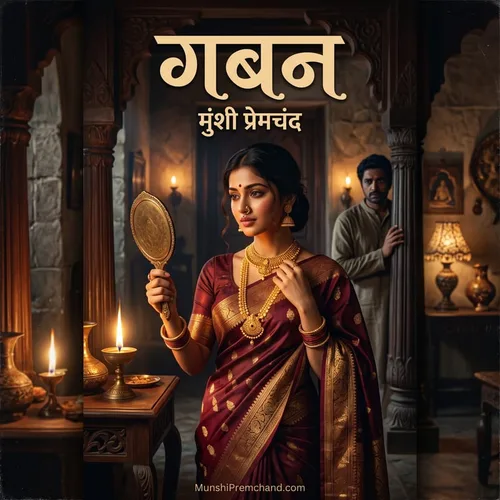
As soon as morning came, Dayanath took the jewelry to the goldsmith and the accounts were settled. The goldsmith was owed 1,500 rupees, but he was not satisfied with merely taking jewelry worth 1,500 rupees. He could only take jewelry that had already been sold at a discount. Who takes back something that has already been sold? If it had merely been pledged, that would have been different. The transaction for these articles had already been completed. He talked about various principles of business and put Dayanath into such a vice that the poor man could think of nothing but agreeing. What could an office clerk do against a shrewd shopkeeper? Jewelry worth 2,500 rupees went for 1,500, and even then 500 rupees remained due. Father and son argued bitterly about this for several days. Each blamed the other. They stopped speaking to each other for several days, but the theft was kept secret. If the police were informed, there was a danger that the whole truth would come out. Jalpa was simply told that the property would not be recovered and that reporting it would only cause needless trouble. Jalpa too thought that if the property could not be recovered, there was no point in filing a report.
Jalpa loved jewelry more than perhaps anything else in the world, and there was nothing surprising in that. When she was an innocent three-year-old, gold bangles had been made for her. Whenever her grandmother took her into her lap, she would talk only about jewelry: “Your bridegroom will bring beautiful jewelry for you. You will walk with a little dancing step.”
Jalpa would ask, “Will it be silver or gold, Grandmother?”
Grandmother would say, “It will be gold, daughter. Why would he bring silver? If he brings silver, you throw it in his face.”
Manki would tease her: “He will certainly bring silver. Where will he find gold?”
Jalpa would begin to cry, and then the old grandmother, Manki, the maids of the household, the neighbor women, and Din Dayal would all laugh. For them it was an inexhaustible source of amusement.
When the girl grew a little older, she began arranging weddings for her dolls. Gifts were sent from the groom's side, she dressed the bride in jewelry, seated her in a palanquin, and sent her away. Sometimes the doll-bride would sulk with her doll-groom over jewelry, and the poor doll-groom would find jewelry somewhere or other to please his wife. It was during those days that the peddler gave her the Chandrahār that she still kept safely.
When she grew a little older still, she began sitting among the older women and listening to their discussions of jewelry. In that small world of women there was no other subject of conversation. Who had had which ornaments made, how much they cost, whether they were solid or hollow, jeweled or plain, how much jewelry had arrived at which wedding—these important subjects were endlessly discussed, criticized, and commented upon every day. No other subject could be so interesting or so readily understood.
Jalpa, raised in this ornament-laden world, naturally developed this love of jewelry. More than a month had passed, and her condition remained unchanged. She neither ate nor drank properly nor laughed or spoke with anyone. She lay on her cot staring with vacant eyes into the empty sky. The whole household had tried to reason with her and failed; the neighbor women had tried and failed; Din Dayal had come and tried, but Jalpa would not leave her sickbed. She no longer trusted anyone in the household, and she remained indifferent even toward Rama. She thought the whole family was neglecting her. They were all intent on making her suffer. If they had so much money, why would they not have her jewelry made? We are most angry with the people we love most. Jalpa was angriest with Ramanath. If he insisted to his parents, no one could refuse him; but did he ever say anything? His mouth seemed sealed shut. If he loved her, he would not sit so unconcerned. He would not sleep at night until he had had everything made. It was only love based on appearances. How could a mother and father refuse him? If he went, it would be on their side—what was she to him?
She was not merely distant from Rama; whenever he asked anything, she would give him two or four sharp replies. The poor man would be left looking miserable. He was burning in the very fire he had kindled himself. If he had known that his boasting would produce this result, he would have sealed his lips. Anxiety and remorse crushed his heart. Once, from morning to evening, his days had passed in laughter, pleasure trips, and carefree amusement; now he wandered from place to place looking for employment. All his cheerfulness had vanished. Again and again he became angry with his father. If only his father wanted, all the money could be repaid in two or four months, but he did not care. He might die, yet his father would not abandon his principles. A fire smoldered in his loving, innocent heart. Seeing Jalpa's withered face, a cold sigh escaped him. Their happy dream of love had been broken so soon. Would those days ever return? How could three thousand rupees' worth of jewelry be made? Even if he obtained a job, what great position would he ever get? Perhaps he could not save three thousand even in three lifetimes! He wanted to devise some way to become the owner of immense wealth as quickly as possible. What if a lottery ticket were drawn in his name? Then he would cover Jalpa with jewelry. First he would have the Chandrahār made. It would be set with diamonds. If he knew how to make counterfeit notes at that moment, he would certainly make them.
One day he wandered about until evening looking for a job. Because of chess he was acquainted with many good and influential people, but out of embarrassment and fear he could not reveal his situation to anyone. He also knew that the respect he enjoyed would last only as long as he did not stretch out his hand before anyone for help. Once his pride was broken, no one would ask about him again. He could not see a single decent person who might understand everything without being told and get him a good position. His mind was very bitter that day. He felt so angry with his friends that he wanted to scold each one and, if they came, drive them away from the door. If anyone now invited him to play chess, he would give him such a scolding that the man would remember it as a child remembers a beating. But if he thought about it carefully, he would realize that his friends were not as much to blame as he was. There was not a single friend to whom he had not boasted extravagantly. It was his habit. He had always hidden the true condition of his household as though it were a disgrace. That was why, despite having so many friends, he was unemployed. He could not tell anyone his inner suffering, and inner suffering, when trapped inside like a breath, becomes unbearable. He came home and sat down with a dejected face.
Jageshwari brought water and put it down. “Where have you been all day today? Come, wash your hands and face.”
Rama had just picked up the water pot when Jalpa came and said fiercely, “Take me to my home. Right now!”
Rama put the pot down and stared at her as though he did not understand what she was saying.
Jageshwari said, “Do daughters-in-law leave their husbands' homes like this? What are you saying, daughter-in-law?”
Jalpa: “I am not one of those daughters-in-law. I will go whenever I please. I am afraid of no one. When no one here cares about me, I do not consider anyone my own either. I lie here all day like an orphan. No one even looks in. I am not a bird whose cage can simply be closed after food and water have been placed inside. I am a human being too. I will not stay in this house for another moment. If no one comes to take me, I will go alone. There is no wolf waiting on the road to carry me away. And even if one did, what would it matter? What happiness am I enjoying here?”
Rama said cautiously, “At least let me know what happened. What is the matter?”
Jalpa: “Nothing happened. It is my own wish. I do not want to stay here.”
Ramanath: “If you leave like this, what will your family say? Think about that too!”
Jalpa: “I have thought about all of it, and I do not want to think any more. I am going to pack my clothes and leave on this very train.”
Saying this, Jalpa went upstairs. Rama followed her, wondering how he could calm her down.
Jalpa went into her room and began rolling up her bedding when Rama caught her hand and said, “I swear by me, do not even mention leaving at this moment!”
Jalpa frowned and said, “I swear by you that I don't care.”
She pulled her hand away and began rolling up the bedding again. Rama stood awkwardly to one side. Jalpa tied the bedding into a bundle and then began clearing out her trunk. But she was no longer as determined as before. She repeatedly closed and opened the trunk. The rain had stopped; only the water that had collected on the roof was dripping.
At last she sat on the bundle of bedding and said, “Why did you make me swear?”
Hope tickled Rama's heart. He said, “What other means did I have to stop you?”
Jalpa: “Do you want me to choke to death here?”
Ramanath: “Why do you speak such ominous words? I am ready to go with you. If you refuse to stay, I will have to take you. Go—God is my master. But at least ask Father and Mother.”
The dying fire was fanned into flames. Jalpa cried out, “Who are they to me that I should ask them?”
Ramanath: “No one?”
Jalpa: “No one! If they were anyone to me, they would not have abandoned me like this. When people have money, they cannot watch their loved ones suffer. Could they not wipe my tears? I lie here day after day, and does anyone even pretend to ask how I am? Women from the neighborhood come to visit; how can I meet them? I cannot even show them this face. I neither go anywhere nor meet anyone nor speak to anyone. How long can anyone live like this? I have no hope left from these people. After all, there are two other boys; perhaps they will save something for them instead of giving it all to you!”
Rama had another opportunity to make grand statements. He was happy that after so many days he had finally got a chance to please her. He said, “My dear, your thinking is quite right. That must certainly be the case. Otherwise, what would two and a half or three thousand rupees mean to them? There are tens of thousands deposited in the bank; they go to the office merely to pass the time.”
Jalpa: “But they are the most miserly people imaginable!”
Ramanath: “If they were not miserly, where would all that wealth come from?”
Jalpa: “I don't care about anyone. What shortage is there in my home? We will get bread and lentils there too. I have two or four friends, fields and farms, orchards and gardens. I will have enough to keep myself occupied.”
Ramanath: “And do you know what my condition will be? I will waste away and die. Since the theft happened, only my heart knows what I have been going through. I told Mother and Father not once but hundreds of times, insisted that they have at least two or four things made, but no one paid the slightest attention. I don't know why they have turned their faces away from me.”
Jalpa: “When you get a job somewhere, call me.”
Rama: “I am looking. I will get one very soon. I have met thousands of important people; how long can it take to get a job? Yes, I want a reasonably good position.”
Jalpa: “I understand their attitude. I will stay here now on my own terms. Why don't you ask someone for a job?”
Ramanath: “I am ashamed to ask anyone.”
Jalpa: “What is there to be ashamed of? If you are ashamed to ask, write a letter.”
Rama sprang up. What a simple solution—and this straightforward idea had not occurred to him until now. He said, “Yes, you have suggested a very good method. I will certainly write tomorrow.”
Jalpa: “Write after taking me home. You won't be back tomorrow.”
Ramanath: “So you really will go? Then I will already have a job and will have written the letters! Shall I sit and cry in the sorrow of separation, or shall I look for a job? No, abandon the idea of leaving now. No, I swear, I will run away somewhere. I have seen what this house is like. Apart from you, who is sitting here for whose sake I should rot away? Move aside and let me open the bedding.”
Jalpa moved slightly away from the bedding and said, “I will come back very soon. You go, and I will come.”
Rama opened the bedding and said, “No, thank you. I am not falling for that trick. What do you care? You will enjoy yourself with your friends and never even ask how I am, while my life here will be at stake. How will I ever set foot in this house again?”
With a show of gratitude, Jalpa said, “You have opened the bedding I had already tied up. Otherwise I would have reached home so happily today. Shahzadi was right: men are great sorcerers. Today I had firmly decided that even if Brahma himself came down, I would not yield. But you ruined all my plans in two minutes. Be sure to write the letter tomorrow. We cannot survive any longer without producing some income.”
Ramanath: “Not tomorrow. I am going right now to write two or three letters.”
Jalpa: “At least eat some betel before you go.”
Ramanath ate betel and came to the men's room to sit down and write letters.
But then, thinking of something else, he got up and walked away in another direction. What can a woman's loving insistence not make a man do?