Complete English Translation: Fatiha
1
Straight out of the government orphanage, I was enlisted directly into the army. My physique was robust and muscular; compared to ordinary men, my arms and legs were vastly longer and sinewy. My height was a full six feet and nine inches. In the regiment, I was renowned by the name of 'Dev'—the Giant. From the moment I joined the army, fortune began to turn in my favour, and several feats were accomplished by my hands that brought me an increase in income alongside prestige. Every single soldier in the regiment knew me. Major Sardar Himmat Singh showed me immense favor and kindness, for I had once saved his life. Moreover, whenever I looked upon him, an inexplicable wave of devotion and reverent respect welled up in my heart. I regarded him as my elder and protector, and Sardar Sahib’s treatment of me was equally affectionate and brotherly.
I had no knowledge of my father and mother, nor did I possess any distinct memory of them. Occasionally, when I sat down to ponder this question, a few hazy scenes would float before my eyes—a family living amidst colossal, soaring mountains, and the countenance of a woman who was perhaps my mother. After all, my upbringing had indeed unfolded amidst rugged hills. Eighty miles east of Peshawar lies a village named 'Kulaha,' where a government orphanage was situated. It was there that I was raised. Leaving that place, I had stepped straight into the military. My body had been forged by the climate of the Himalayas, and I was just such a towering, primal frontiersman as were the Afridi, Ghilzai, and Mahsud tribal folk inhabiting the borderlands. If there was any difference between their lives and mine, it was merely that of civilization. I could read and write a little, converse with courtesy, observe etiquette and military protocol, and show deference between high and low; yet in physical appearance, I was identical to any frontier tribesman.
From time to time, an ardent longing arose within my heart to roam freely across those wild mountain ranges; but the stark problem of livelihood suppressed my desire. In that arid, desolate land, there was no guaranteed means of sustenance. Out there, people would slay a man for a crust of bread, rip open a corpse's shroud for a rag of clothing, and ambush an imperial military detachment for a single rifle. Furthermore, every single soul among those wild tribes knew my name and thirsted for my blood. Had they ever laid hands upon me, my name and trace would have been wiped from the earth without hesitation. Heaven alone knew how many Afridis and Ghilzais I had struck down, how many I had captured and packed off to imperial penitentiaries, and how many of their mountain hamlets I had reduced to ash! Consequently, I too maintained relentless vigilance, and so far as possible, never stayed in one post for more than a single week.
2
One afternoon, around two o'clock, I was walking toward the residence of Major Sardar Himmat Singh. In those days we were enjoying a spell of relative respite; several hostile villages had recently been burnt to cinders, and there was no immediate danger anticipated from their direction. We spent our days carefree in gossip, banter, and pastime. Having grown restless sitting idle in my quarters, I set out for Sardar Sahib's house merely to divert my mind.
On the way, however, a sudden calamity occurred. An elderly Afridi—who, despite his years, still possessed strength enough to snap a young Hindustani soldier’s neck—was locked in a ferocious struggle with an army sepoy. Before my very eyes, he whipped out a sharp dagger from his waist and plunged it into the sepoy's chest. The soldier had carried a breech-loading cartridge rifle, and that weapon was the sole cause of the clash. In the blinking of an eye, the sepoy was finished, and the old tribesman took the rifle and bolted.
I dashed after him; but he ran with such incredible speed that he vanished from sight in moments. I pursued him heedlessly, running flat out. At last, as we reached the border perimeter, I closed the gap to within twenty paces of him. He glanced behind and saw that I alone was chasing him. He raised the rifle and took aim directly at me. Instantly, I threw myself flat upon the earth; the bullet struck the boulder right before my face. Believing that I had fallen victim to his shot, he stepped cautiously toward me with measured strides. Holding my breath, I lay motionless as a corpse.
The moment he drew near enough, I sprang up like a tiger, seized his neck, slammed him to the ground, drew my dagger, and thrust it deep into his chest. The Afridi's life-breath departed.
Just then, several men from my regiment arrived on the scene. From all sides, people began heaping praises upon me. Until that instant, I had been operating in a haze of combat; but now my senses returned. For reasons I could not comprehend, looking down at that dead old man made my heart tremble with acute dread and distress. Up to that day, I had slain countless Afridis; yet never before had my inner soul been shaken with such inexplicable anguish. I sank down onto the ground, staring at the old warrior. The arriving sepoys, assuming I had been wounded, showered me with anxious questions. Slowly, I got up and walked back toward the cantonment in silence. The soldiers followed behind me, dragging the corpse of the elderly Afridi. The townspeople raised a chorus of triumphant acclamations in my honour. I quietly slipped inside the house of Major Sardar Himmat Singh.
Sardar Sahib was sitting in his private chamber writing something. Looking up at me, he asked, "Well, did you finish off that Afridi?"
Taking a seat, I replied, "Yes, sir. But Sardar Sahib, for some unknown reason, I have suddenly turned coward."
Sardar Sahib looked at me in astonishment. "Asad Khan and cowardice? It is impossible for those two words to exist in the same sentence!"
Rising to my feet, I said, "Sardar Sahib, my heart finds no peace inside this room. Please, let us go outside and sit on the veranda. An inexplicable turmoil grips my chest."
Sardar Sahib rose, came over to me, and patted my back affectionately. "Asad, you are merely exhausted from running so hard, that is all. Come along, let us sit on the veranda. The cool evening breeze will refresh you."
Sardar Sahib and I went out to the veranda and sat down on wicker chairs. At the crossroads of the city square, the corpse of the old man lay exposed, encircled by a surging crowd. When the people caught sight of me sitting on the veranda, they began pointing in my direction with admiration. Observing this scene, Sardar Sahib remarked, "Do you see, Asad Khan, how high you stand in the estimation of the people? Every child in this town praises your valor. And yet you claim you are a coward!"
I smiled faintly and said, "Ever since I struck down that old man, my soul has been heaping curses upon me."
Sardar Sahib chuckled. "Only because you struck down someone weaker than yourself."
Reassuring myself, I said, "Perhaps that might be so."
At that precise moment, an Afridi woman walked slowly into view and halted directly in front of Sardar Sahib's bungalow. The moment Sardar Sahib set eyes upon her, his face blanched paper-white. His frightened gaze shifted from her to me. I too stared at his countenance in bewilderment.
That woman possessed a muscular, powerful frame that few men could boast of. She wore a shalwar of coarse khaki cloth and a thick blue tunic. A kerchief was tied about her head after the fashion of Balochi women. Her complexion was a radiant wheat-golden, and the bloom of fierce youth fairly burst from her presence. Yet her eyes burned with such lethal savagery as would plant terror into any man's heart. The woman's gaze swept from Sardar Sahib to me, and she began to glare with such terrifying intensity that even my blood ran cold. She looked once more at Sardar Sahib, spat contemptuously upon the earth, and then, keeping her piercing eyes fixed on me, strode slowly away.
As she departed, Sardar Sahib breathed a sigh of immense relief, as though his life had returned. A crushing weight seemed to lift from my own head as well.
I asked Sardar Sahib, "Sir, do you know her?"
Sardar Sahib drew a deep, shuddering sigh. "Yes, all too well. There was a time when she was willing to lay down her life for me, and in truth, she saved my life by staking her own. But today, she loathes the very sight of my face. It was she who murdered my wife. Whenever I look upon her, my wits vanish into thin air, and that horrific scene begins to dance before my eyes."
In a voice shaken with dread, I asked, "Sardar Sahib, she stared at me with such frightening malice as well! My hair stood on end. Why?"
Sardar Sahib shook his head with grave solemnity. "Asad Khan, you too must remain on your guard. She is undoubtedly linked to that old Afridi you killed. It is very likely he was her father or her brother. The way she stared at you carries grave meaning. She is a terrifying woman."
Hearing Sardar Sahib's words, every nerve in my body trembled. Turning the conversation, I asked, "Sardar Sahib, why do you not hand her over to the police? She would surely hang for her crime."
Sardar Sahib replied, "Brother Asad Khan, she saved my life once, and perhaps even now harbors affection for me in some corner of her heart. Her tale is a long one. Someday, when time permits, I shall narrate it."
Sardar's remarks ignited my curiosity. I began to press him persistently to tell me the tale. At first he tried to evade it, but seeing my insistent urging, he felt compelled to relent: "Asad, I regard you as my brother; therefore, I shall conceal nothing from you. Listen—"
3
"Asad Khan, five years ago I was not the aged man you see before you today. At that time my age did not exceed forty years. Not a single strand of hair had turned gray, and I had strength enough to wrestle down two strapping youths at once. I fought against the Germans in the Great War, sending countless enemies to the realm of death. After the German war, I was posted here to the frontier as Major of the native regiment.
"When I first arrived here, immense hardships confronted me; but I cared nothing for them and gradually overcame every obstacle. First and foremost upon arriving, I began learning Pashto. After Pashto, I mastered other local dialects, until I could speak them with effortless fluency and local idiom. Thereafter, forming small patrols, I scoured the interior of the tribal territory. In those reconnaissance missions, I escaped death by a hair's breadth on several occasions; yet enduring every ordeal, I managed to hold my ground safely. During that era, feats were accomplished by my hands that earned me great renown and prestige in the imperial government. Once, single-handedly, I rescued the wife of Colonel Hamilton, and I saved the lives of countless native men and women. My tale begins three years after my arrival here.
"One night, I was lying asleep in my camp. A fierce engagement with the Afridis was underway. Exhausted by the day's fighting, the soldiers were lying in heavy slumber. A profound hush enveloped the encampment. As I lay resting, sleep overtook me as well.
"When I woke, I found an Afridi warrior—whose age was nearly double my own—straddling my chest, on the very verge of plunging a dagger into my heart! I was completely at his mercy; there was no conceivable way of escape. Yet in that perilous moment, I exercised utmost composure and addressed him in Pashto: 'Do not kill me! I am an officer in the government forces. Take me captive; the government will pay you a ransom to secure my release.'
"By God's mercy, my words struck home. Drawing a rope from his waist, he bound my hands and feet, hoisted me over his shoulder like a sack of baggage, and stepped outside the tent. Outside, carnage was raging in full fury. He let out a peculiar, piercing cry and bolted toward the wilderness with me loaded upon his shoulder. I can tell you that he did not feel my weight in the slightest and dashed forward at tremendous speed. Behind him raced several men belonging to his raiding band, carrying their looted spoils.
"By dawn, we reached the banks of a mountain lake. The pool was encircled by soaring crags. Its water was crystal-clear, and wild shrubs grew along its banks. Reaching the lake, we all halted. The old warrior, who was in fact the chieftain of that band, flung me down upon a flat boulder. My lower back took a savage blow; it felt as though a bone had fractured, but by God’s grace, nothing was broken. Flung upon the stone, the chieftain stood over me and demanded, 'Well, how much money will you get us?'
"Suppressing my agony, I answered, 'Five hundred rupees.'
"The chieftain twisted his face in disdain. 'No! We will not take so petty a sum. If we receive a single paisa less than two thousand rupees, your life is forfeit!'
"Thinking rapidly, I replied, 'The government will not spend such a vast sum on a native officer.'
"The chieftain drew his dagger and snapped, 'Then why did you lie and say the sarkar would grant a reward? Die right here then!'
"The chieftain advanced toward me with the bared dagger.
"Terrified, I blurted, 'Very well, Sardar, I will have two thousand rupees paid to you!'
"The chieftain halted and burst into a booming laugh. The reverberations of his laughter shook the lifeless crags around us. I thought to myself, What a terrifying monster of a man!
"The other men of the band stepped forward and laid their plundered loot before the chieftain. It consisted of several rifles, cartridges, loaves of bread, and clothing. I was searched as well. I carried a six-shot revolver. Beholding that revolver, the chieftain leaped with joy, turning it over and over in his hands with delight. Right then and there, the division of booty commenced. Everything was divided into equal shares, but my revolver was not included; that weapon became the personal prize of the chieftain himself.
"After resting briefly, the march resumed. This time my legs were untied, and I was ordered to march alongside them. A cloth was bound across my eyes so that I might not observe the route. My wrists were tied with rope, one end of which was held in the grip of an Afridi.
"As we marched, my legs grew numb with agony, yet their destination remained far away. The scorching summer sun of Jeth blazed overhead; my feet burned on the scalding rocks, my throat parched with agonizing thirst; yet they marched on relentlessly. They conversed among themselves as they walked, but now I could scarcely understand a word. Occasionally I caught an isolated term, but for the most part, their rapid mountain dialect eluded me. They were elated by their triumph, and one Afridi began singing a song in his tongue. It was a magnificent tune."
Asad Khan asked, "Sardar Sahib, what was that song?"
4
Sardar Sahib said, "I still remember the meaning of that song. The essence was this: An Afridi warrior is setting out for war; his woman asks him, 'Where are you going?'
"The young warrior answers, 'I am going to bring back bread and clothing for you.'
"The woman asks, 'And will you bring nothing for your children?'
"The youth replies, 'For the child, I shall bring a rifle, so that when he grows up, he too may fight and win bread and clothing for his beloved.'
"The woman asks, 'Tell me, when will you return?'
"The youth answers, 'I shall return only when I have won spoils of victory; otherwise, I shall perish on the battlefield.'
"The woman cries, 'Bravo! Go forth, you are a hero, and you shall surely triumph!'
"Listening to that song, I was captivated. Just as the song drew to a close, our march halted. My blindfold was removed. Before me spread a vast open clearing surrounded by natural caverns carved into the cliffside, which served as their dwelling places.
"Then I was searched once more, and this time all my garments were stripped away, leaving only my pajama bottoms. In front of us lay a massive slab of stone. Gathering together, the tribesmen rolled it aside and led me toward the opening beneath. My soul shuddered with horror. They are going to bury me alive in a grave! Looking at the chieftain with an expression of agonizing despair, I pleaded, 'Sardar, the sarkar will pay you your money. Do not murder me!'
"The chieftain laughed and said, 'Who is killing you? You are merely being imprisoned. You will remain locked inside this chamber; when the money arrives, you shall be set free.'
"Hearing the chieftain's words, life returned to my limbs. Placing my pocketbook and pencil before me, the chieftain ordered, 'Here, write in this. If even a single paisa arrives short, your life will not be spared!'
"I penned a letter addressed to the Commissioner Sahib and handed it over. They lowered me into that dark pit and drew up the rope.
"Asad Khan, as I was being suspended into that well, my innermost spirit was trembling. Down below, instead of total pitch darkness, a faint moonlight filtered in. Inside, the cavern was neither too cramped nor too expansive. The floor was jagged and rough; it appeared as though torrents of water had cascaded there for centuries, carving out this subterranean pit. The well was enclosed by thick walls of rock, pierced here and there by crevices through which air and light entered. Reaching the bottom, I sat brooding upon the vicissitudes of my fate. My heart fluttered with intense anxiety. To suffer the torments of a subterranean black hole had also been inscribed in my destiny by Providence!
"Slowly, twilight descended. Until then, none of them had checked on me. My soul was tormented by gnawing hunger. Again and again, I cursed Providence and cursed myself; for when a man becomes utterly helpless, he curses the Almighty.
"At long last, through one of the wall crevices, four large, thick rotis were hurled down from outside. Exactly as a starving dog rushes for a scrap of bread, so did I leap forward, seize the bread, and look up at the aperture; but no more food fell, nor did any command follow. I sat down and began devouring the rotis. A little later, an iron cup brimmed with water was set down at that opening. Giving thanks to the Almighty, I lifted the cup and drank. When my thirst was partially quenched, I called out, 'I need a little more water!'
"At this, a blood-curdling laugh echoed from the other side of the stone wall, and a voice rang out sharply: 'Water will be given tomorrow now! Hand back the cup, or you will get no water tomorrow either!'
"What could I do? Defeated, I placed the cup back on the ledge.
"In this manner, several days passed. Regularly, twice a day, four rotis and a cup of water were provided. Gradually, I grew accustomed to this barren existence. Solitude no longer tormented me so acutely. Sometimes in my own Hindustani tongue and sometimes in Pashto, I would sing. This diverted my spirits and brought peace to my heart.
"One night, I was singing a Pashto song. It was the verse of Majnun addressing the scorching desert whirlwinds:
'Do you not possess that fiery heat that burns entire caravans to dust? Why then does your scorching blaze not consume me? Is it because a fiercer inferno already rages within my own breast?
Listen, when Laila arrives here wandering in search of me, cover my corpse with the desert sand, lest the sight of my withered form shatter Laila’s heart like fragile glass!'
"I ceased singing. At that very instant, someone whispered through the aperture, 'Prisoner, sing once more!'
"I started in surprise. A mingling of joy and wonder gripped me. I asked, 'Who are you?'
"From the aperture came the reply: 'I am Turya, the chieftain's daughter.'
"I asked, 'Did you like that song?'
"Turya replied, 'Yes, prisoner, sing! I wish to hear it again.'
"With a surge of delight, I began to sing. When the song ended, Turya said, 'Sing this song to me every night. In exchange, I shall bring you extra rotis and water.'
"Turya departed. Thereafter, I sang that song faithfully every night, and Turya would come and stand beside the rock wall to listen.
"A channel for my diversion had opened.
"Slowly, an entire month slipped away, but no one had yet sent the ransom money to secure my release. With each passing day, I grew more despondent of my survival.
"Exactly one month later, the chieftain arrived at the aperture and barked, 'Prisoner! If the money does not arrive by tomorrow, you will be put to death! I cannot feed you rotis any longer.'
"All hope of life was extinguished. That day I could neither eat nor drink. Night fell, and the rotis were tossed down again; but I had no desire to touch them.
"At the appointed hour, Turya arrived and called, 'Prisoner, sing the song!'
"That night, nothing brought me cheer. I remained silent.
"Turya called again, 'Prisoner, have you fallen asleep?'
"In a bleak, hollow voice, I replied, 'No. What use is sleeping tonight? Tomorrow I shall sleep a sleep from which I need never wake again.'
"Turya asked, 'Why? Will the sarkar not send the money?'
"I answered, 'They may send it; but tomorrow I am to be put to death. Of what use is the money after I am dead?'
"In a comforting tone, Turya said, 'Come, sing your song. I will not let you die tomorrow.'
"I began to sing. As she prepared to leave, Turya asked, 'Prisoner, would you prefer to stay in the wooden stocks outside?'
"I replied eagerly, 'Yes! Anything to escape this subterranean hell.'
"Turya said, 'Very well. Tomorrow I shall speak to Abba.'
"The very next day, I was hoisted out of the dark well. Both my legs were thrust through the holes of two thick timber beams, and the wooden wedges were hammered securely into natural rock crevices.
"The chieftain walked up to me and said, 'Prisoner, you are granted a respite of fifteen more days. After that, your head will be severed from your body. Write a second letter to your home today. If the money does not arrive by Eid, you yourself will be slaughtered as the sacrifice!'
"I penned a second letter and handed it over.
"After the chieftain left, Turya arrived. She was the very woman who walked past our veranda just now. She was the chieftain's daughter. It was she who listened to my songs, and it was she whose intercession had saved my life.
"Turya stood gazing at me. I too looked upon her.
"Turya asked, 'Prisoner, who is there in your home?'
"In a plaintive, mournful voice, I said, 'Two little children; and no one else.'
"I knew well that the Afridis have an immense, tender love for children.
"Turya asked, 'Do they have no mother?'
"Merely to evoke her pity, I replied, 'No, their mother has died. They are all alone in the world. Heaven knows whether they are alive or dead, for there was no one beside me to look after them.'
"As I spoke, tears welled up in my eyes. Turya's eyes did not remain dry either. Composing her emotion, she asked, 'Then you have no one else? The children are all alone? They must be crying bitterly!'
"Rejoicing inwardly, I said, 'Yes, they must surely be weeping. Who knows, perhaps they have already perished of neglect.'
"Cutting in, Turya declared, 'No, they could not have died yet. Tell me, where do you live? I shall go and find out about them.'
"I gave her my home address. She remarked, 'I have been to that quarter several times. I often go to the city bazaar to purchase provisions. When I go next, I will bring you news of your children.'
"With an anxious heart, I asked, 'When will you go?'
"Thinking for a moment, she said, 'I will go this coming Thursday. Now, sing that song for me.'
"That day, I sang with profound passion and fervor. I watched the effect it produced on Turya. Her body began to tremble, tears brimmed over her eyelashes, her cheeks turned pale, and she sank trembling to the earth. Beholding her condition, I sang with redoubled intensity, and at the conclusion, I whispered, 'Turya, if I am killed, carry the news of my death to my children.'
"My words had their full, shattering effect. In a choked, trembling voice, Turya promised, 'Prisoner, you shall not die! For the sake of your children, I will set you free.'
"Feigning despair, I said, 'Turya, even if you release me, I cannot survive. I will wander lost and perish in this wilderness; and moreover, calamity will fall upon you. I cannot bring doom upon you merely to save my own life.'
"Turya replied, 'Do not worry about me. No one will ever suspect me. I am the chieftain's daughter; whatever I say, they will believe. But will you truly send the money once you reach home?'
"Overjoyed, I swore, 'Yes, Turya, I will surely send the money!'
"As she departed, Turya said, 'Then I shall secure your freedom.'
"Following this incident, Turya constantly spoke of my children. Asad Khan, in truth these Afridis hold children exceedingly dear. If Providence has made them savage, predatory beasts, He has not deprived them of the tenderest human feelings.
"At last, Thursday arrived; but the chieftain had not yet returned from his raid, nor had any man of the raiding band come back. That evening, Turya came and said, 'Prisoner, I cannot go to the city today, for my father has not returned. If he does not return tomorrow either, I will set you free at night. Go home to your children; but mind, do not forget to send the ransom money. I am trusting you.'
"That night, I sang with boundless enthusiasm. Turya listened until midnight before retiring to sleep. I prayed earnestly to God that the chieftain would not return the next day. Bound in those wooden stocks, my legs had become completely numb and crippled. My entire body ached with agony. I had been far better off inside the dark well, for at least there I could move my limbs!
"The following day, the raiding band still did not return. Turya appeared deeply anxious. In the evening, she came, unbolted the wooden beams from my legs, and said, 'Prisoner, now go! Come, I will escort you part of the way.'
"For some moments I lay helpless, unable to move. Gradually, sensation returned to my legs, and offering thanks to God, I set out beside Turya.
"To keep Turya pleased, I sang songs along the entire journey. Turya listened again and again, weeping repeatedly. Near midnight, we reached the shores of the mountain lake. Standing there, Turya instructed me: 'Walk straight in that direction; you will reach Peshawar. Go with extreme caution, lest someone make you the target of their bullet. Here, take your clothes. But remember, send the money without fail! I am standing surety for you. If the money does not arrive, my life will be forfeit alongside yours. If the money arrives, no Afridi will ever raise a hand against you, even if you were to strike one of us down. Go! May God protect you and reunite you with your children.'
"Turya did not linger. Humming softly, she turned back into the darkness. Midnight had passed. A terrifying silence reigned across the wilderness; only the wind whistled mournfully through the crags, while the full moon shone in all its sixteen phases high in the heavens. It was dangerous to linger by the lake. Slowly, I pushed southward, scanning every shadow. By God's grace, as dawn broke, I reached the Peshawar boundary.
"The frontier was guarded by military pickets. The moment they saw me, a commotion swept through the entire garrison. Everyone had taken me for dead. Beholding me returning alive and well, all rejoiced.
"Receiving the news, Colonel Hamilton came immediately to meet me. Inquiring after everything, he remarked, 'Major Sahib, I had given you up for dead. I received your two letters, but I never dreamt for a moment that they were written by your hand. I regarded them as forgeries. Thank God you have escaped alive!'
"I thanked the Colonel, but thought in my heart: A letter written by a dark native officer was assumed a forgery; had a white officer written it, not two thousand, but four thousand rupees would have been rushed! Several villages would have been burnt to ashes, and heaven knows what retaliations launched!
"Quietly, I returned to my quarters. My soul found peace in the embrace of my wife and children. That very day, through a trusted native courier, I dispatched two thousand rupees to Turya."
5
Sardar Himmat Singh drew a cold, heavy breath and said, "Asad Khan, my story has not ended yet. The tragic catastrophe is still to come. Returning here, I gradually forgot all my past sufferings, but I could never forget Turya. It was through Turya’s benevolence that I had been reunited with my wife and children; indeed, it was through her that I had received my very life. How could I ever forget her?
"Months and years rolled by. I saw neither Turya nor her father. Turya had spoken of coming, but she never arrived. Upon returning, I had sent my wife away to her maternal home, fearing that if Turya came, I would be proven a liar. But when three full years passed and Turya did not appear, I felt reassured and brought my wife back from her parents' house. We were living peacefully when suddenly the hour of catastrophe struck.
"One evening, I was sitting in this very veranda conversing with my wife when someone knocked on the outer door. The servant opened it, and walking boldly up the staircase, a Kabuli woman ascended straight into the house. Stepping onto the veranda, she asked in pure Pashto, 'Where is the Sardar Sahib?'
"Stepping inside the room, I asked, 'Who are you? What do you want?'
"The woman produced several pieces of coral and said, 'I have come to sell these corals. Will you buy them?'
"Saying this, she laid large, lustrous corals upon the table.
"My wife had also stepped into the room with me. She picked up the corals and began examining them. The Kabuli woman asked, 'Sardar Sahib, who is this woman to you?'
"I answered, 'She is my wife. Who else could she be?'
"The Kabuli woman said, 'Your wife was supposed to be dead! Have you married a second time?'
"I snapped indignantly, 'Silence, you foolish creature! You are the one who will die!'
"My wife knew no Pashto; she was engrossed in admiring the corals.
"Hearing my retort, the Kabuli woman's eyes flared with sudden, lethal fury. In a voice dripping with venom, she hissed: 'Yes! Had I not been a fool, how would I have ever let you go? Hell-hound, you lied to me! Look—if your wife was not dead before, she is dead now!'
"Even as the words left her lips, leaping like a tigress, she plunged a sharp dagger deep into my wife’s breast!
"I lunged forward to restrain her; but she leaped out into the courtyard and cried: 'Now recognize me—I am Turya! I had come today to dwell in your house! I would have married you and belonged to you forever. For your sake I abandoned father, tribe, and home! But you are a liar, a treacherous deceiver! Now weep over the corpse of your wife, as I shall weep over your name from this day forth!'
"Saying this, she vanished down the stairs like lightning!
"I rushed to my wife's side. The blade had struck straight into her heart. That single blow had ended her life. A doctor was summoned, but she had already breathed her last."
As he spoke, tears brimmed in Sardar Sahib's eyes. Wiping his moist cheeks, he said, "Asad Khan, never in my wildest nightmares could I have conceived that Turya could possess so demonic a heart. Had I recognized her beforehand, this calamity would never have occurred. But there was darkness in the chamber; and moreover, I had long since given up expecting her.
"Since that day, Turya has never entered my house again. Now, whenever she catches sight of me from afar, she hisses like a venomous viper and walks away. Beholding her, my heart trembles and I am rendered utterly helpless. Several times I resolved to have her arrested, but the moment I see her face, I turn utterly useless; my limbs become paralyzed, and all my celebrated bravery vanishes into thin air!
"Not only that, but Turya still retains an inexplicable tenderness toward me. She constantly leaves some precious gift for my motherless children. On days when she does not encounter the boys outside, she tosses the gift inside the doorway. Bound to each parcel is a scrap of paper inscribed: 'For the children of Sardar Sahib.'
"To this day, I have failed to understand this woman. The more I attempt to comprehend her, the more impenetrable the riddle becomes. I cannot discern whether she is a human being or a demoness!"
At that very moment, Sardar Sahib's young son ran up to the veranda, holding out a charm. "Father, look! That same woman has just dropped off this gold amulet (taaviz) for us!"
Sardar looked at me and said, "Do you see, Asad Khan? Was I not just telling you? Even today she has left this gold amulet. Heaven knows how many amulets and valuable gifts she has bestowed upon Arjun and Nihal. I tell you, Turya is an extraordinarily baffling woman."
6
Taking leave of Sardar Sahib, I walked toward my quarters. The corpse of the old Afridi had been removed from the city crossroads; yet reaching that spot, the hair on my body stood on end. Involuntarily, I halted there for a minute. Suddenly, I glanced behind me. Like an ethereal shadow, a woman was stalking right behind me! Seeing me halt, she stopped as well and pretended to buy something at a nearby shop.
I asked my heart: Is that Turya?
My heart answered: Yes, it is surely she.
Why is Turya stalking me? Pondering this ominous thought, I reached home, ate my dinner, and lay down on my bed. But the day's turbulent events had unhinged my peace so profoundly that sleep would not come. The harder I tried to close my eyes, the further sleep fled from me.
The garrison gong chimed midnight; it struck one; it struck two; yet I lay wide awake, tossing and turning in futile attempts to slumber. In the midst of this restless brooding, when sleep finally overpowered me, I had no recollection.
Though my body slept, my consciousness remained strangely awake. In a nightmare, I sensed a woman—whose features bore a strong resemblance to Turya but were infinitely more monstrous and terrifying—tearing through the wall into my room. In her hand gleamed a razor-sharp dagger, reflecting the dim glow of the lantern. Walking on stealthy tiptoes with vigilant, predatory eyes, she was advancing slowly toward my bed. Seeing her approach, I wanted to spring up, but my hands and feet refused to obey me, as though all life had been drained from my muscles!
The woman reached my bedside. She stared down at me for a few terrifying moments, and then raised the hand gripping the dagger aloft. I tried to scream for help, but my throat convulsed in a choke; not a single sound escaped my lips! She jammed both my hands beneath her knees and mounted my chest!
I began to thrash convulsively, and my eyes snapped wide open!
In reality, a Kabuli woman was kneeling on my chest! In her hand was a dagger, and she was poised to strike it into my heart!
I gasped, "Who... Turya?"
It was indeed Turya! Pressing me down with ferocious strength, she snarled, "Yes! I am Turya! Today you murdered my father! In retribution, your life shall be extinguished!"
With that, she raised the dagger to strike.
In that supreme instant, it was a question of life or death. The desperate instinct for survival surged through my veins. I was not ready to die; my youth, my dreams, and my desires were still unfulfilled! With all my might, I wrenched my right arm free, and in a single violent heave, my hand broke loose. Summoning every ounce of my colossal strength, I clamped my hand around Turya's dagger-wielding wrist!
Curiously, Turya offered no resistance whatsoever. Her gaze transfixed upon my wrist, she slid off my chest onto the floor. Her eyes were petrified, staring motionless at my bare right hand.
I laughed grimly and mocked, "Turya, the tables have turned! Now it is your turn to die! I killed your father, and now I shall finish you off!"
Turya continued to stare in silent shock at my hand. She uttered not a single syllable.
Shaking her violently, I demanded, "Why do you not speak? Your life is in the palm of my hand now!"
The spell broke. In a voice profound, grave, and trembling with disbelief, Turya spoke:
"You are my brother! Today... you killed your own father!"
Hearing Turya's words at such a moment, I burst into incredulous laughter. "Afridis are treacherous deceivers—this I have learned for certain today!"
Turya said in a calm, solemn tone: "You are my long-lost elder brother, Nazir! That mark tattooed on your hand—that very mark proclaims you are my lost brother!"
Ever since childhood, a coiled snake had been tattooed upon my right hand. That very mark had been inscribed as my personal identification in the army register.
I laughed in derision. "Turya, you cannot deceive me with such fables! I shall not spare you under any circumstance."
Turya threw the dagger from her hand onto the floor and said, "In truth, you are my brother! If you do not believe me, look—on my right hand as well, the exact same snake is tattooed!"
I looked at Turya's outstretched hand: tattooed there was a coiled snake identical to mine in every stroke and curve!
Thinking deeply, I said, "Turya, I cannot trust you. This could easily be a coincidence."
Turya said, "Release my wrist. I will not strike you! Afridis do not speak lies."
I released her hand. She sat down upon the earth and gazed at me with sorrowful tenderness. After a moment, she asked, "Tell me, do you know who your parents were?"
Shaking my head, I replied, "No. I was raised in a government orphanage."
Hearing this, Turya rose to her feet and cried: "Then you are indeed my lost elder brother, Nazir! You were lost a year before I was born! Our parents had come to launch a raid upon the government army encampment, and you were with them. Our mother was a fierce warrior; you were bound securely to her back while she fought. During the battle, a bullet struck her leg and she collapsed unconscious. In that chaos, someone untied you and carried you away. My father carried my wounded mother away on his shoulders, but could never find you. They searched far and wide, but no trace of you was ever found. Amma spoke of you constantly. On her hand too, the exact same mark was tattooed!"
Saying this, she held her hand beside mine once more. I compared her tattoo with my own. In truth, both snakes were identical line for line, without the variation of a hair's breadth!
A wave of overwhelming despair and horror crashed over me. I collapsed backwards onto the cot.
Turya sat down beside me, and with infinite tenderness, began wiping the cold sweat from my brow. She whispered, "Nazir... Amma always said that you were not dead, that you were alive, and that one day you would surely be reunited with us."
I could doubt Turya's words no longer. A voice deep within my own soul whispered that what Turya spoke was the sacred truth. Drawing a long, shuddering breath, I asked, "Turya... was that old man whom I killed today... was he our father?"
A dark cloud of sorrow settled over Turya's countenance. In a voice heavy with grief, she said, "Yes, Nazir. That unfortunate soul was our father. Who could have known that he was destined to be slaughtered at the hands of his own beloved son?"
Then, speaking in a voice of deep solace, she continued: "Yet Nazir, you committed this act in utter ignorance. With father dead, I was left completely alone in this world; but having found you, I shall forget the grief of losing our father. Nazir, do not torment yourself with remorse! How could you have known who was your father and who was your mother? Look—I myself came tonight to murder you! I would have slain you; but by God's infinite mercy, I caught sight of our ancestral mark. It was God's will."
From Turya, I learned that our father's name was Hyder Khan, chieftain of an Afridi clan. I spoke with Turya regarding Major Sardar Himmat Singh as well. She recounted how she had fallen in love with Sardar Sahib, fighting her own father and tribe to come and marry him; but finding his wife there, she had been driven mad with jealousy and fury, and in that frenzy had murdered her. Going in the guise of a Kabuli trader, she had intended merely to tease and reveal herself; but the wheel of circumstance had steered events into bloodshed.
I described Sardar Sahib’s miserable state to her. Listening quietly, she pondered for a long while, and then said, "No. That man is false and deceitful. I will not marry him. But for your sake, I shall put aside my grievance. Bring his children to me tomorrow; I will shower them with a mother's affection."
In the morning, my servant was astonished to find Turya inside the house. I said to him, "She is my sister."
The servant could scarcely believe my words. Then I recounted the entire history in detail and sent him immediately to inquire after our father's body. Returning, the servant reported, "The corpse is still lying at the police station."
I wrote a letter to the commanding officer explaining the full circumstances and petitioning to claim the body. Permission arrived from the commanding officer without delay.
I also dispatched an urgent note summoning Major Himmat Singh.
Arriving in haste, Major Sahib asked, "What is the matter, Asad? Why did you write for me to come so urgently?"
I smiled and said, "Major Sahib, my name is no longer Asad. My real name is Nazir."
Major Sahib stared at me in astonishment. "Have you lost your senses overnight?"
Laughing, I said, "No, Sardar Sahib, listen further: Turya is my own biological sister, and the old man whom I killed yesterday was my father!"
Hearing this, Sardar Sahib looked as though he had fallen from the sky! His eyes widened in utter disbelief. "What, Asad? Are you trying to drive me mad?"
Taking Sardar Sahib by the hand, I said, "Come, hear the whole truth from Turya's own lips. She is sitting inside my quarters waiting for you."
In a state of utter daze, Sardar Sahib followed me. Seeing him enter, Turya rose to her feet, laughed, and said, "Prisoner, sing that song once again!"
Hearing Turya's greeting, both Sardar Sahib and I broke into laughter.
Seating Sardar Sahib, I related the entire history in full detail. Having listened to the astonishing tale, Sardar Sahib turned to me and said, "Nazir—for now I shall call you only Nazir—I ask you for Turya's hand! I wish to marry her."
I laughed and remarked, "But you are a Hindu, and we are Muslims."
Sardar Sahib laughed heartily and replied, "Soldiers have no caste or creed!"
Turya spoke up immediately: "No, Sardar Sahib, I will not marry you. But if you send your two motherless children to me, I shall be a true mother to them."
Sardar Sahib took his leave with a smile of peace.
That very evening, accompanied by Sardar Sahib, Turya, and our fellow soldiers, we went and laid our father's body to rest in the earth.
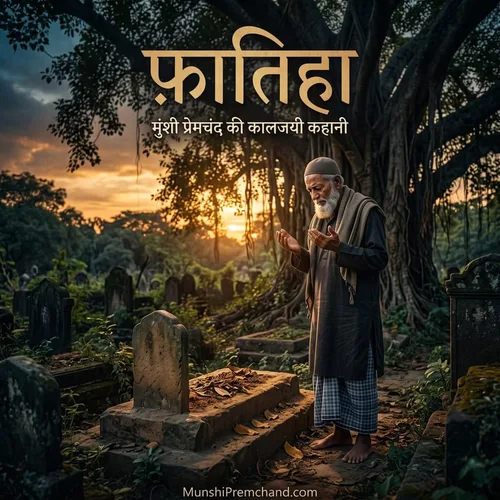
The sun was setting behind the rugged western peaks. Darkness was gradually descending across the frontier hills; and there, side by side, Turya and I knelt beside our father's grave, reciting the Fatiha for the peace of his soul.
Summary of Fatiha
'Fatiha' is one of Munshi Premchand's most gripping, psychologically profound, and dramatic short stories set against the backdrop of the North-West Frontier during the colonial era. It revolves around Asad Khan (whose true name is Nazir), a towering orphan soldier raised in a government orphanage, his long-lost sister Turya, and his commanding officer Major Sardar Himmat Singh.
Asad Khan, renowned across the regiment as 'Dev' for his six-foot-nine frame and unmatched valor, kills an elderly Afridi warrior in combat after the latter stabs an imperial sepoy for a rifle. Though accustomed to warfare, Asad is seized by an inexplicable, overwhelming guilt after this particular killing. Major Himmat Singh consoles him and shares his own past captivity five years earlier by an Afridi chieftain named Hyder Khan. In captivity, Hyder Khan's daughter Turya had fallen in love with Himmat Singh after hearing him sing Pashto verses, eventually freeing him out of compassion for his motherless children. Years later, when Turya arrived at Himmat Singh's home hoping to marry him, she discovered his living wife; consumed by jealous fury at his deception, she stabbed the wife to death, yet subsequently nurtured a protective affection for his motherless sons, leaving gold charms and gifts at their door.
That night, Turya infiltrates Asad's quarters to avenge her father's death. As Asad pins her wrist to defend his life, Turya sees an identical coiled snake tattoo on his hand, realizing he is her long-lost elder brother Nazir, abducted as an infant during a tribal clash. The horrifying realization dawns that the old Afridi Asad killed was none other than their biological father, Hyder Khan. Overcoming shock and grief, Turya comforts her brother, recognizing the hand of destiny. The siblings reconcile with Major Himmat Singh, who offers to marry Turya. She gently declines marriage across religious boundaries but embraces the maternal care of his children. The story concludes at sunset as brother and sister kneel beside Hyder Khan's grave to recite the Fatiha (prayer for the departed soul).
Publication History
'Fatiha' (फ़ातिहा) was composed by Munshi Premchand during his late mature phase and published in 1929 in contemporary literary journals before being collected in Mansarovar, Part 7 (मानसरोवर भाग 7).
The story reflects Premchand's deep interest in the North-West Frontier, tribal psychology, martial ethos, and the tragic ironies produced by colonial military service, where colonized subjects were deployed against frontier tribesmen without realizing their shared blood and humanity.
This unabridged English translation was published in 2026 by MunshiPremchand.com as part of the MunshiPremchand.com English Translation Series.
Themes & Critical Significance
- The Tragic Irony of Colonial Warfare: Premchand brilliantly exposes the cruelty of imperial military service. Asad Khan, stripped of his tribal identity in a state orphanage, is trained by the imperial army to hunt down his own kin. The climactic duel between father and son—where neither recognizes the other—symbolizes the fratricidal tragedy wrought by colonial warfare.
- Primal Instinct and Unconscious Guilt: Long before Asad learns the old warrior's identity, his soul is tormented by an inexplicable guilt. Premchand uses this psychological intuition to illustrate the indelible pull of blood ties and the voice of innate human conscience over formal military triumphs.
- Complex Frontier Psychology: The tribal figures—Hyder Khan and Turya—are portrayed neither as barbaric savages nor as romanticized saints, but as fierce, honorable, and intensely emotional human beings. Turya embodies extreme passion: capable of savage violence when betrayed, yet bound by unshakeable familial loyalty and maternal tenderness toward motherless children.
- Reconciliation, Forgiveness, and Fatiha: The narrative moves through cycles of plunder, abduction, murder, and revenge, only to culminate in forgiveness and spiritual peace. The recitation of the Fatiha at dusk over Hyder Khan's grave elevates the frontier tragedy into a sublime hymn of familial reconciliation and redemption.