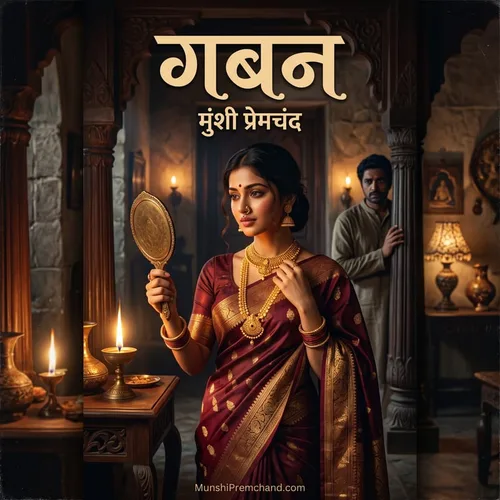
A month passed. A notice was appearing in Prayag’s most widely circulated daily newspaper, urging Ramanath to return home and promising a reward of five hundred rupees to anyone who could trace him, but no news had yet come from anywhere. Jalpa was wasting away with worry and grief. Seeing her condition, Dayanath too began to feel pity for her. At last, one day he wrote to Din Dayal, “Come and take your daughter-in-law with you for a few days.” As soon as Din Dayal received the message, he came anxiously, but Jalpa refused to go to her parents’ home. Din Dayal said in astonishment, “Do you intend to lie here and die?”
Jalpa said gravely, “If my life has to leave me in this way, who can stop it? I am not going to die just yet, Grandfather, believe me. There is no place there for an unfortunate woman either.”
Din Dayal—“After all, what harm is there in going? Shahzadi and Basanti are both here. You will pass the time laughing and talking with them.”
Jalpa—“I do not feel like leaving Lala and Ammaji here alone. If I am destined to weep, then I will weep.”
Din Dayal—“What is this? I hear that some debt had accumulated. Some people say he had taken government money.”
Jalpa—“Whoever told you that lied outright.”
Din Dayal—“Then why did he leave?”
Jalpa—“I truly do not know. I keep having the same suspicion myself.”
Din Dayal—“Did he quarrel with Lala Dayanath?”
Jalpa—“He would not even raise his head before Lalaji, nor would he eat so much as a betel leaf. How could he quarrel with him? He liked wandering about. Perhaps he thought, ‘No one will let me go if I stay here, so let me run away.’”
Din Dayal—“Perhaps that is what happened. Some people get an obsession with wandering from place to place. Tell me frankly if you have any difficulty here. Shall I send you some money for expenses?”
Jalpa said proudly, “I have no difficulty, Grandfather! By your kindness, I lack nothing.”
Dayanath and Jageshwari both tried to persuade Jalpa, but she would not agree to go. Then Dayanath said irritably, “It is better than lying here all day and crying.”
Jalpa—“Is it another world there, or will I become someone else by going there? And why should I be afraid of weeping? When it was time to laugh, I laughed; now that it is time to weep, I will weep. He may have gone hundreds of miles away, but I see him sitting here before me all the time. He is not here himself, but he lives in every single thing in this house. If I leave this place, I will go mad with despair.”
Din Dayal understood that this proud woman would not abandon her resolve. He got up and went outside. When he was leaving in the evening, he held out a fifty-rupee note to Jalpa and said, “Keep this. You may need it.”
Jalpa shook her head and said, “I have absolutely no need for it, Grandfather. Yes, there is one thing I want: give me your blessing. Perhaps your blessing will bring me good fortune.”
Din Dayal’s eyes filled with tears. He placed the note on the cot and went outside.
The month of Kuvar had begun. Pieces of cloud, empty of rain, could sometimes be seen racing across the sky. Jalpa would lie on the roof and watch those fragments of cloud playing in the heavens. What greater amusement is there for hearts afflicted by worry and grief? The pieces of cloud changed into all sorts of colors and assumed all sorts of shapes; sometimes they came together affectionately, sometimes they rose and separated from one another, sometimes they began to race, sometimes they stood still. Jalpa would think that Ramanath too might be sitting somewhere watching this play of the clouds. This imagination gave her a strange pleasure. She felt toward those wandering creatures of the sky the same kind of intimacy that a gardener feels toward the plants he has planted, or a child toward the little houses he has built. In adversity, the mind turns inward. Jalpa had now begun to suspect that God had given her this punishment for her sins. After all, Ramanath had to bring money every day by squeezing it out of someone. No one would willingly have given it to him.
How happy she used to be when she saw that money. It was with that money that things for her daily pleasures and adornment kept coming into the house. Now those objects burned her heart when she looked at them. They were the root of all her suffering. It was for their sake that her husband had been forced to go away. Those things now pierced her eyes like thorns and stabbed her heart like sharp needles.
At last, one day she gathered all those things together: velvet slippers, silk stockings, various ribbons, combs, hairpins, mirrors—who could count them all? A respectable heap had accumulated. She would immerse the whole heap in the Ganges and begin a new life from that day forward. It was because of these very objects that she had come to this state today. Today she would destroy this web of illusion. Some of the things were so beautiful that she felt reluctant to part with them, but what could these little drops of water do against the blazing fire of remorse within her? Until midnight she kept picking up the objects and setting them apart, as though preparing for a journey. Yes, it truly was a journey—from darkness to light, from falsehood to truth. She thought to herself: if God is merciful and he returns home, she would live in such a way that they could get by on the very least. She would not waste a single penny. She would not allow even a farthing beyond their honest earnings to enter the house. Today her new life would begin.
As soon as it was four o’clock and she began to hear the sound of people coming and going on the road, Jalpa picked up the bag and went to bathe in the Ganges. The bag was very heavy; it became difficult to carry it even ten steps hanging from her hand. She changed hands again and again. She was also afraid that someone might see her. She had never had occasion to walk carrying such a burden. Rickshaw drivers called out to her, but she paid no attention. At last, when her hands became useless with fatigue, she put the bag on her back and began walking more quickly. She had drawn her veil low so that no one would recognize her.
When she reached near the bathing steps, it had become light. Suddenly she saw Ratan coming in her motorcar. She wanted to lower her head and hide her face, but Ratan recognized her from a distance, stopped the motorcar, and said, “Where are you going, sister? What is this bag on your back?”
Jalpa lifted her veil and said without hesitation, “I am going to bathe in the Ganges.”
Ratan—“I have already bathed and am returning, but come, I will go with you. I’ll take you home afterward. Put the bag down.”
Jalpa—“No, no, it is not heavy. You go; you will be late. I can go myself.”
But Ratan would not listen. She got out of the car, took the bag from her hands, and, putting it in the car, said, “What have you put in this? It is very heavy. Shall I open it and see?”
Jalpa—“There is nothing in it worth your seeing.”
The bag was not locked. Ratan opened it and, astonished, said, “Where are you taking these things?”
Jalpa, getting into the car, said, “I am going to cast them into the Ganges.”
Ratan said in astonishment, “Into the Ganges! Have you gone mad? Come, let us go back home. Leave the bag there and come later.”
Jalpa said firmly, “No, Ratan. I will not leave until I have drowned these things.”
Ratan—“But why?”
Jalpa—“First drive the car, then I’ll tell you.”
Ratan—“No, tell me first.”
Jalpa—“No, that will not do. Drive first.”
Ratan, defeated, drove the car forward and said, “All right, now will you tell me?”
Jalpa said reproachfully, “You should have understood this much yourself. Why do you ask me now? What use are these things to me anymore? Looking at them makes me suffer. When the person who was meant to see them is no longer here, what should I do by keeping them?”
Ratan drew a long breath, took Jalpa’s hand, and said in a trembling voice, “You are doing a great injustice to Babuji, sister. How eagerly he must have brought these things! How happy he must have been seeing how beautiful they looked on you! Each thing is a separate memory of his love. By casting them into the Ganges, you are showing terrible disrespect for that love.”
Jalpa fell into thought. Her mind wavered between resolve and doubt, but in a moment she recovered herself and said, “That is not it, sister! Until these things are out of my sight, my mind will not be at peace. It was this very extravagance that brought me to this ruin. This is the bundle of my misfortune, not a memory of love. Love is engraved upon my heart.”
Ratan—“Your heart is very hard, Jalpa. I do not think I could do this.”
Jalpa—“But I regard these things as the root of my misfortune.”
After remaining silent for a moment, she continued, “He has done me a great injustice, sister! I believe that a man who hides anything from his wife does not love her. If I had been in his place, I would not have abandoned everything and run away like this. I would have told her all the anguish in my heart and taken her advice in everything I did. Why should there be secrecy between husband and wife?”
Ratan said with a grave smile, “There are very few men who open their hearts completely to their wives. When you yourself keep something hidden in your heart, why do you expect him to hide nothing from you? Can you honestly say that you kept nothing from him?”
Jalpa said hesitantly, “I did not keep anything hidden in my heart.”
Ratan said emphatically, “You are lying, absolutely lying. If you had trusted him, he too would have opened his heart.”
Jalpa could not brush aside this accusation. Today she realized that the deception had begun from her side first. They had reached the bank of the Ganges. The car stopped. Jalpa got down and began to lift the bag, but Ratan pushed her hand away and said, “No, I will not let you take it. Consider it drowned.”
Jalpa—“How can I consider it so?”
Ratan—“Have mercy on me, as a sister.”
Jalpa—“As a sister, I could wash your feet, but I cannot keep these thorns in my heart.”
Ratan frowned and said, “You will not listen in any way?”
Jalpa said calmly, “No, not in any way.”
Ratan turned her face away in resignation. Jalpa picked up the bag, hurried down from the steps to the water’s edge, lifted the bag, and threw it into the water. Having achieved this victory over her own weakness, her face became radiant. Never had she felt as much pride and joy as she did today—not even when she had acquired these things. Among the countless people who were bathing and praying at that moment, perhaps none felt such a light within their own conscience. It was as though the golden radiance of dawn were spreading through every pore of her body. When she came back up after bathing, Ratan asked, “Did you drown them?”
Jalpa—“Yes.”
Ratan—“You are very hard-hearted.”
Jalpa—“It is this hardness that conquers the mind. If I had become hard-hearted a few days earlier, why would this day have come?”
The car drove on.