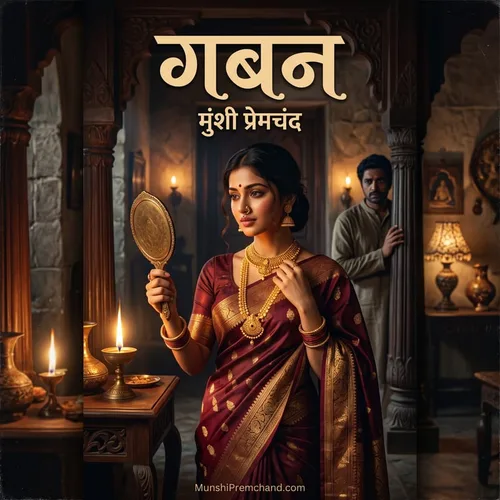
Jalpa was no longer the secluded woman who spent the whole day lying sadly with her face covered. She no longer liked sitting at home. Until now she had been helpless; she could not go anywhere or visit anyone. Now, by God's grace, she too had acquired jewelry. Why, then, should she remain shut up at home, suppressing her spirits? Clothes and ornaments are not sweets whose taste can be enjoyed in solitude. What was the use of keeping jewelry locked in a jewelry box? Whenever she received an invitation from somewhere in the neighborhood or among her community, she would certainly go with her mother-in-law. After a few days, she no longer needed her mother-in-law at all. She began going out alone. Then she was no longer confined even by any particular occasion or purpose. Her beauty, clothing and ornaments, and her modesty and gracious manners soon raised her to a position of honor among the women of the neighborhood. Without her, their gatherings seemed empty. Her voice was so gentle, her speech so sweet, and her appearance so incomparable that she seemed like the queen of the assembly. Her arrival brought new life to the women's world of the neighborhood. Every day there would be a gathering somewhere or other. The women would amuse themselves by singing and playing music or chatting for an hour or two. Sometimes at one house, sometimes at another, singing continued for fifteen days in succession during Phagun. Jalpa had been blessed not only with extraordinary beauty but also with a generous heart. The expense of betel leaves and other refreshments usually fell upon her. Sometimes singers were invited, and she took responsibility for their hospitality and care. At times she would go with the women to bathe in the Ganges; the carriage fare and the expenses for refreshments on the riverbank also fell upon her. In this way, two or three rupees a day would simply disappear. Rama was an ideal husband. If Jalpa asked for something, he would place even his life at her feet. What did money matter? He was always watching her face for her wishes. Jalpa would tell him every day about these gatherings. Seeing how much respect and honor she enjoyed among the women, he would swell with pride.
One day this group became seized with the desire to go to the cinema. Everyone was enchanted by the spectacle and excitement there. After that, trips to the cinema became a regular occurrence. Until then Rama had had no particular interest in the cinema. Even if he had, what could he have done? Now money had begun to come into his hands, and Jalpa insisted; so why should he not go? In the cinema hall he met many women who laughed and talked freely without covering their faces. Their freedom was secretly casting its spell on Jalpa as well. As soon as she stepped outside the house, she would uncover her face, but out of modesty she sat only among the women who remained behind the screen. How much she wished that Rama would sit beside her too! After all, in what respect was she inferior to those fashionable women? In beauty and appearance she was no less than they were. In dress and adornment she was second to none. She was skilled in conversation. Why, then, should she sit with the veiled women? Although Rama was not highly educated, he was liberal-minded under the influence of the times and the country around him. Earlier he had been such an ardent devotee of purdah that when he took his mother to bathe in the Ganges, he would not even allow her to speak to the priests. If he ever heard his mother's laughter in the men's quarters, he would come and scold her: "Have you no shame at all, Mother? There are people outside, and you are laughing." His mother would become embarrassed. But with the passage of time this scruple disappeared from Rama. Moreover, Jalpa's beauty further emboldened him. If Jalpa had been ugly, dark, clumsy, and unattractive, he would have forced her to remain behind the screen. He would have been ashamed to walk or sit with her. But there was both pleasure and pride in going out with a woman as exceptionally beautiful as Jalpa. Among the respectable women there, none could equal Jalpa in beauty, figure, or adornment. Though she was a village girl, she had absorbed the city's ways so completely that one might have thought she had been born in the city. The only slight deficiency was her lack of English education, and Rama was making up for that too.
But how was this restriction of purdah to be broken? Rama could see many friends and acquaintances sitting in the hall. How much they would laugh if they saw him sitting with Jalpa! At last, one day he resolved to stand before society openly and challenge its conventions. He said to Jalpa, "Today you and I will sit together in the cinema."
A delightful thrill ran through Jalpa's heart. A glow of genuine happiness appeared on her face. She said, "Really? No, brother, the women who sit with me will never let me live in peace."
Ramanath—"If we are so afraid, then nothing will ever happen. What sort of absurdity is this, that women should sit hiding their faces behind a screen?"
And so the matter was settled. On the first day both of them remained self-conscious, but from the second day onward they grew confident. After several days, the time also came when Rama and Jalpa could be seen walking together in the park in the evening.
Jalpa said with a smile, "What if Babuji sees us?"
Rama—"So what? Nothing will happen."
Jalpa—"I would..."
She opened out the sari and gazed at it with enchanted eyes.
Ramanath—"How beautifully this watch looks on your wrist! My money has been well spent."
Jalpa—"Tell me honestly, how much did you spend?"
Ramanath—"Shall I really tell you? One hundred and thirty-five rupees. Seventy-five for the sari, ten for the shoes, and fifty for the watch."
Jalpa—"That makes one hundred and thirty-five, not one hundred and fifty. I wasn't exaggerating when I said it. But how will all this money be paid back? That wretched woman invited me for nothing. Now I shall simply stop going out."
Rama too was absorbed in the same anxiety, but he did not reveal his feelings lest he spoil Jalpa's happiness. He said, "It will all be paid."
Jalpa said contemptuously, "From where will it be paid? Let me hear. Not even a penny remains in hand; where will the money come from? It is only because Babuji is managing the household expenses that we are getting by; otherwise we would know what would happen. Do you think I am crazy about jewelry and saris? Take these things back."
Rama looked at her lovingly and said, "Keep these things. I won't bring anything again without asking you."
In the evening, when Jalpa put on the new sari and new shoes, fastened the watch around her wrist, and looked at herself in the mirror, her face lit up with pride and delight. She may genuinely have said that the things should be returned, but at that moment she was not prepared to make so great a sacrifice. In the evening Jalpa and Rama set off toward the cantonment. There was a signboard: "Indubhushan, Advocate, High Court." Rama now learned that the woman was Pandit Indubhushan's wife. Panditji was a famous lawyer of Kashi. Rama had seen him many times, but how could he ever have had the good fortune to become acquainted with such an eminent man? Six months earlier he could not even have imagined that one day he would have the honor of being invited to his house; yet today, thanks to Jalpa, this impossible thing had happened. He was the guest of one of the great lawyers of Kashi.
Rama had thought that many men and women would be invited, but there was no one there except the lawyer and his wife, Ratan. As soon as Ratan saw the two of them, she came out onto the veranda, shook hands with them, took them inside, and introduced them to her husband. Panditji shook hands with both guests while reclining in an easy chair and said with a smile, "Forgive me, Babu Sahib, I am not in good health. Are you working in some office here?"
Rama said shyly, "Yes, in the municipal office. I have only recently come here. I intended to enter the legal profession, but seeing the condition of new lawyers here, I did not have the courage."
Rama did not think it improper to tell a small lie in order to enhance his own importance. The effect was very good. If he had frankly said, "I am a clerk earning twenty-five rupees," perhaps the lawyer would have considered it beneath his dignity to converse with him. He said, "You did very well not to come into this profession. There you will reach a good position after two or four years; here it is possible that you would not get a single case for ten years."
Jalpa still could not decide whether Ratan was the lawyer's daughter or his wife. The lawyer was certainly not under sixty. His smooth bald head gleamed among the white hair around it like varnished wood. His mustache was neatly trimmed, but the wrinkles on his forehead and the lines on his cheeks showed that this traveler had grown weary from his journey through the world. Reclining in the easy chair, he looked like a man who had been ill for years. His complexion, however, was fair, a fairness that even sixty years of summer and winter had failed to destroy. He had a high nose, a broad forehead, and large eyes filled with pride. His face seemed to say that he disliked speaking to anyone or answering anyone's questions. In contrast, Ratan was a well-built, dusky young woman, very sociable and untouched by pride. There was no conventional sign of beauty in her face. Her nose was flat, her face round, and her eyes small; yet she looked like a queen. Beside her, Jalpa seemed like a jasmine flower before a sunflower.
Tea arrived. Nuts, fruit, sweets, and ice cream were arranged on the tables. Ratan and Jalpa sat at one table. The other table was for Rama and the lawyer. Rama sat down at his table, but the lawyer was still reclining in his easy chair.
Rama said to the lawyer with a smile, "Won't you come over?"
The lawyer smiled from where he lay and said, "You begin; I will come in a moment."
The guests drank tea and ate fruit, but both Rama and Jalpa felt awkward laughing and talking in front of the lawyer. With lively old men one can enjoy pleasant company, but even if such dry, lifeless people are young, they make others feel lifeless too. After much urging, the lawyer drank two sips of tea. He remained seated at a distance, watching the scene. So when Ratan said to Jalpa, "Come, let us walk in the garden and leave these two gentlemen to discuss society and morality," it was as though a noose had been loosened from Jalpa's neck. Rama watched the two women leave the room like a bird escaping from a cage and heaved a long sigh. If he had known that trouble was going to fall upon his head here, he would never have come!
The lawyer pursed his lips, turned to one side, and said, "I don't know what has happened to my stomach; nothing seems to digest. Even milk doesn't digest. I don't know why people drink tea with such enthusiasm. I am afraid even of looking at it. As soon as I drink it, my body begins to cramp and sparks seem to fly from my eyes."
Rama said, "Haven't you taken any medicine for your digestion?"
The lawyer said with distaste, "I have not the slightest faith in medicines. You will not find more ignorant people in the world than these physicians and doctors. None of them has any real power of diagnosis. No two physicians or two doctors ever agree on a diagnosis. The symptoms are the same, but one physician says it is a disorder of the blood, another a disorder of bile; one doctor says there is inflammation of the lungs, another says there is a disorder of the stomach. They simply prescribe medicine on the basis of guesses, and mercilessly put the knife to the throats of patients. These doctors would have sent me to hell long ago, but I escaped their clutches. I hear great praise of yoga practice, but I cannot find any holy man from whom I could learn it. There is always a danger that performing some practice merely on the basis of books may do harm instead of good."
While the science of health was being refuted here, the two women were speaking intimately to one another.
Ratan said with a smile, "You must have been very surprised when you saw my husband."
Jalpa had not merely been surprised; she had been confused as well. She said, "The lawyer must be married to you for the second time."
Ratan—"Yes, it has only been five years. His first wife died thirty-five years ago. At that time he was only twenty-five. People advised him to marry again, but he already had a son and refused. He remained alone for thirty years. But five years ago his grown son died, and then it became necessary for him to marry. I had no parents. My maternal uncle raised me. I cannot say whether he took pity on me or whether he was captivated by his own goodness. I believe it was simply God's will. But ever since I came here, I have kept getting fatter. The doctor says I cannot have children. Sister, I don't long for children myself, but my husband is very unhappy when he sees my condition. I am the root of all his illnesses. If God were to give me a child today, all his ailments would disappear. I long so much to become thin. I take hot-water tub baths, go walking every day, eat less ghee and milk, have reduced my food by half, and work as hard as I can; yet I keep growing fatter day by day. I cannot understand what to do."
Jalpa—"The lawyer must be irritated with you."
Ratan—"No, sister, not at all. He has never once mentioned it to me, even by mistake. Not a single word has escaped his lips that would reveal his inner suffering; but I know that worry is consuming him. One cannot control everything. What can I do? I spend as much as I like and live as I please, and he never says a word. Whatever he earns, he brings and places in my hands. I tell him, 'What need do you have to continue practicing law now? Why don't you rest?' But he cannot sit at home. He has practically renounced food except for two chapatis. If I insist a great deal, he will eat two or four grapes. I feel sorry for him and serve him as much as I can. After all, he is wearing himself out for my sake."
Jalpa—"A man like that should be regarded as a god. Here, if a woman dies, the man marries again at once. Remaining alone for thirty years is not something everyone can do."
Ratan—"Yes, sister, he is indeed like a god. Even now, whenever his first wife is mentioned, he begins to cry. I will show you her photograph sometime. He looks so stern on the outside, but his heart is just as soft inside. He has arranged monthly support for many orphans, widows, and poor people. That bracelet of yours is very beautiful."
Jalpa—"Yes, it was made by a very fine craftsman."
Ratan—"I don't know anyone here at all. I don't like troubling my husband about jewelry. I am afraid to have things made by ordinary goldsmiths; who knows what they might mix into them? All my co-wife's jewelry is kept here, but I don't like it. Have a pair of bracelets like yours made for me through Babu Ramanath."
Jalpa—"Let me ask."
Ratan—"I was so happy that you came today. I spend the whole day sitting alone. I feel restless. Whom can I visit? I don't know anyone, and I don't even feel like making friends with people here! I invited one or two women to my house and went to theirs, hoping to establish sisterly relations with them; but after seeing their manners and ways, I thought it better to keep away. Both of them wanted to take advantage of me. They borrowed money from me and still have not returned it. I saw such a passion for cosmetics and adornments in them that I am ashamed even to say it. Do come every day, sister, even if only for half an hour."
Jalpa—"Why, that would be wonderful."
Ratan—"I will send the motorcar for you."
Jalpa—"What is the need? Carriages are readily available."
Ratan—"I don't know why I don't feel like letting you go. Ramananathji must consider himself very fortunate to have found you."
Jalpa said with a smile, "He doesn't consider himself fortunate at all; he is always scolding me."
Ratan—"Really! I cannot believe it. There he comes too. Ask him whether he can have another bracelet like this made."
Jalpa—"(to Rama) If we ask Charan Das, how long would it take him to make a bracelet like this? Ratan wants one just like it."
Rama promptly said, "Yes, why couldn't he make it? He can make one even better than this."
Ratan—"How much did this pair cost?"
Jalpa—"Eight hundred."
Ratan—"That's no problem; but it must be exactly like this, made from the same design."
Rama—"Yes, yes, I will have it made."
Ratan—"But, brother, I don't have the money with me right now."
When money is concerned, a man can say nothing before women. Can he say, "I don't have money with me at the moment"? He would rather die than make such an excuse. He will borrow money, flatter others, but he will not reveal his helplessness before a woman. He considers even discussion of money beneath him. Jalpa knew her husband's financial condition very well. But if Rama had made some excuse at that moment, she would have felt very bad. She was afraid that he might say, "I will ask the jeweler and let you know." Her heart was pounding; but when Rama boldly said, "Yes, yes, there is no question of money. You can pay whenever you like," she was pleased.
Ratan—"Then when may I expect it?"
Rama—"I will tell the jeweler today itself; even then it will take at least fifteen days."
Jalpa—"Come to my house for tea next Sunday."
Ratan gladly accepted the invitation, and the two men took their leave. When they reached home, it was already evening. Ramesh Babu was sitting there. Jalpa got down from the carriage and went inside; Rama went to Ramesh and said, "Have you been here long?"
Ramesh—"No, I just arrived. Did you go to the lawyer's house?"
Ramanath—"Yes. It cost me three rupees."
Ramesh—"No harm. That money will be recovered. There is nothing wrong with establishing relations with important people; important things get accomplished through them. You should invite them too one day."
Ramanath—"I have invited them for tea this Sunday."
Ramesh—"If you don't mind, shall I come too? You know that the lawyer has a brother who is an engineer. One of my brothers-in-law has been unemployed for a long time. If the lawyer recommends him, the poor fellow might get a position. Just introduce me to him; I will take care of the rest. God willing, I will arrange the party in such a way that the lady will be pleased. I will bring the tea sets, colored glass vases, and chandeliers. Leave the chairs, tables, carpets—everything—to me. There will be no need for coolies or laborers. I will put those fellows to work."
Ramanath—"Then it will be great fun. I was very worried."
Ramesh—"There is nothing to worry about. I will put that servant girl to work. I will tell her, 'If you want the position, show what you can do.' Then see how she runs around getting everything done."
Ramanath—"Didn't you get your brother-in-law a job somewhere just two or three months ago?"
Ramesh—"Oh, I still have six more to take care of. There are seven of them altogether. Sit down for a while; let's make a list of the necessary things. We will start running around from today; only then will I be able to gather everything. And how many guests will there be?"
Ramanath—"The lady will be there, and perhaps the lawyer too."
Ramesh—"That's very good. If there are too many people, it becomes a commotion. We have business with the lady. What use is there in flattering idle men?"
The two men prepared a list. Ramesh Babu began collecting the things the very next day. He had connections with good households and brought together all sorts of fine decorative articles; the whole house began to sparkle. Dayanath also joined in the preparations. His job was to arrange things neatly: which flowerpot should go where, which picture should hang where, where a particular carpet should be spread. On these questions the three men would argue for hours. Before going to the office and after returning from the office, all three were absorbed in these tasks. One day a debate arose over where the mirror should be placed in the room. Dayanath said there was no need for a mirror in that room; it should be put in the room behind it. Ramesh opposed him. Rama stood silently in a dilemma. He could not agree entirely with one side or the other.
Dayanath—"I have seen the drawing rooms of hundreds of Englishmen. I have never seen a mirror in any of them. A mirror belongs in a dressing room. Putting a mirror here is rather absurd."
Ramesh—"I have not had the opportunity to see hundreds of Englishmen's rooms, but I have certainly seen two or four, and I saw mirrors in them. Besides, is it necessary that we imitate the English even in these tiny matters? We are Indians, not Englishmen. Large full-length mirrors are kept in the rooms of Indian aristocrats. What you have said sounds like the sort of thing our corrupted babus say: in clothing, in room decoration, in speech, in tea and liquor, in porcelain cups—in short, in every matter of display they try to mock the English, but the qualities that made the English English, and through which they rule the world, do not touch them even in the slightest. Have you too developed a desire to become English in your old age?"
Dayanath considered imitation of the English very objectionable. He also disliked this tea party. If anything gave him some satisfaction, it was the thought that they might become acquainted with a few important people. In his whole life he had never worn a coat. He drank tea, but he did not insist on a porcelain set. He had no objection to bowls and dishes, glasses, lotas, basins—anything at all; but at this moment he was determined to defend his position. He said, "Indian aristocrats' rooms do not have tables and chairs; they have carpets. You have put chairs and tables here and made it English in style, and now you are using Indians as your example for the mirror. Either keep it Indian or make it English. What is this half-partridge, half-quail arrangement? A four-cornered cap does not look good with a coat and trousers!"
Ramesh Babu had thought that Dayanath's tongue would finally be silenced, but this reply left him stunned. He saw the ground slipping from beneath his feet. He said, "So you have never seen a mirror in an Englishman's room? Then name five or ten Englishmen whose rooms you have seen. Apart from that miserable head clerk of yours, perhaps you have never even set foot in the room of another Englishman. You have taken that miserable fellow as your ideal of English taste? Wonderful! I admit it."
Dayanath—"That is your language; call him miserable, mixed-breed, weak-kneed, whatever you like, but apart from his color he is not inferior to the English in any respect, and before that he was European."
Ramesh was still trying to think of an answer when a motorcar stopped at the door, and Ratan Bai stepped out and came onto the veranda. All three men immediately came outside. Rama was displeased to see Ratan arrive at that moment. He was afraid she might enter the room too, in which case the whole truth would be exposed. Stepping forward and shaking her hand, he said, "Come, this is my father, and this is my friend Ramesh Babu." But neither of the two gentlemen extended a hand or moved from his place. They stood awkwardly. Ratan too saw no need to shake hands with them. She greeted them from a distance and said to Rama, "No, I won't sit down. I don't have much time at the moment. I wanted to say something to you."
Saying this, she walked with Rama toward the motorcar and spoke softly: "You must have told the jeweler, haven't you?"
Rama said without hesitation, "Yes, he is making it."
Ratan—"That day I said I would not be able to pay the money immediately, but I thought perhaps you might be inconvenienced, so I brought the money. It needs eight hundred, doesn't it?"
Jalpa had told her that the bracelet cost eight hundred. Rama could have taken that much money. But Ratan's simplicity and trust stopped his hands. He could not betray such a generous and guileless woman. He had no hesitation in taking two or four annas from traders here and there. He knew that they too fleeced their customers with the blade turned the other way. His conscience felt not the slightest hesitation in treating such people in this manner, but to deceive this goddess required the heart of an old sinner. Somewhat hesitantly he said, "Did Jalpa tell you that the bracelet cost eight hundred? Perhaps she didn't remember correctly. Her bracelet cost six hundred. If you wish, I can have an eight-hundred-rupee one made for you!"
Ratan—"No, I like that very one. Have one made for six hundred."
She took her purse from the motorcar and drew out six hundred-rupee notes. Rama said, "Why such haste? Once the thing was ready, we could have settled the account."
Ratan—"The money would have been spent if I had kept it. So I thought I would bring it and put it on your head. It is my habit that whatever I do, I finish as quickly as possible. Delay makes me uneasy."
With this she got into the motorcar, and the car sped away. Rama went inside to put the money in the trunk, while the two older men began talking.
Ramesh—"Did you see that?"
Dayanath—"Yes, my eyes were open. Now the same wind is entering my own house. May God save us."
Ramesh—"It is true enough, but this is the kind of woman one finds nowadays. When there is a need, at least she can help with something. If you fall ill, she can call a doctor. Here, even if we were dying, what chance would there be of a woman stepping outside the house?"
Dayanath—"We cannot tolerate this Englishness, brother. What can we do? There is the love of one's child; otherwise I feel like telling Rama plainly, 'Brother, take a separate house and live there.' Once one's eyes are gouged out, the pain is gone. I become angry with those men who let women get so completely above themselves. Just wait and see, one day this woman will betray the lawyer."
Ramesh—"Sir, I do not agree with you on that point. Why assume that any woman who goes out is necessarily morally corrupted? But she certainly thinks highly of Rama. I wonder why she gave him the money."
Dayanath—"I suspect there is something fishy here. I wonder whether Rama is playing some trick on her."
At that very moment Rama was coming out from inside. The last sentence reached his ears. Furrowing his brows, he said, "Yes, of course I am playing a trick. I am cheating her and extorting money from her. That is my profession!"
Ramanath—"You have practically made me out to be a confirmed swindler; what else can I say? Why did this suspicion arise in your mind? What have you seen in me that gave you such an idea? I simply wear clean clothes and follow the new fashion a little; apart from that, what fault have you seen in me? Whatever I spend, I spend from money I have honestly earned. The day I have to resort to deception and fraud, I will swallow poison and end my life. Yes, it is true that some people know how to spend money and some do not. That is a matter of one's own good sense; if you choose to call it deception, you have that right. When such suspicions about me arise on your side, perhaps the best thing for me is to blacken my face and go away somewhere. Ramesh Babu is here. You may ask him anything you wish about me. He will not lie on my behalf."
These words, colored with the hue of truth, reassured Dayanath. He said, "The day I learn that you have adopted such methods, I will blacken my own face and leave before you do. I became suspicious because I saw your expenses increasing; I do not hide that. But since you say your intentions are clean, I am satisfied. I want only this: let my son remain poor if necessary, but let his intentions never become corrupt. My prayer to God is that He keeps you on the path of truth."
Ramesh said with a smile, "All right, that matter is settled. Now tell me, why did she give you the money? I was counting them; there were six notes, apparently one hundred rupees each."
Ramanath—"I have brought home a fool."
Ramesh—"If you joke with me, I will hit you. If you really have brought one home, I will pat you on the back—good for you! Make as much as you can, but don't let your reputation suffer. Not a whisper of it should reach anyone's ears. I am not afraid of God. Whatever He asks, I will answer. But I am afraid of people. Tell me the truth: why did she give you the money? If there is any commission to be earned, include me in it."
Ramanath—"She has asked me to have a jeweled bracelet made."
Ramesh—"Then come, I will have it made by a good jeweler. You have taken on this trouble at a bad bargain. You don't know women's nature. They do not trust anyone. You could spend two or four rupees from your own pocket, and she would still think you had cheated her. You are unlikely to earn any good reputation from it; disgrace, however, is waiting at the door."
Ramanath—"You are talking about foolish women. Educated women are not like that."
A little later Rama went inside and said to Jalpa, "Your friend Ratan came just now."
Jalpa—"Really! Then there must have been a great commotion. There wasn't even any preparation here."
Ramanath—"The good thing is that she did not come into the room. She came to pay for the bracelet. You had probably told her it cost eight hundred; I took only six hundred."
Jalpa said sheepishly, "I was only joking."
Jalpa had thus given her explanation, but for a long time afterward her mind remained in turmoil. If Rama had taken eight hundred rupees, perhaps there would have been no such turmoil. She would have been happy with her success; but Rama's judgment had awakened her moral sense. She regretted having spoken so carelessly. She thought: "They must consider me so mean in their hearts. And how dishonest must Ratan think me now."