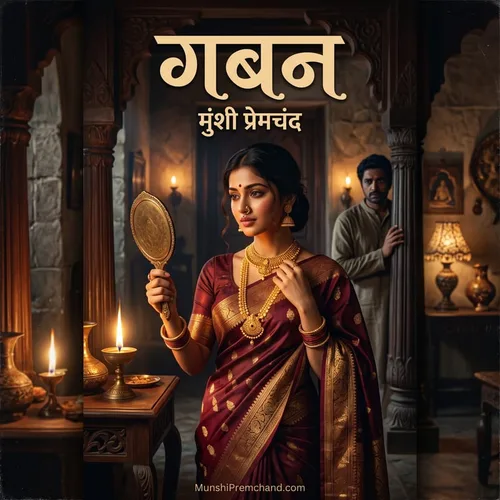
Ratan continued to encourage Jalpa in her letters, but she never wrote anything about herself. If she herself was suffering, how could she tell her the story of her own sorrows? The same Ratan who had never attached any importance to money had, in this one month, become dependent even for her daily bread. Her married life might not have been very happy, but she had never lacked for anything. Even a journey can be completed riding a wretched horse if the road is good; if servants, money, food, and other provisions are available, and the horse too is swift, what more could one ask! Ratan's condition was like that rider's. Like him, she was moving slowly along the journey of life. At times she must have become irritated with the horse; seeing other riders flying past, she too must have wished that she could fly in the same way, but she was not unhappy, nor did she weep over her fate. She was like a cow tied by a thin tether, content with the chaff and bran in its manger. Green fields stretched out before it, fragrant grasses swayed there, yet it never broke the tether and wandered away. To it there was no difference between that thin tether and an iron chain. Youth does not hunger for love as much as it hungers for self-display. The hunger for love comes later. Ratan had every means of displaying herself. Her youthful soul was absorbed in adornment and display. Laughter and amusement, outings and excursions, eating and drinking—this was her life, as it is, for the most part, the life of all human beings. She had neither the desire nor the purpose of going into deeper waters. Prosperity does much to soothe mental anguish. She had countless ways of forgetting her sorrows: there were cinemas, theatres, travel, cards, pets, music; but a person has no means of forgetting poverty except to weep, curse one's fate, or become detached from the world and take one's own life. Ratan's fate had taken a turn. The dream of happiness had been shattered, and the skeleton of poverty now stood staring at her. And all this had happened through her own hands!
Panditji was one of those people who had no fear of death. Somehow he had become convinced that people of weak health could live for a very long time if they observed a proper diet and exercised caution. He never went beyond the limits of diet and caution. Then what enmity could death possibly have with him that it should unnecessarily pursue him? The thought of writing his will occurred to him when he was on the verge of death, but as soon as Ratan heard the word "will," she became so grief-stricken and frightened that Panditji thought it best to put the matter off at that time. After that, he never again became conscious enough to have a will written. After Panditji's death, Ratan became so detached from the world that she had no awareness of anything. This was the very time when she should have been especially careful. She ought to have remained as vigilant as though enemies had surrounded her, but she left everything to Manibhooshan, and Manibhooshan gradually appropriated all her property. He devised such conspiracies that Ratan did not even get the slightest hint of his deceitful conduct. When the noose had been tightened completely, he came one day and said, "The bungalow will have to be vacated today. I have sold it."
Ratan said somewhat sharply, "I told you that I would not sell the bungalow yet."
Manibhooshan threw off the cloak of courtesy, knitted his brows, and said, "You have a bad habit of forgetting things. In this very room I mentioned this to you, and you agreed. Now that I have sold it, you put on this show! The bungalow will have to be vacated today, and you will have to come with me."
"I want to remain here for now."
"I will not let you remain here."
"I am not your maidservant."
"The responsibility for your protection rests upon me. To preserve the honor of our family, I will take you with me."
Ratan bit her lips and said, "I can protect my own honor. I do not need your help. You cannot sell anything here without my consent."
Manibhooshan struck her with a thunderbolt: "You have no right over this house or over Uncle's property. It is my property. You can ask me only for your maintenance."
Ratan said in astonishment, "Have you been eating too much bhang?"
Manibhooshan said in a hard voice, "I do not eat so much bhang that I begin talking nonsense. You are educated; you were the wife of a great lawyer. You must know a great deal about the law. In a joint family, a widow has no right over her husband's property. There was never any separation between Uncle and my father. Uncle was here and we were in Indore, but that does not prove that we had separated. If Uncle had wanted to leave his property to you, he would certainly have written a will, and even though such a will would have had no legal validity, we would have respected it. His failure to make a will proves that he did not wish to interfere with the ordinary operation of the law. You will have to vacate the bungalow today. The motorcar and the other things will also be auctioned. If you wish, come with me, or stay. A house costing ten or eleven rupees a month will be quite enough for you to live in. I have arranged fifty rupees a month for your maintenance. After the debts and accounts are settled, there is no room for anything more."
Ratan gave no answer. She sat there for some time, stunned, then had the motorcar brought and spent the entire day going from one lawyer to another. Panditji had many lawyer friends. They all expressed their regret after hearing her story and kept wondering that the lawyer sahib had not written a will. There was now only one course open to her. She could try to prove that the lawyer sahib and his brother had separated. If this could be proved—and it would be quite easy to prove—Ratan would become the owner of the property. If she could not prove it, she had no recourse. Unfortunate Ratan returned home. She resolved that she would not resort to lies to obtain what was not hers. Not under any circumstances. But who had made such a law? Was a woman so low, so insignificant, so worthless? Why?
All day Ratan sat absorbed in worry and silence. For so long she had thought of herself as the mistress of this house. What a great mistake that had been. The people who had once looked to her face while her husband was alive had now become the arbiters of her fate! This terrible humiliation was unbearable for a proud woman like Ratan. Granted, the money had been earned by Panditji, but she herself had bought this village; many of these houses had been built before her very eyes. It had never even occurred to her for a moment that one day this property would become the foundation of her livelihood. She could never have been so far-sighted. In buying this property, in improving and adorning it, she had felt the same joy that a mother feels when she watches her child flourish. There had been no selfish motive in it, only the pride of belonging, the same affection a mother feels, but the moment her husband's eyes closed, even the children she had raised and cherished in her lap were snatched from her lap. She had no right over them! If she had known that one day this difficult problem would confront her, she would have squandered the money or given it away in charity, but she would never have driven the nail of property into her own breast. It was not as though Panditji had earned some extraordinarily large income. Could she not have gone to Shimla in the summers? Could she not have kept two or four more servants? If she had chosen to make jewelry, she could have had one piece of jewelry made for the value of each house, but she had never allowed these things to go beyond reasonable limits. All for the sake of dreaming this one dream! This dream! What else had there been? What had been hers yesterday, she could not even raise her eyes to look at today! How costly that dream had been! Yes, now she was an orphaned woman. Until yesterday she had given alms to others; today she herself would have to beg. There was no other support! Even before, she had been an orphan; only through an illusion had she imagined herself to be the mistress. Now even the support of that illusion was gone!
Suddenly her thoughts changed direction. Why should I consider myself an orphan? Why should I beg at other people's doors? There are millions of women in the world who earn their living through hard work. Can I not do some work? Can I not sew clothes? Can I not keep a small shop of some kind? I can teach children too. So what if people laugh? Why should I care about their laughter? It is not laughter directed at me; it is the laughter of my society.
In the evening several cartmen arrived at the door. Manibhooshan came and said, "Aunt, tell me what things you want, and I will have them loaded and sent over. I have arranged a house."
Ratan said, "I do not need anything. Nor should you take a house for me. Whatever I have no right to, I cannot even touch. I did not bring anything from my own home. I shall return in the same way I came."
Manibhooshan said sheepishly, "Everything is yours; how can you say that you have no right to anything? At least look at the house. The rent is fifteen rupees. I think you will have no difficulty there. Whatever things you ask for, I will have them delivered there."
Looking at him with sarcastic eyes, Ratan said, "You took a fifteen-rupee house for me for nothing! What will I do with such a large house? A single room is enough for me; I can get one for two rupees. I already have the ground to sleep on. The less burden of someone's charity I carry on my head, the better!"
Manibhooshan said very humbly, "After all, what is it that you want? Just tell me."
Ratan said excitedly, "I want nothing. I will not take even a straw from this house with me. Whatever I have no right to is just like another person's property to me. I will not become a beggar for charity. You are entitled to these things; take them. I do not mind in the least! A gift out of pity can neither be taken by force nor given by force. There are thousands of widows in the world who are supporting themselves through hard labor. I am one of them. I too will work for my living, and if I cannot, I will drown myself in some pit. A person who cannot even feed herself has no right to remain alive and become a burden on others." Saying this, Ratan left the house and walked toward the gate. Manibhooshan stopped her way and said, "If you do not wish it, I will not sell the bungalow yet."
Ratan looked at him with burning eyes. Her face was flushed. Restraining the surging force of her tears, she said, "I have said it: I have no connection with anything in this house. I was a hired servant. What relationship does a servant have with the house! I do not know what sinner made this law. If God exists somewhere, and if there is any justice before Him, then one day I will ask that sinner before Him: Did you have no mothers or sisters in your own house? Were you not ashamed to insult them? If only my voice had enough strength to reach the whole country, I would say to all women: Sisters, do not marry into a joint family, and if you do, then until you have established a separate home of your own, do not sleep peacefully. Do not imagine that after your husband you will be maintained with honor in that household. If your husband has left no son, then whether you remain alone or stay in the family, it is all the same. You cannot escape humiliation and hard labor. If your husband has left something behind, you can enjoy it by living separately, but by remaining in the family you will have to lose it. A family is not a bed of flowers for you; it is a bed of thorns, not a boat that will carry you across, but a creature that will swallow you."
Evening had fallen. The dust-filled Phagun wind was blowing dust into the eyes of those on the road. Ratan walked along the road, adjusting her shawl. Several familiar women stopped her on the way; several stopped their motorcars and asked her to get in, but at that moment Ratan found their kindness as piercing as an arrow. She walked quickly toward Jalpa's house. Today her real life had begun.