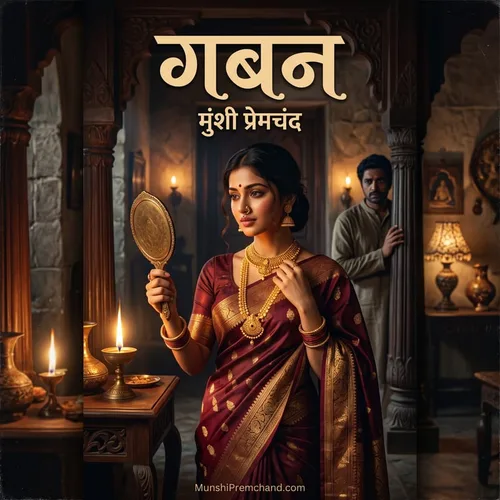
Ever since Rama had left, Ratan had become deeply worried about Jalpa. She wanted to keep helping her in one way or another. At the same time, she wanted to make sure that Jalpa never realized what she was doing. If she could discover Rama’s whereabouts by spending some money, she would gladly spend it. The sight of Jalpa’s tearful eyes tore at her heart. She wanted to see her happy. Tired of her own dark, sorrowful home, she would often go to Jalpa’s house. After laughing and talking there for an hour, her heart would become lighter. Now the same gloom had descended there as well. Coming there made her feel that she too was still part of the world—the world where there was life, longing, love, and amusement. Her own life had been offered upon the altar of a vow. She observed that vow with body and soul, but was there in the vessel placed over the Shiva-linga the same flow, movement, and music that existed in a river? Its task was to keep Shiva’s head cool, but had the river’s current, waves, and sound not disappeared from it?
There was no doubt that Ratan was acquainted with the prominent and wealthy families of the city, but where there was prestige, there was also social obligation, display, jealousy, and gossip. She had also grown tired of the company at the club. There was certainly amusement there, certainly entertainment, but there were also men’s restless desires, troubled hearts, and wild words. If Jalpa’s house lacked that grandeur, if it lacked that wealth, it also lacked that display and that jealousy. Rama was young and handsome, and perhaps even fond of pleasure, but Ratan had so far had no reason to suspect him, and with a beautiful woman like Jalpa there was little reason for such a suspicion either. Tired of the cunning and hardness of all the other shopkeepers in the marketplace of life, she had taken refuge in this little shop; but even this shop had now broken apart. Where would she now buy the necessities of life? Where would she find genuine goods?
One day she brought a gramophone and played it until evening. The next day she brought a bowl of fresh dry fruits and left it there. Whenever she came, she brought some gift. Until now she had met Jageshwari very rarely, but now she often sat beside her and chatted about this and that. Sometimes she oiled her head and braided her hair. She had also grown fond of Gopi and Vishwambhar. Sometimes she took the two boys for rides in her motorcar. As soon as they returned from school, both would come to her bungalow and play there with several other boys. Ratan took heartfelt pleasure in their crying, shouting, and quarrelling.
The lawyer had also begun to feel some affection for Rama’s family. He repeatedly asked, “Has there been any letter from Rama Babu? Have you heard anything? They are not having any difficulty, are they?”
One day Ratan came, and her face was drawn and her eyes heavy with fatigue. Jalpa asked, “Are you not feeling well today?”
Ratan said in a subdued voice, “I am all right, but I had to stay awake all night.
“He has been suffering badly since last night. His asthma attacks come in winter. The poor man spends the whole winter taking Emulsion and Sanatogen and who knows what other tonics, but the disease will not leave his throat. There is a famous physician in Calcutta. This time I intend to have him treated by that doctor. I will leave tomorrow. He does not want to take me, saying that I will suffer greatly there, but my heart does not agree. There should be someone there who can speak for him. I have been there twice, and each time I went, I fell ill myself.
“I do not like it there at all, but should I think of my own comfort or his illness? Sister, sometimes I become so weary of life that I feel like taking a little arsenic and going to sleep. Even fate cannot bear to see this much. If someone could take everything I possess and make him well, if only the root of this illness could be destroyed, I would gladly give it all.”
Jalpa said apprehensively, “Have you not called a physician here?”
“I have already seen the physicians here, sister! Doctors and practitioners—I have seen them all!”
“Then when will you return?”
“Nothing is certain. It depends on his illness. I may return in a week, or it may take a month or two. But until the root of the illness is destroyed, I will not return.”
Fate was laughing from somewhere in the heavens. Jalpa smiled inwardly. If the root of a disease had not been destroyed in youth, how could it be destroyed in old age? But it was impossible not to sympathize with such good intentions.
She said, “If God wills, he will return from there well very soon, sister!”
“You would make me very happy if you came too.”
Jalpa said sorrowfully, “How could I go, sister? I might not even be able to. All day long I remain hopeful that some news will arrive. If I went there, my heart would be even more anxious.”
“My heart tells me that Babuji is in Calcutta.”
“Then search around a little. If you find any trace of him, tell me immediately.”
“That does not need to be said, Jalpa.”
“You will keep sending letters, won’t you?”
“Yes, certainly. If not every day, I will write every other day. But you must reply too.”
Jalpa began preparing betel leaves. Ratan kept looking expectantly at her face, as though she wanted to say something but was too embarrassed to do so. When Jalpa handed her the betel, she sensed what was in her mind and said, “What is it, sister? What are you trying to say?”
Ratan—“Nothing. I have some money. Keep it with you. If I keep it, I will spend it.”
Jalpa objected with a smile, “And what if I spend it?”
Ratan said cheerfully, “It is yours, sister. It is not someone else’s.”
Jalpa remained lost in thought, looking down at the floor. She gave no answer. Ratan said reproachfully, “You have not answered me, sister. I cannot understand why you keep yourself distant from me. I want there to be not the slightest difference between you and me, but you keep running away from me. Suppose you spend a hundred or a hundred and fifty of my rupees—so what? Sisters do not keep an account of every penny.”
Jalpa said gravely, “May I say something? You will not take offense?”
“If there is something to take offense at, of course I will.”
“I am not saying it to hurt you. It may sound unpleasant. Think about it yourself: in this sisterly affection of yours, is there not some element of pity? You feel sorry for my poverty and—”
Ratan quickly covered her mouth with both hands and said, “Enough, let it be. Think whatever you like, but that feeling has never been in my heart and never could be. I know that if I were hungry, I would come to you without hesitation and say, ‘Sister, give me something to eat; I am hungry.’”
Jalpa said with the same bluntness, “You can say that now. You know that at another time you could feed me dry fruits instead of puris or bread. But God forbid that a time should ever come when there is not even a piece of bread in your house. Perhaps then you would not be able to ask so freely.”
Ratan said firmly, “Even in that condition I would not hesitate to ask you. Friendship does not consider circumstances. If that thought remains between us, understand that it is not friendship. By saying such things, you are closing your door to me. I had imagined that I would spend the remaining days of my life with you, but you are already warning me away. The unfortunate do not even receive the alms of love.”
As she said this, Ratan’s eyes filled with tears. Jalpa thought herself unfortunate, and those who suffer have the freedom to speak harsh truths. But Ratan’s inner anguish was far more piercing than her own. Jalpa still had hope that her husband would return. She was young; as soon as he returned, these bad days would be forgotten. The sun of her hopes would rise again. Her desires would once more blossom and bear fruit. The future, with all its hopes and aspirations, lay before her—vast, bright, beautiful.
But what future did Ratan have? Nothing. Emptiness. Darkness!
Jalpa wiped her eyes and stood up. She said, “Keep replying to my letters. Keep giving me the money.”
Ratan took a bundle of notes from her purse and placed it before her, but there was no happiness on her face.
Jalpa said simply, “Have you taken offense?”
Ratan said resentfully, “What can I do to you by taking offense?”
Jalpa put her arms around her neck. Her heart overflowed with affection. She had never loved Ratan so much before. Until now she had kept her distance from her; she had even felt jealous of her. Today she saw Ratan’s true nature. She really was unfortunate—and even more so than herself.
A moment later, Ratan departed with tears and a smile in her eyes.