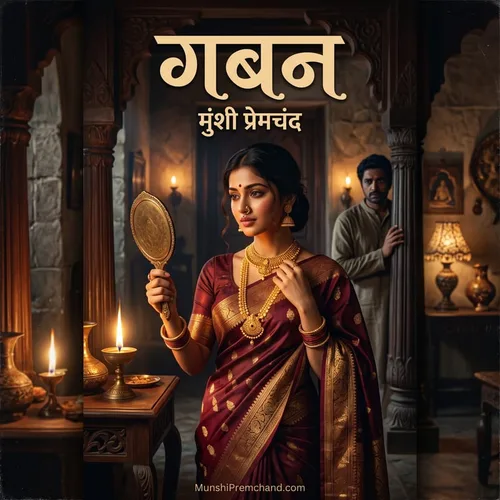
Mahashay Dayanath had gone to the wedding with as much enthusiasm as anyone could have, but he returned equally discouraged. Din Dayal had given generously, but everything they received from that side was spent on dancing, entertainments, and ceremonial expenses. Again and again he regretted his mistake: why had he spent so much money on display and spectacle? What need was there? At most people would have said, “Mahashay is very miserly.” What harm would there have been in hearing that? I had not taken a contract to entertain the villagers. This was all Ramanath's audacity. He had inflated all the expenses and ruined me. All the other demands could have been postponed for ten or five days, but the goldsmith would not agree under any circumstances. He had promised to pay him one thousand rupees on the seventh day after the wedding. The seventh day came and the goldsmith arrived; but where was the money? Dayanath was not accustomed to pleading and making excuses, yet today he tried hard to deceive him. He promised to pay all the money in installments over six months. Then he came again after three months; but the goldsmith was an experienced man and would not leave until Dayanath promised to return, on the third day, the items corresponding to the unpaid amount. Even that promise was an act of his generosity. The third day had now arrived, and Dayanath could think of no way to save face. An ordinary man might not have been so anxious; he would have put off the moneylender for months with excuses. But Dayanath was inexperienced in such matters.
Jageshwari came and said, “How long has the food been getting cold? Come and eat.”
Dayanath raised his head as though hundreds of maunds were loaded upon it. He said, “You people go and eat. I have no appetite.”
Jageshwari: “Why have you no appetite? You didn't eat anything last night either! Will the moneylender's money be paid off by giving up food and water?”
Dayanath: “I am wondering what answer I will give him today. I have become badly trapped by this marriage. Will the daughter-in-law return some jewelry?”
Jageshwari: “You have already heard what she is like, and still you hope for that? She has taken a vow that until the Chandrahār is made, she will not wear a single piece of jewelry. She has locked all the jewelry in a chest. She is wearing only that one imitation-crystal necklace around her neck. I have seen many daughters-in-law, but never one like this. And how bad it would look to take jewelry away from a daughter-in-law who arrived only yesterday.”
Irritated, Dayanath said, “You are rubbing salt into my wounds. If it feels so bad, bring out a thousand rupees and give them to me so I can pay the moneylender. Will you give them? I feel bad about it myself; but what is the remedy? How will I get out of this?”
Jageshwari: “Did you marry off your son, or was it a joke? Everyone takes loans for weddings; you have done nothing new. Who takes loans for food and clothing? Shouldn't there be some reward for being a righteous man? Satyadev is in the same position as you, yet he built a solid house and bought a landlord's estate. At his daughter's wedding he must have spent at least five thousand.”
Dayanath: “And then both his sons went away too!”
Jageshwari: “Death and life are the way of the world. Those who take loans die, and those who do not take them also die. If you wish, you can repay all the money within six months.”
Dayanath frowned. “What I have never done in my whole life, I cannot begin doing at the end. Tell the daughter-in-law plainly. What need is there to hide it from her, and how long can it remain hidden? If not today, then tomorrow she will know everything. If she returns just three or four pieces, the matter will be settled. Ask her once.”
Jageshwari said irritably, “You ask her yourself. I cannot say it.”
Suddenly Ramanath came in from outside carrying a tennis racket. He wore a white tennis shirt, white trousers, and canvas shoes. Against his fair complexion and handsome features, this outfit gave him the air of a wealthy young man. He carried jasmine garlands in a handkerchief, and their fragrance filled the air. He was trying to go upstairs without being noticed by his parents when Jageshwari stopped him. “He is the one who sowed all these thorns, so why don't you consult him?” Then to Rama she said, “You squandered twelve or thirteen hundred rupees on dancing and entertainments. Tell us what answer we are to give the goldsmith. With great difficulty he has agreed to take back some jewelry; but who will ask the daughter-in-law for hers? This is all your doing.”
Ramanath deflected the accusation. “What did I spend? Father did whatever was spent. Yes, I did whatever I was told to do.”
There was much truth in Ramanath's statement. If Dayanath had not wanted it, what could Rama have done? Everything had happened with his permission. But assigning blame would solve nothing. Dayanath said, “I am not blaming you, brother. I did it; but somehow this trouble has to be lifted from our heads. The goldsmith is demanding payment. His man will come tomorrow. What answer will we give him? To my mind, the only remedy is to return jewelry worth that amount. Even in returning the jewelry he will make trouble; but for the sake of ten or twenty rupees of profit he may agree to take it back. What do you advise?”
Ramanath said shyly, “What advice can I give on this matter? But I can tell you that she will not gladly accept this proposal. Mother knows how upset she was when the Chandrahār did not come with the wedding gifts. She has vowed not to wear any jewelry until the Chandrahār is made.”
Jageshwari, pleased that her side had been supported, said, “That is exactly what I have been telling him.”
Ramanath: “There will be crying and lamentation, and along with it the family's respectability will be exposed.”
Dayanath frowned. “There is no need to hide the truth from her. The sooner she understands our actual circumstances, the better.”
Ramanath had bragged extensively to Jalpa, as young men often do. He had boasted that there was a landed estate bringing in several thousand rupees in profit, and that there was money in the bank earning interest. If he now spoke of jewelry, Jalpa would take him for a complete liar. He said, “The veil will be lifted one day anyway, but if we lift it so soon, the result will be that she will begin to think of us as lowly people. Perhaps she will even write to her family. There will be disgrace all around.”
Dayanath: “We even told Din Dayal that we were millionaires.”
Ramanath: “But you never told him that we had borrowed the jewelry and would return it within a few days. After all, was this whole performance staged merely to establish our standing, or was there some other reason?”
Dayanath: “Then we will have to ask for it under some other pretext. We cannot manage without asking. Tomorrow we will either have to pay the money or return the jewelry. There is no other way.”
Ramanath gave no answer. Jageshwari said, “What other excuse can we make? If we say that we need to lend it to someone for a ceremony, perhaps she will not give it. Even if she does, how will we return it within two or four days?”
Dayanath thought of a solution. “What if we give her plated jewelry in place of those ornaments?” But he immediately realized how weak the idea was and himself objected to it: “Yes, later, when the plating wears off, we will have to be ashamed. My intelligence is failing me. I think we should simply explain the whole situation to her. It will certainly hurt her for a while, but the road ahead will be clear.”
It was possible, as Dayanath thought, that Jalpa would cry and then become calm; but this was disastrous for Rama. He would no longer be able to face her. If she asked, “What happened to your estate? What happened to the money in the bank?” what would he say? He said bitterly, “Can't we put it off? If you had wanted to pay, you could easily have raised twelve or thirteen hundred rupees by now.”
Dayanath asked, “How?”
Ramanath: “The same way your brothers do!”
Dayanath: “I cannot do that.”
The three sat silently for some time. Dayanath announced his decision. Jageshwari and Rama did not agree with it. The burden of solving this knot therefore fell upon the two of them. Jageshwari too had in a way made up her mind. Dayanath would have to break his rule, even if only after being driven to it. What kind of principle was it to keep singing the praises of one's rules while a crisis hung over one's head? Ramanath was badly trapped. He knew very well that his father would not do today what he had never done before. He would have no hesitation in asking Jalpa for the jewelry, and that was precisely what Rama did not want. He regretted having bragged to Jalpa. Now the entire burden of preserving his reputation rested upon him. Jalpa's incomparable beauty had cast its spell over him on the very first day. He had been unable to contain his pride in his good fortune. Was this house worthy of such an extraordinary beauty? Jalpa's father earned five rupees as a servant, but Jalpa had never swept her own house. She had never hemmed her own sari, never made her own bed, and had not even stitched the fold of her own sari. Dayanath earned fifty rupees, yet here there was only a maid to wash dishes and tend the kitchen. All other work had to be done by the family itself. Jalpa knew nothing of the difference between city and countryside. She had never had an opportunity to live in a city. Several times she had asked her husband and mother-in-law in astonishment, “Is there no servant here?” At Jalpa's home there had been no shortage of milk, curd, or ghee. Here even the children did not have enough. To make up for all these deficiencies, all Ramanath had were his sweet, grand words. The rent of the house was five rupees; Ramanath had said fifteen. The boys' education cost barely ten rupees; Ramanath had said forty. At the time he had not the slightest suspicion that one day the whole truth would come out. Falsehood has no foresight; but who knew that the day would come so soon? If he had not bragged, he too, like Jageshwari, could have left the entire burden to Dayanath and remained carefree. Now he was trapped in the net he himself had woven. How could he get out?
He thought of many solutions, but there was not one that would not entangle him in further complications, sinking him deeper into a swamp. Suddenly a scheme occurred to him. His heart leapt, but he could not bring himself to speak of it. Oh! What degradation! What deceit, what cruelty! His conscience condemned him for contemplating such trickery against his beloved. If someone had given him a thousand rupees at that moment, he would have become that person's slave for life.
Dayanath asked, “Have you thought of anything?”
“I haven't thought of anything.”
“We have to think of some solution.”
“You think of it. I can't think of anything.”
“Why don't you ask her for two or three pieces of jewelry? If you want, you can get them; it is difficult for us.”
“I am ashamed.”
“You are a strange man. You will neither ask her yourself nor let me ask her, so how is this boat supposed to move? I have told you a thousand times not to expect anything from me. I cannot spend my final days in jail. I don't understand what there is to be ashamed of. In whose life do such occasions never arise? Ask your mother yourself.”
Jageshwari agreed. “I couldn't bear to see my own man sitting worried while I sat wearing jewelry. Otherwise, would I not have jewelry today? One piece after another went away. The wedding gifts had been worth no less than five thousand rupees, but within five years everything was gone. Since then I have not even had the chance to have a single ring made.”
Dayanath said firmly, “This is not the time to be ashamed. You will have to ask for them.”
Ramanath said hesitantly, “I cannot ask for them. Tell me to bring them away.”
As he said this, his eyes filled with tears from shame, anguish, and awareness of his own degradation.
Dayanath stared at him in astonishment. “You will bring them away secretly from her?”
Ramanath said sharply, “What else do you think I mean?”
Dayanath put his hand to his forehead and, after a moment, said in a wounded voice, “No, I will not let you do that. I have never cheated anyone, and I never will. And that too with my daughter-in-law! Shame, shame! Why resort to deception for something that can be managed straightforwardly? If she happens to see you, what do you think she will think of you in her heart? Asking is far better.”
Ramanath: “What does it matter to you? You can take the things from me. But if you knew this situation would arise, why did you need to take so much jewelry? You brought unnecessary trouble upon yourself. It would have been a million times better to take only as much as could easily be carried. What is the use of eating so much that your stomach begins to hurt? I thought you would have found some solution. How was I to know you would dump this basket of troubles on my head? Otherwise I would never have allowed you to take those things.”
Dayanath said somewhat shamefacedly, “Even after all that, there was such an uproar merely because the Chandrahār was missing.”
Ramanath: “That uproar could have harmed us. If there was an uproar even after all this, then our purpose was not achieved either. We were disgraced on one side, and this calamity landed on our heads on the other. I do not want to show that we are so destitute. Once the theft has occurred, we have no choice but to bear it.”
Dayanath fell silent. In his agitation Rama had spoken very plainly to him, and he listened quietly. At last, when he could bear no more, he got up and went to the library. This was his daily routine. Until he had read two or four periodicals, he could not digest his food. Once inside that safe fortress, he was free from the worries and obstacles of the household.
Rama also got up from there, but instead of going to Jalpa he went to his own room. He did not have a separate room; there was only one men's room, where Dayanath chatted with his friends, both boys studied, and Rama played chess with his companions. When Rama entered, the two boys were playing cards. Gopi was thirteen, Vishwambhar nine. Both trembled before Rama. Rama himself played plenty of cards and chess, but seeing his brothers play made his hands itch to punish them. He could spend the whole day wandering about himself, but heaven forbid that his brothers should go out anywhere. Dayanath himself never beat the boys. Whenever he had an opportunity, he played with them. Seeing them fly kites awakened his childlike nature. He would engage them in a few kite duels. Sometimes he even played gilli-danda with the children. That was why the boys feared Rama as much as they loved their father.
The moment they saw Rama, the boys hid the cards under the mat and began studying. They bowed their heads and waited for a slap, but Ramanath did not slap them. Sitting on a stool, he said to Gopinath, “You have seen the cannabis shop on the corner, haven't you?”
Gopinath answered happily, “Yes, of course I have!”
“Go and get four annas' worth of majun. Run there. And bring half a seer of sweets from the confectioner's shop too. Here, take this rupee.”
In about fifteen minutes Rama returned with both things and headed toward Jalpa's room.