When Rama was leaving the office in the evening, Ramesh Babu came running up and reminded him to bring the money the next day. Rama felt irritated inwardly. “You are determined to pose as the tail of some great paragon of honesty! What a hypocrite! If the need were your own, you would go around flattering everyone; but when it is my affair, you suddenly become an idealist. These are only teeth for show; even when you are dying, your life will not leave your body quickly!”
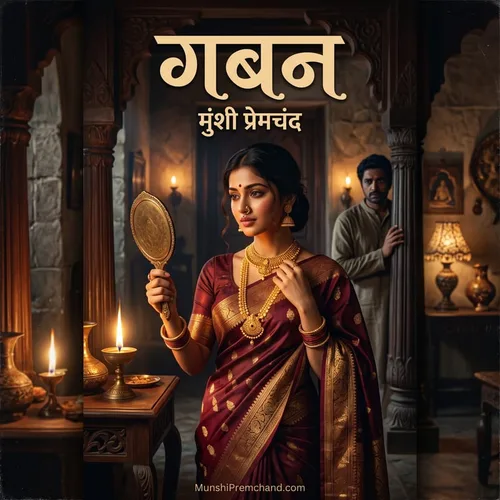
After walking some distance, he thought, “Let me go to Ratan once more.” But there was no one else from whom he could hope to get help. When he reached her bungalow, she was sitting on a circular platform in the garden. Beside her sat a Gujarati jeweler, taking beautiful ornaments out of a box one after another and showing them to her. Seeing Rama, she was delighted.
“Come, Babu Sahib, come and see what lovely things Sethji has brought. Look how beautiful this is; outside they say it costs a hundred rupees.”
Rama took the necklace in his hand, looked at it, and said, “Yes, it does seem to be a good piece.”
Ratan—“He is asking far too much.”
Jeweler—“Baiji, if anyone can bring a necklace like this for two thousand, I will pay whatever penalty you name. My cost alone has come to twelve hundred.”
Rama smiled and said, “Don’t say that, Sethji, or you will have to pay the penalty.”
Jeweler—“Babu Sahib, you could get a necklace even for a hundred rupees, and exactly like this one. In fact, one even better in sparkle and brilliance. But one must know how to judge. I myself did not even try to bargain with you. What bargaining can there be with you? We are not merely petty traders, Babu Sahib; we judge a man’s temperament. What a grand, aristocratic taste Madam has shown—wonderful!”
Ratan looked at the necklace with greedy eyes and said, “At least reduce the price a little, Sethji. You seem to have sworn never to lower it!”
Jeweler—“Don’t even mention a reduction, Your Ladyship. This piece is a gift for you.”
Ratan—“All right, then tell me one thing: what is the least you will take for it?”
The jeweler said, somewhat vexed, “Twelve hundred rupees and twelve cowries, Your Ladyship. I swear to you, I can sell it for fifteen hundred in this very city. And I will even tell you who bought it.”
As he said this, the jeweler took out the case in which the necklace was kept. Ratan became convinced that he would not reduce the price at all. Restless like a child, she said, “You are packing it away so quickly that the necklace will catch the evil eye.”
Jeweler—“What can I do, Your Ladyship? When a thing is not appreciated in such a court, one naturally feels hurt.”
Ratan went into the room, called Rama, and said, “Do you think he will come down any further?”
Ramanath—“In my opinion, the piece is not worth more than a thousand.”
Ratan—“Oh, perhaps. I have only six hundred rupees with me. If you can arrange four hundred rupees, I will buy it. He is going to Kashi on this very trip. He will not agree to sell it on credit. The lawyer has gone to some gathering and will not return before nine or ten. I will return your money tomorrow.”
Rama said with great hesitation, “Believe me, I am completely empty-handed. I came to ask you for money. I am in great need. Give me that money, and I will bring you a good necklace from here. I am sure a necklace like this can be found for seven or eight hundred.”
Ratan—“Come now, I am not going to be taken in by your words. In six months you could not even have a bangle made; now how will you bring a necklace? I have already looked at several shops here; a piece like this may not turn up anywhere. And even if one does, I would have to pay one and a half times the price.”
Ramanath—“Then why not ask him to come tomorrow? If he is eager to sell it, he will stay.”
Ratan—“All right, ask him and see what he says.”
They both came outside the room. Rama said to the jeweler, “Why don’t you come tomorrow at eight?”
Jeweler—“No, Your Ladyship. Tomorrow I have to meet two or three wealthy gentlemen in Kashi. If I do not leave today, I shall suffer a great loss.”
Ratan—“I have six hundred rupees with me at this moment. Leave the necklace with me and take the rest of the money when you return from Kashi.”
Jeweler—“There would be no objection to the money; I could wait a month or two. But what certainty is there for people like us who live away from home? We are here today and somewhere else tomorrow. Who knows when I will come here again? Give me a thousand right now and give me the remaining two hundred later.”
Ramanath—“Then there will be no deal.”
Jeweler—“That is for you to decide; but I will tell you this much: you will not find merchandise like this again.”
Ramanath—“If there is money, there will be plenty of merchandise.”
Jeweler—“Sometimes even when one has the money, good merchandise cannot be found.”
Saying this, the jeweler put the necklace back into its case and began packing up his box as though he would not stay another moment.
Every nerve in Ratan’s body was tense, as though a prisoner were standing there waiting to hear the verdict on his fate. All her tenderness, all the affection within that tenderness, all the impatience, yearning, and effort within that affection were becoming concentrated upon that necklace, as though her very life had hidden itself in its price, as though the accumulated desire of all her births and lifetimes were hovering over that necklace. Seeing the jeweler close the box, she began to writhe like a fish without water. At one moment she opened the box, at another she opened a drawer; but nowhere could she find the money.
Suddenly, hearing the sound of a motorcar, Ratan looked toward the gate. The lawyer was coming. He stopped the motorcar in front of the veranda and walked toward the platform. Ratan came down from the platform and said, “You said you would come at nine?”
The lawyer replied, “There wasn’t even a quorum there. What was the point of sitting around? No one wants to work sincerely; everyone wants to earn a name for free. Is this some jeweler?”
The jeweler stood up and saluted.
The lawyer said to Ratan, “Well, have you liked anything?”
Ratan—“Yes, I have taken a liking to a necklace. He is asking twelve hundred rupees.”
The lawyer—“That’s all! Pick out something else too. You have nothing good for your head.”
Ratan—“I will take this necklace now. Who wears things on the head these days?”
The lawyer—“Take it and keep it. If it is there, you may wear it sometime. Otherwise, if you see someone else wearing one someday, you will say, ‘If I had one, I would wear it too.’”
The lawyer did not love Ratan with the love of a husband; his feeling for her was more like the affection of a father. Just as an affectionate father buys toys at a fair by repeatedly asking his children what they want, he too bought things for Ratan by asking her what she liked. All she had to do was say the word. What else did he have, besides wealth, with which to make her happy? He needed an anchor in his life—an embodied anchor, something with whose support he could stand in the struggle of life in his worn-out condition, just as a worshipper needs an idol. Without an idol, upon whom could he place flowers, whom could he bathe with Ganges water, whom could he offer delicious food? In the same way, the lawyer too needed a wife. For him, Ratan was more than a mere imagined idea of companionship; she was the living presence that soothed his spiritual thirst. Perhaps without Ratan his life would have been as empty as a face without eyes.
Ratan took the necklace out of its case, showed it to the lawyer, and said, “He is asking twelve hundred rupees for this.”
In the lawyer’s eyes, the value of money lay in the pleasure it could provide. If Ratan liked the necklace, he did not care how much he would have to pay for it. He took out his checkbook, looked at the jeweler, and asked, “Tell me the truth—how much should I write? If there is any discrepancy, you will answer for it.”
The jeweler examined the necklace from every side and, hesitating, said, “Make it eleven hundred and fifty.”
The lawyer wrote the check and handed it to him, and the jeweler saluted and departed.
At that moment Ratan’s face was radiant like the natural beauty of spring. Such pride, such delight had never appeared on her face before. It was as though she had acquired all the wealth in the world.
She went inside with the necklace hanging around her neck. The lawyer’s habits and ideas were a strange mixture of old and new customs. Even now he would not eat food cooked by just any Brahmin. Today Ratan had gone to prepare all sorts of fine dishes for him; how could she express her gratitude to him?
Rama sat for some time listening to the lawyer’s praise of Europe, but at last, disappointed, he left.