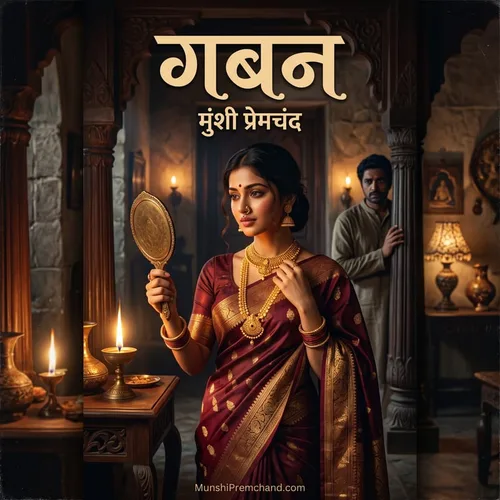
Gangu's shop was famous in the jewellers' quarter. Though Gangu was a Brahmin, he was extremely skilled at business. His shop was crowded with customers every day. His devotion to his work inspired confidence among customers. At other shops there was always a fear of being cheated; there was no such deception here. The moment Gangu saw Rama, he smiled and said, “Come, Babuji, please come upstairs. You have been very kind. Munimji, have some betel brought for him. What is your command, Babuji? It seems you are angry with me. You never come. Show a little mercy to the poor from time to time.”
Gangu's courtesy gave Rama courage. If he had not invited him with such insistence, perhaps Rama would not have had the courage to enter the shop. He had not yet tested his own credit. Entering the shop, he said, “What chance do poor fellows like us have here, Maharaj? Even if there were something in my pocket...”
Gangu—“What are you saying, sir? This is your shop. Take whatever you need; the payment can be settled later. We know how to judge people, Babu Sahib. It is not like that. We are fortunate that you have come to our shop. Shall I show you some jeweled pieces? A bangle, a necklace? Some goods from Delhi have just arrived.”
Ramanath—“Show me a necklace at a modest price.”
Gangu—“Something around seven or eight hundred?”
Ramanath—“Oh no, at most four hundred.”
Gangu—“I will show you both. Take whichever you like. There is no trickery of any kind here, Babu Sahib. Do not worry about that at all. Whether it is a five-year-old child or a hundred-year-old man, we treat everyone the same. We have to show our faces to the Master one day, after all.”
The chest was brought forward, and Gangu began taking out necklaces and showing them. Rama's eyes widened and his heart began to leap. What workmanship! What beautiful arrangement of gems! What brilliance! Their sparkle outshone the lamp. Rama had decided that he would not borrow more than a hundred rupees, but the four-hundred-rupee necklace did not look good enough to him. And he had only three hundred rupees in his pocket. He thought: What good would it do to take this necklace if Jalpa did not like it? I should take something that makes her tremble with delight the moment she sees it. How beautiful this jeweled necklace would look around her neck! The necklace seemed to draw his heart toward it with a thousand gem-bright eyes. He gazed at it, overwhelmed, but did not have the courage to say anything. If Gangu refused to extend three hundred rupees of credit, how humiliated he would be! Reading the doubt in his mind, Gangu said, “This is the piece worthy of you, Babuji. Put it in a dark room and the room itself will become bright.”
Ramanath—“This is the one I like too; but understand that I have three hundred rupees.”
A blush of embarrassment spread across Rama's face. With his heart pounding, he looked at Gangu.
Gangu said sincerely, “Babu Sahib, don't even mention money. Tell me and I will send goods worth ten thousand rupees with you. The shop is yours; what is the difficulty? If you wish, I can show you another piece or two. A shishphool has just been made. It looks exactly like a rose in bloom. It will delight your heart to see it. Munimji, show the shishphool. And the price is not particularly high either; I will give it to you for two hundred and fifty.”
Rama smiled and said, “Maharaj, don't talk so sweetly only to shave me with a hidden razor. I am completely inexperienced in matters of jewelry.”
Gangu—“Don't say that, Babuji. Take the piece and have it shown in the market. If anyone offers you less than two hundred and fifty rupees, I will give it to you for free.”
The shishphool arrived. It truly was a rose, with diamond buds shining like drops of dew upon it. Rama stared at it as though some supernatural object had appeared before him.
Gangu—“Babuji, two hundred and fifty rupees is merely a reward for the craftsman's workmanship. This is a fine piece.”
Ramanath—“Yes, it is very beautiful; but, brother, don't start demanding payment tomorrow itself. I will pay you as quickly as I can.”
Gangu placed both pieces in two beautiful velvet cases and handed them to Rama. He then had Rama's name entered by the munim, offered him betel, and bid him farewell.
Rama's happiness at that moment knew no bounds, but it was not pure happiness; a doubt was mixed into it. It was not the happiness of a child who asks his mother for money and buys sweets. It was the happiness of a child who has stolen money to buy them. The sweets taste sweet, but his heart keeps trembling with the fear that he may be beaten when he gets home. He was not particularly worried about repaying six hundred and fifty rupees; if he found the opportunity, he could repay it within six months. His only fear was that Babuji would hear of it and certainly be angry. But as he moved forward, his eagerness to see Jalpa adorned with the jewelry gradually overcame that fear.
In his haste to reach home, he left the main road and entered a lane. Dense darkness had settled there. Clouds had already been gathering when he left home. No sooner had he entered the lane than drops of rain struck his head like pellets. Before he could open his umbrella, he was drenched. He feared that in the darkness someone might come and snatch both pieces from him; in the roaring rain, no one would hear a cry. People could even be murdered in dark lanes. He began to regret coming this way. What disaster would have occurred if he had arrived two or four minutes late? His untimely anxiety had already disturbed his dreams of happiness. Somehow the lane ended and he reached the road. He saw lanterns. That day he truly experienced how much confidence the light of day and lamps can inspire.
When he reached home, Dayanath was sitting and smoking his hookah. Rama did not enter that room. He wanted to slip inside without being noticed, but Dayanath called out, “Where have you been at this hour?”
Rama did not answer him. If he started giving a lecture, he would be delayed for hours. He went straight inside. Jalpa was standing at the doorway waiting for him. She immediately took the umbrella from his hand and said, “You are completely soaked. Why didn't you stop somewhere?”
Ramanath—“Who knows what rain will do? It might keep falling all night.”
Saying this, Rama went upstairs. He had thought Jalpa would follow him, but she remained downstairs talking with her younger brothers-in-law, as though she had completely forgotten about the jewelry—as though she had no idea that Rama had just returned from the jewellers' market.
Rama changed his clothes and came downstairs in irritation. At that very moment Dayanath came to eat. Everyone sat down for the meal. Jalpa had controlled herself, but in this state of anticipation she could not eat anything. When she went upstairs, Rama was lying on the cot. Seeing her, he said playfully, “Going to the jewellers' market today was a complete waste. The necklace wasn't ready at all. I have ordered it to be made.”
The face that had been glowing with excitement became dull. Jalpa said, “I knew that already. It will take at least five or six months to make.”
Ramanath—“No, he swore he would make it very soon.”
Jalpa—“Oh, let him give it whenever he wants.”
The highest point of anticipation is disappointment. Jalpa turned away and was about to lie down when Rama burst into loud laughter. Jalpa was startled. She realized that Rama had been teasing her. Smiling, she said, “You really are mischievous. What did you bring?”
Ramanath—“How did I fool you?”
Jalpa—“That is simply a man's habit. What new thing have you done?”
Jalpa was overwhelmed with joy when she saw the two pieces of jewelry. Waves of happiness seemed to rise in her heart. She wanted to conceal her feelings so that Rama would not think her shallow, but every part of her face betrayed her. Her smiling eyes, glowing cheeks, and radiant lips gave her away. She put the necklace around her neck, adorned her hair with the shishphool, and, intoxicated with happiness, said, “I bless you. May God fulfill all your wishes.”
Today Jalpa's longing had been fulfilled—the longing that since childhood had been a dream of her imagination and a playground for her hopes. Today that desire had been satisfied. If Manki had been there, she would have shown her the necklace first and said, “May your necklace be a blessing to you.”
Rama was intoxicated with pride. Today he felt that his life had been successful. For the first time in his life, he experienced the joy of victory.
Jalpa asked, “Shall I go downstairs and show it to Mother?”
Rama said modestly, “Why would you go and show Mother? These are not such great things.”
Jalpa—“Now I will not ask you for anything else for a whole year. Only after paying for these will the burden on my heart be lightened.”
Rama said proudly, “Why worry about the money? How much can it be?”
Jalpa—“Let me show them to Mother and see what she says.”
Ramanath—“But don't tell her that I brought them on credit.”
Jalpa ran downstairs as though she had discovered a treasure.
It was already past midnight. Rama was sleeping peacefully in the intoxication of happiness. Jalpa came onto the roof and looked once toward the sky. Pure moonlight was scattered everywhere—the moonlight of Kartik, in which there is the peace of music, the sweetness of peace, and the intoxication of sweetness.
Jalpa returned to the room, opened her jewelry box, and took out the glass moon-necklace that she had once considered herself blessed to wear. But now, before this new moon-necklace, its brilliance had faded just as the light of the stars fades before clear moonlight. She broke the imitation necklace apart and threw its beads down into the lane, just as a worshipper, after the worship is over, immerses clay idols in water.