You have sworn to sit beside me. Whenever I see you, you remain withdrawn. If you loved me, you would trust me too. How can there be love without trust? You cannot love someone to whom you cannot tell even your worst thoughts. Yes, you can amuse yourself with her, you can indulge in pleasure with her. Just as someone goes to a prostitute. People go to a prostitute only to enjoy themselves, no one goes to her to confide their innermost thoughts. That is our condition too. Tell me, is it or is it not? Why do you hide your eyes? Do you think I do not see that you come from outside somewhat frightened? While talking, I see that your mind is somewhere else. Even while eating, I see that you take no pleasure. Whether the lentils are thick or thin, whether there is too little or too much vegetable, whether there is enough rice or whether it is properly cooked. Your eyes do not turn toward any of this. You eat as though performing forced labor and hurry away. Do I not see all this? Should I not see it! I am a pleasure-seeking woman, that is how you see me. My work is–to amuse myself, indulge in pleasure, enjoy myself. What do I care about your worries! But God did not give me such a heart. What can I do. I understand, when I have to spend my life anyway, when I am merely an object for your entertainment, then why should I put my life in danger?
Jalpa had never spoken to Rama with complete openness before. He had never even guessed that she was so thoughtful. In truth, he regarded her merely as a woman, just as other men regarded their wives. He was enchanted by her youth. He had never even tried to see the nature of her soul. Perhaps he thought there was no soul there at all. If she had not been a treasure of beauty and grace, perhaps he would not even have liked to speak to her. All his attraction, all his attachment, was centered only on her beauty. He thought that Jalpa was happy with nothing but this. He did not want to burden her with the weight of his worries; but today he learned that Jalpa was just as thoughtful as he himself was. This was a very good opportunity to tell her all about his mental anguish, but alas, his hesitation! It had once again sealed his lips. How could he now say the things he had hidden for so long? Would doing so not amount to admitting the accusations Jalpa had made against him? Yes, today the veil of illusion had been lifted from his eyes. He realized that trying to build love upon sensual pleasure had been his own ignorance.
Rama fell asleep while occupied with these thoughts; it was already past midnight. He had gone to sleep because he intended to get up very early, but when he awoke, rays of sunlight were entering the room and rousing him. He got up at once and, without even washing his face and hands, put on his clothes and prepared to leave. He wanted to go to Ramesh Babu. Now he would have to tell him the whole story. Once he understood the full situation, he would surely be willing to provide some kind of help.
Jalpa was preparing to cook at that time. Seeing Rama leaving in this manner, she looked at him questioningly. Anxiety, fear, restlessness, and anguish seemed to be staring from his face. For a moment she became almost senseless. Holding a knife in one hand and a bitter gourd in the other, she stared toward the doorway. What was the matter? Why did he not tell her anything? Even if she could do nothing else, she could at least sympathize with him. She felt like calling out and asking what was wrong. She even got up and came to the doorway; but Rama had already gone far down the road. She saw him walking very fast, as though he had gone mad. He did not look to the right or the left. With his head bowed, bumping into passersby and paying no attention to carts, he hurried away. At last she returned and began cutting the vegetables again; but her mind remained fixed in that direction. What was the matter? Why did he hide so much from her?
When Rama reached Ramesh’s house, it was eight o’clock. Babu Sahib was sitting on the cot performing his evening prayers. Seeing him, he gestured for him to sit. About half an hour later, when he had finished his prayers, he said, “You haven’t even washed your face and hands yet? This slovenliness is what I dislike. Whether you do anything else or not, at least keep your body clean. What happened? Have you arranged the money?”
Ramanath—“It is because of this very worry that I have come to you.”
Ramesh—“You are a strange man. Why are you ashamed to tell your father? The worst that will happen is that he will taunt you, but you will be freed from this crisis. Tell him everything plainly. Such accidents happen often. What is there to be afraid of? If you cannot tell him, I will go and tell him myself.”
Ramanath—“If I were going to tell him, I would have done so by now. Can’t you arrange something?”
Ramesh—“Why shouldn’t I be able to? But I do not want to. I cannot have any sympathy for a man like this. If you can tell me this, why can’t you tell him? Take my advice. Go and tell him. If he does not give you the money, then come to me.”
Rama no longer had the courage to say anything. People could be so hard even when they had become so close. He got up and left; but he could think of nothing. At that moment Rama was like a drop of water falling from the sky onto a heated surface. He would walk ten steps quickly, then stop after thinking of something and turn back ten or fifteen steps. Sometimes he would enter one lane, sometimes another.
Suddenly an idea occurred to him: why not write a letter to Jalpa and tell her all his difficulties? He could not say anything with his mouth; but he felt no difficulty writing it with a pen. He would write the letter and give it to Jalpa, then sit in the outer room. What could be simpler? He rushed home and immediately wrote a letter.
“Beloved, what can I say about the calamity in which I am caught? If I cannot arrange three hundred rupees within an hour, handcuffs will be put on my hands. I tried very hard to borrow the money from someone, but I could not get it anywhere. If you could give me one or two of your ornaments, I could pawn them and manage for the time being. As soon as the money comes, I will redeem them. If I had not been forced into this situation, I would not have troubled you. For God’s sake, do not be angry with me. I will redeem them very soon…”
The letter was not yet finished when Ramesh Babu came in smiling and sat down. “Did you tell him?”
Rama lowered his head and said, “I haven’t had the opportunity yet.”
Ramesh—“So will you get the opportunity in two or four days? I am afraid that today too you may go away empty-handed, and then there will be real trouble!”
Ramanath—“Once I have decided to ask him, what is there to worry about now?”
Ramesh—“If you get the opportunity today, go to Ratan. That day I told you so emphatically, but it seems you have forgotten.”
Ramanath—“I haven’t forgotten, but I am ashamed to ask her.”
Ramesh—“You are ashamed even to ask your own father? If there were not this hesitation among our own people, why would we be in this state today?”
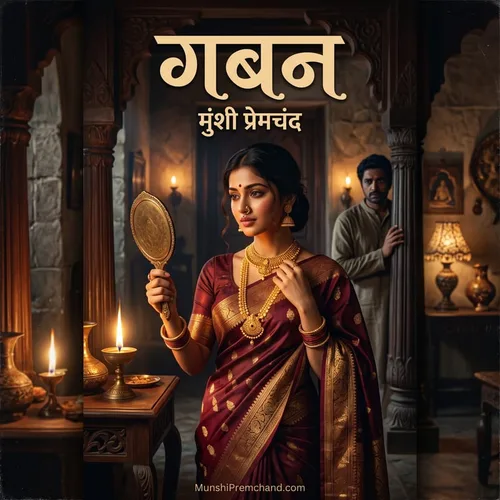
When Ramesh Babu left, Rama put the letter into his pocket and went into the house, intending to give it to Jalpa. Jalpa was getting ready to go to a certain Mahima’s house. She had received an invitation a little while earlier. She had put on her most beautiful sari. Jeweled bangles adorned her hands, and a necklace hung around her neck. With a mirror placed before her, she was putting earrings into her ears. Seeing Rama, she said, “Where did you go so early this morning? You did not even wash your hands and face. You are outside all day anyway; at least stay home in the mornings and evenings. When you are not here, the house feels so empty. I was just thinking, if I had to go to my parents’ home, should I go or not? I would not feel at all at ease there.”
Ramanath—“And you are sitting ready to go somewhere.”
Jalpa—“The merchant’s wife has sent for me. I will leave by noon.”
At that moment Rama was like a hunter who, seeing a doe playing joyfully with her fawns, lowers the gun that was ready on his shoulder and becomes absorbed in watching that scene of maternal affection and love.
Seeing him staring fixedly at her, Jalpa smiled and said, “Look, don’t cast the evil eye on me. I am very afraid of your eyes.”
In a single leap Rama passed from the real world into the world of imagination and poetry. At such a moment, when every part of Jalpa’s being was dancing with joy, could he hand her the letter and crush her happy imaginings? What heartless hunter would put a knife to the neck of a chirping bird? What tasteless man would pluck a morning flower and trample it beneath his feet? Rama was not so heartless, so devoid of feeling. He could not inflict such a great blow upon Jalpa. No matter what calamity might fall upon his head, no matter how much disgrace he might suffer, even if his very life were crushed, he could not be so cruel. With affection he said, “I will not cast the evil eye on you; yes, I will hold you close to my heart.” In this one sentence all his worries and all his difficulties were dissolved. He sacrificed himself upon the altar of affection and hesitation. Compared with this humiliation, all the other sufferings of life were insignificant. At that moment he was like a child who, unwilling to endure the momentary pain of having an abscess lanced, forgets even the fear that it may burst, become an ulcer, keep him bedridden for years, and perhaps ultimately cause his death.
When Jalpa began to go downstairs, Rama suddenly drew her close and embraced her, squeezing her as though he would never again have this good fortune. Who knew whether this might be his last embrace? His arms seemed to cling to Jalpa like thousands of threads of silk woven together. It was as though a dying miser had clenched the key to his treasure in his fist, and every moment his grip grew tighter. Would his life not leave him if someone forcibly opened that fist?
Suddenly Jalpa said, “Give me some money; I may need some there.”
Rama started. “Money! I don’t have any money at the moment.”
Jalpa—“You do, you do. You are making excuses to me. Just give me two rupees; I do not want any more.”
Saying this, she put her hand into Rama’s pocket and pulled out, along with some coins, the letter.
Rama reached out and tried to snatch the letter from Jalpa’s hand, saying, “Give me the paper; it is an official document.”
Jalpa—“Tell me whose letter it is.”
Jalpa opened the folded note and said, “This is an official document! Liar! It is written by you yourself…”
Ramanath—“Give it to me. Why are you troubling me?”
Rama tried to snatch the paper away, but Jalpa pulled her hand back and said, “I will not give it without reading it. I have told you, if you insist too much, I will tear it up.”
Ramanath—“All right, tear it up.”
Jalpa—“Then I will certainly read it.”
She stepped two paces back, opened the letter again, and began to read.
Rama did not try to snatch the paper from her again. It seemed to him as though the sky had split open, as though some terrible creature were advancing to devour him. He came rushing down and went out of the house. Where could he hide his face? Where could he hide so that no one could see him? His condition was like that of a naked man. Though he was clothed from head to toe, he was naked. Ah! The entire veil had been torn away! All his deception had been exposed! All the things he had tried for so long to conceal, all the hardships he had endured to keep them secret, seemed today to have blackened his face. He could not bear to see his own disgrace with his own eyes. It would be easier to die than to hear Jalpa’s sobs, his father’s reproaches, and the whispers of the neighbors. Once no one remained in the world, what would he care what anyone said about him? Alas! His ruin was coming upon him for the sake of only three hundred rupees; but if this was God’s will, what could he do? What kind of life was it to live after falling in the eyes of those he loved?
How low, how deceitful, how cunning, how boastful must Jalpa think him now. Could he show her his face?
Was there no place in the world where he could begin a new life, where he could turn his face away from the world and live apart from everyone? Where he could hide so completely that the police could not discover him? Where else could there be such a place except in the lap of the Ganges? If he remained alive, he would certainly be caught within a month or two. What would his condition be then? He would stand in court wearing handcuffs and shackles. A group of constables would be surrounding him. The whole city would go to watch the spectacle of him. Jalpa would go too. Ratan would go too. His father, relatives, friends, strangers, everyone would come from different quarters to watch his humiliation. No! He would not disgrace himself in such a way; he would not. It would be far better to drown himself and die!
But then another thought came: what would become of Jalpa? Alas, he had dragged her down with him too! Babuji and Ammaji would weep and eventually console themselves; but who would protect her? Could he not remain hidden? Could he not live in obscurity in some small village far from the city? Perhaps one day Jalpa might take pity on him and forgive his offenses. Perhaps he might even acquire some money; but it was impossible that he could ever look her straight in the eyes. Who knew what condition she was in at that moment! Perhaps she understood the meaning of his letter. Perhaps she had realized something of the situation. Perhaps she had shown his letter to Amma, and the two of them were anxiously searching for him. Perhaps boys had been sent to call his father. Perhaps even the sight of death would not frighten him as much as seeing someone he knew! Looking around cautiously, he walked on through the burning sunlight, without knowing where he was going. Suddenly he was startled by the whistle of a train. “What! Have I come so far?” The train was standing before him. He felt a powerful urge to board it, as though the moment he sat inside it he would be free of all his troubles; but he had no money in his pocket. There was a ring on his finger. He called the head porter and said, “Can you get this ring sold somewhere? I will give you one rupee. I have to travel by train. I left home with money, but it seems I must have dropped it somewhere. If I go back, I will miss the train and suffer a great loss.”
The head porter looked him up and down, took the ring, and went inside the station. Rama began pacing in front of the ticket window. His eyes remained fixed in that direction. Ten minutes passed, and there was no sign of the head porter. What if he disappeared with the ring? Rama went inside the station looking for him. He asked a porter. The porter asked, “What is the head porter’s name?” Rama bit his tongue. He had not even asked his name. What could he say? Just then the train whistled. Rama became impatient. He understood that the head porter had cheated him. He boarded the train without buying a ticket. He resolved that he would simply say that he had no ticket. If he had to get off, at least he would walk ten or fifteen miles from there.
The train moved, and at that moment Rama began to weep over his condition. Alas, who knew whether he would ever be fortunate enough to return! Where would he find these days of happiness again? Those days were gone, gone forever. In this way, hiding his face from the whole world, he would one day die. No one would even be there to shed tears over his corpse. His family would weep and then fall silent. All this had happened merely because of a little hesitation. If he had told Jalpa the truth about his condition from the beginning, why would he now have to flee with disgrace written across his face? But how could he have told her? Would she not have come to think herself unfortunate? At least he had kept Jalpa happy for some days. He had not allowed her desires to be killed; for Rama’s own peace of mind, that much was enough.
The train had not been moving for even ten minutes when the carriage door opened and the ticket examiner came inside. Rama’s face went pale with fear. In a moment he would reach him. How humiliated he would have to be in front of so many people! His heart began pounding. The closer the ticket examiner came, the faster his pulse beat. At last the calamity was upon him. The ticket examiner asked, “Your ticket?”
Rama composed himself somewhat and said, “My ticket is with the head porter. I gave him money to buy the ticket. I don’t know where he went.”
The ticket examiner did not believe him. “I know nothing about that. You will have to get off at the next station. Where are you going?”
Ramanath—“It is a very long journey. I am going as far as Calcutta.”
Ticket examiner—“You can buy a ticket at the next station.”
Ramanath—“That is precisely the difficulty. I had a twenty-five-rupee note. There was a great crowd at the window. I gave the note to that head porter to get the ticket, but he disappeared and never returned. Perhaps you know him. He is a tall, heavily smallpox-scarred man.”
Ticket examiner—“You can make a written complaint about the matter; but you cannot travel without a ticket.”
Rama said humbly, “Brother, what can I hide from you? I have no more money. Do whatever you think proper.”
Ticket examiner—“I am sorry, Babu Sahib, but the rules leave me no choice.”
All the passengers in the compartment began whispering among themselves. It was third class, and most of them were laborers traveling eastward in search of work. They took pleasure in seeing a man of the babu class being humiliated in this way. Perhaps they would have been even happier if the ticket examiner had pushed Rama out. Rama had never felt such embarrassment in his life. He stood silently with his head bowed. This was only the beginning of this new journey in life. Who knew what further calamities he would have to endure? At whose hands would he be deceived? He felt like jumping from the train. Better to die than suffer such humiliation. His eyes filled with tears. He put his head out of the window and began to weep.
Suddenly an old man who was sitting right beside him asked, “Where will you go in Calcutta, Babuji?”
Rama thought the rustic was making fun of him and replied irritably, “What is it to you where I go?”
The old man did not take offense at this. He said, “I am going there too. We will travel together.” Then, quietly, he added, “Take the money for your fare from me and pay me back there.”
Now Rama looked at him carefully. He was an old, worn-out man of about sixty or seventy. His flesh had withered so much that there seemed to be nothing left but bones. His moustache and the hair on his head were shaven. Apart from a small bundle, he had no other belongings.
Seeing Rama looking at him, he said again, “Will you get off at Howrah, or are you going somewhere else?”
Rama, crushed under the weight of the old man’s kindness, said, “Baba, I will get off farther ahead. I will arrange some money and come back.”
The old man said, “How much money do you need? I am going there too. Give it to me whenever you can. Do you think I will run away with your ten or fifteen rupees? Where is your home?”
Ramanath—“I live here in Prayag.”
The old man said reverently, “Blessed is Prayag! Blessed indeed! I too am returning after bathing at the Triveni. It truly is the city of the gods. Shall I take out the money?”
Rama said hesitantly, “Understand that I may not be able to repay you as soon as I arrive.”
The old man said simply, “Oh, Babuji, you are not going to run away with my ten or fifteen rupees. I have seen the priests of Prayag lend money to pilgrims without even taking a written acknowledgment. Will ten rupees be enough for you?”
Rama lowered his head and said, “Yes, that is more than enough.”
After paying the fare to the ticket examiner, Rama thought, “What a simple, charitable, guileless soul this is! Among those who call themselves civilized, how many would there be who would rescue a traveler they did not even know? The other passengers too began looking at the old man with reverence.”
From the old man’s conversation Rama learned that he was a Khatik by caste and had a vegetable shop in Calcutta. He was originally from Bihar, but had been earning his livelihood in Calcutta for forty years. His name was Devi Din. He had long wished to go on a pilgrimage and was returning after visiting Badrinath.
Rama said in astonishment, “You have been to Badrinath? There are such steep mountain climbs there.”
Devi—“When God shows His mercy, everything becomes possible, Babuji! What one needs is His mercy.”
Ramanath—“Your children must be in Calcutta?”
Devi Din laughed dryly and said, “The children all went to God’s house. I had four sons. Two had been married. All of them departed. I am left sitting here. They were all born from me. The farmer is the one who harvests the seeds he himself has sown.”
Saying this, he laughed again. After a little while he said, “The old woman is still alive. Let us see which of us goes first. She says she will go first; I say I will go first. We shall see whose word holds. If I can, I’ll show you. She still wears jewelry. She sits at the shop wearing gold earrings and a gold neck ornament. When I told her, ‘Come, let us go on a pilgrimage,’ she said, ‘Should I turn the shop into dust for the sake of your pilgrimage?’ That is the state of life. She may die today or tomorrow, but she will not leave the shop. No one ahead, no one behind, no one to weep, no one to laugh; yet the attachment to possessions remains. Even now she keeps having one ornament or another made. Who knows when her appetite will be satisfied? It is the same in every household. Wherever you look—‘Oh, jewelry! Oh, jewelry!’ They will give their lives for it, starve the men of the household, sell the things in the house. And how much more should I say? They will even sell their honor. Small and great, rich and poor—all are afflicted with the same disease. Where are you going to work in Calcutta, brother?”
Ramanath—“I am going there now. Let us see whether I can find some employment.”
Devi—“Then stay at my house. There are two rooms, a courtyard in front, and one room upstairs. If I sold it today, I could get ten thousand. I will give you one room. Once you find some work, you can take a house of your own. Fifty years ago I ran away from home to Howrah; since then I have seen both happiness and sorrow. Now I pray, ‘Lord, take me away.’ Yes, make the old woman immortal. Otherwise, who will take her shop, who will take the house, and who will take the jewelry!”
Saying this, Devi Din laughed again. He was so cheerful and so full of laughter that Rama was astonished. He laughed at the slightest thing. Things that made other people weep made him laugh. He had many stories of life to tell and knew countless jokes. It seemed as though he had known Rama for years. Rama too had to invent a fictitious story about himself.
Devi—“So you have run away from home too? I understand. There must have been a quarrel at home. Your wife must have said, ‘I have no jewelry; my fate is cursed.’ The mother-in-law and daughter-in-law must not have got along. Listening to their quarrels must have made your heart sour.”
Rama—“Yes, Baba, that is exactly the case. How did you know?”
Devi Din laughed and said, “That is a very powerful mantra, brother. It can even be awakened on an oilman’s skull.”
“You do not have any children yet, do you?”
Rama—“No, not yet.”
Devi—“You must have younger brothers too?”
Rama said in astonishment, “Yes, elder brother, you are exactly right. How did you know?”
Devi Din laughed loudly again. “It is all the magic of mantras. Your in-laws must be wealthy, then?”
Rama—“Yes, brother, they are.”
Devi—“But they must not have much courage.”
Rama—“You are absolutely right, brother. They are very timid. Since I married, I have not even called my own daughter.”
Devi—“I understand, brother. That is the way of the world. For a son, they will tell you to steal or beg; for a daughter, there is nothing in the house.”
Rama had not slept for three days. All day he had wandered about desperately seeking money, and all night he had lain awake with worry. At that moment, while talking, he fell asleep. His head drooped and he began to doze. Devi Din immediately opened his bundle, took out a mat, spread it on the wooden platform, and said, “Come and lie down here, brother. I will sit in your place.”
Rama lay down. Devi Din repeatedly looked at him with affectionate eyes, as though his own son had returned from some distant land.