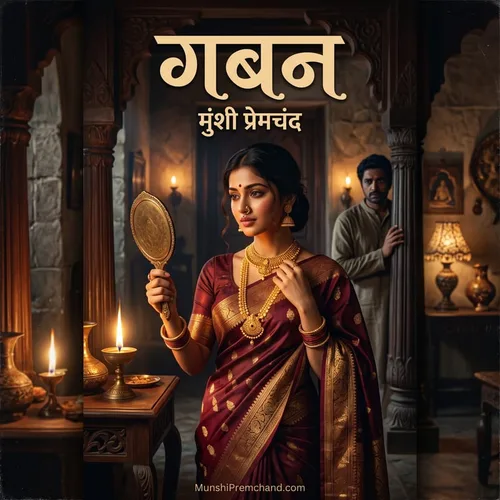
From that day onward, a spirit of service arose in Jalpa's love for her husband. Whenever he went to bathe, he found his dhoti freshly washed and laid out for him. He also found oil and soap placed on the shelf. When he was about to leave for the office, Jalpa would bring his clothes and lay them before him. Earlier, he had to ask for betel leaves before they were given to him; now they were thrust upon him insistently. Jalpa watched his face. There was no need for him to say anything. Even when he sat down to eat, she would fan him. Formerly she had gone into the kitchen to cook with great reluctance and had treated the task as forced labor even then. Now she went into the kitchen with great affection. The dishes were still the same, but their taste had improved. In the face of this sweet affection, those two pieces of jewelry seemed utterly insignificant to Rama.
On the very day that Rama bought jewelry from Gangu's shop, the other jewelers also learned of his fondness for ornaments. Whenever Rama passed that way, shopkeepers on both sides would rise and salute him: "Please come in, Babuji. At least have some betel. Do take a look at a couple of things from our shop."
Rama's self-restraint increased his credit even further. At last, one day a broker came to Rama's house, and despite all his refusals, he opened his small jewelry chest.
To get rid of him, Rama said, "Brother, I don't want to buy anything at the moment. Why waste both your time and mine?" The broker said very humbly, "Babuji, just take a look. If you like something, buy it; if you don't, don't. There is no harm in looking. After all, if we don't go to wealthy people like you, whom should we go to? Others have made good sums of money from you; perhaps it is our fortune that we may get four pennies from you as well. Show these to Bahuji and Maiji. My heart tells me that today my first sale will be made through you."
Ramanath—"Don't talk about women's tastes. The things must be good. What is there to delay if they like them? But, brother, I have no money on hand at the moment."
The broker laughed and said, "Babuji, you say such things that one can only exclaim, 'Wonderful!' If you give the word, we could sacrifice a thousand or fifteen hundred rupees for you. We people judge a man's temperament, Babuji. If God wills, I shall not get up today without making a sale."
The broker took two things out of the chest: one was a jeweled bracelet of the latest fashion, and the other was an earring. Both pieces were extraordinary. They glittered as though a lamp were burning inside them. It was ten o'clock. Dayanath had already gone to the office, and Rama was about to go to eat. There was absolutely no time, but on seeing these two things he forgot everything else. He brought both cases inside the house. The moment the two women saw the cases in his hands, they rushed upon them and began taking out the ornaments and examining them. Their brilliance and splendor so captivated them that they had lost all power to weigh their merits and defects.
Jageshwari—"Compared with today's things, the old ornaments simply do not look good."
Jalpa—"I feel like vomiting when I look at those old things. I don't know how women used to wear them in those days."
Rama said with a smile, "So you both like the things, don't you?"
Jalpa—"Why wouldn't I like them? Maiji, you take them."
Jageshwari lowered her head to hide the anguish in her heart. A woman whose entire life had been spent in the worries of household affairs—could she even have hoped in her dreams that she would one day wear such ornaments? Ah, not a single desire in that poor woman's life had ever been fulfilled. Her husband's income had never been enough that anything remained after supporting the children and maintaining the household. From the day she became mistress of the home, it was as though her austerity had begun, and all her desires had one by one been reduced to dust. She turned her eyes away from the ornaments. They held such attraction that she was afraid to look at them. What if the veil covering her detachment were to fall? She said, "What would I do with them, daughter? My days of dressing up and wearing ornaments are over. Who brought them, son? How much do they cost?"
Ramanath—"A jeweler brought them to show me. I haven't asked the price yet, but they must be expensive. I wasn't going to buy them anyway, so what was the point of asking the price?"
Jalpa—"If you weren't going to buy them, why did you bring them here?"
Jalpa spoke these words with such agitation that Rama became embarrassed. There was so much excitement and contempt in her voice that he did not have the courage to take the ornaments back. He said, "Then shall I buy them?"
Jalpa—"If Mother isn't telling you to buy them, what will you do by buying them? Is he giving them away for free?"
Ramanath—"Consider that they are being given for free."
Jalpa—"Do you hear what he is saying, Maiji? Go and return them. When we have money later, we can get plenty of jewelry."
Jageshwari said in a voice full of temptation, "He isn't asking for the money right now, is he?"
Jalpa—"Even if he gives them on credit, he will charge interest, won't he?"
Ramanath—"Then shall I return them? Decide quickly. If you want them, take them; if you don't, return them. Don't get caught in temptation and indecision."
Jalpa found this straightforward talk very harsh at that moment. She had not expected such words from Rama. Refusal was supposed to be her job; Rama should have urged her to take them. Looking at Jageshwari with yearning eyes, she said, "Return them. Who will endure the demands day and night?"
She was about to put the ornaments back into their cases when Jageshwari picked up the bracelet and put it on, as though wearing it for even a moment might fulfill her long-cherished desire. Then, ashamed in her heart of such weakness, she was about to take it off when Rama said, "Now that you have put it on, Ma, keep wearing it. I am giving it to you." Jageshwari's eyes filled with tears. A longing that had never been fulfilled until today was being fulfilled by Rama's devotion to his mother; but could she place such a heavy burden of debt upon her beloved son? He was still only a young man; what means did he have? Who knew whether money would come into his hands quickly or only after a delay? They did not even know the price. If it was very expensive, where would the poor boy get the money? How many demands would he have to endure, and how humiliated would he have to become? In an anxious voice she said, "No, son, I only put it on like that. Take it away and return it."
Seeing his mother's saddened face, Rama's heart was shaken by filial love. Could he, out of fear of debt, not even do this much for his self-sacrificing mother? Did he not have some duty toward his mother? He said, "We will get plenty of money, Ma. Don't worry about it."
Jageshwari looked toward her daughter-in-law, as though saying, "See how much oppression Rama is inflicting on me."
Jalpa was sitting there with an air of indifference. Perhaps she feared that Mother might actually take the bracelet. Jageshwari had no doubt that her daughter-in-law did not like seeing her wear the bracelet. She immediately took it off and, approaching Jalpa, said, "I am giving it to you from my side. I have already had all the wearing and dressing up that was meant for me. Now you wear it a little; let me see."
Jalpa had not the slightest doubt that Mother had money. She thought perhaps she had relented today and would pay for the bracelet. A moment earlier, she had thought that Rama would have to pay the money, and that was why, despite wanting it, she had wanted to return it. If Mother was paying its price, why should she refuse? Yet, outwardly, she said, "If you don't have the money, then leave it, Maiji. What is the hurry?"
Rama said somewhat irritably, "Then are you taking this bracelet?"
Jalpa—"If Maiji won't agree, what can I do?"
Rama—"And why don't you keep these earrings too?"
Jalpa—"At least go and ask the price."
Rama said impatiently, "Take these things. What does the price matter to you?" Rama went outside and asked the broker the price, and was stunned. The bracelet cost seven hundred rupees, and the earrings one hundred and fifty. He had estimated that the bracelet would cost three hundred at most and the earrings forty or fifty rupees. He regretted not asking the price earlier; if he had, why would he ever have brought these things into the house? He was ashamed to return them, but whatever the case, he would have to return them. He could not carry such a huge burden on his head. He said to the broker, "These are very high prices, brother. I had estimated them at three or four hundred at most."
The broker's name was Charan Das. He said, "If there is even a penny's difference in the price, sir, I will never show my face again. The goods are from Dhaniram's establishment. You can go and ask him yourself. My brokerage is certainly one and a half annas per rupee—give it to me or don't, as you please."
Ramanath—"Well, brother, at these prices we don't want to take the things at present."
Charan Das—"Please don't say that, Babuji. What great matter are these sums for you? Even if the goods circulate for two months, twice the amount will come back to your hands. Who could be a greater connoisseur than you? These are all things chosen by wealthy people. What do rustic people know of their value!"
Ramanath—"Eight hundred and fifty rupees is a lot, brother."
Charan—"Don't look at the face of the money, Babuji. When Bahuji sits there wearing them, one glance at her will make all the rupees worthwhile!"
Rama was confident that Jalpa would recoil as soon as she heard the price of the jewelry. He did not continue talking with the broker. He went inside, laughed loudly, and said, "Maiji, what price had you imagined for this bracelet?"
Jageshwari did not want to make a fool of herself by giving an answer. "With jeweled things like these, there is no fixed calculation of weight and measure. Whatever price they settle at is the right one."
Ramanath—"All right, you tell me, Jalpa, what price do you estimate for this bracelet?"
Jalpa—"It cannot be less than six hundred."
Rama's whole plan was ruined. He had wanted to frighten Jalpa by making her afraid of the price, but there was very little difference between six and seven hundred. And it was possible that Charan Das might agree to that much. Somewhat embarrassed, he said, "They aren't crude stones."
Jalpa—"Whatever they are, they aren't worth more than six hundred."
Rama—"And the earrings?"
Jalpa—"A hundred rupees at most!"
Ramanath—"You missed again. He is asking one hundred and fifty."
Jalpa—"He must think us fools if he expects us to take them at that price."
Rama's maneuver had backfired. Jalpa had not been greatly mistaken about the value of these things. After all, Rama's financial condition was not hidden from her, and yet she was sitting there willing to pay seven hundred rupees for the jewelry. Rama had no idea that Jalpa had been delighted by the bracelet for an entirely different reason. Now there was only one way out: the broker must refuse to settle for six hundred. He said, "He will not take a penny less than eight hundred and fifty."
Jalpa—"Then return them."
Ramanath—"I feel ashamed to return them, Ma. You yourself go into the veranda and tell him that we won't pay more than seven hundred. If he wants to give them for that, let him; otherwise he can go."
Jageshwari—"Why should I go and talk to that broker?"
Jalpa—"Why don't you tell him yourself? There is nothing to be ashamed of."
Ramanath—"I won't be able to give him a straight answer. He will flatter me endlessly. 'You are a great man, a rich man, a king. What is one hundred and fifty rupees to you?' I will be swept away by his talk."
Jalpa—"All right, I will tell him myself."
Ramanath—"Excellent! Then the whole matter is settled."
Rama slipped back and kept out of sight. Jalpa came into the veranda and said, "Come here for a moment, jeweler! Have you come to rob us or to sell your goods?"
Charan Das rose from the veranda and came to the doorway. "What is your command, Madam?"
Jalpa—"Have you come to sell goods, or to rob people? You are asking seven hundred rupees for the bracelet?"
Charan Das—"Seven hundred is merely the price of its workmanship, Your Honor!"
Jalpa—"Then take it to someone who will throw seven hundred rupees at it. And you ask one hundred and fifty for the earrings—is that not robbery?"
Charan Das—"Bahuji, you are being most unfair. Where is eight hundred and fifty, and where is seven hundred?"
Jalpa—"You are free to take your goods away."
Charan Das—"After coming to such a great household, should I take the goods back? Please wear them for now! If it were a matter of ten or five rupees, I would not go back on my word. I am not lying to you, Bahuji. There is only a rupee or so of profit in these things. From that same amount you must count the shop rent, discount, account expenses, customary fees, brokerage, everything. Say something that allows us to earn a few pennies too. Don't make me return early in the morning."
Jalpa—"I have said it: seven hundred."
Charan made a face as though he had been placed in a terrible moral dilemma. Then he said, "If it were anyone else, I would suffer a loss, but I cannot refuse your word. When will the money be paid?"
Jalpa—"It will be paid soon."
Jalpa went inside and said, "In the end, did you get it for seven hundred or not? He was plainly trying to snatch another hundred and fifty. I regret that I did not ask for even less. These people rob their customers like this."
Rama was frightened at taking on such a heavy burden, but circumstances had taken such a turn that the burden had fallen upon him after all.
Jalpa went upstairs in a surge of happiness, carrying both things; but Rama stood there with his head bowed, sunk in worry. Even after knowing his condition, why had Jalpa not rejected these things? Why had she not insisted, "I will not take them"? Why had she remained caught in indecision? It was difficult enough to pay five hundred and fifty rupees; where would he get this much more? In truth, the fault was entirely his. He should have driven the broker away from the door itself.
But he consoled himself. This was only atonement for his own sins. Besides, this was what a man earned for. They were hardly facing starvation, were they?
After eating, when Rama went upstairs to change his clothes, Jalpa was standing before the mirror, putting the earrings into her ears. The moment she saw him, she said, "I must have risen after seeing the face of someone auspicious today. Two things have fallen into my hands for free."
Rama asked in astonishment, "Why for free? Won't we have to pay for them?"
Jalpa—"Mother will pay."
Ramanath—"Did she say something?"
Jalpa—"She gave them to me as a gift, so who else will pay?"
Rama smiled at her innocence and said, "You took these things thinking that? If Mother were going to pay, she would have given the money at the very time the jewelry was stolen. Did she not have money then?"
Jalpa, confused, said, "How was I to know? You can still return them. Just say that the person for whom you took them did not like them."
Having said this, she immediately took the earrings out of her ears. She also removed the bracelet, put both things into their cases, and held them out toward him in a manner like a cat playing with a mouse. The cat does not let the mouse escape its grasp; yet it does not truly release it either. She did not have the courage to stretch out her hands fully. Was her heart not in exactly the same condition? Her face was fluttering with anxiety. Why was she looking at the floor instead of at Rama? Why did she not raise her head? Where was the heartfelt joy one feels on escaping a crisis? Her condition was exactly like that of a mother who is giving her child permission to go abroad. The same helplessness, the same anguish, the same tenderness were now appearing on Jalpa's face.
Rama did not possess enough sternness to take the cases from her hands. He was willing to endure demands, humiliation, hiding his face, burning in the fire of anxiety—anything. But he was not willing to do anything that would break Jalpa's heart or make her feel herself to be an unfortunate woman. All his knowledge, all his effort, all his judgment rose up in opposition to this blow. In the struggle between love and circumstances, love prevailed.
He smiled and said, "Leave them. Now that we have taken them, why return them? Mother will laugh at us too."
Jalpa said in a deliberately trembling voice, "One should stretch one's feet only as far as one's blanket. Why take on a new trouble unnecessarily?"
Rama, as though sinking into deep water, said, "God is the master of all."
And he immediately went downstairs.
How, in a moment of temptation and hesitation, do we sacrifice the happiness and peace of our lives? If Jalpa had been able to steady herself in this gust of temptation, if Rama had not bowed before his hesitation, if the true light of love had shone in both their hearts, they would not have strayed from the path and gone toward ruin.
It was eleven o'clock. He was already late for the office, but Rama was going as though he had returned after performing the last rites of a beloved relative.