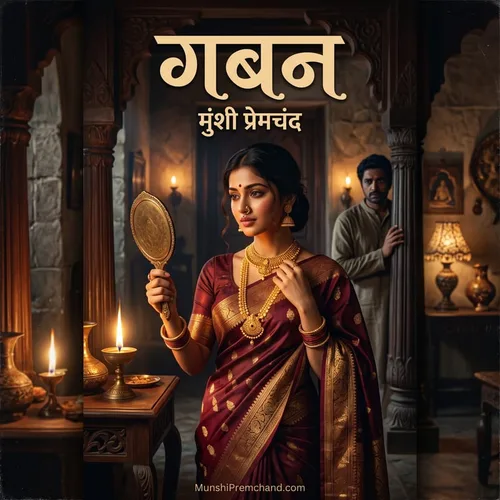
When Rama drove away in the motorcar, he could neither think nor understand anything; he did not know where he was going. Familiar roads had become unfamiliar to him. He had no anger toward Jalpa, not the slightest. Nor was he angry with Jaggo. His anger was directed at his own weakness, his own greed, his own cowardice. In the atmosphere created by the police, his sense of right and wrong had become corrupted. He had thought only that day, when Jalpa had explained it to him, of what a great injustice he was about to commit. After that, the thought had not arisen in his mind again. The officers had kept him enticed with grand promises. They would say, "Why worry about your wife? The moment you arrive with a jeweled necklace and present a bag of money, all Begum Sahib's anger will disappear. You will get a good post somewhere in your own province, and spend your life comfortably. What anger!" They had given him many examples from their own experience. Rama had become entangled in their trap. Then he never got another opportunity to meet Jalpa. The police influence grew stronger and stronger. Today he had gone to Jalpa with the jeweled necklace in his pocket, to give her the good news of his victory. He knew Jalpa would initially wrinkle her nose and frown, but he also knew that she would certainly be pleased when she saw the necklace. The commissioner's letter to the Home Secretary of the United Provinces would reach him tomorrow. After spending two or four days sightseeing here, he would head home. He also wanted to take Devi Din and Jaggo with him. How could he ever forget their kindness? With these plans in his mind, he had gone to Jalpa as a devotee might go to worship a deity carrying fruit and offerings, but instead of granting him a boon, the deity had rejected his offering; he did not have the courage even to look at the offerings before him. He thought, "I will go to the judge right now and tell him the whole story. Let the police become my enemies; let them rot me in prison; I don't care. I will expose everything. Can't the judge change his decision? The accused are still in the lockup. The police will grind their teeth, they will rage and dance with fury; perhaps they will eat me alive. Let them eat me! It was this very weakness that blackened my face."
The angry image of Jalpa appeared before his eyes again. Oh, how angry she had been! If I had known she would become so furious, I would have changed my statement even if the whole world had turned upside down. These police officers had completely deceived me. If the judge hears nothing and does not acquit the accused, Jalpa will never look at my face again. With what face will I go to her? And what will I do by remaining alive? For whom?
He stopped the motorcar and looked around. He could not understand where he had come. Suddenly he saw a watchman. He asked him for the address of the judge's bungalow. The watchman laughed and said, "Sir, you have gone very far out. It must be six or seven miles from here at least. He lives over there, toward Chowringhee."
Rama asked for the road to Chowringhee and drove on. It was nine o'clock. He thought, "If I do not meet the judge, the whole game will be ruined. I will not leave without meeting him. If he listens to me, that will settle it; if not, tomorrow I will tell the High Court judges. Surely someone will listen. I will have the whole story printed in the newspapers; then everyone's eyes will open."
The motorcar was traveling at thirty miles an hour. In only ten minutes he reached Chowringhee. There was still the same bustle here, but Rama drove on at the same furious speed. Suddenly a policeman showed a red light. He stopped, and when he leaned out of the car, he saw the same daroga!
The daroga asked, "Haven't you gone to the bungalow yet? Don't drive such a fast motorcar. There'll be an accident. Tell me, did you meet Begum Sahib? I thought she would be with you too. She must have been very happy!"
Rama was so angry that he felt like tearing out the man's moustache, but he replied smoothly, "Yes, she was very happy."
"I told you, didn't I? That is the only remedy for a woman's anger. You were trembling for nothing."
"It was my foolishness."
"Come, I will go with you too. We'll have a game of cards and get a little merriment going. Deputy Sahib and Inspector Sahib will come. We'll have Zohra called. There will be a couple of hours of fun. Why don't you bring Mrs. Ramanath to the bungalow itself now? She is staying at that butcher's house."
Rama said, "For now I have to go somewhere else on an urgent matter. You take the motorcar; I will come on foot."
The daroga went inside the motorcar and said, "No, sir, I am in no hurry. Go wherever you want to go. I won't interfere at all."
Rama said somewhat irritably, "But I am not going to the bungalow now."
The daroga smiled and said, "I understand, but I won't interfere at all. That Begum Sahib—"
Rama interrupted him, "No, I do not want to go there."
The daroga said, "Then is there some other prey? There will be no shortage of entertainment at the bungalow tonight either. Something to amuse you will be provided there."
Rama suddenly turned his eyes red with anger and said, "Do you take me for a lecher? I am not so degraded."
The daroga, somewhat embarrassed, said, "All right, sir, I have done wrong. Forgive me. Such insolence will never happen again. But do not yet consider yourself out of danger. I will not let you go anywhere unless I am completely assured of your safety. You have no idea how many enemies you have. I am saying this only for your own good."
Rama bit his lips and said, "It would be better if you did not worry so much about my welfare. You people have ruined me completely, and even now you will not let go of my throat. Let me die according to my own fate now. I am tired of this slavery. I do not want to remain a child who follows his mother everywhere. If you want your motorcar, take it gladly. Fifteen men have had to be sacrificed for the sake of riding in this motorcar and living in that bungalow. If I get some position, perhaps fifteen hundred men will have to be sacrificed. My chest is not strong enough for that. Take your motorcar."
Saying this, he got out of the motorcar and hurried ahead.
The daroga called out several times, "Just listen, hear me out," but Rama did not even turn around to look. A little farther on, he turned around a bend. The judge's bungalow was on this very road. There was no one on the road. Rama went from one side of the road to the other, reading the numbers of the bungalows as he went. Suddenly he stopped at one number. He stood there for a minute, waiting for someone to come out so that he could ask whether the sahib was at home. He did not have the courage to go inside. He thought, "What will I say if the judge asks me why I gave false testimony? To say that the police forced me to testify, tempted me, threatened to kill me—that would be shameful. If he asks me, 'You took such a great stain upon yourself merely to escape a sentence of two or three years, and became determined to cause the deaths of so many people; where was your reason at that moment?' What answer do I have? I will only have to be needlessly humiliated."
He would be made a fool of. He turned back. He did not have the strength to face this shame. Shame has always defeated the bravest of men. Even those who do not fear death itself do not have the courage to stand before shame. To leap into fire or stand before a sword is far easier than this. Great kingdoms have been destroyed to preserve honor, rivers of blood have flowed, and lives have been sacrificed in a festival of death. It was that same sense of shame that made Rama's feet retreat today.
Perhaps he would not have been so frightened by a prison sentence.