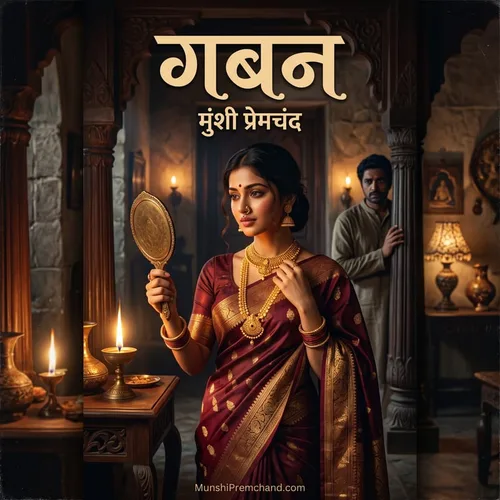
A month passed. Jalpa remained deeply agitated for many days. Several times she felt such a frenzy that she wanted to have the whole story published in some newspaper at once, expose everything, and bring down all the castles in the air. But all these agitations subsided. Some power hidden in the depths of her soul kept her tongue from speaking. She had cast Rama out of her heart. She no longer felt anger toward him, nor hatred, nor even pity—only indifference. Even if she had received news of his death, she probably would not have wept. Yes, she might have been saddened for a little while, thinking of it as a play of divine providence, a pitiless joke of Maya, a cruel sport. The bond of love that had been placed around her neck two and a half years earlier had broken, but its mark remained. In the meantime, she had seen Rama several times passing in front of her house in his motorcar. His eyes seemed to be searching for someone. There was some shame in those eyes, some plea for forgiveness, but Jalpa never raised her eyes toward him. Even if he had come at that moment and fallen at her feet, she would not have looked at him. Rama's despicable cowardice and immense selfishness had, as it were, torn Jalpa's heart apart, yet the mark of that bond of love still remained. That love-stricken image of Rama, which had once made her heart overflow when she looked at it, would sometimes enter the darkness covering her heart like a faint, soiled, joyless moonlight, and for a moment those memories would begin to weep. Then the curtain of that same darkness and silence would fall again. There were no tender memories of the future for her; only a harsh, joyless present stood before her in a terrible form, staring at her.
The Jalpa who had once taken offense at the slightest thing in her own home was now the very embodiment of service, sacrifice, and forbearance. Jaggo kept trying to stop her, but before dawn she would sweep the entire house, finish the cooking and washing of utensils, knead the flour and leave it ready, and light the stove. Then all the old woman's work was merely to bake the rotis. She had also put aside all notions of ritual purity and untouchability. The old woman would push and coax her into the kitchen and make her eat something or other. The two had developed a love like that between a mother and daughter.
All the proceedings of the trial had ended. The lawyers on both sides had finished their arguments. Only the judgment remained to be pronounced. Today was the date fixed for it. After finishing her household work early that morning, Jalpa sat listening for the newspaper boy's voice, as though her own fate were about to be decided that day. Just then Devi Din brought the newspaper and placed it before her. Jalpa pounced upon the paper and began reading the judgment. What was the judgment? It was a fanciful story, with Rama as its principal hero. The judge had praised him repeatedly. The entire prosecution rested upon his testimony.
Devi Din asked, "Has the judgment been printed?"
Jalpa, still reading the paper, said, "Yes, it has!"
"Who was sentenced?"
"No one was acquitted. One has been sentenced to death. Five have received ten years each, and eight have received five years each. It was that Dinesh who was sentenced to death."
Saying this, she put the newspaper down and, drawing a long breath, said, "Who knows what will become of the wives and children of these poor men!"
Devi Din immediately said, "From the very day you told me about them, I have been making inquiries. Eight of the men are not even married yet, and their families are doing well. They have no hardship of any kind. Five are married, but their families are also comfortable. One has a business in his family, one is a landlord, someone's father or uncle is in service. I asked several people, and some money has also been collected here. If their families want it, it will be given to them. Only Dinesh is ruined. He has two small children, an old mother, and a wife. He was a schoolmaster somewhere here. He lived in a rented house. That is where the trouble lies."
Jalpa asked, "Can you find out the address of his house?"
"Yes, what difficulty is there in finding it?"
Jalpa said pleadingly, "Then when will you go? I will go with you too. There is still time. Come, let us go and see."
Devi Din objected, "Let me go and see first. How will you keep running around everywhere with me like this?"
Jalpa suppressed her feelings, bowed her head helplessly, and said nothing. Devi Din left. Jalpa began looking at the newspaper again, but her thoughts were fixed on Dinesh. The poor man would be hanged. What must have happened to him when he heard the sentence of death? His old mother and wife must have beaten their breasts when they heard the news. The poor man was only a schoolmaster; they must barely have been able to make ends meet. What other support could they have? Imagining their calamity filled her with such anger and complete hatred toward Rama that she could no longer remain indifferent. Such agitation rose in her mind that, if he came at that moment, she wanted to rebuke him so severely that he would remember it for the rest of his life.
"Are you a human being? Never. You are a demon in human form, a demon! You are so vile that there are no words with which to express it. You are so vile that today even the vilest of men is spitting upon you. Why did no one kill you earlier? These men's lives would have been lost anyway, but at least your face would not have been blackened. How did you fall so low? How could the son of a father who was so truthful and so honest become so greedy and so cowardly?"
Evening came, but Devi Din did not return. Jalpa repeatedly stood at the window and looked out in every direction, but there was no sign of Devi Din. Gradually eight o'clock came, and Devi Din still had not returned. Suddenly a motorcar stopped at the door, and Rama got out and asked Jaggo, "Is everything well, grandmother? Where has grandfather gone?"
Jaggo looked at him once and turned her face away. She said only, "He must have gone somewhere. I don't know."
Rama took four gold bangles from his pocket, placed them at Jaggo's feet, and said, "I brought these for you, grandmother. Wear them. Aren't they too loose?"
Jaggo picked up the bangles and threw them onto the ground. Rolling her eyes angrily, she said, "Where there is room for so much sin, there is no room for four bangles! By God's grace I have worn plenty of bangles already, and even now there must be a seer or two of gold lying around, but whatever I ate and wore, I earned through my own labor. I never throttled anyone, never carried a bundle of sin upon my head, never allowed my intentions to go astray. May fire consume the womb that gave birth to a bad son like you. You must have come to give this ill-gotten money to the daughter-in-law! You must think that she will go mad with delight at the sight of your bag of money. Even after living with her for so long, your greedy eyes could not recognize her. Men like you were not worthy of that goddess. If you want your own welfare, turn around on these very feet and go back from where you came. Why go before her and humiliate yourself? If you had come today wounded at the hands of the police, beaten and punished, and had been thrown into prison, the daughter-in-law would have worshipped you and washed your feet and drunk the water. She is one of those women who may work as a laborer, go hungry, and wear torn rags, but cannot bear to see anyone do wrong. If you were my son, I would give you poison. Why are you standing here burning me? Why don't you leave? Have I taken anything from you?"
Rama listened silently with his head bowed. Then he said in a wounded voice, "Grandmother, I have done wrong, and I will remain ashamed of it until I die, but I am not as vile as you think I am. If you knew what harsh treatment the police subjected me to, what threats they made against me, you would not call me a demon."
The sound of these words reached Jalpa's ears. She peered down from the staircase and saw Ramanath standing there. He wore a Banarasi silk turban, a fine silk coat, and golden spectacles. In this one month his body had filled out. His complexion had also become fairer. Such radiance had never before appeared on his face. His final words reached Jalpa's ears. She came rushing down like a hawk, thudding step after step, and struck him with arrows dipped in poison:
"If you can be cowed so easily by harsh treatment and threats, then you are a coward. You have no right to call yourself a human being. What harsh treatment did they inflict? Let me hear it! People have laughingly allowed their heads to be cut off, have watched their sons die, have accepted being crushed in oil presses, yet have not moved even a hair's breadth from the truth. You too are a man; why did you yield to threats? Why did you not stand there with your chest bared and say, 'Make me the target of your bullets, but I will not lie'? Why did you not bow your head? The soul has been placed within the body so that the body may protect it, not so that it may destroy it completely. And what reward did you receive for this sin? Let me at least know that!"
Rama said in a subdued voice, "So far, nothing."
Jalpa hissed like a serpent and said, "I am very glad to hear that! May God grant that even after blackening your face you receive nothing! That is my sincere prayer. But no, the police would never anger men made of wax like you. You will get some position, perhaps even a good one, but you cannot escape from the web in which you have become entangled. Giving false testimony, fabricating false cases, and trading in sin are what fate has written for you. Go, enjoy the pleasures of life to your heart's content. I told you before, and I say it again today: I have no relationship with you. I have understood that you are dead. You too should understand that I am dead. Now go. I am a woman. If anyone tries to force me to commit a sin by threatening me, even if I cannot kill him, I will cut my own throat. Do you not even have as much courage as a woman?"
Rama pleaded like a beggar, "Won't you listen to any excuse I have to offer?"
Jalpa said proudly, "No!"
"Then shall I go somewhere with my face blackened?"
"That is your choice!"
"Will you not forgive me?"
"Never, under any circumstances!"
Rama stood with his head bowed for a moment. Then he slowly went below the veranda and said to Jaggo, "Grandmother, when grandfather comes, tell him to meet me for a little while. Wherever he tells me to come, I will go."
Jaggo, somewhat softened, said, "Come here tomorrow."
As Rama got into the motorcar, he said, "I will not come here again, grandmother."
When the motorcar drove away, Jalpa said contemptuously, "He came to show off his motorcar, as though he had just bought it!"
Jaggo rebuked her, "You should not have been so unrestrained, daughter-in-law! When a person's heart is wounded, he cannot think clearly."
Jalpa said mercilessly, "He is not so sensitive, grandmother! He sold his soul for the sake of this pleasure, so why would he give up the pleasure? Didn't you ask what he would do by meeting grandfather? If grandfather had been here, he would have scolded him so severely that he would remember it for the rest of his life."
Jaggo said contemptuously, "If I were in your place, such words would never have come out of my mouth. Your heart is very hard. Another man would have quietly listened to all this—I was trembling, afraid that he might raise his hand against you—but he is very patient."
Jalpa said with the same mercilessness, "This is not patience, grandmother. It is shamelessness."
Devi Din came and asked, "Did brother come here? I saw him in the motorcar on the way."
Jaggo said, "Yes, he came. He said that grandfather should meet him for a little while."
Devi Din said indifferently, "I will meet him. Was there any conversation here?"
Jaggo said regretfully, "What conversation? First I worshipped him, and when I was done, the daughter-in-law offered him a proper garland of fruit and flowers."
Jalpa lowered her head and said, "A man suffers whatever he does."
Jaggo said, "He came to meet us, thinking of us as his own."
Jalpa said, "No one went to call him. Did you find out anything about Dinesh, Dada?"
Devi Din said, "Yes, I found out everything. His house is in Habde. I know the whole address and everything about it."
Jalpa said timidly, "Will you go now, or sometime tomorrow?"
Devi Din said, "As you wish, daughter. If you want to go right now, I am ready."
Jalpa asked, "You must be tired?"
Devi Din replied, "There is no tiredness in such work, daughter."
It was eight o'clock. The road was filled with a stream of motorcars. On both sides of the road, thousands of men and women, dressed in their finery, walked along laughing and talking. Jalpa thought, "How absorbed the world is in its own pleasures and amusements. Let whoever has to die for it die; it will not abandon its habits. Everyone is sitting there building his own little mud house. Let the country be swept away—it does not care. Let its little house remain standing! Let nothing interfere with its self-interest." Her innocent heart would have been pleased to see the market closed. If everyone had appeared with heads bowed in grief, brows furrowed, and faces flushed with inner anguish, she would have felt some satisfaction. She did not know that in this vast sea of humanity, the fall of such tiny pebbles does not raise even a ripple; not even a sound is heard.