A play is considered a success when the theater-going public likes it. A wedding procession is considered a success when the people who happen to see it along the road like it. A play is tested for four or five hours; a wedding procession is tested for only a few minutes. All the decoration, running about, and preparation are settled within five minutes. If everyone exclaims, “Bravo!” the spectacle has passed; otherwise it has failed. Money, labor, anxiety—all wasted. Dayanath's spectacle passed. In the city it would have ranked third-class; in the village it ranked first-class. Some people were delighted by the booming and honking of the band; others stared wide-eyed at the motorcar. Some rolled about in delight at the flower-covered platforms. The fireworks were the center of the entertainment. When the rockets shot upward with a hiss and scattered red, green, blue, and yellow powder across the sky; when the spinning wheels were released and dancing peacocks emerged from them, people became spellbound. “What craftsmanship!”
None of these things held the slightest attraction for Jalpa. Yes, she wanted to see the groom with one eye, and that too while hiding from everyone; but where was there an opportunity amid that crowd? During the welcoming ceremony at the doorway, her friends pulled her up to the roof, and she saw Ramanath. All her detachment, indifference, and heartache seemed to vanish as if by magic. A glow of happiness spread across her face. Affection is a storehouse of vitality.
After the doorway ceremony, the wedding procession went to the guest quarters. Preparations for the meal began. Some ate puris; others cooked khichdi over cow-dung cakes. Dancing and singing began to entertain the villagers who had come to watch the spectacle.
At ten o'clock, the band suddenly began playing again. It became known that the wedding gifts were arriving. Every ceremony in the wedding procession was performed with the beating of drums. The groom was coming for his first meal—the band played. The bride's father was coming to meet the groom's father—the band played. As soon as the gifts arrived, there was a commotion in the house. Men and women, old and young, all became eager to see them. As soon as the trays reached the wedding pavilion, everyone abandoned whatever they were doing and rushed to look. People began jostling one another. Manki was dying of thirst; her throat had gone dry, but the moment the gifts arrived, her thirst vanished. Din Dayal was lying almost lifeless from hunger and thirst, but at the news he sprang to attention and ran over. Manki began taking out each item and displaying it. Everyone there was an expert in this art. The men had commissioned jewelry; the women had worn it; everyone began criticizing and evaluating it. “How beautiful the chuhdanti is! It must weigh ten tolas.” “Bravo! If it weighs even a grain less than eleven and a half tolas, I'll admit defeat.” “Look at this sherdaha—what workmanship! One feels like kissing the craftsman's hands. This must be no less than twelve tolas.” “Bravo! If it weighs less than sixteen tolas, I won't show my face.” “Yes, the gold is not quite as pure as it could be.” “Look at this bracelet—perfectly secure setting, such delicate workmanship that the eye cannot rest on it. How it sparkles! The stones are genuine. Where is this brilliance in false stones?” “But this guluband is the real thing—what beautiful flowers! And the diamonds between them are sparkling! Some Bengali goldsmith must have made it.” “Have Bengalis taken a contract for craftsmanship? Our country has craftsmen of every description. What can Bengali goldsmiths do compared with them?”
In this way, each item was examined and criticized. Suddenly someone said, “Isn't there a Chandrahār?”
Manki made a sorrowful face and said, “It didn't come.”
A woman exclaimed, “What! The Chandrahār didn't come!”
Din Dayal said gravely, “Everything else is here. Only the Chandrahār is missing.”
The same woman pulled a face and said, “A Chandrahār is something else altogether!”
Manki moved the gifts aside and said, “Poor girl, a Chandrahār simply wasn't written in her fate.”
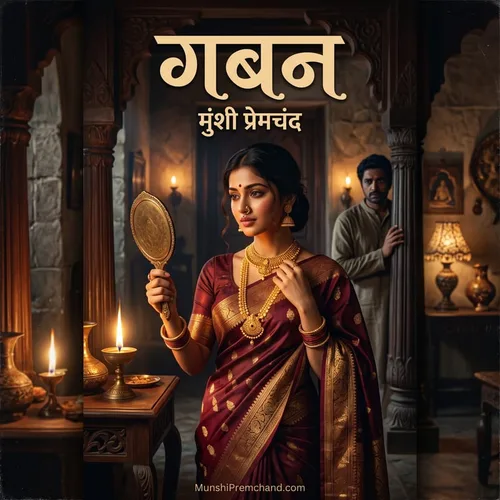
Behind this circular crowd, standing in the darkness like an embodiment of hope and longing, was Jalpa. She heard the names of all the other ornaments, but not the name of the Chandrahār. Her heart was pounding. “Isn't there a Chandrahār? Perhaps it is underneath everything.” She kept reassuring herself in this way. When it became clear that there was no Chandrahār, it felt as though her heart had been struck. She felt as though not a drop of blood remained in her body. It seemed she would faint. In a state of delirium, she went to her room and began to sob bitterly. The longing that had sprouted in her heart seven years earlier, and now stood laden with flowers and leaves, had been struck by lightning. The green, flourishing plant had been burned; only its ashes remained. All her hopes had rested upon this very day. Misfortune had snatched away even that support. In the force of her despair, she felt like tearing her own face. Had she been able, she would have picked up the wedding gifts and thrown them into the fire. A statue of Shiva stood in a niche in the room. She picked it up and smashed it so violently that, like her hopes, it too was shattered. She resolved that she would never wear jewelry. What good did jewelry do? Those who lacked beauty could adorn themselves with ornaments; God had made her beautiful as she was, and she would not look bad without jewelry. They had brought cheap things; they had not even mentioned the expensive ones. If the object was merely to count the number of pieces, twice as much jewelry could have been bought for the same money.
She was sitting there consumed with anger when three of her friends came and stood before her. They had assumed that Jalpa had not yet heard about the wedding gifts. The moment Jalpa saw them, she wiped her eyes and began to smile.
Radha smiled and said, “Jalpa, it seems you must have performed great austerities. I have never seen wedding gifts like these. Now all your wishes have been fulfilled.”
Jalpa raised her long eyelashes and looked at her with such helpless eyes, as though she had no hope left in life. “Yes, sister, all my wishes have been fulfilled.”
None of the three young women could guess how much boundless, heartbreaking pain those words contained. All three stared at her curiously, as though they did not understand what she meant.
Basanti said, “I feel like kissing the craftsman's hands.”
Shahzadi said, “A wedding display should be such that everyone who sees it is thrilled.”
Basanti: “Your mother-in-law seems very clever. She has left nothing out.”
Jalpa turned her face away and said, “So she has.”
Radha: “Everything else is there; only the Chandrahār is missing.”
Shahzadi: “What does it matter if one Chandrahār is missing, sister? There is a guluband in its place.”
With a sarcastic air, Jalpa said, “Yes, what does it matter if a body is missing one eye? All the other limbs are still there. What difference does an eye make, whether it is there or not!”
Just as we laugh when children speak seriously, Radha and Basanti could not restrain their laughter at these longing-filled words from Jalpa. Shahzadi, however, did not laugh. This longing for jewelry was not a matter of laughter to her; it was a matter for tears. Pretending to sympathize, she said, “They must all be savages from somewhere, to bring everything else and not bring the Chandrahār, the king of all ornaments. When Lala comes, I will ask him where he learned such a custom—who does such a thing?”
Radha and Basanti trembled inwardly, afraid that Jalpa might see through them. If they could, they would have silenced Shahzadi, and they repeatedly signaled to her to stop. But Jalpa took Shahzadi's sarcasm to be full of sympathy. With tearful eyes she said, “What will you accomplish by asking, sister? What had to happen has happened!”
Shahzadi: “You tell me to ask? I will make them cry. A bracelet did not come with my wedding gifts; I was so disappointed that I felt like kicking away all the jewelry. I did not sleep soundly until the bracelet was made.”
Radha: “So you know that Jalpa's Chandrahār will not be made?”
Shahzadi: “It will be made when it is made, but it was not made for this occasion. It isn't a ten- or fifteen-rupee item that one can have made whenever one wants. It costs hundreds, and good craftsmen are not always available.”
Jalpa's broken heart seemed to revive at these words from Shahzadi. In a choked voice she said, “That is what I think too, sister. If I did not get it today, when will I get it?”
Radha and Basanti were cursing Shahzadi inwardly and threatening her with gestures as though they would slap her, but Shahzadi was enjoying the spectacle. She said, “No, that isn't the point, Jalli. Everything can be achieved if you insist. Keep reminding your parents-in-law again and again. You can get a great deal done by remaining angry with your husband for two or four days. Just understand this: don't let the people in the house have any peace; keep the matter constantly in their minds. They will realize that there can be no peace until the Chandrahār is made. You must not slacken even a little, or the whole matter will be spoiled.”
Radha, suppressing a laugh, said, “If she can't manage it herself, why don't you call us? Are you getting up now, or will you spend the whole night giving advice?”
Shahzadi: “I'm coming, what is the hurry? Ah, I just remembered—Jalli, your mother has a beautiful Chandrahār. Won't she give it to you?”
Jalpa sighed deeply and said, “What can I say, sister? I have no hope.”
Shahzadi: “At least ask once. What occasion is left for her to wear it now?”
Jalpa: “I cannot ask her.”
Shahzadi: “I will ask her.”
Jalpa: “No, no, I beg you. I want to test her maternal affection myself.”
Basanti caught Shahzadi's hand and said, “Are you getting up now, or will you spend the whole night giving advice here?”
Shahzadi got up, but Jalpa blocked her way and said, “No, sit a little longer, sister. I beg you.”
Shahzadi: “When these two witches won't even let me sit. I am teaching you the tricks of the trade, and these two are snapping at me. Can't you hear? I am a bundle of poison too.”
Basanti: “You certainly are a bundle of poison.”
Shahzadi: “You too returned from your in-laws' home after a year. What new things did you have made?”
Basanti: “And what did you have made in three years?”
Shahzadi: “Leave me out of it. My husband doesn't even ask what I want.”
Radha: “Jewelry has no value before love.”
Shahzadi: “Then may dry love nourish you.”
Just then Manki came and said, “What are you three doing sitting here? Come, people are coming to eat.”
The three young women left. Seeing the Chandrahār around her mother's neck, Jalpa thought to herself, “Her heart still isn't full of jewelry!”