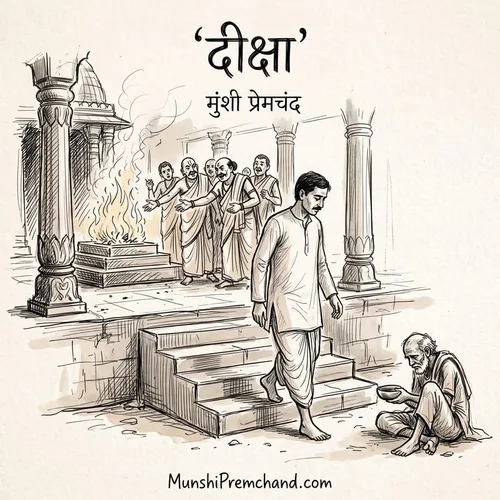
Complete English Translation: Diksha (Initiation)
I
When I was a schoolboy, playing ball games and constantly receiving stern rebukes from my venerable schoolmasters—which is to say, when I was in the green prime of early adolescence, before true knowledge had dawned and before practical intellect had developed—I was an ardent, crusading member of the Temperance Association, the Nasha-Nivarini Sabha.
I participated diligently in every one of its public assemblies and collected monetary donations for its sacred cause. Not only that, but I was also an initiated vow-taker, having formed an unshakeable, rock-solid resolution to observe the vow of absolute abstinence for all eternity.
When the President of the Association, at the solemn moment of administering my initiation (diksha), looked me in the eye and inquired, "Do you possess full faith that you will remain steadfast upon this vow until the final breath of your life?" I replied without a shadow of hesitation or doubt: "Yes, sir! I possess absolute, unshakable faith!"
The President smiled gently and pushed the pledge document across the table. With what immense pride and boundless joy did I sign my name that day! For weeks, I strutted through the streets with my head held high, looking down upon lesser mortals.
Indeed, my self-righteous fervor was so unbounded that on several occasions I behaved with intolerable impudence toward my own father. Every evening, to wipe away the exhausting fatigue of his daily labor, my father was accustomed to drinking a modest glass of liquor. To my puritanical eyes, this was an unendurable abomination. In all fairness, I must confess that while my father indulged in this vice, he practiced it with exquisite artistry. The moment a faint, pleasant intoxication warmed his veins and a gentle rosy glow tinted his eyes, he would sit down to his dinner—he was an extraordinarily frugal eater—and thereafter, for the rest of the night, he remained blissfully liberated from all the earthly illusions and anxieties of Maya.
Yet I, his virtuous son, took it upon myself to lecture him! I would challenge him to heated moral debates. On one unforgettable occasion, I wrought absolute havoc. Seizing his bottle and his glass, I dashed them against a stone slab with such furious violence that Lord Krishna himself could not have hurled King Kamsa with greater force! Shards of splintered glass flew across the entire house, and for several days thereafter, the barefoot women of our household cut their soles and shed blood. Yet look at my self-righteous arrogance! I cared nothing for the stern glances of my elders.
When my father arrived home and received the tragic bulletin regarding his life-giving elixir, he simply turned on his heel, walked straight to the bazaar, and within a single moment, the empty void upon the wall niche was triumphantly replenished. I sat waiting in my room, girding my loins for an epic mythological battle between gods and demons; but upon my father's countenance, not the faintest trace of anger or displeasure appeared. He looked at me with an expression of quiet enthusiasm—an expression which I now recognize was brimming with pure goodwill, spiritual amusement, and boundless paternal affection—and smiled softly.
He smiled in precisely the same subtle manner that the President of the Temperance Association had smiled months before. Today, after decades of bitter experience, I finally grasp the true meaning of that smile; in those youthful days, I was incapable of understanding it. That is the sum total of my intellectual growth over a lifetime! What gentle irony was packed into that smile, what mockery of my puerile vows, and what tender pity for my naive simplicity—only now do I comprehend its secret depths!
Throughout my college years, I remained steadfast upon my vow. Many of my classmates were by no means abstinent; in their eyes, I was regarded as an austere moralist. In the rough-and-tumble camaraderie of college life, such narrow puritanism could hardly pass without mockery. I was routinely teased; some bestowed upon me the title of "the Mullah," while others ridiculed me as "the Moral Preacher." Friends would chuckle in mocking pity: "Alas, poor fellow, you have never tasted the cup!"
The upshot was that, to survive in their company, I was compelled to adopt an outward posture of "broad-minded liberalism." I would sit in the room while my friends sipped their drinks; the cannabis mortar would grind, and I would watch passively. When friends pressed me urgently: "Come on, brother, take just a little sip!" I would reply in a modest, apologetic tone: "Please forgive me, gentlemen; it simply does not suit my physical system."
Notice the subtle shift: in place of moral principle, I had now begun to offer the flimsy excuse of bodily incapacity! That fierce, crusading zeal of Satyagraha which had once smashed my father's bottle had quietly evaporated into thin air.
Matters reached such a pass that in my fourth year of college, when news arrived of the birth of my first son, my "liberalism" scaled the absolute heights of absurdity. Yielding to the joyful clamor of my classmates, I threw a lavish feast and personally acted as their cupbearer, pouring drink after drink into their glasses with my own hands! On that day, playing the role of the Saqi brought me genuine, heartfelt delight.
Alas! What men grandly call "liberalism" is often nothing more than an elegant alias for sliding down from one's principles, an excuse for abandoning one's ideals! For comforting one's uneasy conscience, there is never any shortage of ingenious rationalizations. In this wide world, the easiest, most effortless task is to deceive oneself! I told myself: I have not taken a drop myself, have I? I merely served my friends; what harm has come to me? Why should I break the hearts of dear companions? The true victory lies in serving wine to others while remaining completely sober oneself!
Well, I emerged from college with an unblemished record. I commenced my legal practice in my hometown.
Instantly, I found myself yoked to a grinding mill from dawn until midnight. The carefree strolls, lively amusements, and joyful banter of college life vanished like smoke. Visits from old friends ceased entirely; even during the court vacations, I could scarcely find a moment to catch my breath.
For the first time, I realized the terrifying, brutal reality of the struggle for existence. Indeed, to call it a "struggle" is an utter delusion. Where are the martial exhilaration, the high romance, the heroic courage, and the triumphant victory cries of a battle in this sordid routine? This is not a battle; it is a chaotic, vulgar jostling of elbows, a relentless shoving match in a suffocating crowd! It is like those desperate mobs outside a theatre: “No matter if your ribs are crushed, shove forward and see the show!” Where is the ecstasy of meeting the beloved? All one gets is the privilege of kissing the beloved's dusty threshold, enduring the vile curses of the gatekeeper, and slinking away with an embarrassed face!
Sitting at my desk all day long, a chronic nausea of the spirit overtook me. I could barely force down two dry rotis at night, and I would mutter to myself in despair: Is it merely for the sake of these two dry rotis that I endure this brain-splitting torment and ruin my eyesight? Toil, sweat, and burn yourself out—and all for nothing!
Alongside this misery, there burned the customary middle-class ambition: to possess a motorcar, a grand brick mansion, a small landed estate, and a handsome balance in the bank! But even if all these treasures were realized, what would it profit me? My descendants would enjoy the fruits, while I would have perished in vain! I would remain nothing more than the mythical serpent coiled jealously over buried treasure. No, this could not go on! I refused to sacrifice my breath solely for others; I was determined to taste the sweet fruits of my own labor!
What could I do? Should I travel somewhere for a pleasure trip? All my clients would scatter like dust! I was hardly an eminent, indispensable barrister whose absence would halt the courts; nor could I afford to emulate certain nationalist leaders who, while professing the vow of Non-Cooperation, quietly pounced upon lucrative briefs whenever a wealthy client appeared. My humble practice consisted of bagging small quail, sparrows, and green pigeons. Should I go to the theatre every night? Utter madness! I would return at two in the morning, lose all my sleep, and die an untimely death.
Then I looked at my professional colleagues. What did they do that kept them looking so cheerful, robust, and exuberant? They appeared to carry not a care in the world!
Self-gratification is the beating heart of Western education. The East sacrifices its life for posterity, for family honor, for religious duty; the West lives for the pleasure of the individual self. In the East, the master of the house is the humble servant of all: he labors the hardest, eats only after everyone has been fed, and clothes himself only after everyone has been clothed. In the West, the individual considers it his sacred right to consume the finest delicacies and wear the best garments. Here, the family is supreme; there, the individual is sovereign. Outwardly, we Indians are Eastern; inwardly, we are thoroughly Westernized. Our noble ideals are crumbling into dust with each passing day.
I began to reason with myself: What have I gained from all these years of rigid asceticism? I labor like a pack-mule all day, and at midnight I pull a bedsheet over my head and sleep like a corpse! Is this any life at all? No pleasure, no entertainment, no relaxation! After wrestling with legal files all day, how on earth can I play tennis? To take a leisurely evening walk, one at least needs energy in one's legs! To make such a barren existence palatable, there is only a single sovereign remedy: self-forgetfulness! A magic potion that, even for a single fleeting hour, liberates me from the grinding anxieties of this world! Let me forget my circumstances, let me forget myself, let me laugh a little, let me roar with merriment, let fresh vigor surge through my veins! There is only one herb on earth endowed with these miraculous properties—and I know it well!
What vow? What pledge? Those were the silly fancies of childhood! How could I know in those innocent days that I would be reduced to such an exhausting plight? Then, youthful vitality overflowed; my legs were bursting with strength; what need had I for a horse? Then, the natural intoxication of youth was coursing through my veins. Where has it gone today?
This seductive rationalization began gnawing at the very roots of my ancient discipline. Day after day, it returned to the assault, armed with ever-fresh arguments: Are you the only wise philosopher walking the earth? Look around you—everyone drinks! Look at the Sessions Judges: they step off the bench, slip into their private chambers, take a stiff peg, and return refreshed! In ancient times, such rigid vows were easily observed, because earning an honest living was not a murderous, cutthroat ordeal. People will laugh, of course: ‘Look at the great moral crusader who used to wag his tail—he has landed in the trap at last!’ Let them laugh! I took that stupid pledge for nothing. It was solely because of that ridiculous vow that I had to endure years of joyless penance! By staying sober, what grand empire did I conquer? What medals did I win?
In youth, I used to read in books that alcohol causes this terrible ruin and that catastrophic disease; but I look around me, and I see no one being ruined! Of course, to become a shameless, brawl-seeking drunkard is an entirely different matter. In that sense, even the misuse of the most wholesome nectar turns into poison! When intellectual knowledge exceeds its proper boundaries, it wanders into atheism. One should drink in seclusion, to awaken one's dormant consciousness, not to put it to sleep! The only hesitation will be on the very first day. After that, who cares?
The best strategy, I concluded with exquisite cunning, is to arrange circumstances in such a clever manner that my friends will forcibly pour the drink down my throat! In that way, my dignity and reputation will remain perfectly intact. Once the pledge has been shattered by ‘compulsion,’ I will never need to offer apologies or hang my head in shame before my family!
II
I resolved that this grand dramatic performance should be staged on the auspicious day of Holi.
Could there be a more propitious festival for such a baptism? Holi is the universal day of revelry and drinking. On that day, to become thoroughly intoxicated is culturally forgivable! If there can be such a thing as "Holy Holi," then by the same logic, there can surely be "holy theft" and "holy bribery"!
Holi arrived at last—after an agonizingly long wait. I began meticulous preparations for my initiation (diksha).
I invited a select circle of seasoned, experienced drinkers. I ordered bottles of imported whisky and champagne from Kellner & Co.; I procured lemonade, soda water, blocks of ice, roasted spicy snacks, perfumed tobacco, and sweetmeats. My sitting room was not very large. I ordered the heavy bookshelves of law reports to be cleared away, spread a spotless white carpet across the floor, and in the evening, sat waiting eagerly for my guests—looking for all the world like a foolish bird spreading its wings to welcome the hunter's snare!
One by one, the comrades began to arrive. By nine o'clock, the entire assembly was comfortably seated upon the carpet. Among them were several lightweight novices who would turn into babbling fools after a single sip; but there were also several disciples of the sage Agastya—men who could swallow entire oceans of liquor, gulp down bottle after bottle, and yet not show the faintest trace of redness in their eyes!
I brought forth the bottles, the crystal glasses, and the platters of spicy snacks, placing them prominently before the gathering.
One gentleman cried: "Ah, brother! Without ice and soda, where is the delight?"
I replied eagerly: "I have ordered plenty of ice and soda; I simply forgot to bring them in!"
Another said: "Then let us begin in the name of God!"
A third asked: "Who shall be our Saqi, our cupbearer?"
I volunteered with modest enthusiasm: "Entrust that humble service to me!"
I began filling the glasses and distributing them with lavish generosity. The company drank with gusto. Within minutes, the market of boisterous merriment grew warm. A gale of ribald jokes, vulgar banter, and roaring laughter swept through the room.
Yet, to my profound mortification, not a single soul bothered to ask me! What an absolute fool I had made of myself! Perhaps they felt awkward about offering a drink to an established abstainer? No one even teased me in jest, as though I were a pious, lifelong Vaishnava saint! How was I to drop a hint?
After racking my brains, I cleared my throat and remarked in a wistful tone: "You know, gentlemen... I have never tasted a drop of liquor in all my life."
One friend stared at me: "Why haven't you tasted it? In the court of the Almighty, you will be held accountable for this crime!"
A second chimed in: "Speak up, Sir Lawyer! Speak up, explain yourself! What answer will you deliver to God? I demand to know on His behalf: why don't you drink?"
I said coyly: "Just my personal disposition... my heart never felt inclined."
The second retorted: "That is no answer at all! Did you pass your law examinations by bartering millet?"
A third shouted: "Answer the court! Give an answer! What do you take God for? Do you think the Almighty is an ordinary fellow to be bamboozled?"
The second pressed: "Do you harbor some religious objection?"
I whispered: "It is possible."
The third guffawed: "Oho! Behold the righteous saint! What an immense paragon of piety! Pray, let me inspect your tail, Sir Saint?"
I protested: "Do righteous men have tails?"
A fourth laughed: "Of course! Some have tails a yard long, others two yards long! Whom do you take yourself for? In this iron age, who is a righteous saint except creatures with tails? All the rest of us are miserable sinners!"
The third sneered: "A righteous lawyer! Oho! Just like a chaste, saintly prostitute! Oho!"
The second declared: "You cannot possibly harbor any religious objections! To become a practicing lawyer is itself the definitive proof of being completely devoid of religious sentiment!"
I stammered: "Brothers... it simply does not suit my system."
The third pounced: "Aha! Caught the rogue at last! It doesn't suit your system? Shall I make it suit your system?"
The second asked: "Has any doctor forbidden you?"
I said: "No."
The third exclaimed: "Wonderful! Look at him—he has become his own physician! Celestial nectar doesn't suit your system? Arrey, Sir Righteousness, take just one sip and see!"
The second said: "I am amazed to hear such nonsense from an educated gentleman. Brother, this is not poison; this is medicine, the supreme panacea, the divine Soma-rasa of the Vedic sages! Don't tell me you have taken some silly Temperance pledge?"
I murmured: "Suppose... suppose I have?"
The third roared: "Then you are a certified fool, an absolute, unadulterated simpleton!"
The fourth recited an Urdu couplet:
"The cups are about to circulate, the connoisseurs are seated in wait;
Do not avert your gaze, O Saqi—look, we are waiting right here!"
The second argued: "Every single one of us was once a pledged member of the Temperance Society! But when those foolish boys no longer exist, how can the pledge remain? Our names may be the same, but we are no longer those boys! When the follies of childhood were discarded, that pledge went along with them!"
I asked feebly: "After all, what practical benefit does one derive from it?"
The second replied: "That can be discovered only by drinking! Drink one cup; if you feel no benefit, don't drink again!"
The third cheered: "Bravo! Bravo! Now we shall catch the rogue and pour it down his throat!"
The fourth broke into song:
"In such sweet misery we dwell, drinking day and night,
Even in our deepest slumber, we murmur your holy name!"
The first friend, a massive, heavily built fellow, stepped forward: "You fellows will achieve nothing with empty talk. I know how to administer the dose!"
Gripping my throat with a wrestler's fist, he clamped the brimming crystal cup against my lips!
My solemn vow was shattered! The sacred initiation (diksha) was accomplished! My heart's secret desire was fulfilled!
Yet, assuming an expression of artificial fury, I gasped: "You rascals! In dragging yourselves down, you have drowned me as well!"
The second friend roared: "Congratulations, brother! Heartiest congratulations!"
The third shouted: "Congratulations, congratulations! A hundred times congratulations!"
III
A newly initiated convert is always an intensely devout fanatic.
Every evening, liberated from the endless courtroom squabbling and legal hair-splitting, I would sit in seclusion—or in the company of two or three close friends—and down glass after glass. A surge of exhilarating euphoria would wash over my soul!
At night, deep sleep enveloped me; but in the morning, my limbs ached with dull pain, my joints felt stiff, and my brain felt numb and sluggish. I wanted nothing more than to remain sprawled idly upon my bed. My drinking companions advised me: "To clear the morning hangover, the most sovereign remedy is to down a stiff peg at dawn!"
The suggestion lodged firmly in my mind. Formerly, upon rising and washing my face, I was accustomed to performing my morning prayers; now, after washing my face, I would slip into the solitude of my private room and sit down with the bottle!
I was fully aware that a fondness for intoxicants is a dangerous snare, that a man gradually becomes the helpless slave of his addiction, to such an extent that he cannot function without it. Yet despite knowing all this, I fell deeper and deeper beneath its absolute dominion. Matters reached such an alarming pass that I could not perform a stroke of work without a drink inside me! That which I had touched merely for light amusement became, within a single year, as indispensable to my daily existence as water and air!
If on any day the court arguments dragged on late into the evening, such crushing exhaustion would overpower me that I felt as though I had marched forty miles on foot. In that irritable state, the moment I crossed my threshold, I would lose my temper over the pettiest trifles: I would roar at the servants, slap the children, and unleash verbal fury upon my poor wife!
Yet through it all, I prided myself on not being like those vulgar, loud-mouthed drunkards who create public brawls, utter obscenities, and scream in the streets. Nor did my physical health appear to suffer any visible decline.
Then came the monsoon season.
The rivers and rivulets were swollen with torrential floodwaters. Yet British officials are notorious for embarking on administrative inspection tours even during the height of the monsoon—all they care about is pocketing their generous daily traveling allowances! What miseries the rural populace endures in the rain is of no concern to them.
I was engaged as defense counsel in an important criminal trial held in the touring camp of a British Joint Magistrate. I had anticipated that I would finish the arguments and return home by dusk; but owing to the flooded rivers and ferry delays, instead of arriving at ten in the morning, I reached the camp only late in the afternoon.
The Joint Magistrate was waiting for me. The proceedings commenced; but by the time the arguments concluded, the clock was striking nine at night!
How can I describe my wretched agony? My nerves were screaming for alcohol! I felt an urge to tear the Joint Magistrate to pieces with my bare teeth! At times, I wanted to rip out the beard of the opposing prosecutor, who had dragged out the legal arguments with unnecessary verbosity! At times, I wanted to dash my own head against the stone pillars! I ought to have considered the possibility of delay beforehand; the Joint Magistrate was not my obedient servant to dismiss the court at my whim! I could neither remain standing nor sit down. A moderate drinker can scarcely conceive of the ferocious torment I was enduring!
At nine o'clock, the court rose. But where was I to go? It was a stormy, pitch-black monsoon night; for miles around, there was no human habitation. To return home across flooded rivers was not merely difficult, it was physically impossible. Nor was there any village nearby where the life-giving elixir could be procured. And even if there were a village, who would go? A practicing lawyer is not a police sub-inspector who can order forced labor (begaar) at his pleasure!
I was stranded in absolute catastrophe. The clients had vanished, the spectators had dispersed, the court peons had retreated. My Muslim legal adversary had joined the camp chaprasi at his dinner cloth and was now sprawled comfortably asleep on the veranda of the government dak bungalow; but what was I to do? My soul was on the verge of leaving my body! Sitting on a coarse hemp mat upon the veranda, I wept bitter tears over my fate. Sleep would not come to grant me respite from this torture. To make matters worse, I burned with fury seeing how sweetly and soundly the other lawyer was snoring, as though he were reposing upon a bridal bed in his in-laws' palace!
While I was drowning in this private hell, inside the lit rooms of the dak bungalow, the British Sahib was downing glass after brimming glass of vintage liquor!
The sweet, rhythmic gurgle of the liquor being poured from the bottle into the crystal glass drifted out through the bamboo blinds, driving my feverish craving to the brink of absolute madness! I could sit still no longer. Creeping silently across the veranda, I approached the chick blind and peered inside.
Ah! What a heavenly, life-giving spectacle greeted my eyes! Inside a sparkling crystal tumbler, crowned with floating chips of ice and bubbling soda water, the ruby-faced goddess of wine shone in all her glory! The water rushed uncontrollably into my mouth. If a painter had captured my face at that exact second, he would have won the first prize for the ultimate depiction of human greed!
The Sahib's eyes were flushed red with wine; his cheeks glowed with a healthy crimson. Sitting in solitary comfort, he sipped his drink and, in a wave of euphoric contentment, hummed an English song. What a contrast between that paradise of imperial luxury and my miserable, tormented purgatory! Several times, an overwhelming impulse urged me to walk boldly inside and beg the Sahib for a single glass; but the terrifying dread that in place of wine I might receive a shower of heavy British boot-kicks—and that in this desolate wilderness there was no one to hear my appeal—held me back in terror.
I remained standing there like a starving ghost until the Sahib concluded his lavish dinner. Having eaten his fill and consumed his liquor, he summoned his khansama to clear the banquet table. The khansama had been dozing beneath the table; he scrambled up, collected the plates, and stepped out onto the veranda.
Catching sight of me standing in the shadows, he started with shock.
I quickly reassured him: "Do not be afraid, brother! It is only me."
The khansama looked at me in astonishment: "Ah, it is you, Vakil Sahib! Were you standing here all this while?"
I whispered: "Yes... I was merely watching how these English lords eat and drink. He drinks heavily, doesn't he?"
The khansama rolled his eyes: "Arrey, sir, don't ask! He finishes two full bottles between dawn and dusk! Twenty rupees worth of imported liquor down his throat every single day! When he sets out on an administrative tour, he never carries less than four dozen bottles in his baggage!"
I confessed with a sheepish sigh: "I, too, suffer from this wretched habit... but today, I am completely stranded."
The khansama clicked his tongue in sympathy: "Then you must be enduring terrible agony, sir!"
I groaned: "What can I do? There isn't a shop for miles. I thought the court would finish quickly and I would return home for the night, so I brought no supplies."
The khansama sighed: "I know the misery well, sir. I am addicted to opium! If I miss my dose for even a single day, I go raving mad! An addict may go without food for three days, but if he gets his intoxicant, he has not a worry in the world."
I clutched his arm: "That is precisely my condition, brother! I feel as though the life has been drained completely from my body!"
The khansama shook his head: "Huzoor ought to have kept at least one small bottle in his pocket."
I muttered: "That was my fatal blunder, or why would I be weeping like this?"
"You won't be able to sleep a wink tonight, will you?"
"Sleep? My breath is trembling upon my lips! God knows how I shall survive until morning!"
I desperately hoped that the khansama would offer to quench my burning thirst of his own accord, saving me from the humiliation of begging. But the khansama was a shrewd old fox.
He said: "Take the name of Allah and go to sleep, sir; eventually sleep will overcome you."
I gasped: "Sleep will never come! Death may come, but sleep, never! Tell me... does the Sahib keep a strict count of his bottles? Surely he doesn't count them?"
The khansama whispered with a shudder: "Arrey, Huzoor, he is an absolute demon! If a bottle is not completely finished, he scratches a mark with a diamond upon the glass! It is impossible for a single drop to be missing!"
I pleaded frantically: "I am in mortal agony! I need only a single glass—just enough to induce sleep! Whatever reward you name, I will gladly give it to you!"
The khansama hesitated: "Huzoor will reward me, of course; but the terror is that if the Sahib gets wind of it, he will skin me alive!"
I begged: "My dear friend, bring it! I have no strength left for patience!"
The khansama lowered his voice: "My life is at your service, sir; but a single bottle of that whisky costs ten rupees. Tomorrow, I will send a village laborer to town to replace the bottle and restore the Sahib's count."
I said: "I won't drink an entire bottle!"
The khansama insisted: "You must take the whole bottle with you, Huzoor! If a half-empty bottle remains in my custody, he will suspect me at once. He is intensely suspicious—he sniffs my breath every morning to check if I have touched his wine!"
I had earned twenty rupees as my professional fee for the day's trial. To part with half of my day's hard-earned income cut me to the quick; but what choice was there? I quietly pulled two five-rupee notes from my pocket and pressed them into the khansama's hand.
Within a few minutes, he slipped out of the pantry and handed me a sealed bottle of English whisky, along with a lump of ice and a bottle of soda.
Huddled in the pitch darkness of the veranda, I uncorked the bottle and began pouring the nectar of life into my parched, tormented soul!
How could I know that cruel Destiny was quietly hatching a sinister conspiracy against me, preparing to force a far more bitter draught down my throat?
IV
Who can describe the heavy, leaden slumber of drunkenness? Moreover, I had consumed more than half a bottle of potent Scotch whisky!
I slept well past sunrise. It was nearly eight o'clock in the morning when the sweeping sweeper shook me awake.
Before going to sleep, I had placed the half-empty bottle and the glass beside my pillow, concealed beneath my umbrella, and thrown my lawyer's black gown over them. The moment I opened my eyes, my hand reached instinctively toward my pillow.
The bottle and the glass were gone!
My heart stopped beating with sheer terror! I leaped up, thinking that perhaps the khansama had quietly retrieved them at dawn.
Filled with dread, I walked toward the servants' quarters behind the dak bungalow. But the terrifying spectacle that met my eyes froze my feet to the ground!
The British Sahib had seized the khansama by the ear! Several dozen bottles of liquor were arranged upon a wooden crate. The Sahib was counting aloud: "One... two... three..." and barking at the trembling servant: "Where is the other bottle? Speak, you rascal!"
The khansama was weeping: "Huzoor, may God blacken my face if I have touched a single drop!"
The Sahib roared: "Do you think I lie? Were there not twenty-nine bottles in this crate?"
The khansama swore: "Huzoor, by Allah, I do not know how many bottles were there!"
At this, the Sahib delivered a barrage of stinging slaps across the khansama's face. "You counted them! If you do not tell me where that bottle went, I will kill you right here! No one can touch me—I am the Magistrate, and all the judges are my brothers! I will beat you to death this instant unless you confess!"
The breath vanished from my body.
After many long years, I remembered God! In the inner sanctuary of my trembling heart, I began desperately invoking Lord Krishna, the Lifter of Mount Govardhan: O Lord, my honor rests in Your hands! You alone can steer this sinking boat ashore, or it will drown in midstream! He is a brutal Englishman—God knows what catastrophe he will unleash! O Lord, seal the khansama's lips! Take away his speech! You have saved the greatest sinners and demons of history—You redeemed even Ajamil! I, too, am a sinner, the vilest of traitors! Deliver me from this calamity! If my life is spared today, I swear I will never raise my eyes toward alcohol again!
They say that even ghosts flee before a severe beating! With every passing second, I was paralyzed with fear that the proverb would prove true, that under the rain of blows, the khansama would break and blurt out my name! If he spoke, my doom was sealed! It was not merely the fear of having my legal license revoked, or of being prosecuted for receiving stolen goods, or of being disgraced before the Sessions Judge—what terrified me to the depths of my soul was the prospect of becoming the target of the Sahib's heavy leather boots! What if the brute came running at me with a horsewhip?
Ordinarily, I am not a frail man; I am a robust, athletic individual. In college, I had won prizes in sports and gymnastics; even now, during the monsoon months, I swing heavy wooden clubs (mugdars) every morning. But at that moment, sheer terror had unmanned me! The moral foundation of my soul had long since crumbled into dust. Where can a thief find courage? My professional career, my social prestige, my very life hung suspended upon a single word from that servant's lips—upon a single word! Whose thread of existence was ever more fragile, more rotten, more precarious than mine?
I was swearing solemn oaths in my heart—not the hollow vows of ordinary drunkards, but a desperate, terrifying vow: If I escape this disaster, I will never touch liquor again! To barricade my mind from every future rationalization, I bound my soul with terrifying spiritual curses!
Yet alas, cruel Fate was entirely deaf to my prayers! Neither the Lifter of Govardhan nor Lord Narasimha descended to my rescue; those divine avatars appeared only in the golden age of Satya Yuga! Neither my inner vows nor my frantic curses availed me anything. What was written in my dark destiny had to be fulfilled. To ensure that my vow remained unbreakable, Providence deemed mere inner oaths insufficient!
To give the poor khansama his due, he proved true to his salt. He endured slaps, suffered brutal kicks, had his beard pulled, but not a single word escaped his lips! He was a magnificent, truthful, heroic soul. In his place, I could never have displayed such unyielding fortitude; at the very first slap, I would have vomited the entire truth! The terrible dread I harbored regarding him proved completely baseless. As long as I live, I shall sing the praises of that brave man.
Yet the thunderbolt fell upon me from an entirely unexpected direction!
V
When the physical beating failed to extract a confession, the Sahib gripped the khansama by the ear and marched him toward the main veranda of the dak bungalow.
Seeing them approach, I scrambled onto the veranda, sat down, and assumed an innocent, vacant expression, as though I knew nothing of the world.
The Sahib dragged the khansama directly before me. I rose to my feet with trembling knees. At that moment, had someone slashed my veins, not a single drop of blood would have emerged.
The Sahib glared at me and demanded: "Well, Vakil Sahib! Do you drink liquor?"
I could not deny it.
"Did you drink liquor last night?"
I could not deny it.
"Did you purchase a bottle of liquor from this khansama of mine?"
I could not deny it.
"Did you conceal the bottle and glass beneath your pillow after drinking?"
I could not deny it!
I had been terrified that the khansama would betray me; instead, my own tongue betrayed me completely!
The Sahib snarled: "Do you know that this is criminal theft?"
I could not deny it.
"I can suspend you from practice, I can cancel your license, I can send you to prison!"
It was the absolute truth.
"I can knock you down with my boots and break your bones, and no one can touch me!"
It was the absolute truth.
"You black man pretend to be a lawyer, and you buy stolen liquor from my servant? You swine! But I will grant you whatever punishment you choose. What do you say?"
I stammered in a trembling voice: "Huzoor... I beg for your gracious pardon."
"No! I ask what punishment you prefer!"
"Whatever Huzoor deems proper."
"Very well! That is what you shall receive!"
Saying this, that merciless brute summoned two Indian constables and commanded them to grip my arms firmly.
I stood there in crushed, silent submission, with my head hanging low, looking for all the world like a naughty schoolboy waiting to receive the cane from his schoolmaster! What punishment had this monster devised for me? Would he tie my hands behind my back, or force me to perform humiliating sit-ups holding my ears? There was no hope of divine intervention, yet what could I do except silently invoke the invisible powers?
Leaving me in the custody of the two constables, the Sahib stepped into his office. A moment later, he emerged holding a large bottle of black stamping ink and a stiff stencil brush!
At that sight, tears began gushing uncontrollably from my eyes! Such monstrous, degrading humiliation—and all for a little drop of whisky! That too, after paying twice its market value!
The Sahib dipped the brush into the ink and began painting my face pitch-black! It was that indelible, oily stamping ink which would require seers of washing soda to remove! And I stood there, shivering like a drowned cat!
Even those two Indian constables felt not a shred of pity for me. Both were fellow Indians, yet at their hands this disgraceful outrage was being enacted! Swaraj has indeed arrived in this wretched country!
The Sahib painted my face with energetic strokes, roaring with laughter all the while, until not a fraction of an inch of bare skin remained visible except my blinking eyes! For a few drops of liquor, a cultured advocate was being transformed into a black baboon!
In my burning heart, I muttered: The moment I escape from here, I shall file a massive defamation suit against this monster! Or I will hire local ruffians to thrash him with shoes in his own courtroom!
Having converted me into a wild ape, the Sahib ordered the constables to release my arms. Then, clapping his hands loudly, he began chasing me across the compound!
It was nine o'clock in the morning. The court clerks, the clients, the chaprasis, and the village litigants had all arrived. Hundreds of people had gathered in the compound.
God knows what madness seized my senses, but I turned and bolted for my life!
That was the most agonizing, pathetic spectacle of the entire farce! Ahead of the pack, I was sprinting like a madman; behind me, the Sahib and hundreds of clapping spectators were running, shouting in gleeful chorus: "Catch him! Catch him! Don't let him get away!"—exactly as if they were chasing a stray monkey through a village!
The chase continued uninterrupted for nearly a mile! Fortunately, I was a robust, athletic man accustomed to gymnastic exercises, so I outpaced the mob; otherwise, God alone knows what further indignities they would have inflicted upon me. Perhaps they intended to seat me backwards upon a donkey and parade me through the district!
When the shouting crowd was left far behind, I collapsed, gasping for breath, beside the muddy banks of a drainage canal.
Now, with a degree of safety restored, fury flared in my chest: If anyone dares approach me now, I will brain him with heavy stones! But I made no attempt to wash my face in the muddy stream. I knew well that ordinary water could never wash away that indelible chemical blackness.
My mind raced: How can I prosecute this Englishman? I must conceal the fact that I bought stolen liquor from his servant. If that truth is proven, I shall be prosecuted myself! Well, what harm is there in concealing it? I will invent another pretext for his hostility; but a lawsuit I must certainly launch!
Yet... where was I to go? To whom could I show this pitch-black countenance? Alas! If the scoundrel had to blacken my face, was there no soot on a cooking griddle, no soot inside a kerosene lamp? At least that soot could have been wiped away with a handkerchief! The humiliation would have remained confined to that bungalow! But with this permanent black lacquer, I was walking around as the living billboard of my own disgrace! Anyone else in my position would have drowned himself in the river!
The only saving grace was that thus far, I had encountered no acquaintances along the desolate country path; otherwise, what answer could I have offered to their bewildered inquiries?
When my exhaustion subsided, I thought: How long can I sit here by this ditch? Let me make an effort—perhaps the ink might yield to friction.
I scooped up a handful of coarse river sand and began scrubbing my cheeks with all my might. To my astonishment, the black ink began to flake away! Who can ever imagine the ecstatic joy that flooded my breast at that discovery? My courage surged. I scrubbed my face with wet sand so furiously that the skin was peeled raw in several places; yet to rid myself of that terrifying black mask, even the sharpest physical agony seemed like a blessing!
True, I was bareheaded, clad only in a crumpled dhoti and kurta; but that was no great disgrace. My black advocate's gown, my formal achkan, and my turban had all been abandoned in the dak bungalow, but I cared nothing for their loss.
The blackness had been scrubbed away!
Yet... though the physical blackness was washed away with sand, the indelible stain upon my soul could never be erased!
Many long years have elapsed since that fateful morning. Exactly five full years have passed, and in all that time, I have never uttered the name of alcohol, let alone touched a glass with my lips!
Perhaps it was the mysterious, divine decree of Providence to set my wandering feet upon the path of righteousness. No moral argument, no philosophical lecture, no witty sermon could ever have exerted such an everlasting, unshakeable impression upon my soul! Looking at the magnificent fruit, I must confess that whatever transpired was for the absolute best. It was precisely what I deserved!
Yet even today, when the memory of what my spirit endured on that rainy morning crosses my mind, my sleep vanishes in an instant!
Why should I prolong the tale of my misfortune? The reader can easily deduce the aftermath. The scandal spread, of course; but in place of hanging my head in shame, I deemed it wiser to adopt an attitude of brazen audacity! I would laugh loudly at my own folly and recount the tale of my misadventure with fearless candor.
To be sure, I employed a little clever fabrication to salvage my wounded masculine pride: in my public version, I claimed that when the liquor warmed my blood at midnight, I took the bottle and glass, marched boldly into the Sahib's private chamber, knocked him off his chair, and thrashed him soundly! This little fictional interpolation provided a soothing balm to my battered, humiliated spirit. What truly transpired in the depths of my heart is known only to my own conscience.
My single greatest terror was that the news might reach the ears of my beloved wife, causing her unspeakable grief. Whether she ever heard the tale, I cannot say; but to this day, she has never uttered a single word about it to me.
Summary of Diksha (Initiation)
Diksha is a masterfully satirical, autobiographical-style narrative exploring the psychology of addiction, rationalization, and the harsh realities of colonial rule. As an idealistic schoolboy, the narrator joins the Temperance Association (Nasha-Nivarini Sabha) and takes a lifelong pledge never to drink alcohol. He is so fiercely righteous that he lectures his father and violently smashes his father's evening liquor bottle, misunderstanding his father's amused, compassionate smile.
During college, peer pressure gradually softens his dogmatism into a hollow "liberalism," where he uses bodily excuses rather than moral principles, eventually serving drinks to his friends as a cupbearer (Saqi) at a celebratory party. After graduating and entering the exhausting, cutthroat world of legal practice, professional stress completely shatters his idealism. Seeking an escape from endless toil, he constructs elaborate rationalizations to justify drinking, concluding that he must orchestrate an occasion where friends "force" him to drink so his reputation remains intact. On the festival of Holi, he hosts a drinking party in his chambers and undergoes his ceremonial "initiation" (diksha) when a robust friend clamps a cup to his lips.
Within a year, the narrator becomes a chronic addict, dependent on morning and evening drinks to function. The climax occurs during a stormy monsoon night when he is stranded after court hours at a remote government dak bungalow. Craving alcohol intensely, he watches the British Joint Magistrate drinking comfortably inside. Desperate, the narrator bribes the Magistrate's servant (khansama) ten rupees to steal a bottle of whisky, which he drinks in the darkness before falling into a drunken stupor.
The next morning, the missing bottle is discovered, and the British Sahib severely beats the loyal khansama, who refuses to betray the lawyer. However, when the Sahib interrogates the lawyer directly, the narrator's nerve collapses, and he confesses everything. Rather than jailing him, the arrogant British officer inflicts a theatrical, racially charged humiliation: he has two Indian constables pin the lawyer while he paints his entire face pitch-black with indelible stamping ink, transforming him into a "black baboon," and then chases him across the compound before a jeering crowd. Escaping to a drainage ditch, the lawyer furiously scrubs the ink off with river sand. The horrific public humiliation permanently cures his addiction, leading him to maintain total abstinence for five years. He concludes with sharp self-irony, admitting that he salvaged his pride by telling friends an embellished version where he beat the British officer.
Publication History
Diksha (दीक्षा) was written by Munshi Premchand in 1924 and published in his acclaimed short story anthology Mansarovar, Volume 3 (मानसरोवर, भाग 3).
The story reflects Premchand's keen interest in the Gandhian temperance movement and the anti-liquor picketing campaigns of the 1920s, combining psychological realism, domestic humor, and anti-colonial satire to critique the bourgeois adoption of Western drinking habits.
This unabridged English translation was published in 2026 by MunshiPremchand.com as part of the MunshiPremchand.com English Translation Series.
Themes & Critical Significance
1. The Psychology of Moral Rationalization and Self-Deception
Premchand masterfully dissects the progressive decay of moral integrity. The narrator does not fall into addiction abruptly; he dismantles his principles brick by brick through sophisticated self-deception. Premchand illustrates that the easiest person to deceive is oneself, as the intellect readily manufactures justifications to legitimize base desires.
2. Addiction as a Loss of Human Agency
The transformation of drinking from a festive luxury on Holi into an involuntary daily biological necessity is depicted with acute clinical accuracy. Premchand shows how addiction strips a man of his moral courage, reducing a proud, educated legal professional to a trembling coward whose entire life hangs upon the word of a domestic servant.
3. Colonial Arrogance and Racial Humiliation
The climactic confrontation at the dak bungalow highlights the arbitrary, tyrannical power wielded by British administrators in colonial India. The Sahib treats the Indian lawyer not as an officer of the court, but as a colonized subject to be racially mocked, slapped, and publicly degraded. The presence of Indian constables carrying out the Sahib's orders adds a stinging critique of colonial collaboration.
4. True Initiation through Suffering
The title Diksha operates on a profound double irony. The narrator's first initiation into drinking is an act of folly orchestrated by peer pressure. His true, lasting diksha—his spiritual initiation into self-discipline and humility—is administered through the agonizing public humiliation inflicted by the British officer, proving that suffering often succeeds where moral preaching fails.