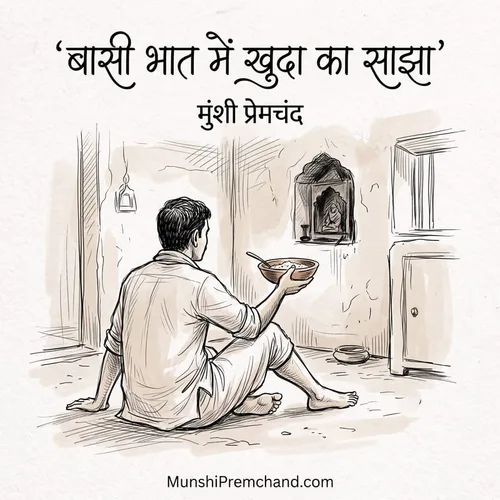
Complete English Translation: God's Share in Stale Rice
1
In the evening, when Dinanath returned home and informed Gauri that he had secured a clerk's job in an office with a salary of fifty rupees a month, her face bloomed with delight. Her faith in the gods grew firmer still.
For the past year, their condition had been wretched. There was neither employment nor income. Whatever modest jewelry remained in the house had already been sold. The house rent hung heavily over their heads. They had borrowed money from every friend who was willing to lend. Their one-year-old child wept for milk. If they managed to obtain a single meal, anxiety immediately gripped them about where the evening meal would come from.
Besieged by relentless demands for repayment, it had become almost impossible for poor Dinanath to step out of his house. The moment he crossed the threshold, clamoring cries arose from all sides: "Splendid, Babuji, splendid! You borrowed the money promising to return it in two days, and for two months you have not even shown your face! Brother, this is hardly honorable. You remember your own necessity, but have not the slightest regard for the necessities of others! That is why the proverb says: lend to an enemy if you must, but never to a friend."
These reproaches pierced Dinanath like barbed arrows, and he often felt tempted to end his life. But gazing upon the helpless face of his silent wife and the innocent eyes of his child, he would stifle the sorrow in his breast and endure.
At last, today God had shown mercy upon him, and the dark days of misery had passed.
Gauri said with a beaming countenance, "Did I not tell you? God remembers everyone. Sooner or later He was bound to remember us as well. But you had no faith! Tell me now, are you convinced of God's boundless benevolence?"
Dinanath argued out of stubborn pride: "This is merely the fruit of my own tireless running about. What has God's benevolence to do with it? I would acknowledge God's hand only if He had torn open the thatched roof and dropped gold from the heavens!"
Yet whatever words his lips uttered, deep reverence for God had begun to blossom within his heart.
2
Dinanath's employer was an exceedingly stern man, and exceptionally demanding in matters of work. He was nearly fifty years of age and in poor health, yet he labored more rigorously than anyone else in the office. No employee dared arrive even a minute late or leave a minute before the appointed closing time. A brief fifteen-minute recess was permitted in the middle of the day, during which anyone who wished could chew betel leaf, smoke a cigarette, or take light refreshments; beyond that, not a single minute of leisure was granted.
Salaries were disbursed promptly on the first of every month. The office remained closed on public festivals, and work was never exacted past the regulation hours. All clerks received an annual bonus, and there was also the provision of a provident fund.
Yet not a single man was happy. No one complained of the hard work or the strict punctuality; the sole grievance was the master's cold and withered demeanor. No matter how diligently one labored, no matter if one poured out his very lifeblood for the firm, not a single word of appreciation or gratitude ever crossed the master's lips.
Whether other employees were satisfied or not, Dinanath harbored no resentment toward his employer. Even when subjected to sharp rebukes and reprimands, he continued to work with unflagging diligence.
Within a year, he paid off all his debts and even managed to accumulate a small nest egg. He was among those who can live contentedly on modest means, provided the income arrives with dependable regularity.
Whenever a single rupee had to be expended on any extraordinary item, husband and wife held counsel for hours, and only after much vigorous dispute was the expenditure finally sanctioned. If a domestic bill was introduced by Gauri, Dinanath stood in fierce opposition. If introduced by Dinanath, Gauri subjected it to searching criticism. The passage of the bill depended entirely upon the persuasive eloquence of the mover; there existed no third authority to certify the measure.
And Dinanath was now a staunch believer. He harbored not the slightest doubt regarding divine mercy or divine justice. He performed his evening prayers faithfully every twilight and read the Bhagavad Gita with unwavering regularity.
One day, when an atheist acquaintance mocked belief in God, Dinanath argued, "Brother, to this day it has never been settled whether God exists or not. Both camps command arguments forged of steel. But in my judgment, it is far safer to be a believer than an atheist. If the Almighty does exist, atheists will find no refuge anywhere except the fires of hell! A believer, on the other hand, holds sweetmeats in both hands. If God exists, what could be better? And even if He does not exist, what has the believer lost? A mere four or five minutes spent in daily prayer!"
The atheist friend made a sour grimace at this two-faced logic and walked away.
3
One evening, just as Dinanath was preparing to leave the office, his employer summoned him into his private chamber. Offering him a chair with unusual warmth, the master said, "How long have you been working here? It must be a full year by now, is it not?"
Dinanath replied with humble courtesy, "Yes, sir, the thirteenth month is currently running."
"Make yourself comfortable. Do you take tea or refreshments when you return home at this hour?"
"No, sir, I am not accustomed to evening refreshments."
"You must chew betel leaf at least? So young a man, and yet practicing such austere restraint!"
Saying this, he rang the desk bell and ordered his orderly to fetch betel leaves and a plate of sweetmeats.
Dinanath grew uneasy. Why this sudden burst of extravagant hospitality? Hitherto, the master barely acknowledged a morning salaam; today, sweetmeats and paan were being laid before him! It seemed the employer was pleased with his work. At this thought, a surge of self-confidence filled his breast, and the remembrance of God flashed across his mind: Truly God is all-seeing and righteous! Otherwise, who in this vast city would have noticed a humble clerk like me?
The orderly brought the platter. Compelled by his master's insistence, Dinanath began eating the sweets.
The employer smiled gently and said, "You have probably found me rather cold and aloof. The truth is that in our country, men have so little sense of personal responsibility that if an officer shows the slightest leniency, subordinates immediately take unfair advantage of his gentleness, and the work falls into ruin. There are, to be sure, a few fortunate masters who can mingle familiarly with their servants, joke with them, and yet their workers never slacken, but labor with even greater zeal. I do not possess that gift; hence I consider it wiser to maintain a distance between myself and my staff.
"Thus far, this policy has served me well. Nevertheless, I continually observe the character and conduct of every man, testing their worth. The opinion I have formed regarding you is that you are thoroughly loyal and trustworthy. Therefore, I wish to entrust you with work of far greater responsibility, where you will have very little manual copying to do, but will supervise others. Your salary will be increased by fifty rupees a month. I am confident that you will execute your duties with even greater devotion than you have displayed hitherto."
Tears welled in Dinanath's eyes, and the sweetmeat in his throat tasted salty with emotion. His heart urged him to throw himself at his employer's feet and say: My very life is at your service! You have exalted my honor, and I shall leave no stone unturned to prove worthy of your trust! But his voice trembled, and he could only look into his master's eyes with an expression of boundless gratitude.
Drawing out a thick ledger, the employer said in a lowered voice, "I require your assistance in a matter upon which the entire future of this establishment depends. Among all these men, I have found you alone to be worthy of absolute confidence, and I trust you will not disappoint me.
"This is the ledger for the past financial year. Certain entries have been recorded in it according to which the company appears to have earned several thousand rupees in profit. But as you know, we have been operating at a loss for several months. The clerk who wrote this ledger had a handwriting almost identical to your own. If the two scripts were placed side by side, even a handwriting expert would find it difficult to discern any difference between them.
"What I require is that you rewrite one single page of this ledger and insert it in place of the existing leaf. I have already had the page number printed in facsimile, and I have engaged a bookbinder who will rebind the volume tonight. No living soul will ever discover the alteration. All that is required is that you copy the page with your own pen."
Dinanath asked in confusion, "If the page is merely to be copied, sir, what is the necessity of removing it?"
The employer laughed, "Do you imagine you are to make an exact copy of the existing page? I shall alter several of the figures! I give you my word that I am undertaking this step solely for the preservation of the firm. If this adjustment is not made, the livelihoods of one hundred men working in this office will be ruined! There is no need for prolonged deliberation. It is barely half an hour's labor. You write with great speed."
A terrible dilemma confronted Dinanath. It was evident beyond shadow of doubt that he was being asked to commit forgery. He possessed no means of ascertaining whether his employer spoke the truth for the protection of the firm or was acting out of pure private greed. But in either case, it was forgery—rank, criminal forgery! Was he to murder his own soul? No, impossible!
He murmured in trembling hesitation, "You must pardon me, sir. I cannot execute this task."
The employer asked with the same unruffled smile, "Why?"
"Because it is an outright forgery, sir."
"What do you call forgery?"
"Altering figures in an account book is forgery."
"Even if that alteration protects the livelihoods of one hundred men? The true financial condition of the company is one thing, its paper status is another. If this alteration is not carried out, several thousand rupees will have to be disbursed immediately in paper profits; the inevitable result will be the bankruptcy of the firm, and every single employee will be thrown into the street!
"I refuse to allow the blood of so many destitute clerks to be shed for the sake of a few wealthy shareholders! If one must practice a little deception for the welfare of others, it is no murder of the soul!"
Dinanath had no answer to this argument. If the employer's words were true, and this deception would preserve the daily bread of a hundred men, then in truth it was not a crime, but a stern and heroic duty. Even if his personal soul suffered a stain, should one not disregard it to rescue one hundred families from starvation?
Yet the moment his moral objection was silenced, fear for his personal safety arose. He said, "But if the matter is discovered, sir, I shall be destroyed! I shall be sentenced to fourteen years of penal transportation across the black waters!"
The employer burst into hearty laughter, "If the matter is ever discovered, my dear fellow, you will not be ensnared—I will be the one trapped! You can simply deny everything."
"Will not the handwriting be recognized?"
"How will anyone even discover that a leaf has been changed? The handwriting is identical."
Dinanath was vanquished. Taking up his pen, he sat down and began copying the altered page.
4
Yet a thief had taken root inside Dinanath's conscience.
To Gauri, he could not breathe a single syllable regarding the matter.
A month later, his promotion took effect. His salary was raised to one hundred rupees a month, and he received a bonus of two hundred rupees in cash. Prosperity entered his household; the signs of abundance became visible in every corner.
Yet Dinanath's guilty mind remained crushed beneath an unbearable burden. The sophistries with which his employer had sealed his lips could never, he knew, satisfy Gauri's simple, honest heart.
His devout faith now became a source of perpetual terror. An awful divine retribution must inevitably follow this sin! No penance, no ritual, no offering could avert it. It might not strike today; it might not strike in a year or two; it might hold off for five or ten years. But the longer it was delayed, the more catastrophic it would be—the principal debt of sin would compound with interest!
He cursed himself again and again: Why did I succumb to the master's temptation? Whether the firm survived or collapsed, what was that to me? Whether those clerks kept their bread or starved, what was that to me? At least my soul would not have been plunged into this agony! But what is done cannot be undone, and divine punishment must surely fall!
This dread drained all enthusiasm, joy, and sweetness from his life.
Malaria was raging across the city. His infant son developed a high fever. Dinanath felt his soul shrink to his fingertips. The hour of divine vengeance had struck! Where should he go? What should he do? His intellect seemed utterly paralyzed.
Gauri said, "Go fetch some medicine, or call a physician. The fever has lasted three days."
Dinanath said with an agonized heart, "Yes, I am going, but a terrible dread clutches my breast."
"What cause is there for dread? Why do you utter such ominous words? Who does not contract fever in this season?"
"Why is God so merciless?"
"God is merciless only to sinners! What wrong have we done to anyone?"
"Does God never forgive sinners?"
"If sinners were never punished, the entire world would sink into chaos!"
"Yet a man sometimes performs acts that may be a sin from one perspective, but a righteous virtue from another."
"I do not understand."
"Suppose by my telling a lie, another man's life is saved—is that a sin?"
"In my belief, such a lie is a holy virtue (punya)!"
"Then whatever sin promotes human welfare is in truth a virtue?"
"Of course! What else could it be?"
For a brief while, Dinanath's ominous dread subsided. He summoned a doctor, treatment commenced, and within a week the child was completely cured.
Shortly afterward, however, Dinanath himself fell ill.
Now he was certain: this was the divine judgment, and from it there was no escape! It was an ordinary attack of malaria, but Dinanath's terror of retribution transformed it into violent delirium. In fever, as in intoxication, the imagination becomes abnormally heightened. What was once merely an inner suspicion now assumed terrifying physical reality.
His fevered mind conjured messengers of death—Yamduts brandishing iron maces and barbed spears; it stoked the blazing cauldrons of hellfire! What effect could a physician's modest draft of medicine produce against the crashing thunder of an eight-thousand-pound mace or the scorching heat of a boiling ocean of fire?
Dinanath was no hypocrite. He harbored no faith in the mythical fantasies of ancient lore; he was a rationalist who had embraced God only when his intellect had been persuaded by logical arguments.
Yet along with God had arrived His mercy and His retribution. Divine mercy had granted him employment and worldly honor; without it, he might have starved. But to starve to death was child's play compared to being hurled headlong into a boiling furnace of hell!
The fear of divine retribution, ingrained through centuries of ancestral conditioning, was so deeply rooted in his psyche that it seemed an integral part of his soul. His modern rationalism rolled over these ancient deposits like ocean waves surging against a granite mountain—washing over them for a fleeting instant, only to recede and leave the immovable peak standing exactly as before.
Yet his life had not yet run its course; he survived. As soon as his strength returned, he resumed attending the office.
One morning, Gauri said, "During the days when you were bedridden and your condition had grown desperate, I made a solemn vow to God: if you recovered, I would feast fifty Brahmins. From that very next morning, your condition began to improve. God heard my prayer! Had He not shown mercy, I would have been left begging for crusts of bread. Go to the market today and fetch the groceries so that I may fulfill my vow. If fifty Brahmins are invited, at least a hundred will arrive; count fifty destitute beggars as well, and twenty or twenty-five friends will surely join. We must prepare for two hundred persons. I shall write out the list of provisions."
Dinanath frowned deeply and asked, "Do you truly believe I recovered through God's mercy?"
"How else did you recover?"
"I recovered simply because life remained within my body!"
"Do not utter such blasphemies! The vow must be fulfilled!"
"Never! I do not regard God as merciful!"
"Do you claim God is cruel?"
"There is no one in the universe more merciless than He! A God who casts His own created playthings into an inferno of fire as punishment for their frailties and foolish blunders can never be called merciful! If God is merciful in some small degree, He is infinitely more cruel! The very conception of such a deity fills me with loathing!
"Love is declared to be the greatest power in existence. Wise thinkers have acknowledged love as the supreme jewel of life and of the universe. Even if not in daily practice, in ideal theory love remains the fundamental truth of our existence.
"Yet your God governs His creation through the terror of punishment! What difference remains, then, between Him and a brutal earthly tyrant? I do not wish to worship such a God; I cannot worship Him!
"For the rich and mighty, God may indeed be merciful, for they plunder the world with impunity. But for people like us, His mercy is nowhere to be seen. Instead, fear stands glaring at us at every turn: Do not do this, or God will punish you! Do not touch that, or God will strike you!
"To govern through love is humanity; to rule through terror is barbarism! Better that there should be no God at all than an autocratic, terrorizing deity! By banishing Him from my heart, I wish to free myself from both His mercy and His retribution!
"A single stroke of cruel punishment reduces years of love to dust. I shower affection upon you daily; but if I were to take a stick tomorrow and thrash you, you would never look upon my face again! For a life ruled by terror and punishment, I refuse to accept God's patronage!
"I need no divine partnership in my stale rice! If you insist on this religious feast, I shall swallow poison!"
Gauri stood paralyzed, staring into his face with terrified, bewildered eyes.
Summary of God's Share in Stale Rice
'God's Share in Stale Rice' (Basi Bhat Mein Khuda Ka Sajha) is one of Munshi Premchand's most penetrating psychological and philosophical explorations of religious guilt, economic desperation, and the moral bankruptcy of authoritarian faith.
Dinanath, an unemployed clerk who has weathered a year of soul-crushing poverty, finds a job paying fifty rupees a month. His wife Gauri celebrates the position as proof of divine compassion. Dinanath, too, gradually abandons his rationalist skepticism, adopting devout religious rituals and arguing that faith in a just God provides moral security.
However, his austere employer entraps him in a profound ethical crisis. The master asks him to forge an account ledger leaf to conceal company losses, claiming that the deception is an act of humanitarian duty necessary to save the firm from bankruptcy and preserve the jobs of one hundred impoverished clerks. Dinanath succumbs to the social argument and the promise of a salary increase.
Although rewarded with a promotion and cash bonus, Dinanath's conscience is shattered. Convinced that an unforgiving God will extract terrible vengeance with compounding interest, his life becomes a living nightmare of religious dread. When malaria strikes his son and subsequently hospitalizes Dinanath himself, his guilt-induced delirium transforms physical fever into horrifying visions of Yamduts and boiling cauldrons of hellfire.
Upon recovering through medical treatment and physical resilience, Gauri insists on hosting a lavish feast for fifty Brahmins to honor a vow she made to the Almighty. Dinanath fiercely refuses, denouncing a deity who governs creation through terror and punishment rather than love. Pointing out that religious fear paralyzes the poor while the wealthy exploit the earth without consequence, he severs his allegiance to an authoritarian God, rejecting divine interference in his hard-won, modest existence.
Publication History
'God's Share in Stale Rice' (Basi Bhat Mein Khuda Ka Sajha) was first published in Hindi in 1934 and subsequently included in Premchand's story collection Mansarovar (Vol. 2). Written during the final, intensely philosophical phase of Premchand's literary career, the story reflects his radical critique of ritualistic religion, institutionalized fear, and the socio-economic conditions that compel ordinary men into moral compromise.
This unabridged English translation was published in 2026 by MunshiPremchand.com as part of the MunshiPremchand.com English Translation Series.
Themes & Critical Significance
- The Morality of Love versus the Religion of Terror: Premchand delivers a scathing critique of traditional religious systems that maintain social control through fear of hellfire, arguing through Dinanath that true morality must be grounded in love, empathy, and human solidarity.
- Economic Insecurity and Moral Vulnerability: Dinanath's capitulation to forgery is not born of innate greed, but of the psychological trauma of prolonged poverty and the cunning humanitarian framing offered by his employer.
- The Psychology of Guilt and Superstition: The narrative brilliantly dissects how ancestral religious indoctrination can hijack a rational mind, transforming an ordinary malarial fever into apocalyptic hallucinations of divine torture.
- Class Bias in Conceptions of Divine Justice: Dinanath perceptively observes that while the affluent celebrate God's benevolence as they amass fortunes through exploitation, religion offers the poor nothing but paralyzing terror and warnings of retribution.
- The Rejection of Parasitic Piety: The memorable title phrase captures Dinanath's ultimate emancipation: an ordinary working man refuses to share his meager, hard-earned bread with a punitive deity whose favor is bought through ritualistic feasts for priests.