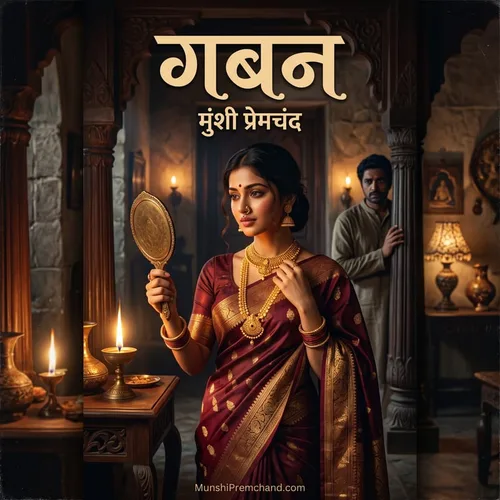
When Rama was coming down the stairs with heavy steps, Jalpa had not the slightest suspicion that he was running away from home. She had already read the letter. Her heart was so irritated that she wanted to go and give Rama a good scolding. “He has deceived me like this!” But in a moment her feelings changed. Could it be that he had spent the government money? That must be it. He must have given Ratan’s money to the goldsmith. Perhaps that day he had taken the government money to pay Ratan. This thought made her angry again. Why did he hide so much from her? Why did he make such grand claims before her? Did he think she did not even know that there were both rich and poor people in the world? Did all women remain loaded with jewelry? Was it a sin not to wear jewelry? When money was left over after more important necessities, jewelry could be made too. People did not cut down on food and clothing, steal, or act dishonestly merely to wear jewelry! Had he thought her so fallen? She thought Rama would be in his room, and decided to go and ask what ornaments he wanted. As she grasped the gravity of the situation, fear replaced her anger. She hurried downstairs, confident that he would be sitting there waiting for her. But when she entered the room, he was nowhere to be found. His bicycle was still there. She immediately peered through the doorway. He was not on the road either. Where had he gone? The two boys had gone to school; whom could she send to call him back? An unknown anxiety stirred within her heart. She immediately went upstairs, removed the necklace from her neck and the bangle from her hand, tied them in a handkerchief, then came downstairs, went out onto the road, hired a carriage, and told the coachman, “Go to the octroi court.” She regretted sitting there for so long. Why had she not immediately taken off the jewelry and given it to him? On the way she kept looking carefully in both directions. Could he really have gone so far so quickly? Perhaps, because he was late, he too had taken a carriage today; otherwise they would certainly have met by now. She asked the carriage driver, “Tell me, did you just see a gentleman going this way in a carriage?”
The carriage driver replied, “Yes, Ma’am, a gentleman just went this way.”
Jalpa felt somewhat reassured. She would reach there by the time Rama did. She repeatedly told the coachman to make the horse go faster. By the time she reached the office, it was eleven o’clock. Hundreds of people were rushing about the courthouse. Whom should she ask? She did not know where he sat. Suddenly she saw a peon. Jalpa called him and said, “Listen, please call Babu Ramanath.”
The peon said, “I am going to call him myself. The head clerk sent me. Have you come from his house?”
Jalpa—“Yes, I have come straight from home. He left home only ten minutes ago.”
The peon—“He hasn’t come here.”
Jalpa was thrown into great confusion. If he had not come here and she had not met him on the way, then where had he gone? Her heart began pounding wildly. Her eyes filled with tears. She knew no one here except the head clerk. She had never had occasion to speak to him, but at that moment her shyness disappeared. Before fear, all other feelings of the heart are suppressed. She said to the peon, “Please tell the head clerk—no, come, I’ll go myself. I have something to discuss with him.” Seeing Jalpa’s appearance and bearing, the peon was impressed and immediately turned back toward the head clerk’s room. Jalpa followed him. As soon as the head clerk heard about her, he came out.
Jalpa stepped forward and said, “Forgive me, Babu Sahib, for troubling you. He left home fifteen or twenty minutes ago. Has he still not come here?”
Ramesh—“Ah, so you are Mrs. Ramanath. He hasn’t come here yet. But he was not in the habit of going out for pleasure during office hours.”
Looking toward the peon, Jalpa said, “I want to ask you something.”
Ramesh—“Come inside and sit down. How long will you stand here? I am surprised where he has gone. Perhaps he is sitting somewhere playing chess.”
Jalpa—“No, Babuji, I am afraid he may have gone somewhere else. About ten minutes ago he wrote me a note.” She searched her pocket. “Yes, here it is. You are kind to him, so there is no need for any concealment. Does he have any government money in his charge?”
Ramesh asked in astonishment, “Why, he hasn’t told you anything?”
Jalpa—“Nothing. He has never said a word about this.”
Ramesh—“I cannot understand it. He has to deposit three hundred rupees today. He had not deposited the previous day’s receipts, had he? There were notes, and he left with them in his pocket. Someone took the notes from him in the market.” He smiled. “He isn’t worshipping some other goddess, is he?”
Jalpa lowered her face in embarrassment. She said, “If that were his fault, you too would not escape that accusation. Someone must have taken them from his pocket. He must not have told me out of shame. If he had said even a word to me, I would have immediately taken out the money and given it to him. What difficulty was there?”
Ramesh Babu asked incredulously, “Is there money at home?”
Jalpa said fearlessly, “He needs three hundred, doesn’t he? I’ll bring it right now.”
Ramesh—“If he has come home, send him here.”
Jalpa came out, sat in the carriage, and told the coachman to go to the Chowk. She had decided to sell her necklace. She had several friends from whom she could have borrowed money. There is great affection among women. Unlike men, their friendship does not end merely with exchanging betel leaves and betel nuts. But there was no time. When she reached the goldsmiths’ quarter, she wondered which shop to enter. She was afraid of being cheated. She went up and down the entire street but did not have the courage to enter any shop. Time was slipping away. At last, seeing an old goldsmith in one shop, her hesitation diminished somewhat. The goldsmith was very shrewd; seeing Jalpa’s hesitation and uncertainty, he understood that a good victim had fallen into his hands. Jalpa showed him the necklace and asked, “Can you take this?”
The goldsmith examined the necklace from every side and said, “If there is even a little room for profit, why wouldn’t I take it? The workmanship is not very good.”
Jalpa—“It isn’t good because you want to buy it. If you were selling it, it would be excellent. How much will you give?”
Goldsmith—“You tell me.”
The goldsmith offered three hundred and fifty rupees and, after bargaining, went up to four hundred. Jalpa was running out of time, so she took the money and left. She had bought that necklace with so much enthusiasm; the longing for it had arisen in her even in childhood. Yet she felt not the slightest sorrow at selling it today for half its price. Rather, she experienced a proud happiness. When Rama learned that she had given him the money, how delighted he would be! Perhaps he had already reached the office. Thinking how wonderful it would be, she returned to the office. Ramesh Babu said when he saw her, “What happened? Did you find him at home?”
Jalpa—“He still hasn’t come here? He did not go home.” Saying this, she held out the bundle of notes toward Ramesh Babu.
Ramesh Babu counted the notes and said, “All right, but where is he still? If he was not going to come, he could at least have written a letter. I was in a terrible predicament. You came just in time. Seeing your good sense at such a moment has made me very happy. This is the true duty of noble women.”
When Jalpa again sat in the carriage and went home, she felt as though she had risen in stature. A strange vitality was coursing through her body. She was certain that Rama would be sitting there anxiously waiting. She would first give him a thorough scolding, and after making him thoroughly ashamed, she would tell him what she had done. But when she reached home, there was no sign of Ramanath.
Jageshwari asked, “Where did you go out in this heat?”
Jalpa—“I went on an errand. He did not eat today. I don’t know where he has gone.”
Jageshwari—“He must have gone to the office.”
Jalpa—“No, he did not go to the office. A peon came from there asking about him.”
Saying this, she went upstairs, put the remaining money into the chest, and began fanning herself. Her body was burning from the heat, but her ears remained turned toward the doorway. Until then she had not the slightest suspicion that Rama had taken the road to a distant place.
Until four o’clock Jalpa was not especially worried, but as the day began to decline, her anxiety increased. At last she climbed onto the highest roof, although no one usually went there because it was in a dilapidated condition, and looked in every direction, but Rama was nowhere to be seen. When evening came and Rama still did not return home, Jalpa became restless. Where had he gone? He never went anywhere without coming home from the office first. If he were at a friend’s house, would he not have returned by now? Who knew whether he even had any money in his pocket? The poor man must have been wandering somewhere all day. Again she regretted that she had not taken off the necklace and given it to him the moment she read his letter. Why had she hesitated? The poor man must be too ashamed to come home. Where should she go? Whom should she ask?
When the lamps were lit, she could bear it no longer. She thought perhaps Ratan might know something. She went to her bungalow and learned that he had not come there at all that day. Jalpa searched all the parks and fields where she often used to go walking with Rama, and returned home in despair by nine o’clock. Until then she had held back her tears, but the moment she stepped into the house and realized that he had still not returned, she sat down in utter dejection. Her suspicion had now become firm: he must certainly have gone somewhere. Yet she still had some hope that perhaps he had come after her and then gone away again. She went and asked Jageshwari, “Did he come home, Ammaji?”
Jageshwari—“He must be sitting somewhere chatting with his friends. The house is just an inn to him. He left the house at ten and there has been no sign of him since.”
Jalpa—“He used to go somewhere only after coming home from the office. Today he did not come home at all. Shall I send Gopi Babu? Let him go and see where he has stayed.”
Jageshwari—“Where will the boys go looking at this hour? Who knows what he is up to. Wait a little longer, then put the food away. How long can anyone keep waiting?”
Jalpa gave no answer. She said nothing to her about the office. If Jageshwari heard about it, she would become frightened and immediately start crying and lamenting. Jalpa went upstairs and lay down, weeping over her fate. Again and again her heart became so restless that it felt as though a thorn were stabbing her. She kept thinking: if he does not come all night, what will we do tomorrow? Until they knew where he had gone, where could anyone go looking for him?
For the first time that day, Jalpa’s heart admitted that all this was the result of her own actions. It was true that she had never insisted upon jewelry; but she had never clearly refused it either. If she had not become so impatient after the jewelry was stolen, why would this day have come? In this weakened state of mind, Jalpa began taking more than her share of the blame upon herself. She knew that Rama accepted bribes and brought money by squeezing and extorting it from people. Yet she had never stopped him. Why had she herself stepped beyond her means? Why did she think of going out every day for rides and amusements? Why did she become so delighted whenever he brought her gifts? At this moment Jalpa was taking this responsibility upon herself as well. Had Rama not done everything only because he loved her and wanted to make her happy? That was the nature of young men. And what had she done to protect him? Why had she not understood that one day there would have to be a penalty for spending more than one’s income? Now she remembered so many things that should have revealed to her the anguish in Rama’s heart, but she had never paid attention to them.
Jalpa remained absorbed in these worries for who knew how long. When the whistles of the watchmen reached her ears, she went downstairs and said to Jageshwari, “He still has not come. You should go and eat something.”
Jageshwari had been sitting and dozing. Startled, she asked, “Where did he go?”
Jalpa—“He still hasn’t come.”
Jageshwari—“He hasn’t come yet? It must be midnight already. Didn’t he say anything to you when he left?”
Jalpa—“Nothing.”
Jageshwari—“You didn’t say anything to him?”
Jalpa—“Why would I have?”
Jageshwari—“Then shall I wake Lalaji?”
Jalpa—“What would be the use of waking him at this hour? Please go and eat something.”
Jageshwari—“I cannot eat anything now. He is such an unpredictable boy. He neither said nor heard anything, and who knows where he has gone and sat down. At the very least, he could have sent word that he would not be coming home tonight.”
Jageshwari lay down again, but Jalpa remained sitting in the same place until the entire night passed—a mountain of a night, every moment of which seemed to pass like a whole year.