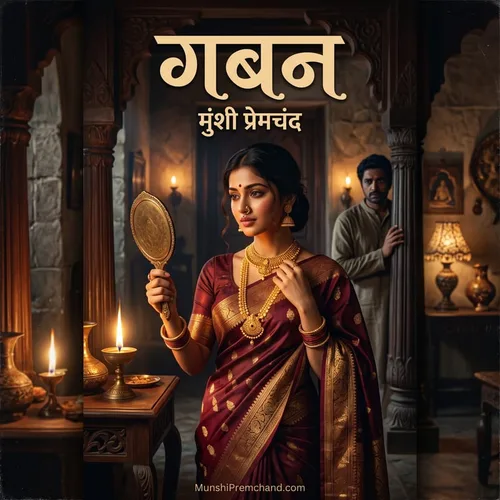
The cool, pleasant, invigorating evening of Chaitra, the bank of the Ganges, the field of dhak trees blazing with tesu blossoms, the shade-giving banyan tree, the cows and buffaloes tied beneath it, the huts rippling with vines of pumpkins and bottle gourds—nowhere dust or commotion, nowhere noise or bustle. Could there be a better place for happiness and peace? Below, the golden Ganges, gleaming beneath red, black, and blue veils, singing in soft tones, now leaping forward, now hesitating, now playful, now grave, was making its way toward infinite darkness, as though a many-colored childhood memory, playing in the lap of sport and delight, were moving toward a future filled with anxiety, struggle, and darkness. Devi and Rama had taken refuge here, near Prayag.
Three years had passed. Devi Din had acquired land, planted a garden, established a farm, bought cows and buffaloes, and was finding happiness, contentment, and peace in the path of action and unceasing effort. The yellow pallor and wrinkles that had once marked his face were gone; a new vitality and a new radiance shone from it. Evening had come. The cows and buffaloes returned from the fields. Jaggo tied them to their posts and brought little bundles of straw to place before them. Just then Devi and Gopi arrived in a bullock cart loaded with stalks. Dayanath had cleared a patch of ground beneath the banyan tree. The stalks were unloaded there. This was the threshing floor of the little settlement.
Dayanath had been dismissed from his job and was now Devi's assistant. He still had the same love for newspapers. Several papers arrived every day, and in the evening, once he was free, Munshiji would read them aloud and explain them. Often ten or fifteen men from the surrounding villages would join the listeners, and every day a small gathering would take place.
Rama had grown so fond of this life that even if he were offered a position as a police inspector, not merely as a station officer, he would perhaps refuse even to mention the city. He rose early in the morning and bathed in the Ganges, then did some exercise and drank milk. By the time the day was well underway, he would sit down with his medicine chest. He had read several books on traditional medicine and could prescribe remedies for minor illnesses. Ten or fifteen patients came every day, and his reputation grew from day to day. As soon as he was free of this work, he went to his garden. There were some vegetables growing there, some fruit trees, and some medicinal herbs. For now the garden produced only vegetables, but he hoped that within three or four years it would yield a good income from lemons, guavas, jujubes, oranges, mangoes, bananas, Indian gooseberries, jackfruit, bael, and other fruits.
Devi unyoked the bullocks from the cart, tied them to their posts, and said to Dayanath, "Has Bhaiya still not returned?"
Dayanath, gathering the stalks, said, "Not yet. I no longer have much hope that she will recover. It is the debt of fate. How comfortably she used to live—a carriage, a bungalow, dozens of servants. And look at her condition now. All the property is still there; the lawyer left a fine estate, but his brothers and nephews seized it."
Devi Din said, "Bhaiya used to say that if she went to court, she would get everything back, but she says, 'I will not lie in court.' She is a woman of very high principles."
Suddenly Jageshwari came out of a hut carrying a small infant in her arms. She handed the child to Dayanath and said to Devi Din, "Brother, please go and see Ratan. I don't know what has happened to her. Zohra and Bahu are both crying! The child—I don't know where he has gone!"
Devi Din said to Dayanath, "Come, Lala, let us see."
Jageshwari said, "What will he do by going? Their grandmother dies before them at the mere sight of a sick person."
Devi Din went into Ratan's room and saw her lying on a bamboo cot. Her body had withered away. The sun-flower-like face that had once bloomed so brightly had withered and turned pale. The colors that had given the picture life and movement had faded away; only its shape remained. The music that had been so pleasing to the ear, so life-giving, steeped in growth and joy, seemed to have dissolved into the sky, leaving only its faint, mournful echo. Zohra was bent over her, looking at her with eyes full of compassion, helplessness, anguish, despair, and longing.
For a year now she had devoted herself to Ratan's care, knowing neither day from day nor night from night. Ratan's affection for her, and the open, unreserved sisterhood she had offered her in an atmosphere of distrust and exclusion, how else could Zohra repay? Ratan had given her the sympathy that she had not even received from Jalpa. Sorrow and toil had brought the two women together; their souls had become united. This deep affection was an entirely new experience for Zohra, something she had never even imagined. In this relationship, her deprived heart had found both a husband's love and a child's affection.
Devi Din looked anxiously at Ratan's face, then took her pulse and asked, "How long has she been unable to speak?"
Jalpa wiped her eyes and said, "She was speaking just now. Suddenly her eyes rolled upward and she fainted. Have you still not brought the physician?"
Devi Din said, "Her medicine is not with the physician." Saying this, he took a little ash, stroked Ratan's head, murmured something, and put a pinch of ash on her forehead. Then he called, "Ratan, daughter, open your eyes."
Ratan opened her eyes and, looking around with startled eyes, said, "My motorcar had come, hadn't it? Where has that man gone? Tell him to bring it after a little while. Zohra, today I will show you around my garden. We will both sit on the swing."
Zohra began crying again. Jalpa too could not hold back her tears. Ratan looked at the ceiling for a moment. Then, as though her memory had suddenly awakened, she said with a shy, sad smile, "I was dreaming, Dada!"
A veil of darkness had fallen over the crimson sky. At that very moment, death cast its veil over Ratan's life.
When Ramanath returned with the physician in the first watch of the night, a silence of death had settled over the place. The grief at Ratan's death was not the kind in which a person cries out in despair; it was the kind in which we weep silently, the kind whose memory is never forgotten, whose weight never leaves the heart.
After Ratan, Zohra was alone. They had slept together, sat together, and worked together. Zohra could no longer take interest in anything by herself. Sometimes she went to the riverbank, remembered Ratan, and wept; sometimes she went to the mango sapling they had planted together and stood there for hours. It was as though her married happiness had been plundered. Jalpa had so little free time from caring for the child and preparing food that she could not spend much time with Zohra; and even when they sat together, they would begin talking about Ratan and both would start crying.
It was the month of Bhadon. A battle seemed to have broken out between earth and water. The armies of water, riding upon the air, rained down arrows of water from the sky. Its land forces had created havoc upon the earth. The Ganges was swallowing villages and towns. Entire villages were swept away.
Zohra went to the riverbank to watch the spectacle of the flood. She could never have imagined that the slender Ganges could become so vast. The waves roared wildly, raised their crests from their mouths, and leapt with their arms into the air. They changed their tactics like clever bandits. At times they advanced a step, then retreated, then whirled around and rushed forward again. Somewhere a hut would tremble and be swept rapidly away, like a drunkard running along. Somewhere a tree, sinking and rising with all its branches and leaves, floated like some creature from the Stone Age. Cows and buffaloes, cots and planks, passed before the eyes like enchanted pictures.
Suddenly a boat came into view. Several men and women were sitting in it. Sitting was hardly the word—they were clinging to it. The boat rose and fell. It seemed certain that it would overturn at any moment. Yet, what courage! They continued to cry, "Victory to Mother Ganga!" The women still sang songs praising the glory of the Ganges.
Who could have witnessed such a struggle between life and death? People stood on both banks, tense and anxious, pressing their hearts down. Whenever the boat tilted, their hearts leapt to their lips. They tried to throw ropes, but the ropes fell short each time.
Suddenly the boat overturned. Everyone disappeared into the waves. For a moment several men and women could be seen sinking and rising, then they vanished from sight. Only something white was moving toward the bank. A current carried it to within about twenty yards of the shore. As it came closer, it became clear that it was a woman. Zohra, Jalpa, and Rama were all standing there. A child could also be seen in the woman's arms. All three became desperate to bring the two of them out, but swimming twenty yards in that direction was not easy. Rama was not a very skilled swimmer either. If his feet lost their footing in the force of the waves, there would be no place left for him except the Bay of Bengal.
Zohra said, "I am going!"
Rama said shyly, "I am ready to go, but I doubt that I can even reach that far. What force there is in the water!"
Zohra stepped into the water and said, "No, I will bring her out right now."
She went waist-deep into the water. Rama said anxiously, "Why are you going to risk your life needlessly? There may be a deep hole there. I was going myself."
Zohra waved her hands and said, "No, no. I swear by you, don't come. I will bring her back myself. I know how to swim."
Jalpa said, "It will be a dead body, what else?"
Ramanath said, "Perhaps she is still alive."
Jalpa said, "Oh, so Zohra can swim too. That's why she had the courage."
Rama looked anxiously toward Zohra and said, "Yes, she knows a little. May God bring her back safely. I am ashamed of my cowardice."
Jalpa said bluntly, "What is there to be ashamed of? What good is there in risking one's life for a dead body? If she were alive, I myself would tell you to go and bring her out."
Rama said self-reproachfully, "Who can know from here whether she is alive or not? Truly, a man with a wife and children becomes impotent. I stood here while Zohra went."
Suddenly a powerful wave came and carried the body farther into the current. Zohra had reached it and was just about to grasp it and pull it toward her when the wave drove it away. Zohra herself was caught in its force and was swept several yards downstream. She recovered herself, but another wave pushed her back again. Rama, frantic, plunged into the water and began shouting at the top of his voice, "Zohra! Zohra! I am coming!"
But Zohra no longer had the strength to fight the waves. She was being swept rapidly downstream together with the body. Her arms and legs stopped moving. Suddenly another torrent came and both disappeared into it. A minute later Zohra's black hair appeared. That was the last glimpse. Then she was gone.
Rama struggled forward for about a hundred yards, beating the water with all his strength, but even over that distance the force of the waves left him breathless. Where could he go now? There was no sign of Zohra anywhere. That final glimpse remained before his eyes. Jalpa stood on the bank crying out in anguish. At last she too jumped into the water.
Rama could go no farther. One force pulled him forward, another backward. The force ahead was love, despair, and sacrifice. The force behind was duty, affection, and attachment. Attachment held him back. He turned back.
For several minutes Jalpa and Rama stood knee-deep in the water, staring in the same direction. Self-reproach had sealed Rama's lips; grief and shame had silenced Jalpa's. At last Rama said, "Why are you standing in the water? You will catch cold."
Jalpa came out of the water and stood on the bank, but she said nothing. The blow of death had overwhelmed her. How unstable life was—this event had made that truth real before her eyes for the second time that day. Ratan's death had been anticipated. They knew she had only a short time left. But Zohra's death was like a thunderbolt.
Only half an hour earlier, the three of them had set out in cheerful spirits to watch the play of the waters. Who could have suspected that they would have to witness such terrible suffering at the hands of death? During these four years Zohra had won everyone's affection through her service, self-sacrifice, and simple nature. What other means did she have to erase her past, to wash away the stains of her former life? All her desires and passions had been absorbed into service.
In Calcutta she had been an object of pleasure and entertainment. Perhaps no respectable man would have allowed her to enter his home. Here everyone treated her like a member of the family. Dayanath and Jageshwari had been reassured by being told that she was Devi Din's widowed daughter-in-law. In Calcutta Zohra had asked Jalpa for nothing more than the privilege of living with her. She had grown disgusted with her own life. Jalpa's trusting generosity had set her upon the path of self-purification. Ratan's pure, selfless life had continually encouraged her.
After a little while Rama too emerged from the water and, sunk in grief, walked toward home. But often he and Jalpa would come and sit on the riverbank and stare for hours toward the place where Zohra had drowned. For many days they retained the hope that perhaps Zohra had survived and would come from somewhere. But gradually even this faint hope disappeared into the darkness of grief.
Yet even now Zohra's face often rises before their eyes. The plants she had planted, the cat she had raised, the clothes she had sewn with her own hands, her room—all these tokens of her memory would bring the image of Zohra before Rama's eyes.