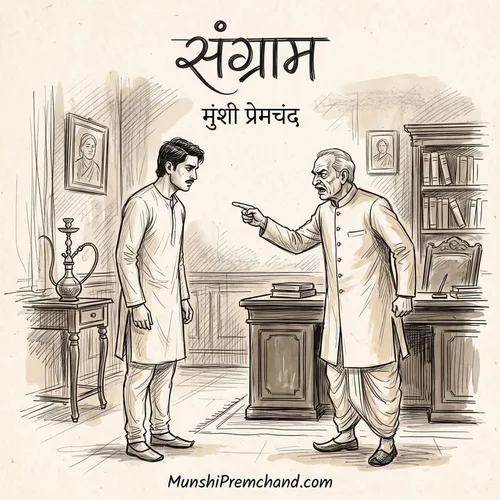
Time: 8:00 AM. Location: Sabal Singh's estate office. Kanchan Singh sits wrapped in a fine shawl, wearing gold-rimmed spectacles, leaning against a plush bolster cushion. The estate accountant (Muneem) is diligently entering figures into ledger books.
Kanchan: The real dilemma is how to justify reducing interest rates. My brother Sabal Singh urges me every day to lower interest rates for tenant farmers. He put me in charge of this financial business specifically to assist poor peasants. But as you know, true righteousness cannot be maintained without capital! The estate income barely covers our household expenses. My brother has never learned the lesson of frugality. Thousands of rupees are squandered annually just entertaining visiting British officials, maintaining polo ponies, horse racing, and club memberships! If I relied solely on estate revenue, where would I get the funds for my extensive charitable work and hosting holy ascetics?
Muneem: Thakur Sahib is an educated man, but his extravagant spending on official hospitality is excessive.
Kanchan: I have a deep desire to build a massive public rest-house (Dharmashala). Where will the money come from? If I charge nominal interest as my brother wishes, all my philanthropic dreams will remain unfulfilled! I don't hoard money for personal luxury; I accumulate it for public welfare. For years I have wished to open a grand public library. In Europe, single philanthropists have founded thousands of libraries! If I stop charging interest, how else can such noble ambitions be realized? Furthermore, look at how much bad debt I absorb! When a tenant has no tangible assets, how can a loan be recovered? If I made it a rule to lend only against solid collateral, how would poor peasants survive emergency crop failures?
(Haldhar enters the room cautiously.)
Kanchan: Ah, Haldhar! What brings you here today?
Haldhar: Nothing special, Huzoor; I just came to pay my respects.
Kanchan: A peasant never comes just to pay respects without a motive! As the Persian proverb says: No greeting is without purpose.
Haldhar: You already know my heart, Huzoor, so why ask? I am in urgent need of a cash loan.
Kanchan: You should have consulted an astrologer before stepping out today! Cash is extremely tight right now. What do you need money for?
Haldhar: My father's annual memorial feast (barsi) is approaching, Huzoor, and there are other household expenses.
Kanchan: And you need to get gold bangles made for your bride as well, I presume?
Haldhar: (Smiling awkwardly) Huzoor reads my mind!
Kanchan: Reading a peasant's mind is no great mystery! Whenever you see green crops swaying in your fields, your pockets start itching! Instead of waiting until the grain is harvested and sold, you rush to borrow money at high interest to fund rituals and jewelry. Then you pay me interest, registration fees, commission to the accountant, and carry home barely eight rupees out of ten! If I refuse to lend, you will curse me and run to some other usurer.
Haldhar: No, Huzoor, that is not so. I genuinely have pressing obligations. The memorial feast must be held to preserve family honor in the community, and bangles must be made. Debt is a wound in one's chest, I know, but I am trapped in difficulty.
Kanchan: My ledger is in a greater difficulty than you! I will have to draw funds from the main bank for you. Had it been anyone else, I would have refused outright. But you are an old tenant whose father dealt with us for decades, so I won't turn you away. However, I warn you beforehand: the entire principal plus interest must be cleared right after the summer harvest! How much do you need?
Haldhar: Two hundred rupees, Huzoor.
Kanchan: Very well. Accountant Sahib, complete the paperwork and disburse the amount. I am going for my morning prayers. (Kanchan exits.)
Muneem: So you need two hundred rupees. Formerly the upfront commission (nazarana) was five percent; it is now ten percent.
Haldhar: As Master wills.
Muneem: The ledger entry fee was previously two percent; it is now four percent.
Haldhar: As Master commands.
Muneem: Stamp paper costs will be five rupees.
Haldhar: Put it all down, Accountant Sahib. Just give me whatever remains.
Significance & Themes
- Hypocrisy of Religious Philanthropy: Kanchan Singh embodies the predatory usurer who uses religious rituals and public charity as a cover for extortionate interest rates (nazarana, processing fees, compound interest).
- The Cycle of Rural Indebtedness: Haldhar represents the trapped Indian peasantry, forced to accept ruinous loan terms to satisfy social obligations and community norms.