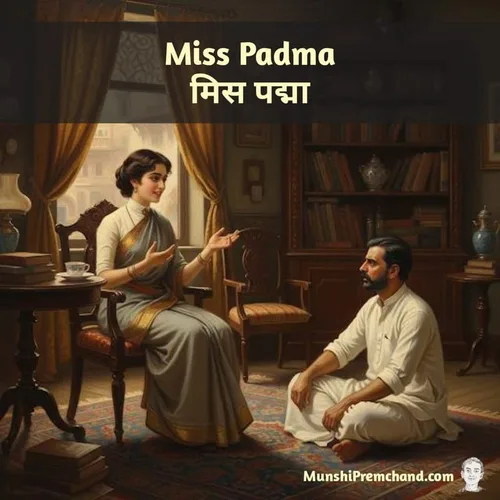
Complete English Translation: Miss Padma
After achieving brilliant success in her legal practice, Miss Padma experienced a brand new sensation—the desolate void of existence.
She had long regarded marriage as an unnatural bond of servitude and had resolved that she would savor life while remaining completely independent. She obtained her Master's degree, passed the bar examinations, and launched her professional practice. She was beautiful, youthful, soft-spoken, and extraordinarily talented. No obstacle hindered her path. In the blink of an eye, she outpaced her young male colleagues at the bar, and her monthly income often surpassed a thousand rupees!
No longer was there a necessity for grueling labor and brain-racking study. Most of her cases were of a kind in which she had already acquired thorough experience; they seemed to require little preparation. She had developed firm confidence in her own powers, having mastered the subtle arts and courtroom stratagems by which legal victories are secured.
Consequently, she enjoyed abundant leisure time, which she spent reading novels and stories, going on pleasure drives, attending the cinema, and socializing. She understood perfectly well that to make life truly happy, an absorbing hobby was essential. She cultivated a passion for planting flowers and shrubs. She would order rare seeds and saplings from far and wide, deriving immense joy from watching them sprout, grow, bloom, and bear fruit; yet, despite everything, an aching void persisted in her life.
It was not that she harbored any aversion toward men. Far from it: she lacked no shortage of suitors. Had she possessed only beauty and youth, worshippers would still have swarmed around her; but here, beauty and youth were wedded to substantial wealth! Why then would the connoisseurs of romance miss such a golden opportunity?
Padma felt no hatred toward romance; what she loathed was subservience—making marriage a lifelong commercial occupation! When one can savor the delights of romantic indulgence while remaining completely free, why on earth should one not do so? She recognized no moral barrier against romantic indulgence, regarding it merely as a natural appetite of the physical body. This appetite could be comfortably satisfied at any clean and respectable establishment; and Padma was perpetually in search of a clean establishment! A customer in a shop buys only what catches her fancy; Padma demanded the very same freedom of choice.
True, she had dozens of admirers—several lawyers, several professors, several doctors, several wealthy aristocrats. Yet all of them were mere profligate playboys—carefree flitters who, like bumblebees, drank the nectar and flew away. There was not a single man among them upon whom she could place her trust. Now she realized that her soul did not crave mere superficial indulgence; it sought something far deeper. What was that elusive thing? Complete, unreserved self-surrender—and that was precisely what eluded her.
Among her suitors was a certain Mr. Prasad—an exceptionally handsome man and a scholar of formidable erudition. He was a professor at a local college. He too was an ardent worshipper of the ideal of free, uninhibited love, and Padma was utterly infatuated with him. She longed to bind him to herself, to make him entirely her own; but Prasad refused to be snared in a net.
Evening had fallen. Padma was preparing to go out for her evening stroll when Prasad arrived. The stroll was postponed at once. Conversation held far greater delight than an evening drive, and today Padma was resolved to lay bare her innermost heart to Prasad. After days of anxious deliberation, she had decided to speak her mind.
Gazing directly into Prasad's intoxicating eyes, she asked, "Why don't you come and live right here in my bungalow?"
Prasad replied with wry, cynical amusement, "The result will be that within two or three months, even these pleasant meetings of ours will come to an abrupt end."
"I do not understand what you mean."
"My meaning is precisely what I have said."
"But why?"
"I will not wish to surrender my independence, and you will not wish to surrender yours. Your former lovers will visit you, and jealousy will consume me. My former admirers will visit me, and jealousy will consume you. Heartburn will follow, then bitter hostility, and in the end, you will throw me out of your house! After all, the bungalow belongs to you! I will naturally feel aggrieved; how then could our friendship ever survive?"
Both remained silent for several minutes. Prasad had laid bare the realities of the situation in such blunt, uncompromising, sledgehammer words that no room was left for argument! At last, it was Prasad himself who proposed a solution:
"Until we both take a solemn pledge that from this day forward I am yours and you are mine, living together is an impossibility."
"Will you take this pledge?"
"Tell me first: will you?"
"I will."
"Then I will take it too."
"However, apart from this single condition, I shall remain absolutely free in every other respect!"
"And I too shall remain absolutely free in every respect, save for this one commitment."
"Agreed!"
"Agreed!"
"Then from when?"
"Whenever you say."
"I say: starting tomorrow itself!"
"Settled! But what if you act contrary to this pledge?"
"And what if you do?"
"You can throw me out of the house; but what punishment will I be able to inflict upon you?"
"You may abandon me—what else could you do?"
"Certainly not! My soul would find no peace in mere abandonment. In that case, I would want to humiliate you; indeed, I would want to murder you!"
"You are dreadfully cruel, Prasad!"
"As long as we are both uncommitted, neither of us has any right to question the other. But once bound by a mutual pledge, neither I will tolerate its violation, nor will you! You possess the power to punish me; I have none. The law will grant me no legal claim whatsoever. I would have to enforce the pledge through sheer physical force alone; and before your army of domestic servants, what could I accomplish single-handed?"
"You look only upon the dark side of the canvas! When I am surrendering myself to you, this bungalow, these servants, and all this property belong to you! We both know that there is no social vice more repulsive than jealousy. Whether you truly love me or not, I cannot say; but for your sake, I am ready to endure anything, ready to do anything!"
"Do you speak from your heart, Padma?"
"From the depths of my true heart."
"Yet, I know not why, my faith does not rest easily upon you."
"I, at least, am placing absolute faith in you!"
"Understand this clearly: I will not dwell in your house as a guest; I will live here as the master!"
"You will live not merely as the master of the house, but as my master! And I shall live as your devoted mistress."
Professor Prasad and Miss Padma now live together, and both are thoroughly delighted. The ideal of life that each had envisioned in their mind has blossomed into reality. Prasad earns a modest salary of only two hundred rupees a month; yet now, even if he squanders double his monthly income, it matters not in the least! Formerly, he indulged in wine only on rare occasions; now he remains intoxicated night and day. He has a private motorcar at his disposal, his own personal servants; he continually orders all manner of costly luxuries, and Padma bears all his extravagant squandering with beaming joy!
No, it was not even a question of 'bearing' it. She herself takes immense pleasure in dressing him in the finest tailored suits and keeping him in the most lavish style. The exquisite wristwatch Professor Prasad wears today could scarcely be found on the wrist of the wealthiest aristocrat in the city!
And the more Padma defers to him, the more Prasad asserts his dominance over her. Occasionally it tastes bitter to her, yet through some mysterious power, she finds herself utterly subjugated to his will. The moment she spots the slightest shadow of gloom or anxiety on Prasad's face, her own mind becomes distraught. Sarcastic taunts and barbed remarks are whispered behind her back in society; her former suitors make deliberate efforts to provoke and torment her with spiteful gossip; but the instant she returns to Prasad's side, she forgets the entire world! Prasad has established absolute dominion over her; he has read that total surrender in Padma's discerning eyes and firmly entrenched himself upon his throne.
Yet, just as in the realm of politics power inevitably leads toward abuse, so too in the kingdom of love authority drifts toward tyranny—and whoever is weak must pay the forfeit. The once proud, fiercely independent Padma was now Prasad's submissive handmaiden; and why would Prasad fail to exploit her vulnerability? He had driven the sharp point of the nail into her heart, and with masterly cunning he hammered it deeper and deeper day by day.
Matters came to such a pass that he began returning home late into the night. He would refuse to accompany Padma on her outings, making excuses that he suffered from a headache; yet the moment Padma departed for her drive, he would bring out his car and speed away!
Two years slipped by, and Padma became pregnant. Her figure had grown heavy. Her beauty had lost its former youthful freshness and intoxicating allure. She was now like the domestic chicken—treated with the casual neglect of wild greens.
One evening, returning home from an outing, Padma found Prasad missing. Her patience wore thin. For several days past, she had noticed a marked change in Prasad's demeanor. Today, she gathered her courage to demand an explanation. Ten o'clock struck, eleven o'clock struck, midnight arrived, and still Padma sat waiting for him. The dinner grew cold, the servants fell asleep. Again and again she would rise, walk to the iron gates, and peer down the desolate road.
Around one o'clock in the morning, Prasad walked in. Padma had summoned a mountain of courage; yet standing before Prasad, she felt a wave of helpless weakness wash over her. Nevertheless, in a slightly stern voice, she asked:
"Where were you all this time tonight? Do you have any idea what hour it is?"
To Prasad, she appeared at that moment like an emblem of absolute unloveliness. He had gone to the cinema with a young female student from his college. He sneered, "You should have gone to sleep peacefully. In your present condition, you ought to rest as much as possible."
Padma's courage surged: "Answer what I ask you! Let me go to hell if I must!"
"Then let me go to hell as well!"
"You are betraying me—I see it clearly!"
"Perhaps the vision of your eyes has grown miraculously sharp!"
"For days now, I have observed your mood completely changed!"
"I have not sold myself into your bondage! If you have grown tired of me, I am ready to pack my bags and walk out this very day!"
"Why do you perpetually threaten to leave? Coming here, you have made no great sacrifice!"
"I have made no sacrifice? You dare have the audacity to say that?"
"I see your temper is growing insufferable! You imagine that you have rendered me a helpless cripple. But I am ready to kick you out this very instant—this very instant, this very instant!"
Padma's courage withered into ashes. Prasad was already gathering his leather trunk.
In utter supplication, Padma wept, "I said nothing to warrant such an explosion of rage! I was merely asking where you were. Do you refuse to grant me even that much right? I never do anything against your wishes, yet you reprimand me at every turn! You feel not an ounce of pity for me! Surely I deserve some sympathy from you! Is there anything I am not willing to do for your sake? And today, when my condition has become so fragile, you turn your eyes away from me..."
Her voice choked with tears, and resting her head upon the table, she broke into inconsolable, racking sobs. Prasad had achieved total, absolute triumph.
Motherhood had now become a source of dark dread for Padma. A permanent pall of gloom hung over her spirit. Occasionally she would shudder with terror, filled with bitter regret. Prasad's tyranny escalated with each passing day. What to do, where to turn?
Her pregnancy had reached its final term; she could no longer attend court. All day long she sat solitary in the bungalow. Prasad would return late in the afternoon, drink his tea, and fly off again—never returning before midnight. Where he spent his hours was no secret to her. Prasad seemed to harbor an open revulsion for her very face: her advanced pregnancy, pale complexion, anxious brow, and melancholy silence.
Yet she never abandoned her desperate efforts to entice him with cosmetics and costly ornaments. But the more desperately she tried, the further Prasad's heart recoiled from her—elaborate adornment on an exhausted, heavily pregnant woman appeared to him even more grotesque and pathetic!
At last, the agonizing labor pains began. Prasad was nowhere to be found. A trained nurse was present, a lady doctor was in attendance; yet Prasad's callous absence made Padma's labor pains infinitely more excruciating.
When the newborn baby boy was placed in her arms, her heart swelled with a momentary surge of maternal joy; but finding Prasad absent, she turned her face away in bitter misery—like a sweet fruit infested with crawling maggots!
Having spent five days in the maternity room, Padma emerged like a prisoner stepping out of a dungeon—a naked, flashing sword! As a mother, she felt a formidable, miraculous new strength surging through her soul. She handed a signed check to her office peon and dispatched him to the bank to withdraw funds to clear the mounting medical bills.
The peon returned empty-handed.
Padma asked in shock, "Where is the money?"
"The bank clerk said that Professor Prasad withdrew the entire balance two days ago."
The words struck Padma like a fatal bullet! Twenty thousand rupees—accumulated through years of exhausting legal labor and treasured like her very lifeblood for her infant's future—wiped clean!
Upon frantic inquiry, the crushing truth was revealed: having emptied her bank account, Prasad had boarded a passenger liner for a voyage to England, taking a young college girl with him!
Shaking with violent fury, Padma rushed into her room. She grabbed Prasad's framed photograph, smashed it onto the stone floor, and ground it beneath her heels! Gathering all his remaining clothes, shoes, and luxury possessions, she struck a match, set them ablaze, and spat upon his name!
A month slipped by.
Padma stood at the iron gate of her bungalow, cradling her fatherless infant in her arms. Her fierce wrath had now dissolved into a quiet, mourning despair. Gazing upon the baby, she felt alternating waves of pity, tender love, and sudden recoil.
Down the quiet avenue, she noticed an English lady walking beside her husband, pushing their infant in an ornate perambulator, laughing together in radiant contentment.
Padma fixed her gaze upon that fortunate couple with eyes brimming with wistful longing—and silent tears welled up and rolled down her cheeks.
Summary of Miss Padma
In Miss Padma, Munshi Premchand delivers a razor-sharp psychological study of Westernized individualism, free love, and the perils of uncommitted relationships in 1930s colonial India. Miss Padma is an accomplished, wealthy, and attractive lawyer who has outpaced her male colleagues, earning over a thousand rupees a month. Believing traditional marriage to be an unnatural institution of servitude, she chooses to live independently. However, despite her professional success, wealth, and gardening hobbies, she feels a profound inner emptiness, realizing that her soul craves complete self-surrender rather than casual flirtation.
She falls in love with Professor Prasad, a handsome college lecturer who advocates the philosophy of free love. When Padma invites him to live with her in her bungalow, Prasad expresses concern about losing his independence and facing mutual jealousy. Ultimately, they enter a live-in arrangement based on a mutual pledge of sexual fidelity while maintaining individual autonomy in all other matters. Moving into her bungalow, Prasad assumes the role of master, while Padma joyfully finances his extravagant lifestyle—providing him with a private car, personal servants, fine suits, expensive watches, and unlimited wine. Over time, Prasad establishes absolute psychological dominance over her.
However, power in relationships inevitably tends toward abuse. When Padma becomes pregnant and her physical beauty fades, Prasad grows distant, callous, and abusive. He stays out until midnight attending cinemas with a female student. When a vulnerable, pregnant Padma asks for affection and sympathy, Prasad threatens to abandon her, reducing the proud barrister to helpless weeping. In her final months, confined to the house, Padma endures total neglect. During her labor, Prasad is absent.
Five days after giving birth to a son, Padma sends her peon to cash a check to pay medical bills, only to discover that Prasad has emptied her bank account of her entire savings—twenty thousand rupees earmarked for the child's future—and fled to England with a college student. In an explosion of grief and outrage, Padma smashes his portrait, burns his clothes, and spits on his name. A month later, standing at her bungalow gate with her fatherless infant, she watches a married European couple happily strolling with their baby in a pram, her eyes filling with tears of longing and regret.
Publication History
Miss Padma (मिस पद्मा) was written by Munshi Premchand and first published in Hindi in 1935. It was later anthologized in Volume 2 of Premchand's celebrated eight-volume collection Mansarovar. Written during a period when Western feminist ideas, live-in arrangements, and modern legal professions were gaining currency among the urban Indian intelligentsia, the story offers a prescient critique of superficial modernism detached from social responsibility and mutual commitment.
This unabridged English translation was published in 2026 by MunshiPremchand.com as part of the MunshiPremchand.com English Translation Series.
Themes & Critical Significance
- The Illusion of 'Free Love' and Western Individualism: Premchand examines the concept of 'free love' (mukt-bhog) stripped of social and moral institutions. While appealing in theory, the rejection of formal marital commitments in a patriarchal society leaves the woman completely unprotected when physical attraction wanes.
- Exploitation and the Tyranny of Power: The narrative illustrates how authority in personal relationships inevitably tends toward tyranny. Despite Padma's professional stature, wealth, and legal expertise, her emotional surrender makes her vulnerable to Prasad's calculated psychological manipulation and financial exploitation.
- Motherhood and Awakening: The onset of pregnancy shifts the power dynamic. Padma's physical transformation exposes the superficiality of Prasad's affection, which was rooted solely in physical glamour and luxury. Childbirth transforms Padma from a submissive lover into an unsheathed sword, yet leaves her bearing the sole emotional and economic burden of single motherhood.
- The Ideal of Lifelong Companionship: The closing image—Padma weeping as she watches a married European couple walking harmoniously with their pram—provides a profound thematic resolution. Premchand suggests that true emotional fulfillment lies not in unbridled personal autonomy, but in mutual sacrifice, lifelong loyalty, and the shared responsibilities of family.