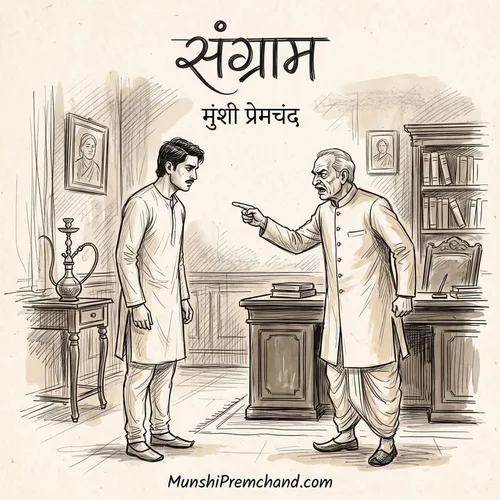
Sabal Singh sits alone in his tastefully furnished drawing room, looking melancholic. A newspaper rests in his hand, but his gaze remains fixed out the window toward the courtyard garden.
Sabal Singh: (To himself) Village panchayats are an absolute necessity in rural India. The cost of legal proceedings in official courts has escalated so much that no poor peasant can ever hope to secure justice there. Even the simplest petition requires expensive stamp paper! ... And what a gracefully molded figure she has! It seems as though every feature was sculpted by divine hands. Her complexion is exquisite—neither too fair nor too dark. But why am I obsessing over her? She is another man's wife! What business do I have admiring her beauty? There are countless beautiful women in the world; she is not the only one. Gyani is no less beautiful—she is so pure-hearted, so gentle and loving. If I gave her the slightest hint, she would jump into fire for me. Her devotion and love for me are boundless! If I even get a mild headache, she loses her mind in worry. I must force my thoughts away from that peasant woman!
(He rises from his armchair, pulls a thick volume from the bookcase, flips through a few pages absently, puts it back on the table, and sits down again. His young son, Achal Singh, rushes into the room carrying a toy air-gun.)
Achal: Father! It's evening already. Aren't you coming for your daily walk today?
Sabal: No, my son. I don't feel like going out today. Have the carriage readied for yourself. Where did you get that gun?
Achal: I won it as a prize! I came first in the running race today. Around twenty-five boys ran with me, boasting and showing off, but when the race started, I sprinted ahead of everyone. None of them could even catch my dust! I could shoot birds with this gun if I wanted.
Sabal: But you must never hunt innocent birds, Achal.
Achal: Oh no, Father, I was just speaking hypothetically. What harm have poor birds ever done to me that I should take their lives? But tell me, is it a sin to shoot predatory birds that hunt smaller birds?
Sabal: (Puzzled by the boy's logic) In my view, you shouldn't kill even predatory birds. Birds do not possess moral discernment between right and wrong; whatever they do is purely out of biological instinct, so they cannot be held culpable or punished.
Achal: But when a dog steals food from the kitchen, doesn't it know it's doing wrong? It treads silently, looking around cautiously with alert eyes, and bolts the moment it hears human footsteps! Crows do the exact same thing. Doesn't that prove animals possess moral awareness? If so, why shouldn't they be punished?
Sabal: (To himself) He is a mere child, yet his logic is astonishingly sharp! (Aloud) Son, our ancient sages have laid down deep philosophies on these matters that you will understand when you grow older. Go enjoy your drive now, but put on an overcoat so you don't catch cold.
Achal: Father, when will you take me to the village where you went for dinner yesterday? I also want to taste the food prepared by Rajeshwari! You went quietly without taking me. I wish I could live in the village every day and run around the fields!
Sabal: Very well, the next time I visit, I will take you along.
(Achal Singh exits.)
Sabal: (To himself) What will be the core thesis of my second essay on judicial reform? That courts merely serve to reinforce the tyranny of the powerful! Where justice is bought with money and argued by high-priced barristers, what standing does a poor man have? Courts are not temples of justice; they are altars of sacrifice! When Rajeshwari served that rustic food to me on a platter, I felt as though my heart was being torn from my chest. If her hand had accidentally touched mine, I might have fainted. Her beauty is intoxicating... How can a woman working under the scorching sun in dusty fields possess such soft, radiant skin? Air and light have polished her beauty into pure gold. Truly it is said that true beauty needs no ornaments! Her body was bare of jewelry, yet her simplicity was far more captivating than any gold. And how delicious that humble meal tasted! Her grace imparted sweetness even to coarse grain rotis. My mind is wandering back to her again... What is happening to me? I am no longer an impulsive youth to fall madly in love with every pretty face I see. I am thirty-five years old, a mature man, the father of a growing boy! This is lust, pure shallow vanity! At my age and with my education, how can I allow my mind to become so polluted? In my youth, I guarded my moral purity fiercely and led an exemplary life. Now, when I should be immersed in spiritual self-reflection, this demon of infatuation has possessed me! Is this temptation testing the discipline of my youth?
(Enter Gyani, his wife.)
Gyani: Should I hide all these heavy books of yours somewhere? Whenever I see you, you are buried in one volume or another! You barely give me a glance.
Sabal: I am the guilty one, my dear; punish me as you wish. These poor books are innocent!
Gyani: Gulabi went toward the garden today and mentioned that a holy saint (Mahatma) has arrived. Hundreds of villagers are flocking there for his blessings. I would also love to go and seek his darshan.
Sabal: Let me inspect his character first before you go. There are plenty of rogues wearing saffron robes who call themselves saints nowadays.
Gyani: You always say every saint is a fraud or a hypocrite! Why do you harbor such aversion toward holy men?
Sabal: Because I rarely see a genuine ascetic among them.
Gyani: But I heard great praise for this Swami. Gulabi said his face shone like a bright lamp, and although hundreds surrounded him, he remained silent and detached.
Sabal: Silence does not prove spiritual attainment. Rudeness is not a mark of sainthood.
Gyani: Those who seek with faith eventually find true masters. If one lacks faith, one will never meet a true saint. You may not desire another child, but I do! No mother ever feels her home is complete with just one child.
Sabal: If the blessings of ascetics could grant children, no childless person would remain in the world! God has blessed us with a wonderful son in Achal. Pray for his well-being, and let us dedicate our lives to public service and charity.
Gyani: (Annoyed) You speak so coldly! That is why I never feel like sharing my heart's desires with you. Go on, read your books—that is where your heart truly resides! (She turns to leave.)
Sabal: Wait, are you upset with me? Painters depict anger as something hideous, but in my experience, a woman's anger only heightens her beauty!
Gyani: (Smiling) Nobody can charm with words like you! You catch me off guard every time... But today I won't be swayed!
Sabal: Don't be in such a hurry. I will invite the Swami right here to our house so you can seek his blessings in peace. In a crowded gathering, you won't even get a chance to speak, and onlookers will laugh, saying the master acts like a refined gentleman while his wife chases after wandering sadhus!
Gyani: Very well! When will you invite him?
Sabal: Tomorrow or the day after.
(Gyani exits.)
Sabal: (To himself) Why is the craving for offspring so overwhelming in human nature? A childless person considers themselves cursed and lives in perpetual grief. If this longing were not so universal, our religious life would be so quiet and dull! There would be no grand pilgrimages, no bustling temples, no vows or ritual donations. All of it springs from this single desire for lineage! Tomorrow I shall visit this Swami and observe his conduct... But why does my mind keep wandering back to Rajeshwari? I never knew simple peasant women could possess such dignity and grace. She is undoubtedly born of noble lineage, trapped in poverty by twist of fate. Her soft hands were not meant to wield heavy farm tools, nor her sweet voice to chase crows from crops. If I knew she was happy in her poverty, my heart might find peace. But dignified women never voice their suffering; they burn silently within. Why has my mind become so restless? Even my boyhood friends used to marvel at my strict moral discipline. If a whisper of my current infatuation reached their ears, I could never show my face again! Let this fire burn within my chest alone—even if it turns my heart to ashes, no one must ever hear my groan. Nothing happens without Divine Will. Perhaps even this awakening of passion holds some hidden purpose...
(He rings the bell for the servant.)
Servant: Huzoor, your command?
Sabal: Saddles on the horse!
Servant: Yes, Huzoor!
Significance & Themes
- Psychological Conflict of the Privileged: Sabal Singh's monologue reveals the classic Premchandian theme of an educated, well-meaning reformer battling his own hypocritical desires and moral weakness.
- Childhood Innocence & Moral Discrimination: Achal's conversation highlights the intuitive moral questioning of children versus the intellectualized justifications of adults.