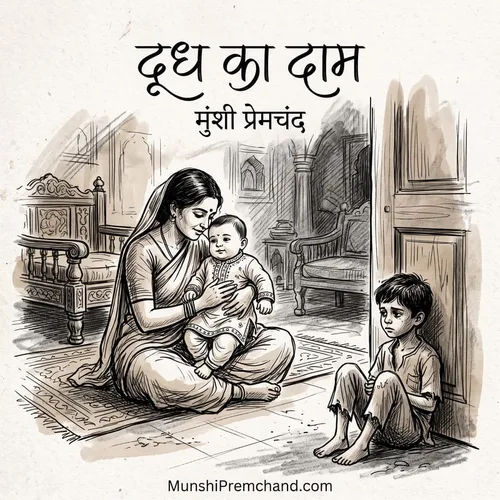
Complete English Translation: Doodh Ka Daam (The Price of Milk)
Nowadays, trained midwives, nurses, and lady doctors have made their appearance in all the large cities; but in rural villages, the maternity rooms remain entirely under the dominion of Dalit Bhangi women, and there is no hope of any change in the near future.
Babu Maheshnath was the prominent zamindar of his village. Educated as he was, he recognized the urgent necessity for hygienic reform in rural maternity practices; but how could he conquer the practical obstacles in his way? No city nurse was willing to go to a rural village, and when one finally agreed after much pleading and persuasion, she demanded such an exorbitant fee that the Babu had no choice but to bow his head and walk away in silence. As for approaching a lady doctor, paying her fee would have required Babu Sahib to sell off half his ancestral estate! Therefore, when after three successive daughters a fourth child—a long-awaited son—was born, it was once again Gudar and Gudar’s wife Bhungi who were summoned.
Children have a peculiar habit of being born in the dead of night. At midnight, the zamindar’s peon raised such a thunderous shout at Gudar’s doorway that the entire neighbourhood woke from sleep. Had it been a daughter, he would have called out in a lifeless, feeble voice.
In Gudar’s humble home, preparations for this auspicious occasion had been underway for months. Their only lurking dread was that another girl might be born, yielding nothing more than the customary, fixed reward of a single rupee and a plain cotton sari. On this very subject, husband and wife had argued dozens of times and even laid wagers.
Bhungi had declared: "If it isn't a boy this time, I shall not show my face! Yes, I swear it—every single sign points to a son!"
And Gudar would retort: "Just wait and see, it will be a daughter—and born right in the middle of the field! If it turns out to be a boy, I shall shave off my mustache—yes, shave it clean off!"
Perhaps Gudar believed that by stoking his wife’s yearning for a son in this fashion, he was clearing the cosmic path for a boy’s arrival.
Now, as the peon shouted the joyous news, Bhungi mocked her husband: "Go ahead and shave your mustache now, you bearded wretch! I kept telling you it would be a son, but you wouldn't listen; you kept chanting your own tune! Today I shall shave your mustache myself, and I won’t leave behind so much as a stubble!"
Gudar laughed good-naturedly: "Go ahead and shave it, good woman! Will the mustache never grow back? Look at it on the third day, and it will be as thick as ever! But whatever reward you receive, I get half—I’m warning you!"
Bhungi flicked her thumb at him playfully, handed her three-month-old infant son Mangal to Gudar, and set off with the peon.
Gudar called out after her: "Hey! Listen, where are you running off to? I have to go play the congratulatory drums at the mansion! Who will look after the baby?"
Bhungi called back from a distance: "Lay him down on the dirt floor! I will come back to nurse him later."
At Maheshnath’s mansion, Bhungi was treated with lavish, royal hospitality. In the morning she received rich herbal tonics; at noon, hot puris and halwa; in the late afternoon, more delicacies; and at night, another sumptuous meal. Gudar too received generous portions of food.
Bhungi could nurse her own baby Mangal no more than once or twice in twenty-four hours. For her own child, cow’s milk was arranged; while the zamindar’s fortunate newborn son, Suresh, drank Bhungi’s rich, wholesome breast milk.
And this arrangement did not terminate on the twelfth day. The zamindar’s wife was a plump, healthy lady; but by some strange misfortune, she produced no milk at all this time. During her three daughters' births, milk had flowed so abundantly that the girls frequently suffered from indigestion; but this time, not a single drop!
Bhungi was both midwife and wet nurse. The mistress would plead: "Bhungi, raise my child on your milk! As long as you live, you will sit and eat at our doorstep for free! I will get my husband to grant you five bighas of tax-free land—your grandchildren will live in comfort!"
Meanwhile, Bhungi’s own darling child Mangal, unable to digest outside cow’s milk, vomited repeatedly and grew thinner and more sickly by the day.
Bhungi would say playfully: "Mistress, at the tonsure ceremony, I shall demand solid silver bangles, I’m telling you!"
The mistress would reply: "Yes, yes, take bangles, sister! Why threaten me? Will you take silver or gold?"
"Bah, Mistress! If I wear silver bangles, whose face will I look upon, and who will mock me?"
"Very well, take gold bangles, sister—I have said yes!"
"And at the wedding, I shall demand a heavy gold necklace, and silver wrist-torques for Gudar!"
"Take those too, if God brings that blessed day!"
Within the mansion, Bhungi’s authority was second only to the mistress. The maidservants, cooks, and peons stood in awe of her. Even the mistress deferred to her whims. Once, she even scolded Babu Maheshnath himself over a casual remark, and he merely laughed it off! The conversation had turned to the subject of Bhangis. Maheshnath had remarked that whatever else might change in the world, Bhangis would always remain Bhangis; it was impossible to make human beings out of them.
At this, Bhungi had retorted: "Master, Bhangis turn the highest aristocrats into living human beings—who is there to make human beings out of them?"
Had anyone else displayed such insolence, would the hair on their head have survived? But on that day, Babu Sahib laughed heartily and said: "Bhungi speaks a profound truth!"
However, Bhungi’s reign could not endure beyond a single year.
The village gods and orthodox elders took offense at a high-caste child drinking the milk of an untouchable woman. The family priest, Pandit Moteram Shastri, even proposed a formal purification ritual. The child was promptly weaned off Bhungi’s milk; but the proposal for a purification ceremony was laughed away.
Maheshnath scoffed: "What nonsense about purification, Shastriji! Until yesterday the child grew by drinking that Bhangi woman’s blood, and today untouchability enters the picture? What a marvelous religion yours is!"
Shastriji shook his sacred tuft of hair and argued: "It is true he grew drinking her blood and flesh yesterday; but yesterday was yesterday, today is today! At Jagannath Puri, touchable and untouchable eat together in the same row; but can we do that here? In times of grave illness, we too eat food wearing our clothes, and even eat khichdi cooked by anyone; but once restored to health, we must observe orthodox purity! The rules of emergency are entirely different."
"So you mean religion keeps changing—sometimes this, sometimes that?"
"Of course! The duty of a king is different from a subject; the duty of the rich is different from the poor. Great kings and emperors may eat whatever they please, dine with whomever they wish, marry whomever they choose—no rules bind them. They are powerful beings. Rules exist only for the middle classes!"
Though no formal purification took place, Bhungi was compelled to descend from her throne. Nevertheless, she received generous gifts—so much charity that she could not carry it away alone—along with gold bangles and two fine, elegant saris, not of ordinary rough cloth like those given during the daughters' births.
That very year, a deadly plague swept the countryside, and Gudar fell in its very first onslaught. Bhungi was left a widow; yet her household carried on as before. The village gossips waited eagerly, thinking Bhungi would soon remarry. Inquiries were made with this Bhangi and proposals arrived from that elder, but Bhungi went nowhere and accepted no one.
Five years slipped away, and her son Mangal, despite being frail, weak, and chronically sickly, was now running about. Beside the robust, well-fed Suresh, he looked like a tiny sparrow.
One afternoon, Bhungi was clearing the clogged underground drain of Maheshnath’s mansion. Filth had accumulated for months, causing wastewater to flood the inner courtyard. She thrust a long, thick bamboo pole deep into the stone drain, shaking it with all her strength. Her entire right arm was buried inside the conduit when suddenly she shrieked in agony and yanked her arm out!
At that very instant, a thick black snake darted out of the drain and fled. The servants rushed forward and killed the snake; but they could not save Bhungi. At first they assumed it was a harmless water snake and were careless; by the time the deadly venom surged through her veins and waves of convulsions overtook her body, they discovered that it was not a water snake, but a lethal spectacled cobra.
Now Mangal was left completely orphaned.
All day long, he hovered around Babu Maheshnath’s gateway. The mansion produced enough discarded leftovers to sustain ten such children, so he never starved. Yet it wounded his young heart deeply whenever food was thrown down to him from above into disposable earthen bowls. Everyone else ate from fine metal plates; for him, rough earthen bowls!
Ordinarily, he possessed no deep philosophical awareness of this discrimination, but the village boys constantly tormented and humiliated him. No one would permit him to join their games. Even the ragged scrap of burlap sack on which he slept was treated as untouchable.
Outside the mansion stood a large neem tree. Beneath this tree was Mangal’s dwelling: a torn piece of burlap, two earthen bowls, and a discarded dhoti that had once belonged to Master Suresh. In scorching summer heat, freezing winter frost, and torrential monsoon rains, that solitary spot remained his shelter; and favoured by fate, Mangal survived through blistering heatwaves, bone-chilling cold, and pouring deluges, growing healthier and stronger than ever before.
His only companion in the world was a stray village dog who, tormented by the cruelties of other dogs, had taken refuge with Mangal. The boy and the dog ate the same discarded scraps, slept on the same burlap sheet, shared the same temperament, and understood each other's innermost nature completely. A quarrel never broke out between them.
The pious villagers often expressed astonished disapproval at Babu Sahib’s "leniency." Seeing an untouchable boy camped barely fifty paces from the main entrance struck them as entirely contrary to religion: "Tch! If this continues, religion will soon meet its end! We too know that God created the Bhangi, and that we should commit no injustice against him—God’s very name is the Redeemer of the Fallen! But social boundaries must be maintained! One feels revulsion merely walking past that gateway. He is the master of the village, so one is forced to visit; but frankly, it fills one with disgust!"
Mangal and Tami shared an intimate friendship. Mangal would say: "Look here, brother Tami, shift over a little! Where am I supposed to lie down? You’ve occupied the whole sack!" Tami would whine softly, wag his tail, and instead of moving away, would climb closer and lick Mangal’s face.
Every evening, Mangal made a pilgrimage to the ruins of his parents' mud hut to weep in solitude for a while. The first year, the thatched roof had collapsed; the second year, a mud wall gave way; and now only jagged, crumbling half-walls remained. That desolate ruin was his sole inheritance of love. That memory, that yearning, that affection drew him to that wilderness once every day, and Tami trotted faithfully by his side. Mangal would perch upon the jagged mud wall and dream of past and future days, while Tami made repeated, unsuccessful leaps trying to settle in his lap.
One evening, several village boys were playing near the mansion. Mangal approached and stood watching from a distance. Whether Suresh felt a fleeting touch of pity, or the game lacked a player to complete the team, one cannot say; but Suresh decided that Mangal should be included in the game today. Who was watching, after all?
"Hey Mangal, will you play?"
Mangal replied: "No, Bhaiya! If the Master catches sight of me, he will flay the skin off my back! It’s fine for you—you will walk away untouched."
Suresh scoffed: "Who comes here to watch, you fool? Come on, we’ll play horse-and-rider! You become the horse, and we will mount your back and race!"
Mangal raised a doubtful question: "Will I remain the horse forever, or will I get a turn to ride too? Tell me that first!"
This was a thorny question. No one had considered it. Suresh thought for a moment and sneered: "Who would let you sit on his back? Think about it—aren't you a Bhangi, after all?"
Mangal stiffened and stood his ground: "When did I say I am not a Bhangi? But my mother raised you by feeding you her own milk! Unless I get my turn to ride, I will not become a horse! You people are terribly cunning: you enjoy riding while I stay a horse forever!"
Suresh shouted: "You must become the horse!" and lunged forward to grab him. Mangal turned and ran. Suresh chased him. Mangal quickened his pace; Suresh exerted all his might, but being overfed and flabby, his breath gave out.
Panting, he stopped and yelled: "Come back and be the horse, Mangal, or if I ever catch you, I will thrash you mercilessly!"
"You must become the horse too!"
"Very well, I will become the horse too!"
"You will sneak away later! You become the horse first; let me ride, and then I will become the horse."
Suresh had indeed intended to trick him. Hearing Mangal’s demand, he turned to his companions: "Do you see his insolence? He is a Bhangi, after all!"
The three boys cornered Mangal and forcibly bent him down into a horse. Suresh promptly mounted his back, clicked his tongue, and commanded: "Giddy-up, horse, run!"
Mangal carried him for a few paces, but the heavy weight threatened to break his frail spine. He quietly arched his back and slipped out from beneath Suresh’s thighs. Master Suresh collapsed onto the dirt with a heavy thud and began wailing like a siren!
Inside the mansion, his mother heard the cries. Whenever Suresh cried, her sharp ears caught the sound instantly—and his crying was entirely distinctive, like the screech of a narrow-gauge railway locomotive! She said to the maid: "Go see—Suresh is crying somewhere! Ask who struck him!"
Just then, Suresh came running inside, rubbing his tear-stained eyes. Whenever he found an excuse to cry, he ran straight to his mother to lodge a complaint, and his mother would dry his tears with sweets and nuts. He was eight years old, but an absolute dunce: excessive pampering had done to his intellect precisely what excessive feeding had done to his body.
The mother asked: "Why are you crying, Suresh? Who struck you?"
Suresh sobbed: "Mangal touched me!"
The mother could scarcely believe it. Mangal was so harmless and meek that she suspected no mischief; but when Suresh began swearing solemn oaths, belief became mandatory.
She summoned Mangal and thundered: "Hey Mangal! You’ve grown arrogant, haven't you? I warned you never to touch Suresh—do you remember or not? Speak!"
In a timid voice, Mangal murmured: "Why wouldn't I remember?"
"Then why did you touch him?"
"I did not touch him."
"If you didn't touch him, why was he crying?"
"He fell down on his own, so he began crying."
Lying and insolence combined! The lady ground her teeth in fury. Had she struck him, she would have been compelled to take an immediate purifying bath: she would have had to hold a stick, and the electric current of untouchability would have traveled up that stick into her body!
Therefore, she showered him with as many venomous curses as she could muster, and roared: "Get out of here this very instant! If I catch sight of your face at this gate again, I will drink your blood! Eating free bread has made you insolent!"
Mangal possessed little pride, but immense terror. Silently, he picked up his earthen bowls, tucked his scrap of burlap under his arm, slung his cloth over his shoulder, and walked away weeping. He would never return here again! At worst, he would starve to death—what harm was there in that? What was the use of living like this?
Where else in the village was there shelter for him? Who would give refuge to a Bhangi? He walked toward the crumbling ruins of his parental hut, where memories of better days might wipe his tears, and wept bitterly. At that very moment, Tami came trotting in search of him, and the two forgot their grief together.
Yet as daylight began to fade, Mangal’s indignation faded with it. The relentless hunger of childhood, sucking the very blood from his veins, grew fiercer and fiercer. His eyes repeatedly turned toward his empty earthen bowls. By now, Suresh’s leftover sweets would have been distributed! What would he eat here—swallow dust?
He consulted Tami: "What will you eat, Tami? I am going to lie down hungry."
Tami whined softly, as if to say: One must endure this kind of humiliation throughout life! If you lose courage like this, how will you survive? Look at me: someone hits me with a stick, I yelp in pain, and a moment later I go back to them wagging my tail! You and I were made for this very destiny, brother!
Mangal said: "Then you go! Eat whatever you find, don't worry about me."
Tami replied in his canine tongue: I will not go alone; I will take you along.
"I will not go."
Then I will not go either.
"You will starve to death!"
Will you remain alive, then?
"Who is there of mine to weep for me?"
It is the same with me, brother! The bitch I loved last autumn proved unfaithful and ran off with Kallu. Luckily she took her puppies with her, or my life would have been in terrible trouble—who would have raised five pups?
A moment later, hunger suggested another comforting thought: "Maybe the Mistress is searching for us, Tami?"
Of course! Babu Sahib and Suresh must have finished eating. The cook must have gathered their leftovers and must be calling out for us!
"In Babu Sahib's and Suresh’s plates, there is always plenty of rich ghee, and that sweet, creamy delicacy!"
It will all be dumped onto the garbage heap!
"Let us see if anyone comes looking for us?"
Who will come looking for you—are you some revered high priest? There will be one shout of 'Mangal! Mangal!' and then the plate will be emptied into the drain!
"Very well, let us go. But I will remain hidden; if no one calls my name, I am turning back. Understand that clearly!"
The two emerged from the ruins and stole into the darkness outside Maheshnath’s gate, hiding in the shadows. But where did Tami have the patience? He slipped quietly inside. He saw Maheshnath and Suresh seated at their dinner plates. Tami crouched quietly in the veranda, terrified that someone might strike him with a stick.
The servants were conversing nearby. One remarked: "Mangal isn't seen anywhere tonight. The Mistress scolded him, so he must have run off."
Another replied callously: "Good riddance! At least we won't have to look upon a Bhangi's face first thing in the morning!"
Hiding outside, Mangal felt his last glimmer of hope drown in deep water. Maheshnath rose from his plate; a servant poured water over his hands. Now he would smoke his hookah and retire to sleep. Suresh would sit beside his mother, listen to a story, and drift into slumber. Who cared for poor Mangal? So much time had passed, yet no one had called his name even by mistake.
For some time he stood there in utter despair, then drew a long sigh and turned to leave forever. At that precise moment, the cook appeared carrying a leaf-plate piled with table leftovers, on his way to the rubbish pit.
Mangal stepped out from the darkness into the light. How could his starving stomach restrain him now?
The cook said: "Oh, you were here? We thought you had wandered off. Here, eat—I was taking it to throw away."
Mangal said with humble meekness: "I have been standing here for a very long time."
"Then why didn't you speak?"
"Out of sheer terror."
"Well, take it and eat!"
The cook raised the leaf-plate high and dropped it from above into Mangal’s outstretched hands. Mangal looked up at him with eyes overflowing with humble, helpless gratitude.
Tami trotted out from the veranda. Sitting together beneath the dark neem tree, the boy and the dog began eating from the leaf-plate.
Mangal stroked Tami’s head with one hand and said: "Look, Tami—see what the fire of hunger does! If we did not accept these kicked-around scraps of bread, what else would we do?"
Tami wagged his tail.
"Suresh was raised by my mother; she nursed him on her own milk."
Tami wagged his tail again.
"People say that no one can ever repay the price of a mother’s milk... and look at the price of milk I am receiving!"
Tami wagged his tail once more in silent, loyal affection.
Summary of Doodh Ka Daam
Doodh Ka Daam ("The Price of Milk"), published in 1934, is one of Munshi Premchand's most devastating satires and profound critiques of caste untouchability, social hypocrisy, and the dehumanization of Dalit labor.
The Sacred Necessity: Bhungi's Milk
The story opens in a rural North Indian village where modern medical facilities are unavailable. When the village zamindar, Babu Maheshnath, is blessed with a son (Suresh) after three daughters, his wife is unable to produce milk. To save the newborn heir, the family summons Bhungi, a woman from the untouchable Bhangi (scavenger) caste, who has recently given birth to her own son, Mangal.
For a full year, Bhungi serves as Suresh's wet nurse. While Suresh thrives on Bhungi's rich mother's milk, her own baby Mangal is relegated to cattle milk, growing weak, thin, and chronically ill. During this period, Bhungi is pampered with rich foods and wields immense informal authority in the mansion, even scolding the zamindar without retribution.
The Reversion to Untouchability
The moment Suresh is successfully weaned, the social illusion shatters. The family priest, Pandit Moteram Shastri, and orthodox elders raise religious objections to a high-caste child consuming an untouchable's milk. Although Maheshnath scoffs at the hypocrisy of performing a purification ritual for a child who grew on Bhungi's blood and flesh, Bhungi is summarily dismissed from her privileged station.
Misfortune strikes swiftly:
- Gudar, Bhungi's husband, dies in a plague epidemic.
- Five years later, Bhungi dies from a cobra bite while clearing a filthy, clogged drain in Maheshnath's mansion—sacrificing her life in the service of the very family whose heir she nourished.
The Orphan and the Stray Dog
Mangal is left completely orphaned, penniless, and cast out. He takes shelter beneath a neem tree outside Maheshnath's estate, surviving on a torn burlap sack with two rough earthen bowls and a discarded cloth. His only friend is Tami, a stray village dog who has also been ostracized by his peers. The boy and the dog share an unbreakable bond of unconditional love, sharing every scrap of food and sleeping together for warmth.
The Crisis: The False Accusation
One evening, Suresh and the village boys invite Mangal to play "horse-and-rider." When Mangal insists that he should also get a turn to ride because his mother raised Suresh on her milk, the boys forcibly make him the horse. Overburdened by Suresh's weight, Mangal slips out, causing Suresh to tumble to the ground.
Spoiled and vengeful, Suresh runs wailing to his mother, lying that Mangal physically touched him. Terrified of ritual pollution, the mistress flies into a rage, curses Mangal, and banishes him from the estate forever.
The Price of Milk
Mangal retreats weeping to the ruins of his parents' mud hut, resolving to starve rather than endure further humiliation. But by nightfall, gnawing hunger overpowers his wounded pride. Accompanied by Tami, he returns to the estate and hides in the dark shadows outside the gate.
When the cook emerges to dump the dinner leftovers into the garbage, he spots Mangal and drops the leaf-plate from a safe height into Mangal's outstretched hands. Sitting under the neem tree, Mangal and Tami eat the discarded scraps together. Mangal gently strokes Tami's head and utters the story's climactic, searing irony: while society proclaims that a mother's milk is priceless and beyond repayment, this degradation—surviving on kicked-around leftovers in the dirt—is the only "price" he receives for his mother's milk.
Publication History
Doodh Ka Daam (दूध का दाम) was written by Munshi Premchand in 1934 during the final, most politically radical and socially incisive phase of his literary career. It was first published in contemporary Hindi literary journals and subsequently collected in the second volume of his definitive anthology, Mansarovar (मानसरोवर भाग 2, Story No. 16).
Written during the height of the anti-untouchability campaigns led by Mahatma Gandhi and Dr. B.R. Ambedkar in the 1930s, the story reflects Premchand's uncompromising critique of the Hindu caste hierarchy, exposing how religious dogma is opportunistically bent to exploit Dalit bodies while denying them fundamental human dignity.
This unabridged English translation was published in 2026 by MunshiPremchand.com as part of the MunshiPremchand.com English Translation Series.
Themes & Critical Significance
1. The Hypocrisy and Fluidity of Caste Purity
Premchand exposes untouchability not as an immutable spiritual principle, but as an opportunistic social convention. When the survival of the landlord's male heir is at stake, the untouchable woman's body and breast milk are deemed pure, essential, and life-giving. The moment the crisis passes, the very same milk is retroactively viewed as polluting, and the woman's orphaned son is treated as an untouchable outcast whose physical proximity defiles the estate.
2. Biological Debt vs. Social Ingratitude
The central metaphor of the story—the "price of milk" (doodh ka daam)—contrasts the universal cultural veneration of motherhood with the reality of caste exploitation. In Indian tradition, a mother's milk is considered a sacred debt that can never be repaid. Yet because Bhungi belongs to the lowest rung of the social order, her maternal sacrifice is completely devalued. Suresh inherits wealth, privilege, and social dominance; Mangal inherits hunger, stigma, and discarded scraps.
3. Animal Companionship vs. Human Cruelty
The relationship between Mangal and the stray dog Tami provides the emotional anchor of the story. While high-caste humans enforce cruel boundaries of pollution and insult, the animal offers unconditional loyalty, warmth, and brotherhood without inquiring into caste. Through this stark contrast, Premchand suggests that the caste-ridden social order has degraded human beings below the moral sensitivity of beasts.
4. The Realism of Hunger over Pride
Premchand refuses to romanticize poverty or endow Mangal with an unrealistic, heroic defiance. Although Mangal initially resolves to starve in his parents' ruins out of wounded self-respect, the biological agony of childhood hunger ultimately compels him to return and beg for scraps. This painful realism underscores the coercive violence of feudal poverty: hunger forces the oppressed to accept the very bread that is kicked at them.