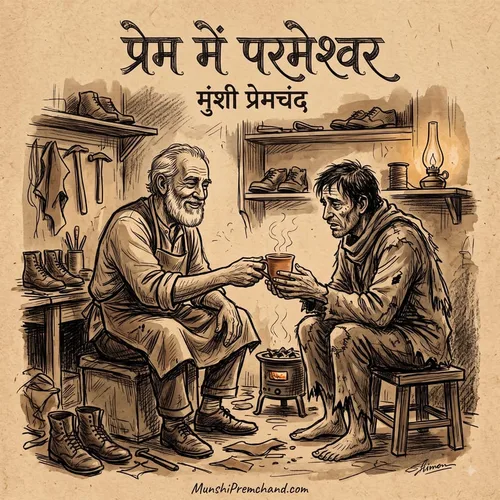
In a small village lived an honest merchant named Murat. He ran a modest shop along the main road, where he had lived for many years and was well acquainted with all the villagers.
Murat was a man of high moral character, truthful, practical, and gentle. Whatever he promised, he fulfilled faithfully. He never cheated in weights or measures, nor did he adulterate ghee or oil. If an item was of inferior quality, he stated so clearly to buyers without deception.
In the autumn of his life, Murat turned his heart toward divine worship. His older children had passed away years before, and finally, leaving behind a three-year-old child, his wife departed this world as well. At first, Murat thought of sending the child to his maternal grandparents' home, but a deep love for the boy bloomed in his heart. He raised the child himself with total devotion. The young boy became the sole anchor of Murat's life; for him alone, Murat labored day and night. But family happiness was not destined to remain in his fate.
When the boy reached twenty years of age, he fell ill and departed for the realm of death.
Murat's grief knew no bounds. His faith was shattered. Bitterly criticizing Providence, he would say:
"God is cruel and unjust! He should have taken an old man like me, yet He struck down a young youth in his prime!"
He stopped visiting the local temple altogether and sank into dark despair.
One day, an old friend who had been away on pilgrimage for eight years came to visit Murat.
Murat wept:
"Look, my friend, total ruin has overtaken me! My living is now meaningless. Daily I pray to God to lift me quickly from this mortal world. On what hope should I live?"
His friend replied gently:
"Murat, do not speak so! We cannot comprehend the mystery of Divine Will. Whatever God does is right. A son's departure and your survival rest in Providence's hands. The root cause of your grief is that you measure happiness only by personal gain; you do not find joy in the well-being of others."
Murat asked:
"What should I do then?"
His friend answered:
"Selfless devotion to God purifies the inner heart. When you dedicate all your actions to the Almighty and live your life in service, you will attain supreme bliss. Begin reading holy scriptures like the Gita and Bhaktamal—they grant spiritual peace and wisdom."
Murat began reading these sacred texts. Within a few days, he developed such deep love for them that he would read until midnight, pondering their spiritual teachings. Formerly, he would weep at bedtime remembering his lost son; now, peaceful contentment washed over his soul. He spent his days in divine contemplation and honest work, leaving behind idle gossip and sorrow. His entire life was transformed.
One night, while reading the scriptures, he came upon these profound verses:
"The one Father has countless children, varying in virtue, character, and station... Yet the Father's love flows equally to all. This entire universe was created by Me, and My mercy rests equally upon all."
Murat paused, closing the book, and pondered:
"If God shows equal mercy to every living creature, should I not show mercy to all as well?"
As he pondered the stories of Sudama and Shabri, a deep longing arose in his heart: Could I ever be blessed with a vision of the Divine?
Musing on this thought, he drifted into sleep. Suddenly, a clear voice called from outside:
"Murat! Murat! Take heart, for I shall visit you tomorrow!"
Murat awoke startled and stepped out of his shop, but saw no one. Wondering whether it was a dream or a divine sign, he returned to bed.
The next morning, after performing his morning prayers, Murat opened his shop and set about his daily chores. Yet the promise of the voice echoed constantly in his mind.
A heavy frost had fallen during the night, and snow lay piled along the road. As Murat sat watching the street, an old laborer named Lalu arrived, shivering in the cold, trying to clear the snow with feeble hands. Old Lalu was exhausted and trembled violently from the freezing cold.
Seeing him, Murat thought: Lalu is freezing; I must warm him up by the fire.
Murat called out:
"Lalu brother! Come inside near the stove! You are shivering—warm your hands."
Lalu came inside gratefully, rubbing his frozen hands over the fire.
Murat said:
"Brother, rest easy. I will clear the snow for you. You are old; I don't want you catching cold."
Lalu asked curiously:
"Were you waiting for someone at the door, Murat?"
Murat smiled hesitantly:
"To tell you the truth, I had a dream last night that I cannot forget. A voice promised me that the Lord would visit me today! Reading how God appeared to humble devotees like Shabri and Sudama, I was sitting here eagerly watching the road when you walked up."
Lalu said softly:
"When your love for God is true, He will surely bless you. Had you not called me inside to warm myself, I might have perished in the cold."
Murat replied:
"Think nothing of it, Lalu brother! Treat this shop as your own home. I am always at your service."
Lalu thanked him warmly and departed.
A short while later, a young woman wearing tattered clothes walked by, carrying an infant in her arms. Both mother and child were shivering uncontrollably in the icy wind.
Murat called out:
"Mother, why stand out in the cold? The baby is freezing! Come inside and wrap yourself near the stove."
The woman stepped inside. Murat seated her near the fire and gave sweetmeats to the child.
Murat asked:
"Who are you, sister?"
The woman wept:
"I am a soldier's wife. Eight months ago, my husband was deployed far away, and I have heard no news of him. I worked as a cook, but when this baby was born, my employer dismissed me. For three months I have wandered without work, selling whatever little I owned to feed my child."
Murat pulled out a warm woolen blanket (loi) and handed it to her:
"Here, take this blanket and wrap yourself and the child."
The woman's eyes filled with tears of gratitude:
"May God bless you! You have saved my child's life."
Murat replied humbly:
"I did nothing; it was the Will of Shri Krishna." He then shared his dream with her.
The woman smiled:
"Nothing is impossible for God; He visits those who love Him."
After the woman left, an old woman selling apples arrived with a heavy basket of apples on her head and a bundle of grain on her back. As she set her basket down to rest, a mischievous young boy snatched an apple and tried to run away.
The old woman caught the boy, grabbed his hair, and began beating him. The boy cried: "I didn't steal it!"
Murat rushed out and gently freed the boy from her grip:
"Forgive him, Mother! He is just a child."
The woman argued:
"This boy is a thief! I won't let him go unpunished."
Murat reasoned gently:
"Forgive him out of mercy. I will make him understand." He turned to the boy: "Ask Mother for forgiveness and promise never to steal or lie again. I saw you take the apple; why did you deny it?"
The boy burst into tears, asked the old woman's forgiveness, and vowed never to lie or steal again. Murat then bought an apple from the woman and gave it to the boy.
The old woman grumbled:
"You will spoil all the village children with such leniency!"
Murat replied:
"Mother, punishment is human nature, but God is all-merciful. If we demand harsh punishment for a child's small mistake, what punishment should we receive for our innumerable sins? If we do not show mercy to fellow beings, how can we expect God's mercy upon us?"
The old woman was deeply moved. As she lifted her heavy basket to leave, the young boy stepped forward respectfully and offered:
"Mother, let me carry this basket to your house for you."
The old woman smiled warmly and walked alongside the boy.
That evening, after finishing his work and reading the Gita, Murat drifted into a peaceful sleep. Suddenly, a radiant vision appeared before his inner eyes!
A gentle voice called:
"Murat! Murat!"
Murat asked in wonder:
"Who are you?"
"I am Lalu," came a voice, and Lalu's smiling face appeared and vanished.
Again the voice called:
"I am here!" And Murat saw the soldier's wife wrapped in the woolen blanket, holding her happy child; she smiled and vanished.
Once more the voice spoke:
"I am here!" And the apple-seller woman and the young boy appeared arm in arm, laughing joyfully before dissolving into light!
Murat sat up in bed, his heart overflowing with transcendent joy. He realized that the Lord HAD visited him three times that day—for to show mercy and love to any living creature is to behold the presence of God Himself.
Significance & Themes
- Premchand's Literary Adaptation: In adapting Tolstoy's Where Love Is, God Is Also, Premchand localized the spiritual philosophy into Indian rural values (Bhakti, Seva, and Karma).
- The Living Presence of the Divine: True worship lies not in ritual temple visits or ascetic isolation, but in active compassion, generosity, and selfless service to the suffering and vulnerable.