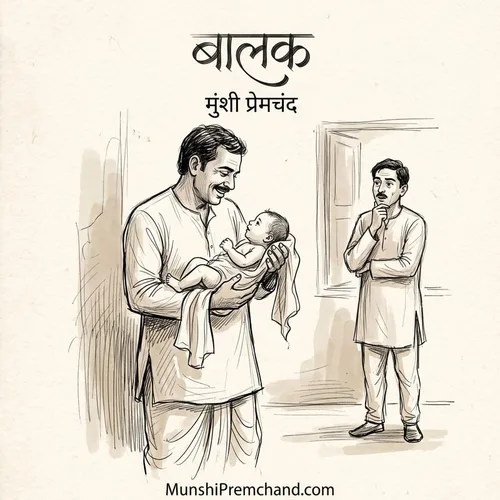
Complete English Translation: The Child
People call Gangu a Brahmin. He regards himself as one too. All my other servants offer me salutations—if I step outside, they salaam; if I return, they salute. But Gangu never bows his head or offers greetings. He clearly expects me to touch his feet! He never washes my soiled dishes, nor does he light my lamp or sweep the floor. Even fan-pulling he touches only when I am sitting alone; if anyone else is present, he withdraws his hand from the rope. I never command him to do any chore that might infringe upon his caste pride.
He is of a quiet temperament and does not associate with the other domestic hands. I have never seen him sitting on another servant's cot or smoking a hookah with them. Nor does he ever venture out to the temple or perform ceremonial baths. Yet he is entirely possessed by the dignity of Brahminhood.
One day, after finishing my correspondence, I was strolling on the veranda when Gangu arrived and stood before me with downcast eyes. Observing his posture, I sensed he wished to say something, but was struggling to find the words.
I said, "What is it, Gangu? Do you need money? You have not yet earned your full month's wage, have you?"
Gangu replied hesitantly, "No, master, I do not want any money."
"Then do you wish to say something else?"
"Yes, master, if you permit me."
"Say whatever you wish."
Gangu cleared his throat and said, "I wish to leave your service."
I was startled. I had never spoken an unkind word to him, nor had I ever overburdened him. I asked, "Why do you wish to leave? Has someone mistreated you?"
Gangu said softly, "No, master, no one has mistreated me. I have spent my days here in utter peace. A master such as yourself is not easily found in this world. But I find myself compelled by personal circumstance."
"What circumstance? Tell me plainly."
Gangu hung his head even lower and murmured, "Master, I am going to marry Gomti Devi."
I looked at him in total astonishment. Gomti Devi was a woman in our neighborhood whom the entire town viewed with contempt. She had married three different husbands, lived with each for a few months, and then abandoned them all. Finally, she had moved into a small tenement in our alley, living entirely alone. The town gossip was that she was of loose character and incapable of living with any man.
I said, "Are you in your right mind, Gangu? Do you not know what kind of woman she is? Three men have discarded her—or rather, she has discarded three husbands! You are a Brahmin, and yet you wish to bring such a woman into your home? What will people say?"
Gangu replied with earnest simplicity, "Master, people say whatever comes to their lips. She was not to blame; it was those men who wronged her. They did not understand her heart. She does not demand wealth or fine clothes; she only asks for love. When a man treats her without love, how can she remain with him? Where love is absent, no woman of spirit will stay. People call her wicked because she will not endure cruelty in silence."
I said, "You are utterly blinded, Gangu. If three men could not keep her, what makes you think she will remain with you? A few days of passion will fade, and then she will abandon you as well, leaving you ruined and disgraced."
Gangu's eyes shone with deep conviction. "Master, if she ever leaves me, it will only be because I was unable to keep her happy. If I serve her with true devotion, she will never desert me. She is not bad; it is the world that is cruel to her."
I realized that reason was powerless against his resolve. When a man is intoxicated by infatuation, argument only strengthens his stubbornness.
I said, "Very well. If you have resolved upon this, you may go. But remember my words—you will regret this step."
Gangu touched his brow and departed.
Five or six months passed. Gangu married Gomti Devi and took a small mud-plastered hut on the edge of the town. He bought a large copper platter, set up a modest chaat stall near the crossroads, and began selling savories.
Occasionally, I saw him on the road carrying his wares on his head. Whenever our eyes met, he smiled with genuine warmth and contentment. He looked healthier and happier than he had ever appeared in my service. His clothes were neat and clean, and his face radiated quiet joy.
One evening, I met him near the market. I asked playfully, "Well, Gangu, how goes your household? Does Gomti Devi still keep you happy, or have you begun to see the light?"
Gangu smiled with absolute pride. "Master, she is not an ordinary woman; she is a goddess! I am so fortunate to have her. Whatever she touches turns to gold. My small hut feels like heaven. I only pray that God grants me the wisdom to serve her worthily."
I was astonished by his enduring devotion. I wondered whether Gomti had truly reformed under the warmth of his genuine affection, or whether Gangu's simplicity was simply shielding him from reality.
Another month slipped by. One morning, as I sat reading my newspapers, Gangu appeared at my gate. But he was completely transformed. His hair was disheveled, his clothes were soiled, his eyes were sunken and reddened with tears, and his body trembled as though struck by fever.
The moment he saw me, he broke down and began to weep bitterly.
I felt a sudden, involuntary sense of vindication—that dark, petty pride one feels when a dire prediction comes true. I thought to myself: Did I not warn you? Now you have reaped what you sowed.
I said in a tone of stern sympathy, "What has happened, Gangu? Has she run away?"
Gangu wept aloud, covering his face with his hands. "Yes, master, she has gone! She left yesterday morning and has not returned."
I said, "I told you so at the very beginning, did I not? You would not listen to me. A woman who abandoned three husbands was never going to spend her life with a poor servant. Did she take all your money and jewelry as well?"
Gangu looked up, wiping his eyes, and his voice carried no bitterness—only pure agony. "No, master, she did not take a single paise! Her gold nose-ring and silver bangles—everything I had made for her—she left neatly folded in a cloth on the cot. She took nothing except the clothes she wore. Oh master, where could she have gone? If only I knew where she was!"
I said, "Why do you weep for such a heartless creature? You should thank God that she left before she brought greater ruin upon your head. Forget her and start your life anew."
Gangu shook his head in distress. "Master, do not speak ill of her. It was not her fault; it must have been my own shortcoming. I must have said something that wounded her pride, or failed to perceive some sorrow weighing upon her heart. She never spoke a harsh word to me. She was so gentle, so patient. If she has left, the defect lies within me. I cannot live without her. I will search for her across the world, from city to city, until I find her!"
Saying this, Gangu turned and rushed away, his heart consumed by sorrow.
I watched him go, marveling at the foolishness of human infatuation. I thought that in a few weeks his grief would subside and he would return to his senses.
A month later, I was sitting on my veranda in the afternoon when Gangu came running into the courtyard. His face was glowing with unimaginable radiance, his eyes dancing with joy. In his arms, wrapped carefully in a clean white cloth, was a tiny newborn infant.
He ran up the steps and fell at my feet, beaming with pure triumph.
"Master, I found her! Gomti is found!" he cried.
I looked at him in utter bewilderment. "You found her? Where was she?"
"In Lucknow, master! She was lying in the women's hospital there. I searched everywhere, asked every traveler, and at last someone told me she had been seen entering the hospital. I went there and found her!"
"And what is this in your arms?" I asked, looking at the bundle.
Gangu beamed, holding the infant toward me with outstretched arms. "It is a boy, master! A beautiful, glowing boy! Look at his face—he looks like a little flower."
I looked at the child, then calculated the months in my mind. Gangu had married Gomti scarcely six or seven months ago. The infant was healthy and full-term.
A wave of disgust washed over me. I looked at Gangu and said coldly, "Gangu, are you blind or utterly shameless? You were married to Gomti only six months ago. How can this child be yours?"
Gangu's smile did not waver in the slightest. His countenance remained as calm and luminous as a still lake.
He looked at me and said with effortless grace, "Master, why should that matter? This child is Gomti's child, and Gomti is my wife. Therefore, the child is mine!"
I stared at him, unable to speak.
Gangu continued, "Master, if someone buys a field that has already been plowed and sown, does he throw away the crop when the harvest ripens? Does he refuse to reap the grain and say, 'I did not cast the seed'? He harvests it gladly and thanks God for the abundance. This child was brought into my home through Gomti. He is God's pure gift. A child belongs to the one who nurtures and loves him. The poor thing was not to blame for anything. Why should I reject an innocent soul whom God has sent into our lives?"
His words struck my heart like a bolt of lightning.
All my bookish wisdom, all my civilized notions of morality, caste pride, and biological pedigree shriveled into utter insignificance before the towering moral stature of this illiterate Brahmin servant. I, who considered myself enlightened, educated, and progressive, had judged a woman and an innocent child through the narrow lens of social vanity and patriarchal possessiveness. But this simple man, who carried chaat on his head through dusty alleys, possessed a heart vast enough to embrace the purest essence of humanity.
He had transcended caste, prejudice, and biological ego, standing upon the highest summit of unconditional love.
My eyes filled with tears of deep reverence and humility. My head bowed involuntarily before him.
I reached out with both hands and took the child into my arms. I looked at the sweet, innocent face of the infant, kissed his soft forehead, and said, "Give him to me, Gangu. Let me bless him."
Gangu looked at me with joyful tears streaming down his cheeks.
"Come, Gangu," I said softly, handing the child back to his loving arms. "Take me to Gomti Devi. I wish to pay my respects to the mother of this child."
Together, we walked down the road toward Gangu's humble cottage, while my heart echoed with the realization that true nobility is not born of pedigree, but of a soul capable of limitless compassion.
Summary of The Child
'The Child' (Balak) is one of Munshi Premchand's most celebrated masterpieces, exploring the themes of unconditional love, moral nobility, and the radical redefinition of paternity and social purity.
Gangu, an illiterate Brahmin servant, values his caste dignity above manual servitude. However, when he falls in love with Gomti Devi—a thrice-abandoned woman ostracized by respectable society—he willingly resigns from his job to marry her, unconcerned with the sneers of the world. He insists that Gomti is not inherently deceitful, but was merely denied genuine love and respect by her former husbands. The two marry and establish a modest, happy household sustained by Gangu's hard work running a chaat stall.
When Gomti unexpectedly disappears months later, the narrator assumes she has reverted to her old erratic ways. Gangu, however, refuses to blame her, questioning his own shortcomings instead. He eventually tracks her down to a hospital in Lucknow, where she had given birth to a child conceived prior to their marriage. Instead of feeling betrayed, Gangu brings both mother and baby home with profound joy.
When the narrator confronts Gangu about the child's obvious biological origins, Gangu offers an unforgettable philosophical rebuttal: just as a farmer who purchases a pre-sown field does not abandon the harvest, a father who loves a mother cannot disown her child. Shamed by his own prejudice and profoundly moved by Gangu's sublime humanity, the narrator recognizes that the humble servant stands far taller morally than the educated elite, and asks to accompany him to offer homage to the family.
Publication History
'The Child' (Balak) was first published in Hindi in 1930 and subsequently included in Premchand's renowned short-story collection Mansarovar (Vol. 2). It reflects the author's mature progressive vision during the Indian national movement, championing widow remarriage, the rehabilitation of marginalized women, and the dismantling of orthodox patriarchal and caste taboos.
This unabridged English translation was published in 2026 by MunshiPremchand.com as part of the MunshiPremchand.com English Translation Series.
Themes & Critical Significance
- Unconditional Love and Moral Nobility: Gangu embodies the highest ideal of love—pure, selfless, and entirely divorced from possessiveness, patriarchal control, or social validation.
- Redefining Paternity Beyond Biology: Through Gangu's metaphor of the pre-sown field, Premchand radically detaches fatherhood from mere biological seed, elevating it to an act of moral nurture, protective care, and spiritual generosity.
- Critique of Social Hypocrisy and Caste Orthodoxy: The narrator represents educated, middle-class society, which professes progressive ideas yet remains hostage to prejudice. In contrast, Gangu, an uneducated Brahmin servant, effortlessly shatters caste orthodoxy and societal judgment.
- Rehabilitation of Marginalized Women: Premchand humanizes Gomti Devi, demonstrating that women branded as 'loose' or 'fallen' by conservative society are often victims of loveless arrangements and domestic tyranny who flourish when granted dignity and genuine affection.
- Universal Human Dignity: The story stands as an enduring tribute to the moral grandeur of the common man, affirming that true spiritual enlightenment is found in everyday acts of boundless compassion.