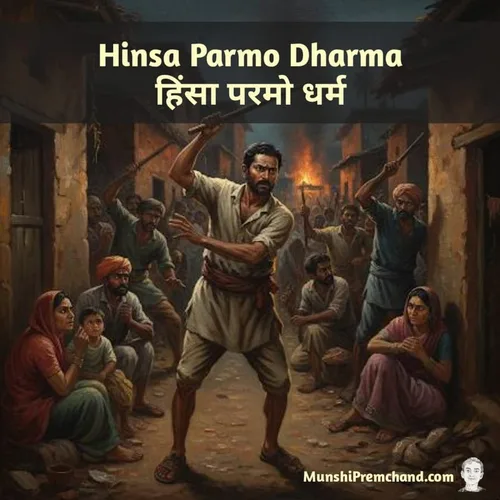
Complete English Translation: Hinsa Parmo Dharma (Violence Is the Supreme Duty)
There exist in this world certain people who, without being anyone’s hired servant, are servants to everyone; who, having no personal work of their own, never find a moment of leisure to lift their heads.
Jamid belonged precisely to this category of human beings. He was completely carefree—harboring neither friendship nor enmity toward anyone. Whoever spoke to him with a pleasant smile earned him as an unbought slave. He found genuine joy in doing useless, unrewarded tasks.
If anyone in the village fell sick, Jamid was instantly at hand to nurse the invalid. Tell him, and he would hasten to the physician's house at midnight, or comb through the thorny wild forests in search of some healing herb. It was utterly impossible for him to witness oppression inflicted upon a poor man and remain silent. Even if someone threatened to beat him to death, he would never desist from championing the oppressed. Hundreds of such occasions had arisen in his life. Scuffles with the local police constable were an everyday affair.
For this reason, people considered him a complete simpleton, a fool. And so it was. When a man sees someone carrying a crushing load, snatches it away, and places it upon his own head; when he runs miles across open fields to help raise a neighbor’s thatch or extinguish a blazing fire—who in the world would ever call him a sensible man?
In short, no matter how much benefit others derived from his existence, no good ever accrued to himself. He was dependent on the charity of others even for his daily bread. He was the madman who wandered carefree, while others fretted over his foolishness.
At last, when people heaped countless reproaches upon him—"Why are you throwing your life away? You work yourself to death for strangers, but will anyone ever inquire after you? If you fall ill for a single day, not a soul will offer you a palmful of water! So long as you serve them, people toss you scraps of bread out of pity; the day calamity strikes, no one will even look you in the face!"—Jamid’s eyes were opened.
He possessed no pots, pans, or worldly goods. One day, he simply stood up and took to the open road.
Two days later, he reached a great city.
The city was vast and magnificent. Its palaces seemed to converse with the sky. The roads were broad and clean, the bazaars bustling with vibrant life. The number of mosques and temples, if not greater than the residential houses, was certainly no fewer. In his countryside village, there was neither a single mosque nor a single temple: the Muslims performed their prayers upon an open earthen platform, and the Hindus poured sacred water at the foot of an old tree.
Beholding this supreme majesty of religion in the city, Jamid was filled with boundless curiosity and delight. In his eyes, religion commanded far greater reverence than any earthly treasure.
He began to think: How steadfast in faith, how truthful these city folk must be! How much compassion, how much wisdom, how much tender empathy must dwell in their hearts, that God has honored them so abundantly!
He looked upon every passerby with eyes of deep devotion, bowing his head in humble respect before them. All the living beings of this city appeared to him like deities incarnate.
Wandering through the streets, evening fell. Exhausted, he sat down upon the raised stone terrace of a temple.
The temple was immense; atop its spire, a golden pinnacle gleamed against the dusk. The assembly hall was paved with polished marble slabs, yet across the open courtyard, piles of cow dung and filthy garbage lay strewn in every corner.
Jamid had a natural aversion to filth. Seeing this neglected condition of the house of God, he could not bear it. He glanced about to see if a broom might be found so that he could sweep the place clean, but no broom was visible anywhere. Left with no alternative, he knelt down and began sweeping the terrace clean using the wide hem of his own cotton garment.
Presently, devotees began assembling for evening worship. Seeing Jamid wiping down the terrace with the cloth of his garment, they began whispering among themselves:
"He looks like a Musalman."
"Must be a street scavenger."
"No, a scavenger does not clean with the hem of his own clothes. He looks like a madman."
"Could he be a spy from the other camp?"
"No, his face looks extremely poor and wretched."
"He must be a disciple of Hasan Nizami."
"Arre, he is cleaning merely out of greed for the cow dung! Must be some innkeeper’s servant." (Addressing Jamid) "Hey, do not dare take away the cow dung, understand? Where do you live?"
Jamid replied: "I am a foreign traveler, sir. What use have I for cow dung? Seeing Thakur Ji's sacred temple, I came and sat down. Dirt was lying scattered about. I thought to myself—pious, religious folk will be arriving, so I began cleaning."
"You are a Musalman, aren't you?"
"Thakur Ji is everyone’s Thakur, sir... whether Hindu or Musalman."
"Do you believe in Thakur Ji?"
"Who would not believe in Thakur Ji, sir? If I do not believe in the One who created me, whom else shall I believe in?"
The devotees huddled together and conferred in low voices:
"He is a rustic villager."
"We should ensnare him; do not let him slip away."
Jamid was neatly ensnared. He began receiving lavish respect and hospitality. An airy, comfortable room was allotted to him to live in. Excellent, delicious food was provided twice a day. Three or four men constantly hovered around him in attentive companionship.
Jamid knew countless devotional hymns by heart. He had a melodious voice as well. Every day, he went to the temple and joined in the kirtan singing. When heartfelt devotion is united with sweetness of tone, what more can one ask? His singing produced a profound impression upon the listeners. Many people began flocking to the temple solely out of love for his music. Everyone became thoroughly convinced that God Himself had selected and sent this prize catch.
One day, a great crowd assembled at the temple. A rich carpet was spread across the courtyard. Jamid’s head was shaved clean. He was dressed in crisp new clothes. A sacred fire sacrifice was performed. Sweetmeats were distributed with Jamid’s own hands.
Beholding all this, he became all the more convinced of the generosity and piety of his benefactors: What noble, gentle souls these are! To show such boundless hospitality to a ragged foreign pauper like me! This is what true religion is called.
Never in his life had Jamid received such honor. Here, that very vagabond youth whom the villagers had mocked as a simpleton was crowned the leader of the faithful! Hundreds of people came merely to catch a glimpse of him. Countless legends regarding his profound scholarship became popular lore. News reports appeared in the vernacular journals proclaiming that an eminent and learned Maulvi had been reclaimed through the sacred rites of Shuddhi.
Simple-hearted Jamid understood nothing of the political calculations behind this adulation. What would he not do for souls so pious and generous? He performed daily worship and sang hymns with gusto. For him, this was nothing new. Back in his native village, he had always sat faithfully during the recitations of the Satyanarayan Katha, singing devotional hymns with the rest. The only difference was that in the rustic village, no one valued him; here, everyone was his devoted admirer.
One afternoon, while Jamid was sitting with several devotees reading from a holy Purana, what did he behold across the street?
A robust, well-built youth—a sacred mark emblazoned upon his forehead and a holy thread hanging across his bare chest—was brutally thrashing a frail, trembling old man.
The old man was weeping, groveling in the dust, falling at the youth’s feet and pleading: "Maharaj, forgive my fault!" Yet the youth with the sacred mark showed not the slightest mercy.
Jamid’s blood boiled. Seeing such a spectacle, it was impossible for him to sit still. He leaped up instantly, dashed outside, and planted himself before the youth, shouting:
"Why are you beating this old man, brother? Do you not feel the slightest pity for him?"
The youth snapped: "I will beat him until I break every bone in his body!"
Jamid: "After all, what fault has he committed? Let it at least be known!"
The youth: "His hen crept into our house and defiled the entire place!"
Jamid: "Did he instruct the hen to go and defile your house?"
The old man wept: "My protector, I keep her covered under a basket at all times! Today a moment of carelessness occurred. I keep crying, 'Maharaj, forgive my fault,' but he refuses to listen. Huzoor, he has beaten me half to death!"
The youth yelled: "I haven't beaten you yet! Now I shall beat you—I will dig a hole and bury you alive!"
Jamid said: "If you try to dig a hole and bury him, brother, you won't be left standing either, understand? If you raise your hand again, it will not go well for you!"
The youth was intoxicated by his own physical strength. He swung his hand to slap the old man once more; but before the slap could land, Jamid seized him by the throat!
A fierce wrestling bout ensued between the two. Jamid was a sturdy, tough youth. He gave the fellow a powerful heave, and the youth crashed flat on his back!
No sooner had the bully fallen than the entire congregation of devotees—who until that moment had been sitting comfortably inside the temple enjoying the spectacle—rushed out in a mob. Blows began raining down upon Jamid from every side!
Jamid could not comprehend in the least why these people were beating him. No one asked any questions. Not a single person uttered a word of reproach to the young man with the sacred mark. Whoever arrived simply took his turn thrashing Jamid!
At last, Jamid collapsed upon the earth, breathless and battered.
Only then did the crowd begin muttering among themselves:
"He betrayed us!"
"Curse his vile caste! One should never expect any goodness from mlecchas! A crow will always flock with crows! A low-born scoundrel will inevitably show his low-born villainy! Nobody cared for him; he was sweeping the temple steps. He didn't have a stitch of clean cloth to his body. We gave him honor, transformed him from a beast into a human being—and yet he could never become our own!"
"Why, treachery is the very root of their religion!"
Throughout the dark night, Jamid lay groaning by the roadside in agonizing pain.
He felt no sorrow over receiving a beating; he had endured such torments countless times before. His sorrow and bewilderment were solely over this single question: Why did these people shower such lavish honor upon me one day, and why have they brought this terrible ruin upon me today without any cause? Where has all their gentleness and piety vanished? I am the very same man. I committed no crime. I did only what anyone ought to do under such circumstances. Why then have these people inflicted such brutality upon me? Why have these gods turned into demons?
He remained trapped in this baffling torment all night long. In the morning, he struggled to his feet and took to the road.
He had gone only a short distance when he encountered the very same old Muslim man.
Seeing Jamid, the old man exclaimed: "By God, yesterday you saved my life! I heard that those tyrants beat you mercilessly. Finding an opportunity, I slipped away and fled. Where have you been all this time? People here have been desperate to meet you since last night! The Qazi Sahib himself went out searching for you last night, but could not find you. Yesterday the two of us were caught alone, so the enemies beat us. It was the hour of prayer, when everyone was inside the mosque; had word reached them, a thousand club-wielding fighters would have arrived! Then those scoundrels would have learned the true cost of flour and lentils! By God, from today I have begun rearing three score hens! Let me see what the Pandit Ji Maharaj does now! By God, the Qazi Sahib has declared: 'If that young pup dares to show his eyes again, come and tell me. Either the youngster will flee from his home, or every bone in his ribs will be smashed to splinters!'"
The old man led Jamid directly to the door of Qazi Zorawar Hussain.
The Qazi Sahib was performing his ritual ablutions. The moment he caught sight of Jamid, he rushed forward, embraced him warmly, and cried:
"By Allah! My eyes were searching for you everywhere! Single-handedly, you broke the teeth of so many infidels! Why shouldn't it be so—after all, the blood of a true believer flows in your veins! What standing do those kafirs have? I heard that they were all preparing to perform your Shuddhi, but you overturned all their foul conspiracies! Islam stands in urgent need of such valiant servants! Through devout believers like you, the name of Islam shines bright! The only mistake you made was that you did not exercise patience for a single month. You should have let the marriage take place—then the real fun would have begun! You would have brought away a fair maiden, and vast wealth for free! By Allah, you acted in too great a hurry!"
Throughout the day, an endless stream of visitors arrived. Everyone was eager to catch a glimpse of Jamid. All praised his courage, his strength, and his religious zeal.
A watch of the night had passed. The traffic of travelers on the street had thinned.
Jamid had begun studying religious texts under the Qazi's guidance. The Qazi had cleared an adjoining room for his lodging. Jamid had just returned from taking his lesson from the Qazi Sahib and was preparing to sleep, when suddenly he heard the sound of a tanga stopping at the front entrance.
Disciples of the Qazi Sahib frequently came and went. Jamid assumed that some follower must have arrived. Coming downstairs, he saw a woman stepping down from the carriage and standing on the veranda, while the driver was unloading her luggage.
Looking around at the building with growing uneasiness, the lady said:
"No, sir. I remember distinctly—this is not their house. Perhaps you have made a mistake."
The carriage driver insisted: "Huzoor simply refuses to listen! I have already told you that the Babu Sahib has changed his residence. Please step upstairs."
The woman walked upstairs. The driver followed behind, carrying her luggage. Jamid stood downstairs, silent and perplexed. He could not comprehend this mystery.
Hearing the driver's voice, the Qazi Sahib emerged onto the terrace roof. Seeing a solitary woman ascending, he quickly bolted the windows of the room on all sides, pulled down a curved sword hanging from a wall peg, and stationed himself at the doorway!
No sooner had the woman climbed the stairs and stepped onto the roof terrace than she recoiled upon seeing the Qazi Sahib. She turned instantly to rush back down, but the Qazi Sahib darted forward, seized her by the hand, and dragged her forcibly into the room!
Meanwhile, both Jamid and the tanga driver had come upstairs. Jamid was utterly thunderstruck by this spectacle. The mystery grew deeper and more sinister. This ocean of learning, this treasury of justice, this abode of morality, religion, and philosophy—perpetrating this monstrous brutality upon an unknown, helpless woman!
Following the driver, Jamid too stepped inside the Qazi's room. The Qazi was holding the woman firmly by both hands. The driver slammed the door shut and bolted it.
The woman glared at the driver with bloodshot, furious eyes and cried: "Why have you brought me here?"
The Qazi Sahib brandished the gleaming sword and said: "First sit down quietly, and everything will become clear to you."
The woman said: "You appear to be a Maulvi! Did God teach you to lock up other men’s wives and daughters by force and destroy their honor?"
The Qazi replied: "Yes! It is the divine commandment of God that the infidels must be brought onto the path of Islam by whatever means possible. If they do not come willingly, then by force!"
The woman retorted: "If someone were to seize your wives and daughters and dishonor them in the same manner, what then?"
The Qazi: "It is already happening! As you do unto us, so shall we do unto you! Besides, we do not dishonor you; we merely admit you into our holy faith. By accepting Islam, one’s honor increases, it does not diminish. The Hindu community has taken a solemn vow to wipe us out. They wish to erase our very name and existence from this country! Through deception, through temptation, through brute force, Muslims are being stripped of their faith—and are Muslims supposed to sit by idly and merely stare at their faces?"
The woman answered: "A true Hindu could never commit such atrocities! It is possible that, pushed to the brink by the wickedness of your hooligans, low-class people have begun seeking revenge in this manner; but even now, no genuine, upright Hindu condones such deeds!"
The Qazi reflected for a moment and said:
"Admittedly, in earlier times such misdeeds were carried out by Muslim rogues and scoundrels. But the respectable members of our community regarded such acts as vile and tried their utmost to prevent them. With the spread of education and civilization, this rowdyism would certainly have disappeared over time. But today, the entire Hindu community sits ready to devour us! What other path is left for us then? We are weak; therefore, compelled by necessity to preserve our existence, we are forced to employ deceit! But why do you take fright so greatly? You will suffer no discomfort here. No other religion respects the rights of women as deeply as Islam does. And a Muslim man stakes his very life for his wife! This young friend of mine—Jamid—stands right before you; your nikah shall be solemnized with him. Then pass the days of your life in complete peace and comfort!"
The woman spat back: "I hold you and your religion in utter contempt! You are a dog—there is no other name for you! Your safety lies in letting me go, otherwise I shall raise an outcry this very instant, and all your pious pretensions of being a Maulvi will be stripped away!"
The Qazi hissed: "If you utter another word, you will have to wash your hands of your life! Just understand that much!"
The woman said: "Before honor, life has no value whatsoever! You may take my life, but you can never take my honor!"
The Qazi: "Why do you stubbornly resist for nothing?"
The woman moved toward the door and demanded: "I say, open the door!"
Until this moment, Jamid had stood completely silent.
The instant the woman moved toward the door and the Qazi Sahib lunged forward and grabbed her arm to drag her back, Jamid threw the door wide open and shouted at the Qazi Sahib:
"Release her!"
The Qazi glared at him: "What nonsense are you babbling?"
Jamid: "Nothing. Your safety lies in releasing her!"
When the Qazi Sahib refused to let go of the woman’s wrist and the tanga driver rushed forward to seize her as well, Jamid delivered a violent shove that sent the Qazi reeling backward! Grasping the woman’s hand, Jamid bolted out of the room.
The carriage driver lunged after them, but Jamid shoved him with such tremendous force that the scoundrel crashed headlong onto his face!
Within an instant, Jamid and the woman were down the stairs and out on the open street.
Jamid asked: "In which neighborhood is your home?"
The woman replied: "In Ahiyaganj."
Jamid: "Come, I shall escort you there."
The woman said with overflowing gratitude: "What greater kindness could there ever be? I shall never forget this noble deed of yours as long as I live. You have saved my honor today; otherwise, I would have been ruined beyond redemption. I realize now that good and evil exist in every community. My husband's name is Pandit Rajkumar."
Just then, another tanga was seen approaching along the road. Jamid helped the woman inside. He was just about to climb up himself when, from the upper terrace, the Qazi Sahib hurled a heavy club down at Jamid! The staff struck the wooden frame of the carriage with a loud crack. Jamid leaped inside, and the tanga sped away into the night.
In Ahiyaganj, they encountered no difficulty in finding Pandit Rajkumar’s house.
The moment Jamid called out at the door, the Pandit rushed out in extreme agitation. Seeing his wife, he exclaimed:
"Where were you all this time, Indira? I searched for you everywhere at the railway station, but couldn't find you. I had been delayed in reaching there. What took you so long?"
Indira, stepping across the threshold, said: "It is a very long story. Let me catch my breath, and I shall tell you everything. Just understand this much: had this Musalman not come to my rescue tonight, my honor would have been lost forever!"
Pandit Rajkumar grew all the more desperate to hear the full account. He followed Indira inside the house, but within a minute, he hurried back outside to Jamid. With tears in his eyes, he said:
"Brother! Perhaps you may take it for flattery, but in your form at this moment, I behold the living vision of my beloved deity! My tongue lacks the power to express my gratitude. Please, come inside and sit down."
Jamid replied: "No, sir. Now grant me permission to depart."
The Pandit pleaded: "How can I ever repay this debt of goodness?"
Jamid looked at him earnestly and said:
"Its only repayment is this: do not take revenge for this villainy upon any innocent, poor Musalman! That is my only prayer to you."
Having uttered these words, Jamid turned away and walked out into the silence of the dark night, leaving the city behind.
Breathing the toxic air of that city had suffocated his very soul. He wanted to flee as fast as possible back to his humble village—where religion was still the sacred name for empathy, love, and harmonious brotherhood.
Toward religion and its professing zealots, his heart was now filled with utter disgust.
Summary of Hinsa Parmo Dharma (Violence Is the Supreme Duty)
Hinsa Parmo Dharma ("Violence Is the Supreme Duty") is Munshi Premchand’s devastating critique of the communal poison that infected Indian society during the 1920s, specifically targeting the competitive conversion campaigns (Shuddhi and Tabligh) and the weaponization of faith by religious hypocrites.
The protagonist, Jamid, is an illiterate, selfless Muslim villager whose entire life is dedicated to serving others without any expectation of reward. Ridiculed by cynical villagers as a "fool" because he prioritizes human need over personal gain, Jamid leaves his village and arrives in a grand city. Awe-struck by the magnificent temples and mosques, he mistakenly assumes that the urban populace must be paragons of spiritual virtue. Finding the courtyard of a grand Hindu temple filthy, he cleans it with his own garment. The temple devotees recognize him as a Muslim and immediately view him as a trophy for conversion. They shave his head, perform a purification ritual, dress him in new garments, and celebrate him in the newspapers as a learned Maulvi who has embraced Hinduism. Jamid happily participates, as singing hymns and attending religious gatherings has always been natural to his broad-minded spirit.
However, the illusion is shattered when a muscular Hindu youth wearing a sacred thread brutally beats a frail Muslim elder whose hen wandered into his house. Jamid steps forward to defend the helpless elder and overpowers the bully. Instantly, the very temple worshippers who had celebrated Jamid turn upon him with savage violence, beating him unconscious and cursing him as an ungrateful mleccha whose religion is inherently treacherous.
Rescued by the Muslim elder, Jamid is brought to Qazi Zorawar Hussain, an influential Islamic cleric. The Qazi embraces Jamid, praising him not for protecting an old man, but for "knocking down the infidels." That night, a corrupt tanga-driver delivers a respectable Hindu woman, Indira, who was tricked into boarding his carriage at the railway station. The Qazi locks her in his room, pulls out a sword, and threatens to kill her unless she converts to Islam and marries Jamid.
Disgusted by this criminal assault dressed up in religious rhetoric, Jamid intervenes. He overpowers both the Qazi and the driver, helps Indira escape, and escorts her safely to her husband, Pandit Rajkumar. When the tearful Pandit asks how he can ever repay him, Jamid asks for only one reward: that no poor, innocent Muslim be harmed in retaliation for this villainous act. Disillusioned with the hypocrisy of organized religion and suffocated by the city's communal hatred, Jamid walks away into the night, returning to his village where faith is still synonymous with love and human solidarity.
Publication History
Hinsa Parmo Dharma (हिंसा परमो धर्म) was written by Munshi Premchand in 1926, during a period of escalating communal riots, competitive proselytization movements, and political polarization across North India. The story was later collected in Premchand's authoritative eight-volume short story collection, Mansarovar (मानसरोवर).
This unabridged English translation was published in 2026 by MunshiPremchand.com as part of the MunshiPremchand.com English Translation Series.
Themes & Critical Significance
- The Irony of the Title: The title Hinsa Parmo Dharma is a scathing, satirical inversion of the classical Indian moral adage Ahimsa Parmo Dharma ("Non-violence is the supreme virtue/duty"). Premchand exposes how self-appointed guardians of religion have replaced compassion and non-violence with hatred, force, and violence as their true operating creed.
- Communal Instrumentalization of Faith: Both the Hindu temple devotees and the Muslim Qazi view religion not as an inner ethical discipline, but as a political numbers game. Worshippers embrace Jamid only as a conversion trophy; the moment he defends a poor Muslim, they beat him. Similarly, the Qazi seeks to abduct and forcibly convert a Hindu woman under the pretext of defending his community.
- Genuine Humanity vs. Institutional Bigotry: Jamid, whom society deems a simpleton, represents the pure, untainted spirit of true religion. His morality is universal: he sweeps the temple terrace out of devotion, defends a Muslim elder against a Hindu bully, and defends a Hindu woman against a Muslim cleric.
- The Plea Against Collective Punishment: Jamid’s parting words to Pandit Rajkumar—begging him not to retaliate against innocent poor Muslims—constitute one of the most powerful anti-communal statements in modern Indian literature, rejecting the toxic logic of collective guilt and communal retribution.