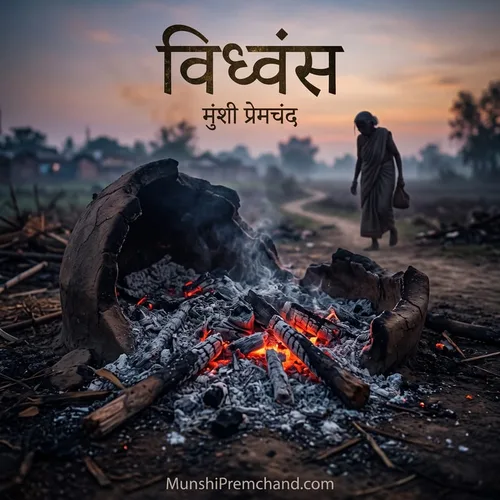
In the village of Beera, in Banaras district, lived an old, childless Gond widow named Bhungi.
She owned not a single inch of land, nor did she have a house she could call her own. Her sole means of survival was a small clay oven (bhad) where she roasted grain for the villagers.
Since rural villagers in North India often subsist on a meal of roasted grain (sattu or chabaina), Bhungi’s oven was crowded with customers from morning till night. Whatever grain she received as roasting fees served as her food, and she slept in a dark corner of the thatched shed beside her oven.
Every morning, Bhungi rose before dawn to collect dry leaves from surrounding orchards to feed her oven fire. A massive pile of dry leaves was always stacked high beside her hearth.
However, whenever the village landlord—Pandit Udaybhan Pandey—demanded unpaid forced labor (begar), Bhungi had to go hungry! Pandit Udaybhan not only forced her to roast large quantities of grain for his household for free, but also made her haul heavy pots of water from the well. Because she lived on his estate, the landlord believed he possessed an absolute right to extract unpaid labor from her whenever he pleased. In his eyes, allowing a poor widow to live on four inches of his village soil was an act of immense charity!
It was the festival of Chait Sankranti. On this sacred day, villagers eat and donate freshly harvested grain. No kitchen fires were lit in homes, so Bhungi's oven was swarming with hungry customers.
Suddenly, two of Pandit Udaybhan’s peons arrived carrying two massive baskets of grain and barked: "Roast this immediately!"
Bhungi trembled at the sight of the heavy baskets. It was already afternoon, and roasting so much grain before sunset was humanly impossible! If she had been allowed to roast grain for regular customers, she would have earned enough food to last an entire week. But now, she was forced to burn in her oven till late at night for free!
Bhungi pleaded: "Leave the baskets here. I will roast it as fast as I can!"
The peon barked: "Finish it by mid-afternoon, or you’ll face the consequences!"
Bhungi worked frantically, shoveling leaves into the furnace and stirring the hot sand. But roasting a mound of grain while feeding the fire single-handedly took time. Mid-afternoon passed, and half the grain remained unroasted. The sand in her pan cooled down, turning the grain hard and inedible.
At dusk, the landlord’s peons returned. Seeing the half-baked grain, they flew into a rage:
"You old witch! You ruined our master's grain! We’ll show you what happens!"
That very night, on the landlord's orders, his men smashed Bhungi's clay oven into dust!
Deprived of her hearth, the helpless widow was left with no means to earn a single morsel of bread.
The villagers also suffered greatly without an oven, but no one dared speak out against the powerful landlord. Well-wishers urged Bhungi to leave for another village, but her heart refused. She had spent fifty long years of her life in Beera! Every tree, every leaf, every memory of her youth was tied to this soil. Leaving her village felt worse than death itself.
A whole month passed.
One morning before dawn, Bhungi quietly sat down beside the ruins of her old oven and began shaping wet clay to rebuild her hearth. She worked in desperate haste, hoping to finish before sunrise.
Just then, Pandit Udaybhan walked by with his armed peons to collect land revenue. Seeing the old widow rebuilding her oven, his blood boiled with rage!
He roared: "On whose authority are you building this oven?"
Bhungi looked up, trembling with fear: "Maharaj... the villagers were suffering without an oven, so I am rebuilding it..."
Pandit Udaybhan kicked the wet clay with his heavy boots, smashing the structure to pieces!
As Bhungi threw herself forward to protect her hearth, the landlord's boot struck her sharply in the waist. Pain shot through her aged body. Standing up with tears in her eyes, she cried out:
"Maharaj! If you do not fear man, at least fear God! What will you gain by destroying a poor widow? Will gold sprout from these four inches of dirt? I beg you, do not take the curse of the helpless!"
Udaybhan snapped arrogance: "You will never build an oven in this village again!"
"If I don't build an oven, how will I eat?"
"I haven't taken a contract to feed your stomach!"
"I serve your house whenever called! Where else shall I go?"
"If you live in my village, you must serve! If you don't like it, pack up and get out!"
Bhungi's eyes flashed with fierce, dignified anger: "Why should I get out? A peasant becomes an owner after tilling a field for twelve years! I have grown old in this hut! My parents and ancestors lived and died here! No one can take this soil from me except the Lord of Death!"
Udaybhan sneered with contempt: "So you've learned to cite the law, have you? (To his peons) Set fire to her pile of dry leaves right now! Let us see how she builds her oven!"
Within seconds, a peon tossed a burning torch into the massive mound of dry leaves!
A terrifying roar of flames erupted into the morning sky! The fire surged upward like a raging demon, its wild red tongues leaping toward the clouds.
Villagers rushed from all sides, standing frozen in horror around the towering mountain of fire.
Bhungi stood beside her destroyed hearth, gazing at the roaring inferno with hollow, peaceful eyes.
Then, before anyone could comprehend what was happening, Bhungi ran forward with wild speed and threw her body directly into the heart of the blazing fire!
"Bhungi! Bhungi!" screaming villagers rushed forward, but the heat was so intense that no one could step within ten yards of the inferno. In a matter of seconds, her withered body was consumed by the roaring flames.
Suddenly, a fierce gale began to blow!
The howling wind caught the raging flames and swept them eastward toward the village! Within minutes, the nearby thatched huts of the peasants caught fire, turning into roaring infernos.
Emboldened by the wind, the wild flames leaped across the road and pounced directly upon Pandit Udaybhan’s massive granary!
Chaos erupted across the village! Villagers threw buckets of water, but the water only fueled the furious blaze.
The flames surged forward and engulfed Pandit Udaybhan’s grand brick mansion!
In a matter of minutes, the landlord's magnificent palace—a symbol of pride, oppression, and feudal cruelty—sank into a roaring sea of fire like a sinking ship! And the agonizing wails of ruin that echoed from the ashes of his palace were far more tragic and pitiable than the quiet cries of the poor widow he had destroyed.
Significance & Themes
- Critique of Feudal Zamindari Oppression: Premchand delivers a scathing condemnation of the feudal system (begar), where wealthy landlords exerted ruthless control over poor low-caste peasants, treating their livelihoods and lives as disposable property.
- The Power of the Curse (Deen Ki Haye): The narrative reflects the deep-rooted Indian folk belief that the quiet, agonizing tears of the oppressed possess a terrifying, destructive power capable of burning down empires of arrogance.
- Self-Immolation as Ultimate Protest: Bhungi's tragic self-immolation is not mere surrender; it is a desperate, tragic form of moral protest against an inescapable system of tyranny, transforming her small hearth fire into a cosmic weapon of divine justice.