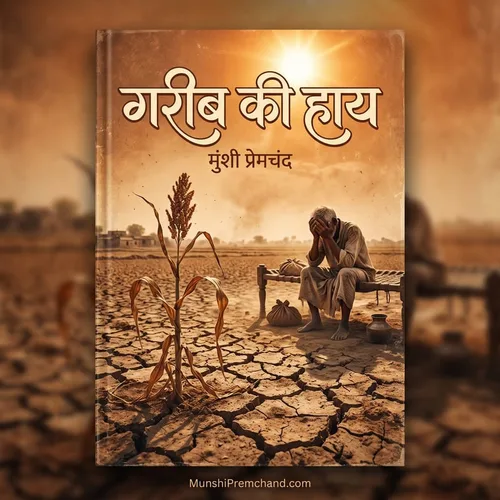
Complete English Translation: Gareeb Ki Haay
Munshi Ramsevak stepped out of his house with knitted brows and declared, "It is far better to die than to endure such an existence!" If death were to accept every such invitation extended to it, the entire world would appear desolate and abandoned today.
Munshi Ramsevak was a prominent grandee of Chandpur village. All the celebrated virtues of rural aristocrats were abundantly present in him; the frailties of human nature formed the very foundation of his life. Every day he was to be seen sitting on a broken wooden bench beneath the shade of a neem tree inside the compound of the munsif's court, his satchel of legal documents spread out before him. No one had ever seen him argue a legal point or plead a case before any magistrate's bench. Yet everyone hailed him as 'Mukhtar Sahib'—the learned legal agent. Whether storms blew, torrential rains poured, or hailstones fell, the Mukhtar Sahib would not budge an inch from his post. Whenever he set out for the courthouse, throngs of villagers would fall in behind him. From all directions, gazes of trust and profound deference rested upon him. It was legendary among all that Goddess Saraswati herself resided upon his tongue. Call it advocacy or call it legal pettifoggery, yet it was maintained solely to uphold the ancestral honour and prestige of his family. His professional earnings were meager. What talk of silver coins—even humble copper pennies often hesitated to venture into his possession without fear!
There was no doubt regarding Munshiji's command of the law. However, the tedious bother of passing examinations had constrained him. In any case, this legal profession of his existed merely to maintain outward dignity; otherwise, the principal source of his sustenance was the blind faith of nearby widows—helpless yet comfortably provided with food and drink—and naive, wealthy old men. Widows deposited their life savings with him for safekeeping. Old men, terrified of their spendthrift, rebellious sons, surrendered their wealth into his care. But once money entered his clenched fist, it forgot the way out. Whenever necessity arose, he would occasionally borrow money as well. Could anyone manage their affairs without taking loans? He would borrow money in the morning on the solemn promise of repaying it by evening, but that evening never arrived. In short, Munshiji had never learned the art of repaying loans; it was his cherished family tradition.
It was precisely such matters that frequently disturbed Munshiji's peace and contentment. Of the law and the courts he had no fear whatsoever; to confront him in that arena was like wrestling a crocodile in deep water. But whenever some obstinate scoundrel clashed with him, dared to doubt his honesty, and became hell-bent on abusing him to his face, Munshiji's sensitive heart was deeply bruised. Incidents of this sort occurred with distressing frequency. Everywhere there exist petty, vile individuals who derive supreme delight solely from humiliating others. Backed by such meddlers, lowly folks would occasionally dare to confront Munshiji face-to-face. Otherwise, a mere vegetable-woman would never have had the audacity to stride into his inner courtyard and shower him with insults! Munshiji had been her patron for years; he had taken greens and vegetables from her stall season after season. If payment had not been made, the vegetable-woman ought to have exercised patience. The money would have reached her sooner or later! Yet that foul-mouthed woman had lost all patience within just two short years and, for the sake of a few paltry annas, had stripped the honour of a respectable gentleman in broad daylight. If, in sheer exasperation, Munshiji resolved to make himself an offering to death, he was hardly to blame!
In that same village lived a poor Brahmin widow named Munga. Her husband had been a havildar in the native regiment deployed to Burma, where he was killed in battle. In recognition of his distinguished service, the imperial government had granted Munga a gratuity of five hundred rupees. A solitary widow in delicate times, the poor woman had entrusted the entire sum to Munshi Ramsevak, requesting small sums month by month to eke out her meager subsistence.
For several years, Munshiji discharged this duty with immaculate outward honesty. But when, despite her advancing years, Munga showed no sign of dying, and Munshiji grew anxious that she had no intention of leaving behind even half the sum for her celestial journey, he said to her one day, "Munga! Do you intend to die or not? Tell me plainly, so that I may begin worrying about my own death!"
On that day, Munga’s eyes were opened; her slumber broke. She said, "Settle my account."
The ledger was ready. In the 'deposit account,' not a single cowrie remained!
Seizing Munshiji’s hand with fierce firmness, Munga cried, "You have suppressed two hundred and fifty rupees of my money! I will not relinquish a single cowrie!"
Yet the fury of the helpless is like the pop of a firecracker—it may startle children, but it produces no real effect. In a court of law, she had no standing whatever. There was no written contract, no formal documentation, no signed receipt. Her only hope lay in the village council.
A panchayat was convened, and elders from several neighboring villages gathered. Munshiji was immaculate in outward intention and legal finesse; what cause had he to fear the panchayat? Standing up before the assembly, he addressed the elders: "Brothers! You are truth incarnate and men of noble lineage. I am the humblest servant of you all. Every fiber of my being overflows with gratitude for your boundless generosity, kindness, and love. And can you truly believe that I would swallow the meager rupees of this helpless, destitute widow?"
The elders chorused in one voice, "No, never! Such a thing is impossible for a man of your stature!"
Ramsevak continued, "If it is the opinion of all you honorable gentlemen that I have embezzled her money, then there is no alternative left for me but to go and drown myself! I am not an opulent man, nor do I boast of vast philanthropy; yet by the grace of my pen and the kindness of you all, I am beholden to no one. Could I ever stoop so low as to devour the sustenance of an orphan widow?"
The elders chorused once more, "No, never! You could never commit such a deed!"
Judgment is pronounced according to the standing of the face. The panchayat exonerated Munshiji. The assembly disbanded. Drawing a deep, shuddering sigh, Munga resigned herself and thought in her heart: Very well! If I could not receive justice here, so be it; but where will he escape justice up above?
Now there was no one left to listen to Munga's sorrow or offer her support. Whatever agonies poverty brings in its wake, she had to endure them all. She possessed a strong, able body; had she wished, she could have earned her bread through manual labor. But on the very day the panchayat concluded, she swore an oath never to work again.
Now, night and day, she chanted only the refrain of her stolen rupees. Rising or sitting, sleeping or waking, she had only one occupation: praying for the 'well-being' of Munshi Ramsevak. Sitting at the doorway of her ruined hovel, she blessed him night and day with all the sincerity of her soul. Often, in her invocations, she employed such poetic couplets and startling metaphors that passers-by stood astonished listening to her.
Gradually, Munga descended into madness. Bare-headed, half-naked, holding a small hatchet in her hand, she would wander off to sit in solitary, desolate places.
Instead of her hovel, she was now to be seen wandering through the cremation ground, along the riverbank, and amidst crumbled ruins. Disheveled matted locks, bloodshot eyes, a countenance stamped with lunacy, and withered, skeletal limbs—beholding her terrifying form, people shrank in dread. No one dared tease her, even in jest. If ever she entered the village lanes, women would bolt their doors from within. Men took detours through side alleys to avoid her path, and children fled screaming in terror.
If there was any lad who did not flee, it was Munshi Ramsevak's worthy son, Ramgulam. Whatever shortcomings remained in the father had been fully perfected in the son! The boys of the village were tormented to distraction by him; the one-eyed and lame men of the village detested his very sight; and as for taking delight in receiving abuses, even a pampered son-in-law arriving at his in-laws' home could scarcely have enjoyed it so thoroughly! He would clap his hands behind Munga, set barking dogs upon her heels, and torment her relentlessly until the poor woman, driven beyond endurance, was forced to flee the village perimeter.
Having lost her money, her senses, and her peace, she had been bestowed the title of 'madwoman'; and now she was truly mad. Sitting alone for hours, she would converse with herself, expressing a violent, visceral yearning to chew, grind, tear, and devour Ramsevak's flesh, bones, skin, eyes, and liver. And whenever this fury reached its fever pitch, she would turn her face toward Ramsevak’s house and howl in a blood-curdling screech:
"I will drink your blood!"
Often, in the dead silence of the night, hearing this roaring screech, women would start up from their beds in terror. Yet far more horrifying than that screech was her boisterous, demonic cackle! In the imagined ecstasy of drinking Munshiji's blood, she would burst into ferocious laughter. That cackling reeked of such fiendish defiance and bestial ferocity that hearing it at night made the blood run cold in people's veins. It sounded as though a hundred screeching owls were laughing in unison!
Munshi Ramsevak was a man of resolute courage and iron nerves. He feared neither civil litigation nor criminal proceedings. Yet hearing those terrifying words of Munga, even he would shudder. A man may not fear human justice, but the terror of divine retribution occasionally awakens such dread in every mortal heart—and even more so in the heart of his wife.
His wife was an exceptionally shrewd and cunning woman. She regularly advised him in all these matters. Those people were mistaken who claimed that Goddess Saraswati resided upon Munshiji's tongue; that celestial gift was truly possessed by his wife! In speaking she was every bit as sharp as Munshiji was with his pen. In their moments of helpless distress, the husband and wife would confer together: What was to be done now?
It was midnight. Following his daily custom, Munshiji had downed a few swigs of liquor to drown his anxieties and gone to sleep. Suddenly, Munga arrived at his front door and let out a piercing screech: "I will drink your blood!"—followed by a wild, ringing cackle.
Hearing that gruesome laughter, Munshiji bolted awake. His legs trembled violently with fear; his heart hammered against his ribs. Gathering immense willpower, he unbolted the inner door, went over, and woke Nagin.
Nagin snapped irritably, "What is it? What are you saying?"
Munshiji whispered in a muted voice, "She is standing right at the door."
Nagin sat up. "What is she saying?"
"Your head!"
"Has she come right to the doorway?"
"Yes! Can you not hear her voice?"
Nagin did not fear Munga herself, but she was terrified of her haunting thought. Even so, she was confident that in a war of words, she could surely humiliate her. Composing herself, she said, "If you say so, shall I go out and have a word or two with her?"
Munshiji forbade her.
Treading on stealthy tiptoes, both crept into the entrance vestibule and peered through a chink in the door. Munga’s dim, shadowy form lay prostrate upon the ground, and her rapid, ragged breathing was distinctly audible. In her hunger for Ramsevak's blood and flesh, she had dried up her own blood and flesh to the bone. Even a child could have knocked her down with a push. Yet the entire village trembled before her. We do not fear a living man, but we are terrified of a corpse!
The night passed. The door remained bolted, but Munshiji and Nagin spent the night awake in vigil. Munga could not force her way inside, but who could bar the entry of her voice? Far more terrifying than Munga herself was her screeching voice!
At dawn, Munshiji stepped outside and demanded of Munga, "Why are you lying here?"
Munga snarled, "I will drink your blood!"
Nagin stepped forward, hissing with fury, "I will scorch your face with embers!"
Yet Nagin's venom had no effect whatever upon Munga. She burst into a resounding, scornful cackle. Nagin shrank back, crestfallen. Before mockery, the sharpest tongue is silenced.
Munshiji spoke again, "Get up from here!"
"I will not get up!"
"How long will you lie here?"
"I will drink your blood and only then depart!"
Munshiji’s sharp pen was utterly powerless here, and Nagin’s fiery tirades turned ice-cold. Both retreated inside the house to confer: How was this calamity to be averted? How could they deliver themselves from this catastrophe?
When a goddess visits, she departs after drinking the blood of a sacrificial goat; but this witch had come to drink human blood! That precious blood—if even a single drop emerged while sharpening a reed pen, the entire household lamented for weeks and months, and the tragedy spread from house to house across the village! Could the drinking of that very blood rejuvenate Munga's withered, skeletal frame?
The rumor spread throughout the village: Munga was staging a dharna—a sit-in unto death—at Munshiji’s doorstep! The villagers found immense amusement in Munshiji's predicament. Within no time, a crowd of hundreds gathered to watch. Occasionally, crowds had gathered at this doorstep before, but this crowd was intensely distasteful to Ramgulam. He felt such burning fury toward Munga that had it been in his power, he would have shoved her straight into a well! The mere thought sent a tickle of malicious glee through Ramgulam's heart, and he could scarcely contain his laughter. Aha! What splendid fun it would be if she fell into the well! But this witch simply will not budge from here! What can be done?
In Munshiji's house was a cow. Though she was fed ample oilcake, grain, and fodder, everything was absorbed directly into her bones; her skeletal frame grew sturdier, but she gave no milk. Ramgulam dissolved a pot full of that cow's liquid dung and emptied the entire vessel over poor Munga! A few stray splashes landed on the onlookers as well. Poor Munga was drenched from head to foot in foul filth, and the spectators scattered in a hurry, exclaiming, "This is Munshi Ramgulam’s door! Such is the hospitality practiced here. Run away quickly, or even grander entertainment will be offered!"
The crowd melted away. Inside the house, Ramgulam laughed heartily and clapped his hands with glee. Munshiji patted the back of his dutiful son for having so effortlessly and ingeniously dispersed the troublesome mob! All the spectators vanished, yet poor Munga remained seated precisely where she was.
Noon arrived. Munga took no food. Evening fell. Despite endless coaxing and entreaties, she refused to touch a morsel. The village headman pleaded with her; even Munshiji went so far as to fold his hands in supplication; but the goddess refused to be appeased. At last, Munshiji turned and retreated inside, remarking that hunger is the surest remedy to reconcile the stubborn.
Munga spent that night as well without a drop of water or a grain of food. The master and mistress of the house spent another sleepless night keeping vigil until dawn. Today, Munga’s roars and cackles were heard far less frequently. The inmates of the house assumed the nuisance was passing.
As dawn broke, they unbolted the door and looked out. Munga lay motionless upon the earth; flies were buzzing about her mouth; the bird of her life had taken flight!
She had come to this doorstep for the sole purpose of dying. To the very man who had robbed the savings of her entire life, she surrendered her life-breath as well! She made a final offering of the very dust of her mortal clay to him. How intensely man clings to wealth! Wealth is dearer to him than life itself, especially in old age. As the day of debt settlement approaches, the interest upon it compounds relentlessly.
It is pointless to describe the commotion that erupted in the village over this event, or the utter humiliation that befell Munshi Ramsevak. When such an extraordinary catastrophe occurs in a small village, the upheaval surpasses all bounds. The disgrace suffered by Munshiji was not a hair's breadth less than what he richly deserved. Whatever remnant of his honour had survived was wiped clean by this single calamity.
Now, even the lowliest tanner (chamar) of the village would not deign to accept a cup of water from his hands or touch his person! If a cow happens to die tied to a tether in someone's courtyard, the master must wander begging from door to door for months in atonement—no barber will shave him, no water-carrier will fetch water for him, no human being will touch him. Such is the penance for go-hatya—slaying a cow. But the punishment for Brahma-hatya—the murder of a Brahmin—is infinitely more severe, and the public humiliation attached to it is boundless. Munga had known this well; and for that very reason, she had chosen to die upon his threshold! She knew: Living, I can accomplish nothing against him; but dead, I can destroy him utterly! When a cake of cow dung burns to ash, saints and ascetics smear it upon their foreheads; a lump of stone heated in the furnace becomes sharper and more destructive than the fire itself!
Munshi Ramsevak was a man of the law. The law had framed no charges against him. Munga had not died under any section of the Indian Penal Code; no precedent for her death existed in the statutes of British jurisprudence. Therefore, those who demanded that he perform religious penance were laboring under a grave delusion!
What did it matter if the water-carrier refused to fetch water? Let him refuse! He would fetch his own water. What shame could there be in doing one's own chores? To the devil with the barber if he refused to shave him! What need was there for shaving at all? A beard is a handsome ornament; a beard is a man's pride and adornment! And if he ever felt revulsion toward hair, razors were available for an anna apiece. The washerman refused to wash their clothes? He cared nothing for that either! Soap was sold for pennies in every lane. A single bar of soap cleans dozens of garments until they gleam white as egret feathers! How could a washerman ever wash clothes so cleanly? He merely thrashes garments against rocks until they are reduced to rags, wears them himself, rents them out to strangers, boils them in vats, and soaks them in soda! He utterly ruins the fabric. That was why coats never lasted more than two or three years; otherwise, in grandfather’s time, two or three achkans and tunics made every fifth year would last a lifetime!
Throughout the day, Munshi Ramsevak and his wife consoled their minds with such rationalizations. But as evening descended, their clever arguments withered away.
Now, terror laid siege to their hearts. As the night deepened, fear escalated in tandem. By an oversight, the outer door had been left open; yet neither had the courage to go and bolt it. At last, Nagin picked up a small oil lamp, Munshiji gripped an axe, and Ramgulam grasped a fodder-cleaver. In this manner, starting at every shadow and hesitating at every step, the three arrived at the doorway. Here, Munshiji displayed great bravado. He made a bold show of stepping outside the door. Trembling, yet in a loud voice, he said to Nagin, "You are frightened for nothing! Is she sitting out here?"
His beloved Nagin yanked him back inside and snapped irritably, "This childish folly of yours is intolerable!"
Having conquered this arena, the trio retreated to the kitchen, and cooking commenced.
Yet Munga was lodged permanently before their eyes. Beholding their own shadows, terror of Munga gripped them. In every dark corner, Munga seemed to sit watching: the identical skeleton of bones, the same disheveled matted hair, the same madness, the same terrifying eyes—every detail of Munga's form was vividly visible!
In that chamber stood several large earthen jars for flour and lentils, beside which lay a pile of old rags. A starving rat (the earthen jars had never seen the face of grain, yet it was renowned throughout the village that the rats of this house were ferocious bandits) crawled beneath the rags in search of grains that had never fallen from the jars. The cloth rustled. The spread-out rags assumed the shape of Munga's withered, spindly legs! Seeing them, Nagin shrieked in horror. Munshiji dashed frantically toward the door; Ramgulam rushed forward and clung to his father's legs.
The rat scurried out into the open. Seeing it, their wits returned. Munshiji now mustered the courage to walk toward the earthen jars. Nagin sneered, "Leave it be! I have seen your celebrated manhood!"
Munshiji took great offense at this insult from his beloved Nagin. "Do you imagine I was afraid? What was there to fear? Munga is dead; is she sitting here? Did I not step outside the doorway just now? You kept holding me back, but I refused to listen!"
Munshiji's argument silenced Nagin. To step outside the door—or to attempt to step outside—was no ordinary feat! Who could brand a man a coward when such proof of his valour had been exhibited? It was mere obstinacy on Nagin's part.
Having eaten their meal, the three entered the bedchamber. Yet Munga did not release her grip here either. They conversed to divert their minds; Nagin recounted legends of Raja Hardaul and Rani Sarandha; Munshiji narrated accounts of several sensational criminal trials. Yet despite all these devices, Munga's specter refused to vanish from their sight. At the faintest creak, all three started in alarm. The rustle of dry leaves outside made their hair stand on end. Every few moments, a faint, subterranean whisper seemed to rise from the depths of the earth, echoing in their ears:
"I will drink your blood!"
At midnight, Nagin bolted awake from sleep. She was pregnant in those days. Munga—with fiery red eyes and sharp, pointed fangs—appeared to be sitting directly upon her chest!
Nagin let out a blood-curdling shriek. Rushing frantically into the courtyard like a madwoman, she collapsed flat upon the earth. Her entire body was drenched in cold sweat.
Hearing her shriek, Munshiji woke with a start; but terror sealed his eyes shut. Like a blind man, he fumbled against the walls searching for the door. Only after a long while did he find the threshold. Stepping into the courtyard, he found Nagin thrashing her hands and feet convulsively upon the ground. Lifting her up, he carried her inside, but throughout the night she never opened her eyes.
At dawn, she began babbling incoherently. Soon a raging fever seized her; her body burned like a red-hot griddle. By evening, delirium set in; and at midnight, when absolute silence reigned over the world, Nagin departed from this life!
The terror of Munga had claimed her life. So long as Munga had lived, she had trembled before Nagin's venomous hiss. Even in her madness, she had never dared confront Nagin. Yet by surrendering her own life, she had taken Nagin's life today! There is colossal power in fear. Man cannot tie a single knot in the empty air, yet fear has constructed an entire phantom universe out of nothing!
The night passed. The sun climbed high into the sky, yet not a single soul from the village came forward to help carry Nagin's corpse. Munshiji went from door to door, but no one stepped out. Who would visit the threshold of a murderer? Who would lift the corpse of a slayer of Brahmins? In this hour of trial, Munshiji’s imposing aura, the dread of his mighty pen, and his brilliant legal acumen—not a single one proved of any use!
Defeated on all sides, Munshiji returned to his house. Here, only pitch darkness confronted him. He reached the doorway, but his feet refused to cross the threshold. Nor could he remain standing outside. Outside was Munga; inside was Nagin! Steeling his heart and reciting the Hanuman Chalisa, he stepped inside. What passed through his mind at that moment, he alone knew; it is difficult for anyone else to imagine.
A corpse lay inside the house; neither kin before him nor friend behind. A second marriage was certainly possible—after all, he had barely entered his fiftieth year this past Phagun. But where could he ever find another woman so capable, so sweet-tongued, and so accomplished? Alas! Who would now argue with the creditors demanding payment? Who would leave them utterly speechless? Who would manage the intricate accounts of lendings and borrowings with such mastery? Whose piercing voice would strike like an arrow into the chests of the debt-collectors? This loss could never be repaired!
The next day, loading the corpse onto a handcart, Munshiji set out toward the holy river Ganga.
The funeral procession had no numbers to boast of: one was Munshiji himself, and the other his jewel of a son, Master Ramgulam! Even Munga's corpse had not been carried away with such utter disgrace.
Even after claiming Nagin's life, Munga did not release her hold upon Munshiji. Her image was permanently enthroned in his mind at every hour of the day. Wherever he went, his thoughts remained transfixed upon her. Had there been any means of diversion, perhaps he would not have been so utterly unhinged; but not even an effigy from the village cast a glance toward his door. The poor wretch had to fetch his own water and scour his own utensils.
Brooding and rage, anxiety and terror—how long could a single brain withstand so formidable an army of foes? Particularly a brain that was drained daily in legal quibbles!
Like a solitary prisoner, ten or twelve days passed for him somehow or other. On the fourteenth day, Munshiji changed into fresh clothes, gathered his satchel of documents, and set out for the courthouse. Today his countenance appeared somewhat brightened. The moment I arrive, my clients will surround me! They will offer condolences for my bereavement. I shall let fall two or three tears. Then will follow an avalanche of sale deeds, mortgage bonds, and compromise petitions! My palm will be greased. In the evening, the pleasant cheer of liquor will be restored, the absence of which has made my heart even more desolate!
Absorbed in these pleasing reveries, Munshiji reached the courthouse compound.
Yet there, instead of a deluge of mortgage deeds, a flood of sale contracts, and the bustling cheer of clients, only the barren, sandy wastes of despair met his eyes! Unfurling his document satchel, he sat for hours, but not a soul ventured near him. No one so much as inquired, "How are you doing, Munshiji?"
Leave alone new clients—even old, established clients whose families had dealt with Munshiji for generations averted their faces from him today! That worthless, incompetent bungler Ramzan—whom Munshiji had always mocked and who could not even write a sentence correctly—was reigning like Lord Krishna surrounded by gopis! Oh, fickle fortune! Clients turned their faces and walked past as though they had never possessed the slightest acquaintance with him!
After sifting the dust of the courthouse all day in vain, Munshiji walked home. Sunk in disappointment and gloom, the closer he drew to his house, the more vividly Munga's specter rose before his eyes. At last, when he pushed open the front door and two dogs—which Ramgulam had locked inside—bolted out suddenly, Munshiji’s wits deserted him completely. Letting out a piercing shriek, he collapsed senseless upon the ground!
No force exerts so profound an influence upon the human mind and intellect as terror! Love, anxiety, despair, financial ruin—all these certainly wound the heart; yet they are merely gentle gusts of wind, whereas terror is a raging tempest.
What befell Munshiji thereafter is not known with certainty. For several days, people saw him trudging to the courthouse and returning withered and crushed. Going to court was his habitual duty; and though clients were entirely extinct, it remained the sole pretense left to escape the relentless badgering of creditors and reassure them of his solvency.
After that, he was not seen for several months. He had departed on a pilgrimage to Badrinath.
One day, a mendicant sadhu arrived in the village—smeared in sacred ash, with long, matted ascetic dreadlocks and a water-pot (kamandal) in his hand. His countenance bore an uncanny resemblance to Munshi Ramsevak. In his speech and accent, too, there was scarcely any difference. He sat beneath a tree beside a smoldering sacred fire (dhuni).
That very night, smoke arose from Munshi Ramsevak’s house. Soon, leaping flames became visible, and the blaze roared into fury! Hundreds of villagers came running—not to extinguish the fire, but to enjoy the spectacle!
What immense, devastating power resides in the curse of the poor!
Following Munshiji’s disappearance, Ramgulam had gone to live at his maternal uncle’s home. He stayed there for some time, but his conduct found favor with no one. One day, he plucked a radish from someone's vegetable patch; the farmer gave him two or three hard slaps. Ramgulam flew into such a rage that when the farmer's harvested chickpea crop was brought to the threshing floor, Ramgulam set fire to it! The entire threshing floor was reduced to ashes, causing thousands of rupees of ruin.
The police investigated; Ramgulam was apprehended. For that very crime, he is currently serving his sentence inside the Reformatory School at Chunar.
Summary of Gareeb Ki Haay
'Gareeb Ki Haay' (The Curse of the Destitute) is one of Munshi Premchand's most searing, realistic, and psychologically terrifying masterworks on rural exploitation, social ostracism, and karmic retribution. Set in the village of Chandpur, the narrative centers on Munshi Ramsevak, a pretentious legal scribe (mukhtar) who lives by exploiting the blind faith of gullible elderly folks and vulnerable widows.
When Munga, a poor Brahmin widow whose soldier husband was killed in the Burma campaign, entrusts her five-hundred-rupee government gratuity to Ramsevak, he gradually withholds her remaining two hundred and fifty rupees. When Munga demands her money, Ramsevak cynically claims the account is empty. He manipulates a village council (panchayat) with slick rhetoric and false piety, leaving Munga utterly ruined.
Driven to madness by betrayal, Munga swears off work, wanders the cremation grounds and ruins like a vengeful specter with a hatchet, shrieking, "I will drink your blood!" (Tera lahu peeungi!), and laughing like a hundred owls. When she stages a hunger strike on Ramsevak's doorstep, Ramsevak's cruel son Ramgulam pours liquid cow dung over her. Munga dies on his threshold of starvation, offering her very corpse as an eternal curse upon the house.
Her death triggers the terrifying stigma of Brahma-hatya (Brahmin slaughter), reducing Ramsevak to a social pariah whom no villager, barber, or water-carrier will touch. The psychological terror of Munga's ghost descends upon the household: a rustling rat sends the family into hysterics, and Nagin—Ramsevak's sharp-tongued, pregnant wife—wakes in terror believing Munga is strangling her chest. Nagin dies of high fever and delirium, and Ramsevak must cart her corpse to the Ganga alone with Ramgulam. When Ramsevak returns to court, all his clients abandon him. Overcome by terror and bankruptcy, he abandons his home and flees to Badrinath. Months later, an ash-smeared sadhu resembling Ramsevak returns, and that night Ramsevak's house burns to ashes while villagers watch in amusement. Ramgulam moves to his uncle's village, sets fire to a farmer's threshing floor out of spite, and is incarcerated in the Chunar Reformatory School.
Publication History
'Gareeb Ki Haay' (गरीब की हाय) was originally written in Urdu under the title 'Aah-e-Bekas' (आह-ए-बेकस / The Sigh of the Helpless) and first published in October 1911 in the prestigious literary journal Zamana (ज़माना), edited by Munshi Daya Narain Nigam. It was subsequently included in Premchand's first major Urdu short-story collection, Prem Pachisi, Part 1 (प्रेम-पच्चीसी, 1914).
The author later rendered the story into Hindi under the title 'Gareeb Ki Haay', publishing it in the anthology Prem Purnima (प्रेम पूर्णिमा, 1918). It was subsequently incorporated into the canonical collection Mansarovar, Part 8 (मानसरोवर भाग 8, 1950).
This unabridged English translation was published in 2026 by MunshiPremchand.com as part of the MunshiPremchand.com English Translation Series.
Themes & Critical Significance
- The Moral Omnipotence of the 'Haay' (The Poor Man's Curse): Premchand explores the traditional Indian moral conviction that the silent agonized sigh (haay) of an exploited innocent possesses devastating supernatural and psychological power. While formal colonial law and corrupt village councils protect the oppressor, the moral universe exacts absolute retribution through the psychological disintegration of the tyrant's household.
- Hypocrisy of the Rural Petty Bourgeoisie: Munshi Ramsevak represents the parasitic class of semi-literate legal pettifoggers who wield the prestige of court documents to fleece the illiterate rural population. His sanctimonious piety, pseudo-rationalizations, and pride in his "ancestral dignity" are stripped bare to reveal naked greed and callous cruelty.
- The Psychology of Terror and Guilt: Premchand provides an extraordinary psychological dissection of fear. Ramsevak and Nagin boast of rationality and legal immunity during the daylight hours, but nightfall unleashes their suppressed guilt. The rustling of a rat, the shadows on the wall, and the nightmare of Munga sitting on Nagin's chest demonstrate how internal guilt manifests as external terror, proving fatal to Nagin and driving Ramsevak to insanity and renunciation.
- Institutional Collusion vs. Social Ostracism: The village panchayat readily exonerates Ramsevak because of his social standing, illustrating how traditional institutions side with wealth and power. Yet when Munga dies on his threshold, the ancient taboo of Brahma-hatya reasserts itself with crushing finality, demonstrating the dual nature of village community life—complicit in legal fraud, yet merciless in social excommunication.
- Intergenerational Degeneration: The moral corruption of Ramsevak directly breeds monstrosity in his son Ramgulam, who graduates from pouring cow dung on a dying widow to committing devastating arson, ending his youth locked in a reformatory school. Premchand demonstrates that ill-gotten wealth and parental immorality poison the subsequent generation at its roots.