Complete English Translation: Kafan (The Shroud)
1
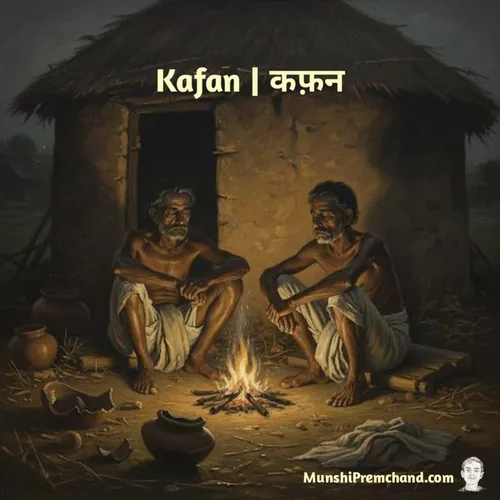
At the doorway of the hut, father and son sat in silence before an extinguished campfire, while inside, the son's young wife, Budhiya, was thrashing in the agonizing throes of childbirth. From time to time, such heart-wrenching screams tore from her lips that both men clutched their chests in distress. It was a freezing winter night; nature was steeped in desolate silence, and the entire village had dissolved into the pitch-black darkness.
Ghisu said, "It seems she will not survive. The whole day has passed in agitation; go inside and take a look."
Madhav retorted irritably, "If she has to die, why doesn't she die quickly? What will I accomplish by looking at her?"
"You are truly callous, you rascal! To show such faithlessness toward the very woman with whom you lived in peace and comfort for a whole year!"
"Well, I cannot bear to watch her writhing and flailing her arms and legs."
They belonged to a clan of Chamars and were infamous throughout the entire village. If Ghisu worked for one single day, he rested for three. Madhav was such a slacker that if he worked for half an hour, he puffed on his chillum pipe for a full hour. Because of this, nobody gave them regular employment. If there was even a handful of grain in the house, they took an oath never to lift a finger for labor. When two or three starvation fasts had passed, Ghisu would climb up a tree and chop down branches for firewood, Madhav would haul them to the market to sell, and for as long as those coins lasted, both of them wandered about aimlessly.
There was no scarcity of work in the village. It was a farming community, and for an industrious man there were fifty chores available. But these two were summoned only when someone had no choice but to settle for the meager labor of one man delivered grudgingly by two. If only both had been holy ascetics, they would have had no need whatsoever for discipline, vows, or self-restraint to achieve contentment and patience! It was simply in their very nature.
What an extraordinary life they led! Apart from two or three earthen cooking pots, they possessed not a shred of property. Covering their nakedness in tattered rags, they drifted through life—wholly liberated from worldly anxieties! Buried under crushing debts. They were showered with abuses and even beaten, yet they bore no sorrow or remorse. They were so utterly destitute that even when lenders knew there was not the faintest hope of recovery, people still ended up loaning them a few coins. During the pea and potato harvests, they would sneak into others' fields, pluck peas or uproot potatoes, roast them, and feast; or they would snap off five or ten stalks of sugarcane to chew throughout the night.
Ghisu had lived sixty years of his life through this improvident reliance on providence alone, and Madhav, like a dutiful son, walked faithfully in his father's footsteps—indeed, he was making the family name shine even brighter. At this very moment, both sat before the dying fire roasting potatoes they had dug up from someone else's field. Ghisu's wife had passed away many years ago. Madhav had been married only the previous year. Ever since this young woman had arrived, she had established the foundations of household order and filled the insatiable bellies of these two shameless idlers. And since her coming, both men had grown even lazier and more addicted to comfort. Indeed, they had even developed an arrogant swagger. If anyone called them for labor, they would shamelessly demand double wages.
That very woman was now dying inside in the throes of labor, and both men were merely waiting for her to die so they could sleep in peace.
Ghisu pulled out a potato, peeled it, and said, "Go take a look at what condition she is in. It must be the mischief of some evil spirit, what else? And here, even an exorcist demands a full rupee!"
Madhav was terrified that if he stepped inside the hut, Ghisu would polish off the lion's share of the roasted potatoes. He said, "I am scared to go in there."
"What is there to be afraid of when I am right here?"
"Then why don't you go inside and look?"
"When my own woman died, I didn't leave her side for three whole days! And besides, won't she feel ashamed before me? I have never even seen her face unveiled—how can I go and look upon her uncovered body today? She won't even be conscious of her clothing! If she sees me, she won't even be able to thrash her limbs freely!"
"I am thinking, if a child is born, what will become of us? We have no dry ginger, no jaggery, no mustard oil—there is nothing at all in the house!"
"Everything will appear. Let God grant it first! The very people who will not part with a single copper coin right now are the ones who will call us tomorrow and give silver rupees. I had nine sons born to me; there was never anything in the house, but somehow God always steered our boat across the river."
In a society where the plight of those who toiled night and day was barely any better than their own, and where those who exploited the vulnerabilities of the peasant farmers lived far more lavishly, the emergence of such a mentality was hardly surprising. We would go so far as to say that Ghisu possessed far greater insight than the simple peasants; instead of blending into the mindless herd of drudging laborers, he had allied himself with the cynical company of village idlers. True, he lacked the cunning to master the craft and authority of that scheming circle; hence, while others of that breed became village headmen and bullies, the whole village pointed accusing fingers at him. Yet he possessed this consolation: that even if he was in tatters, at least he was spared the back-breaking, soul-crushing drudgery of the peasants, and no one could take undue advantage of his simplicity and innocence!
Both men kept pulling the scalding potatoes from the ashes and eating them hurriedly. They had eaten nothing since yesterday. They lacked the patience to let them cool. Several times their tongues were badly scalded. Once peeled, the potato's outer skin burned the tongue, throat, and palate, and keeping that glowing ember inside the mouth was far more perilous than swallowing it down quickly into the stomach, where there were ample resources to extinguish the heat. Therefore, both gulped them down in haste, even though tears welled up in their eyes during the ordeal.
At that moment, Ghisu remembered the Thakur's wedding feast which he had attended twenty years ago. The deep, intoxicating gratification he had experienced at that feast was a landmark event in his life, and its memory was as vivid today as ever. He said, "I can never forget that feast. Never since then have I eaten like that or filled my belly so completely. The bride's family fed puris to everyone—to everyone! Big and small alike feasted on puris fried in pure desi ghee! Chutney, raita, three kinds of dry vegetables, a rich spiced curry, curd, preserves, sweets—how can I even describe the divine taste of that feast! There was no restriction; whatever you wished for, you asked for; eat as much as your belly could hold. People ate and ate until no one could even find room for a sip of water. And still the servers kept dropping steaming-hot, round, fragrant kachoris right onto your leaf-plate! We begged them, 'No, we cannot eat more,' covering our leaf-plates with our hands, but they kept piling them on. And when everyone had washed their hands and mouth, we were given betel leaf and cardamom. But where did I have the sense to take paan? I couldn't even stand up on my feet! I crept straight away and collapsed onto my blanket. Such an open-hearted ocean of generosity was that Thakur!"
Madhav relished these delicacies in his imagination and said, "Nobody feeds us such feasts anymore."
"Who would feed such feasts now? Those days were different. Nowadays everyone preaches economy. Don't spend on weddings, don't spend on funeral rites! Just ask them: hoarding all the wealth squeezed from the poor, where will you take it? There is no limit to their hoarding, but when it comes to spending, they preach economy!"
"You must have eaten at least twenty puris?"
"I ate far more than twenty!"
"I could have devoured fifty!"
"I didn't eat a single puri less than fifty. The food was cooked so well. You aren't even half the man I was."
Having finished the potatoes, both drank some water, pulled their dhotis over their bodies, drew their knees up against their bellies, and fell asleep right before the fire. They lay curled up like two gigantic pythons.
And inside, Budhiya was still groaning.
2
In the morning, when Madhav went inside the hut to look, his wife had grown cold as stone. Flies were buzzing over her mouth. Her petrified, glassy eyes stared unblinkingly toward the rafters. Her entire body was caked in dust. The unborn child had died inside her womb.
Madhav came running out to Ghisu. Then both began to wail loudly, crying "Hai! Hai!" and beating their chests. Hearing their frantic laments, the neighbors came hurrying over and, following ancient village custom, began consoling these unfortunate wretches.
However, there was no time for prolonged lamentation. They had to arrange for wood and a shroud. In their home, money was as nonexistent as meat in a vulture's nest!
Father and son went weeping to the village landlord. The Zamindar detested the very sight of their faces. He had personally thrashed them with his own hands many times for stealing or failing to show up for promised work. He demanded, "What is it, you Ghisu? Why are you wailing? You are scarcely seen anywhere these days! It seems you have no wish to live in this village anymore."
Ghisu placed his forehead upon the ground, tears streaming from his eyes, and cried, "Huzoor! A dreadful calamity has fallen upon me. Madhav's wife passed away last night. She struggled in agony all night long, Sarkar! Both of us sat beside her head. We did whatever we could with medicines and cures, but she betrayed us and slipped away. Now there is nobody left to offer us even a dry piece of bread, Master! We are ruined. Our home is destroyed. I am your humble slave; who else but you can arrange for her burial rites? Whatever little we had in our hands was swallowed up by medicines and doctors. Only through Sarkar's kindness can her funeral proceed. Whose door can I knock on except yours?"
The Zamindar was a man of generous temper. But showing kindness to Ghisu was like dyeing a black blanket—it would never take color. His heart urged him to shout: "Get out! Be off from here! You never appear when summoned, and today, when you have a selfish need, you come flattering and groveling! You worthless parasite, you scoundrel!" Yet this was neither the occasion for wrath nor for punishment.
Grudgingly, seething inside, he pulled out two rupees and tossed them onto the ground. But not a single word of consolation slipped from his lips. He did not even deign to glance in their direction; he merely shook off an annoying burden from his shoulders.
When the Zamindar himself had parted with two rupees, how could the village shopkeepers and moneylenders find the courage to refuse? Ghisu knew very well how to beat the drum of the Zamindar's charity. Someone handed over two annas, someone four annas. Within an hour, Ghisu had amassed a handsome sum of five whole rupees. Someone contributed grain, someone else donated firewood. And by afternoon, Ghisu and Madhav set off toward the market to purchase a shroud. Meanwhile, the village folk began cutting bamboo poles to construct the bier.
The soft-hearted women of the village came in turns to view the corpse, shedding a couple of tears over her miserable fate before walking away.
3
Reaching the bazaar, Ghisu said, "Enough wood has already been gathered to burn her, wouldn't you say, Madhav?"
Madhav replied, "Yes, there is plenty of wood; now we only need the shroud."
"Then come, let us buy some cheap cloth for the shroud."
"Yes, of course! By the time the bier is lifted, night will fall. Who examines a shroud in the dark?"
"What a terrible custom this is! A woman who never got even a rag to cover her naked body while alive must have a brand new shroud when she dies!"
"After all, the shroud merely burns along with the corpse."
"What else does it do? If we had received these five rupees earlier, we could have purchased some medicine and nourishment for her."
Each man could read the secret thoughts stirring in the other's mind. They kept roaming aimlessly through the market. Now they stopped at this cloth merchant's shop, now at another. They looked at a variety of fabrics—silks and fine cottons—yet nothing seemed to suit them. Thus evening descended. Then, through some mysterious divine impulse, both arrived directly before a tavern (madhushala). And, as if acting upon a predetermined arrangement, they stepped inside.
For a moment, both stood hesitating in the doorway. Then Ghisu strode up to the counter and said, "Sahuji, give us a bottle too."
Following that, savories arrived, fried fish was served, and both men sat down in the veranda to drink in serene peace.
After tossing down several earthen cups in quick succession, the warm glow of intoxication enveloped them. Ghisu said, "What would have been gained by wrapping a shroud around her? In the end, it would only have burned to ash. It certainly wouldn't have gone to heaven with the daughter-in-law."
Madhav looked toward the sky, as though making the gods witnesses to their innocence: "It is simply the foolish custom of the world! Otherwise, why would people shower thousands of rupees upon Brahmins? Who has ever seen whether anything reaches the other world or not?"
"Rich people have mountains of wealth; let them burn it. What do we have to burn?"
"But what answer will you give the villagers? Won't they ask where the shroud is?"
Ghisu laughed, "You fool, we will say that the money slipped from our waistbands. We searched everywhere, but couldn't find it. People won't believe us, but they will still provide the money again!"
Madhav too chuckled at this unforeseen windfall and said, "She was truly a wonderful soul, poor girl! Even in dying, she fed and drenched us with such pleasures!"
More than half the bottle was drained. Ghisu ordered two seers of piping-hot puris, spiced chutney, pickles, and fried goat liver. There was a savory-shop right opposite the tavern. Madhav darted across and returned with all the delicacies heaped upon two leaf-plates. A full rupee and a half was spent; only a handful of copper coins remained.
Both men now sat eating the feast with the majestic pride of lions devouring their prey in the deep jungle. There was no fear of answering to anyone, no dread of public shame. They had conquered such trivial emotions long ago.
Ghisu asked in a philosophical tone, "When our souls are filled with such bliss, will she not earn spiritual merit for it?"
Madhav bowed his head reverently, affirming, "She will surely earn it, most definitely! O Lord, You are omniscient. Lead her straight into Heaven! We both bless her from the depths of our hearts. The feast we have enjoyed today was never tasted in our entire lives."
A moment later, a doubt surfaced in Madhav's mind. He asked, "Tell me, Dada, won't we also have to go to that world one day?"
Ghisu gave no answer to this innocent inquiry. He had no desire to spoil this divine ecstasy by brooding over the afterlife.
"If she asks us there, 'Why did you not give me a shroud?' what will you say?"
"I'll say your head!"
"She will certainly ask!"
"How do you know she won't receive a shroud? Do you take me for such a fool? Have I spent sixty years grazing grass in this world? She will get a shroud, and a splendid one at that!"
Madhav remained skeptical: "Who will give it? You have polished off the money. She will demand an answer from me. It was I who filled the parting of her hair with vermilion!"
"Who will give it? Why don't you tell me?"
"The very same people who gave it this time will give it again! Though this time, the rupees won't come into our hands."
As darkness deepened and the stars sparkled with greater brilliance, the tavern's revelry grew louder. One patron broke into song, another boasted of his exploits, another embraced his companion around the neck, while another held an earthen cup to his comrade's lips.
The atmosphere was drenched in intoxicating bliss, the very air thick with drunken euphoria. Many who came here were intoxicated by a single sip; the atmosphere itself was far more potent than the wine. The sorrows and hardships of life dragged them here, and for a fleeting respite, they forgot whether they were alive or dead—or perhaps neither alive nor dead.
And father and son were still savoring their drinks with slow, delighted sips. Every eye in the tavern was fixed upon them with envy. What fortunate souls they were! A whole bottle rested between them!
Having eaten to their fill, Madhav picked up the leaf-plate containing the leftover puris and handed it to a beggar who was standing nearby, watching them with famished eyes. And for the very first time in his life, Madhav felt the pride, joy, and supreme thrill of giving charity.
Ghisu called out to the beggar, "Take it, eat your fill and give your blessings! The woman whose earnings paid for this has passed away. But your blessing will surely reach her. Bless her with every fiber of your being—this money was earned through immense labor!"
Madhav looked toward the sky once more and said, "She will go straight to Heaven, Dada; she will reign as a queen in Heaven!"
Ghisu stood up, swaying as if swimming upon waves of bliss, and said, "Yes, my son, she will go to Heaven! She never tormented anyone; she never oppressed a soul. In her dying breath, she fulfilled the greatest desire of our lives. If she does not go to Heaven, will these fat plunderers go—these men who rob the poor with both hands, and then bathe in the Ganges and pour water in temples to wash away their sins?"
This mood of devout reverence swiftly shifted. Instability is the hallmark of intoxication. A sudden wave of grief and despair overwhelmed them.
Madhav said, "Yet, Dada, the poor creature suffered bitterly in life. What terrible agony she endured before dying!"
Covering his eyes with his hands, he began to weep, sobbing and shrieking uncontrollably.
Ghisu consoled him: "Why do you weep, my son? Rather rejoice that she has escaped this web of worldly illusions (maya-jal), freed from this tangle of misery! How fortunate she was to snap the bonds of worldly attachment so young!"
Then both stood up and began to sing:
"Why entice me with your glances, O enchantress! O enchantress!"
The tavern drinkers stared at them in astonishment, while both men sang at the top of their lungs, utterly lost in their own ecstasy. Then they began to dance. They leaped, they pranced, they tumbled and swayed. They struck dramatic poses, enacted theatrical gestures, and at last, dead drunk, collapsed right there on the floor.
Summary of Kafan (The Shroud)
Ghisu and his son Madhav are Dalits of the Chamar caste, notorious throughout their village for their incurable indolence and aversion to physical labor. On a freezing winter night, they sit outside their dilapidated hut around a dying fire, roasting stolen potatoes and gulping them down scalding-hot, while inside, Madhav's young wife Budhiya screams and thrashes in the agonizing throes of childbirth. Neither man is willing to step inside to check on her—Madhav fears his father will consume the lion's share of the potatoes, while Ghisu rationalizes that he cannot bear to gaze upon an uncovered, writhing daughter-in-law. Since her marriage a year ago, Budhiya had maintained the household and fed both men; now they simply wait for her death so they can sleep. As they eat, Ghisu nostalgically recalls a luxurious wedding feast he attended twenty years ago, vividly describing the puris fried in pure ghee, rich curries, and sweets.
By morning, Budhiya and her unborn child are dead, her body cold as stone. The two men put on a dramatic show of grief, wailing and beating their chests to draw the neighbors. Lacking money for her funeral and cremation, they grovel before the village Zamindar, who begrudgingly tosses them two rupees to rid himself of their nuisance. Using the landlord's donation as leverage, they extract coins from local shopkeepers, amassing five rupees.
Sent to the market to buy a shroud, Ghisu and Madhav rationalize that spending good money on a shroud that will merely burn to ash is absurd, particularly when Budhiya was deprived of even basic clothing in life. Guided by mutual, unspoken desire, they enter a tavern. They spend the entire collection on liquor, fried fish, two seers of hot puris, liver, and pickles, feasting like jungle beasts. In their drunken state, they convince themselves that Budhiya will go straight to Heaven because her death brought them the only feast of their lives. They give their leftovers to a hungry beggar, experiencing the pleasure of charity for the first time. The story concludes with both men singing a folk tune about the worldly enchantress (Thagini kyon naina jhamkawe), dancing wildly, and collapsing senseless onto the tavern floor.
Publication History
Kafan (The Shroud) was Munshi Premchand's final completed short story, written in December 1935 and published in the Urdu literary magazine Jamia in January 1936, followed closely by its Hindi publication in the literary journal Hans. It later served as the titular story of Premchand's fourteenth and final short story collection, Kafan (1936), and is preserved in Mansarovar, Volume 1. It is universally acknowledged as one of the towering masterpieces of modern Indian literature, representing the zenith of Premchand's unflinching realism.
This unabridged English translation was published in 2026 by MunshiPremchand.com as part of the MunshiPremchand.com English Translation Series.
Themes & Critical Significance
- The Brutal Realism of Generational Destitution: Unlike Premchand's earlier idealistic works where moral goodness triumphs, Kafan presents an unvarnished, unsentimental portrait of absolute destitution. Generational poverty, hunger, and relentless caste exploitation strip Ghisu and Madhav of filial love, empathy, and shame, reducing existence to primeval physical appetites.
- Satire on Feudal and Religious Hypocrisy: Premchand launches a scathing critique against religious customs that demand an expensive new shroud and sacred rituals for a dead woman who was denied food, clothing, and basic medical care while living. Ghisu's sharp observations expose the double standards of wealthy oppressors who plunder the poor yet purchase religious absolution at the Ganges.
- Indolence as Subversive Resistance: Ghisu's refusal to work is not mere laziness; it is a conscious, cynical rejection of a feudal socioeconomic system where peasants toil night and day only to remain starved and indebted. For Ghisu, hard work is a fool's errand that benefits only the upper-caste masters.
- Tragic Irony and Carnivalesque Freedom: In the tavern, the father and son invert social hierarchies. By playing the role of wealthy patrons and bestowing leftovers upon a beggar, they briefly taste dignity and spiritual benevolence. Their final intoxicated dance (Thagini kyon naina jhamkawe) is both a dance of liberation and a macabre celebration of human degradation.