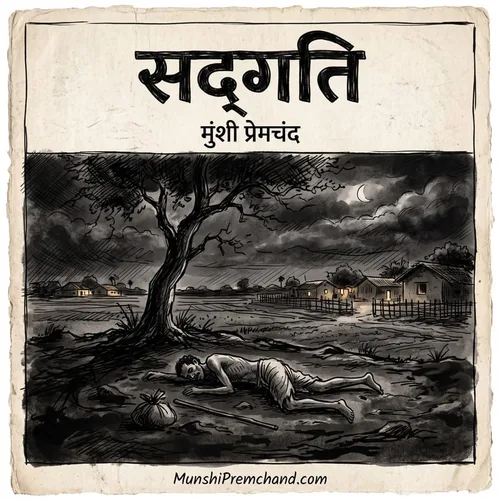
Dukhi the tanner (chamar) was sweeping the front yard, while his wife Jhuria was plastering the earthen floor with cow dung.
Having finished their morning chores, the wife said: "Go to Pandit Baba's house now. Make sure he hasn't stepped out somewhere."
Dukhi asked: "Yes, I'm going, but just think—what will he sit on when he comes here?"
Jhuria suggested: "Can't we get a cot from somewhere? Go ask for one at the Thakur's house."
Dukhi replied bitterly: "Sometimes you say things that make my blood boil! Will the Thakurs give me a cot? They wouldn't even let a spark of fire out of their house, and you expect them to give a cot! If I go to a Kayasth's house and ask for a vessel of water, I won't get a drop—who will give a cot? Our cow-dung cakes, straw, wood, and thatch aren't like theirs that anyone can just pick up and take away! Wash our own small wooden cot and set it out. It's summer—it will dry by the time he arrives."
Jhuria hesitated: "He won't sit on our cot. Don't you see how strictly he observes ritual purity?"
Dukhi grew worried: "Yes, that is true. I'd better pluck some mahua leaves and weave a leaf-plate (pattal). Great men eat on leaf-plates; they are pure. Bring me a stick—I'll go pluck the leaves."
"I'll weave the leaf-plate myself; you go ahead," Jhuria said. "But we must also offer him un-cooked food rations (seedha). Shall I place it in our brass platter?"
Dukhi panicked: "Don't commit such a disaster, or the rations will be ruined and the platter smashed to pieces! Baba will pick up the platter and throw it down! He flies into a rage at the slightest thing. In his anger, he doesn't spare even the Priestess—he beat his son so hard the boy still walks around with a broken arm! Put the rations on a leaf-plate, yes. But mind you—don't touch a single thing yourself!"
"Get the Gond's daughter to buy all the ingredients from the merchant's shop. Make sure the rations are generous—a seer of flour, half a seer of rice, a quarter-seer of lentils, an eighth-seer of ghee, salt, turmeric, and place a four-anna coin at the corner of the leaf-plate. If the Gond girl isn't available, beg the grain-roaster's wife to bring it. Don't touch a thing yourself, or it will be a catastrophe!"
Having given these strict instructions, Dukhi picked up his axe and a heavy bundle of fresh grass and set off toward the priest's house. How could he present himself before the priest empty-handed? He had nothing except grass to offer as a tribute (nazarana). Had he come empty-handed, Baba would have shooed him away from afar!
Pandit Ghasiram was a devout worshiper of God. The moment he woke up, he immersed himself in morning devotions. Washing hands and face took until eight o'clock, after which his true worship began—the first step being the preparation of his morning bhang drink. Next, he ground sandalwood paste for half an hour, then stood before a mirror applying a precise tilak on his forehead with a straw—placing a bright red dot between two white lines of sandalwood paste. Then he stamped circular sandalwood marks on his chest and arms. Finally, he brought out the idol of Thakurji, bathed it, applied sandalwood paste, offered flowers, performed the aarti, and rang the brass bell.
By ten o'clock, he finished his prayers, drank his bhang, and stepped out into the veranda. A couple of clients were already waiting at his doorstep—the immediate reward of his devotions. That was his livelihood.
Today, as he stepped out of his prayer room, he saw Dukhi the tanner sitting with a bundle of grass. The moment Dukhi saw the priest, he stood up, fell prostrate on the ground in full obeisance (sashtang dandavat), and stood with folded hands.
The sight of this resplendent figure filled Dukhi's heart with awe and devotion! What a divine image—a short, plump man with a smooth shaved head, chubby cheeks, and eyes glowing with priestly luster! The red dot and sandalwood marks gave him the majesty of a god.
Looking at Dukhi, the sacred lips spoke: "Why have you come today, Dukhiya?"
Dukhi bowed his head low: "Maharaj, I am arranging my daughter's betrothal. I need your holiness to fix an auspicious date and time (muhurat). When will it be your pleasure to visit?"
Ghasiram replied: "I have no time today. Well, I might come by evening."
Dukhi pleaded: "No, Maharaj, please come soon! I have prepared all the arrangements. Where shall I place this grass?"
Ghasiram ordered: "Throw it before the cow! And take a broom and sweep the front yard clean. The sitting room hasn't been plastered with cow-dung for days—plaster that too. In the meantime, I'll have my lunch. After resting a bit, I'll come. Ah yes—chop that log of wood over there too! And there are four baskets of straw lying in the threshing floor—carry that over and store it in the barn."
Dukhi immediately set to work fulfilling the commands.
He swept the front yard clean, then plastered the sitting room with cow-dung. By then it was twelve noon. The priest went inside to eat.
Dukhi had eaten nothing since morning; intense hunger gnawed at his belly. But what was there for him to eat? His own house was a mile away. If he left to eat, the priest would fly into a rage. The poor man suppressed his hunger and began chopping the log of wood.
It was a massive, gnarled wooden trunk—a stubborn piece of hard timber upon which many a devotee had tried their strength before. It stood ready to battle iron with iron.
Dukhi was accustomed to scraping grass and carrying it to market; he had no practice in chopping hardwood. Grass yielded before his small sickle, but here he swung the heavy axe with all his strength, yet not a mark appeared on the stubborn knot! The axe bounced back.
Dukhi was soaked in sweat, gasping for breath. Exhausted, he would sit down, then force himself up again. His arms refused to lift, his legs trembled, his back would not straighten, darkness danced before his eyes, and dizziness swirled in his head—yet he kept hammering away.
If only I could get a pipe of tobacco, perhaps it would give me some strength!
He thought: Where will I find a pipe and tobacco here? This is a Brahmin neighborhood. Brahmins don't smoke tobacco like us low-castes.
Suddenly he remembered that a man of the Gond tribe lived nearby. Surely he would have tobacco! Dukhi ran to his hut. His effort bore fruit—the Gond gave him both tobacco and a clay pipe bowl, but there was no fire.
Dukhi said: "Don't worry about fire, brother. I'll go get a burning ember from Panditji's house. Food is being cooked there right now."
Carrying the pipe and tobacco, he returned to the priest's house, stood at the inner veranda door, and called out humbly: "Master, if I could get a tiny ember of fire, I could light my pipe!"
Panditji was having his lunch. The Priestess asked angrily: "Who is that man asking for fire?"
Panditji replied: "Oh, it's that wretched Dukhiya the tanner. I told him to chop a little wood. Give him a bit of fire."
The Priestess flared up, her eyebrows knitting in fury: "In your obsession with scriptures and horoscopes, you've lost all sense of religion and purity! Tanner, washerman, low-caste—anyone walks right into our house! Is this a Hindu home or a traveler's inn? Tell that bearded rascal to get out, or I'll scorch his face with a burning firebrand! Coming to ask for fire!"
Panditji tried to reason with her: "He came into the outer door—so what? He hasn't touched any of your utensils. The earth is pure. Why don't you just toss him a bit of fire? He's doing our work after all. If a laborer chopped that wood, he'd charge at least four annas!"
The Priestess roared: "Why did he enter the house premises at all?"
Panditji gave up: "The wretch was cursed by bad luck, what else!"
"Fine, I'm throwing him fire this time; but if he ever steps inside the house again, I'll burn his face off!"
Dukhi caught snippets of this conversation. He felt deep remorse—Why did I come inside? She speaks the truth! How can a tanner step into a Brahmin's house? These people are sacred and pure—that is why the whole world worships them, that is why they command such respect! It's not like us tanners. I've grown old in this village, yet I haven't learned even this much sense!
So when the Priestess stepped out holding a burning coal in iron tongs, Dukhi felt as if he had received a divine boon from Heaven! Folding both hands, he pressed his forehead to the dirt and stammered: "Priestess Mother, I committed a grave sin by stepping inside! It was just a tanner's foolish brain. If we weren't so ignorant, why would we suffer kicks?"
The Priestess brought the fire held in tongs. From a distance of five paces, behind her veil, she flung the burning coal toward Dukhi.
A large glowing spark fell right onto Dukhi's head!
He scrambled back frantically, shaking his hair to throw off the ember. He said to himself: This is the punishment for defiling a holy Brahmin's house! God gave me the reward instantly! That's why the world fears the Brahmins. Anyone else's money can be stolen, but who can steal a Brahmin's due? A man's whole family would be destroyed, his feet would rot and fall off!
He walked outside, smoked his pipe, and then picked up his axe again. The thumping sound of axe strikes echoed once more.
Having thrown fire at him, the Priestess felt a flicker of pity. When Panditji finished eating and stood up, she said: "Give that tanner something to eat too. The poor fellow has been working since morning; he must be starving."
Panditji considered this proposal impractical and asked: "Are there any leftover bread pieces?"
"A couple of pieces might be left."
"What use are two pieces of bread? He's a tanner—he'll gulp down at least a seer of flour!"
The Priestess covered her ears in shock: "My Lord! A whole seer! Then let it be!"
Panditji tried to sound generous: "If there's any husk or bran, mix it into coarse flour and bake two thick, hard flatbreads (littas). That will fill his belly. Thin, delicate bread doesn't satisfy these low-castes—they need thick sorghum bread!"
"Oh, let it go now—who's going to stand over a hot stove in this scorching sun?"
Dukhi smoked his pipe and picked up the axe again. Breathing a bit had brought a little strength back to his arms. He swung the axe for another half-hour, then sat down holding his head, completely drained.
Just then, Chikhuri the Gond walked by. He said: "Why are you killing yourself, old uncle? You won't split that stubborn knot with your axe. You're wasting your life for nothing!"
Dukhi wiped the sweat from his forehead and gasped: "I still have to carry a cartload of straw, brother!"
Chikhuri asked: "Did they give you anything to eat, or do they only know how to exact work? Why don't you go and ask for food?"
Dukhi replied in horror: "What are you saying, Chikhuri? How can a Brahmin's food digest in a tanner's stomach?"
The Gond scoffed: "It will digest just fine—if you get it first! He twirled his mustache, ate a feast, and slept comfortably, while ordering you to chop wood! Even the landlord gives food when he takes labor. Even the government officer pays something when he takes forced labor (begar). This priest is worse than them all, and yet he pretends to be a saint!"
Dukhi whispered in fear: "Speak softly, brother! If they hear you, disaster will fall upon us!"
Saying this, Dukhi steeled himself once more and resumed striking the log with his axe.
Chikhuri felt pity for him. He snatched the axe from Dukhi's hands and swung it with all his strength for half an hour; but not a single crack appeared in the stubborn knot. He threw the axe down and walked away, saying: "You won't split this even if you give up your life!"
Dukhi began to despair: Where did Baba find this impossible log that won't split for anything? Not even a crack appears! How long will I keep chopping it? I have a hundred tasks waiting at home. It's a house preparing for a ceremony—one thing or another is always lacking; but what concern is that to him? Let me go carry the straw at least! I'll tell him: 'Baba, the wood didn't split today; I'll come and chop it tomorrow.'
He picked up the wicker basket and began carrying straw. The threshing floor was no less than two furlongs away. If he brought full baskets, the work would finish faster; but who was there to lift the heavy basket onto his head? He couldn't lift a fully loaded basket by himself. So he carried small loads.
It was four o'clock by the time the straw was finished.
Panditji woke up from his afternoon nap. He washed his face, chewed a betel leaf, and stepped out. He saw Dukhi lying asleep on the ground with his basket beside his head!
He shouted sternly: "Hey! Dukhiya! Are you sleeping? The wood is lying right there untouched! What were you doing all this time? You took till evening just to carry a handful of straw! And on top of that, you're sleeping! Pick up the axe and chop that wood! You can't even split a small piece of wood! Then don't blame me if the auspicious date turns out bad! That's why they say—give a low-caste man food in his home, and his attitude changes!"
Dukhi picked up the axe again. All the excuses he had planned to make vanished from his mind.
His stomach was sticking to his spine. He hadn't eaten even a morsel of breakfast since morning—there had been no time. Standing up felt like climbing a mountain. His spirit was drowning, yet he steeled his heart. He is a Brahmin priest—if he doesn't calculate the auspicious date properly, my daughter's life will be ruined! That is why they command such respect in the world—it is all the magic of the auspicious date! They can make or break anyone's destiny!
Panditji stepped up to the wooden knot and began egging him on: "Yes! Strike hard! Strike harder! Come on, hit it with power! Do you have no strength in your arms? Strike hard! Why are you standing there thinking? Yes! It's just about to split! Strike right into that crack!"
Dukhi was no longer in his senses. Some hidden, supernatural force seemed to be driving his arms! Fatigue, hunger, weakness—all vanished as if by magic. He was astonished at his own arm-strength.
Every blow fell like a lightning bolt! For half an hour, he swung the axe in a state of absolute frenzy—until the wooden log split right down the middle!
The axe slipped from Dukhi's hands and crashed to the ground. And with it, Dukhi collapsed face-down onto the earth!
His starved, parched, exhausted body had given up its final breath.
Panditji called out: "Get up and strike two more blows! Make thin firewood out of it!"
Dukhi did not move. Panditji decided not to bother him further. He went inside, drank his evening bhang, answered nature's call, bathed, donned his formal priestly attire, and stepped out.
Dukhi was still lying in the exact same spot.
Panditji shouted: "Hey! Will you lie there forever, Dukhi? Come, I'm heading to your house now! Is everything ready?"
Dukhi did not move.
Now a chill of suspicion ran through Panditji. He walked closer and looked—Dukhi lay stiff and lifeless!
Panicked, he ran inside and cried to his wife: "Dukhiya seems to be dead!"
The Priestess gasped in horror: "But he was chopping wood just a moment ago!"
Panditji stammered: "Yes, he died while chopping wood! What will happen now?"
The Priestess recovered her calm and said: "What else? Send word to the tanners' quarter (chamarana) to come and carry the corpse away."
Within minutes, the news spread throughout the village. The entire neighborhood belonged to Brahmins, except for one Gond household.
People stopped using the path passing by the priest's house. The village well lay on that side—how could anyone fetch water? Who would dare walk past an untouchable's corpse to draw water?
An old woman said to Panditji: "Why don't you get the corpse removed? Is anyone in the village going to get drinking water or not?"
Meanwhile, Chikhuri the Gond ran to the tanners' quarter and warned everyone: "Listen carefully! Don't any of you go to carry that body! There will be a police investigation! Is it a joke that they took a poor man's life? Let Panditji be a priest in his own house! If you touch the body, the police will arrest you too!"
Shortly after, Panditji arrived at the tanners' quarter, but not a single man was willing to step forward to carry the corpse away. Dukhi's wife Jhuria and his young daughter ran to the priest's door, wailing and beating their chests in agonizing grief. A dozen other tanner women joined them, weeping and wailing; but not a single male tanner came.
Panditji threatened the tanners, pleaded with them, made grand promises—but terror of the police held the tanners firm; not one budged. Frustrated and helpless, the priest returned home.
The wailing and lamenting continued till midnight. Sleep became impossible for the high-caste neighborhood. Yet no tanner came to lift the body—and how could a Brahmin touch an untouchable's corpse? Is such a thing written in any holy scripture or Purana? Let anyone show where it is written!
The Priestess grumbled in irritation: "These witch-like women have eaten my brain out! Their throats don't even get sore!"
Panditji snapped: "Let the hags weep! How long will they weep? When he was alive, no one cared for him; now that he's dead, they've all gathered to create a racket!"
"A tanner's weeping brings ill omen!"
"Yes, very ill-omened!"
"The corpse is already starting to stench!"
"He was a wretched tanner after all! Do these low-castes have any sense of ritual purity or impurity?"
"They have no disgust for anything!"
"They are all defiled!"
The night passed somehow, but when morning broke, still no tanner arrived. The tanner women had wept themselves out and returned home. The stench of decay began to spread through the air.
Panditji brought out a thick rope. Making a slipknot, he looped it around the dead man's ankles and pulled it tight.
It was still early dawn, shrouded in dim light.
Holding the end of the rope, Pandit Ghasiram began dragging the corpse across the dirt. He dragged the dead body out of the village into the distant fields.
Returning home, he immediately took a purifying bath, recited verses from the Durga Saptashati, and sprinkled holy Ganga water throughout his house.
Out in the distant fields, Dukhi's corpse lay abandoned—where jackals, vultures, dogs, and crows tore at his flesh.
This was the reward for a lifetime of devotion, service, and uncomplaining faith.
Significance & Themes
- Systemic Dehumanization & Forced Labor: Premchand presents a devastating critique of how feudal caste hierarchies force the poor into uncompensated labor (begar), treating human beings as disposable tools.
- The Irony of 'Sadgati' (Deliverance): The title is deeply satirical. Instead of receiving spiritual salvation or human dignity in death, Dukhi is worked to death, denied funeral rites, and dragged away like dead cattle.
- Religious Hypocrisy & Ritual Purity: The story exposes how claims of spiritual purity mask cold-hearted cruelty, where touching a living human is defilement, but leaving a corpse to rot for ritual reasons is deemed holy.