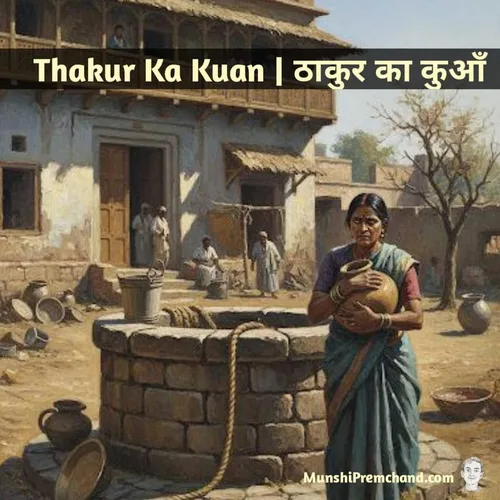
When Jokhu put the brass vessel to his lips, a foul, rotten stench hit his nostrils.
He turned to Gangi and cried: "What kind of water is this? It reeks so badly I can't drink a drop! My throat is parched with thirst, and you give me rotten water to drink?"
Gangi used to draw water every evening. The well was far away, and going back and forth repeatedly was difficult. When she brought water yesterday, it had no smell at all; why did it reek so horribly today?
She put her nose to the vessel—indeed, there was a terrible stench! Some dead animal must have fallen into their well and rotted. But where could they get another vessel of clean water from?
Who would allow them on the Thakur's well? People would shout at them and drive them away from afar. The moneylender's (Sahu's) well was at the far end of the village, but who would let them draw water there either? There was no third well in the entire village.
Jokhu had been lying sick with fever for several days. For a while, he lay silent, suppressing his parched thirst. But then he moaned: "I can't bear this thirst any longer! Bring it here—I'll pinch my nose and drink a little."
Gangi refused to hand over the water. She knew that drinking foul water would worsen his illness, though she did not know that boiling water removes its impurities. She said: "How can you drink this water? Who knows what animal has died in it! I'll go and fetch fresh water from the well."
Jokhu looked at her in astonishment: "Where will you get fresh water from?"
"The Thakur and the Sahu have two wells in the village. Won't they let me draw a single vessel of water?"
"You'll get your bones broken, and nothing else! Sit down quietly! The priest will curse us, the Thakur will strike us with his heavy stick, and the moneylender will charge five times over for every penny! Who understands the pain of the poor? Even if we die, no one comes to peek at our doorstep, let alone offer a shoulder to carry our corpse! Will people like that ever let us draw water from their well?"
There was bitter, undeniable truth in those words. What reply could Gangi give? Yet she refused to let him drink that foul, stinking water.
It was nine o'clock at night. The exhausted laborers of the village had gone to sleep. At the Thakur's front veranda, a small group of idle men had gathered.
The days of battlefield valor were long gone; now they boasted of legal cunning! They discussed how brilliantly the Thakur had bribed the police inspector in a major court case and escaped scot-free! How cleverly he had secured a certified copy of a crucial document when even the court clerks claimed it was impossible without paying fifty or a hundred rupees—yet the Thakur had pulled it off without spending a single copper! It all required tactical cunning!
At that very moment, Gangi reached the Thakur's well to fetch water.
The faint, flickering yellow light of an oil lamp fell upon the well platform. Gangi crouched behind the raised brick wall, waiting for an opportunity.
The water of this well was drunk by the entire village! It was forbidden to no one—except that her unfortunate people could not draw a single drop.
Gangi's rebellious spirit began to question the customary restrictions and forced subjugation: Why are we called low, and why are these people called high? Just because they wear a sacred thread around their necks? Every single one of them here is a scoundrel! They commit thefts, they forge documents, they file false court cases! Only the other day, this very Thakur stole a poor shepherd's sheep and slaughtered it for a feast! Gambling goes on in the priest's house all twelve months of the year! This moneylender mixes cheap oil into pure ghee before selling it! They make people work, but when it comes to paying wages, their souls die! In what way are they higher than us? We don't go around shouting in every street that we are high, we are high! Whenever I pass through the village, they stare at me with lustful eyes as if their hearts are on fire—and yet they boast that they are high!
She heard footsteps approaching the well. Gangi's heart began to thud wildly. If they see me, it will be a disaster! I won't escape a single kick below the ribs!
She picked up her rope and clay pitcher, bent low, and slipped into the dark shadow of a nearby tree. When do these people ever feel mercy for anyone? They beat poor Mahengu so savagely that he spat blood for months—all because he refused to perform uncompensated forced labor! And on top of that, these people claim to be high-caste!
Two women had come to the well to draw water. They were talking among themselves:
"He sat down to eat and instantly ordered: 'Go fetch fresh water!' As if there's money to buy extra pitchers!"
"Men get jealous just seeing us sit comfortably for a moment!"
"Yes! He couldn't just pick up the pitcher and fetch it himself! No, he just barks orders: 'Bring fresh water!'—as if we are nothing but bondslaves!"
"If you aren't bondslaves, what else are you? Don't you get food and clothes? You even manage to snatch five or ten rupees from them now and then! What else are bondslaves like?"
"Don't tease, sister! My heart longs for just a moment of rest. If I worked this hard in someone else's house, I'd live far more comfortably, and they would at least appreciate the effort! Here you work yourself to death, and no one even speaks a kind word to you!"
When both women filled their pitchers and walked away, Gangi stepped out from the shadow of the tree and approached the well's platform. The idle men had left the veranda, and the Thakur was closing his outer door to sleep in the courtyard.
Gangi drew a brief breath of relief. At last, the field was clear! Even the mythical prince who ventured to steal the nectar of immortality might not have stepped forward with such extreme caution and stealth!
Gangi tiptoed onto the well platform. Never before had she experienced such a thrilling sensation of quiet victory!
She tied the rope loop around the neck of her pitcher. She glanced alertly to her left and right—like a soldier crawling into an enemy fortress at midnight. If she were caught now, there was not a grain of hope for mercy or forgiveness.
Recalling the gods in her heart, she steeled her nerve and lowered the pitcher into the well.
The pitcher dipped into the water gently—very quietly, without making a sound. Gangi pulled the rope hand over hand with lightning speed. The pitcher reached the top mouth of the well. Not even a champion wrestler could have hauled it up with such speed!
Gangi bent forward to grasp the pitcher and set it onto the platform—when suddenly, the Thakur's front door creaked open!
A roaring lion's jaws could not have looked more terrifying!
The rope slipped from Gangi's hands!
With a loud splash, the heavy pitcher crashed down into the water, and for several moments, the echoing gurgles of churning water reverberated from the deep well.
"Who's there? Who's there?" shouted the Thakur, striding toward the well.
Gangi leaped off the platform and fled into the dark night!
When she reached her humble hut, she saw Jokhu holding the brass vessel to his mouth, gulping down the same dirty, foul, rotten water.
Significance & Themes
- Structural Injustice of Caste & Untouchability: Premchand exposes how basic human necessities, such as clean drinking water, are denied to marginalized communities under the guise of religious purity.
- The Hypocrisy of Moral Superiority: Through Gangi's internal monologue, the story satirizes elite claims of moral superiority by highlighting their rampant corruption, theft, exploitation, and moral degradation.
- Silent Tragedy & Helplessness: The ending underscores the tragic reality of systemic oppression—despite Gangi's heroic courage, her sick husband is ultimately forced to consume contaminated water.