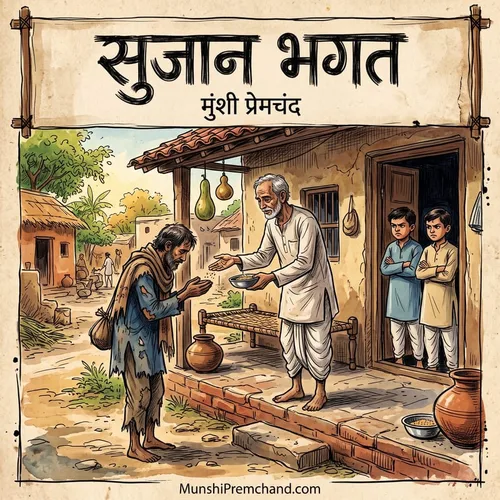
Simple, honest farmers turn toward religion and fame the moment wealth comes into their hands. Unlike the wealthy urban class, they do not immediately sprint toward sensual pleasures and luxury.
For several consecutive years, Sujan's fields yielded pure gold. Every farmer in the village labored hard, but Sujan's stars shone brightest. Even if he scattered seed over barren wasteland, a bumper crop sprang forth! For three straight seasons, his sugarcane crop flourished, and with jaggery fetching high prices in the market, two to three thousand rupees accumulated in his hands.
With prosperity, his heart inclined toward religious charity. Holy ascetics and saints began receiving warm hospitality at his doorstep, and a perpetual prayer fire (dhooni) burned outside his courtyard. Whenever government revenue inspectors or police officers visited the area, they stayed at Sujan Mahato's guest house (chaupal). Mahato beamed with pride—what good fortune that high officers now rested at his door! The very officials before whom he once feared to speak now dried their tongues repeating "Mahato, Mahato!"
Devotional singing sessions (satsang) became a regular feature. A visiting holy man, seeing such favorable hospitality, pitched his permanent camp in the village. Intoxicating herbs flowed, drums (dholak) and cymbals (manjira) resounded, and devotional gatherings flourished.
All this pomp was fueled by Sujan's generosity. Seers of milk were produced in his house every day, yet Sujan swore an oath never to consume a drop himself. Sometimes government officers tasted it, sometimes holy ascetics consumed it—what business had a simple farmer with milk and ghee? A farmer needed only flatbread and wild greens!
Sujan's humility knew no bounds. He bowed his head before everyone in the village, lest people accuse him of growing arrogant with wealth.
Finding that the village had only three wells and many distant fields withered without water, Sujan constructed a solid brick well at his own expense. A consecration ritual (yajna) and a grand feast for Brahmins were organized. On the day the water-wheel (pur) turned for the first time at the new well, Sujan felt he had achieved the four great blessings of human existence. What no one in the village had accomplished before, Sujan achieved through the merit of his ancestors!
One day, a group of pilgrims bound for the holy city of Gaya stopped in the village. They cooked their meals at Sujan's doorstep. Sujan had long harbored a desire to undertake the Gaya pilgrimage himself. Seeing this opportune moment, he prepared to leave with them.
His wife Bulaki suggested: "Postpone it for now—we shall go next year."
Sujan replied with grave solemnity: "Who knows what will happen next year? It is not right to delay sacred duties. What trust can one place in life?"
"Our hands will become empty of cash," Bulaki cautioned.
"If God wills, money will return. What is lacking in His treasury?"
Bulaki had no answer to this. Why spoil her own spiritual salvation by obstructing a noble deed? Next morning, husband and wife departed on the pilgrimage to Gaya.
Upon their return, a grand ritual feast (brahmbhoj) was announced. Invitations were sent to eleven neighboring villages. The event was conducted with such magnificence that praises echoed in all four directions. Everyone declared: If God bestows wealth upon anyone, He should bestow such a generous heart! Arrogance hasn't touched him—he cleared leaf-plates with his own hands! He has brought glory to his lineage!
A envious neighbor whispered: "He must have stumbled upon buried treasure!" But the villagers showered him with scolding: "Yes, your ancestors left a treasure chest that he found! Brother, this is the fruit of honest labor. You too break your back in the fields—why doesn't your sugarcane grow like his? God looks at the purity of a man's heart—He gives to him who knows how to spend!"
From Sujan Mahato, he became Sujan Bhagat.
The code of conduct for a devout Bhagat is different from ordinary men. A Bhagat does not eat without taking his morning bath. Daily prayers and devotional hymns are mandatory in his house. In food and drink, he must observe strict purity; but above all, he must renounce falsehood! A Bhagat cannot speak a lie. If an ordinary man receives one unit of divine punishment for lying, a Bhagat receives no less than a hundred thousand units! In ignorance, many flaws are forgiven; for a knowledgeable man, there is no easy forgiveness.
Sujan now had to live up to the dignity of a Bhagat.
Until now, his life had been that of a simple laborer, without lofty ideals or strict rules. Now a deep moral consciousness awakened within him—a path strewn with thorns. Earlier, self-interest had been his guiding scale; now he weighed every action on the scale of absolute righteousness. He had stepped out of a material existence into a spiritual world.
If he lent money to anyone, taking interest filled his heart with self-reproach. While milking cows, he worried constantly about the calves—lest a calf remain hungry and its silent suffering bring a curse upon him!
Formerly the village headman, he had helped craft false testimony in court cases and settled disputes by levying fines; now he loathed such petty schemings. Earlier, his effort had been to extract maximum work from laborers for the lowest possible wage; now he worried less about the work and more about paying generous wages: "Lest the poor laborer's heart suffer!"
"Lest anyone's heart suffer!" became his constant refrain.
His two grown sons, Bhola and Shankar, began passing sarcastic remarks about him at every turn. Eventually, even his wife Bulaki began regarding him as a mere unpractical pious man who held no concern for household realities. In entering the spiritual world, Sujan Bhagat had been reduced to a powerless figurehead.
Gradually, all practical authority was stripped from Sujan's hands.
Which field to sow, what to give to whom, from whom to collect debts, at what price to sell produce—in such vital household decisions, Bhagatji's advice was no longer sought. The two sons or Bulaki herself settled matters directly.
In the village outside, Sujan's respect grew day by day; inside his own home, it eroded completely.
His sons still treated him with outward reverence—if they saw him lifting a charpoi, they would rush to lift it for him; they wouldn't let him fill his own hookah pipe, and even offered to wash his clothes. But authority was no longer in his hands.
He was no longer the master of the house; he was merely the deity in the temple!
One afternoon, while Bulaki was husking lentils in the courtyard, a wandering beggar began calling out at the front gate. Bulaki thought she would finish husking before giving him something.
Just then, her elder son Bhola walked in and said: "Amma, a holy mendicant is shouting at the door. Give him something, or his heart will suffer!"
Bulaki replied with cool indifference: "Are Bhagat's feet painted with henna? Why doesn't he take something out and give it himself? Do I have four hands? Whose heart am I supposed to satisfy all day? A parade of beggars continues from morning till night!"
Bhola sneered: "He is ruining the household! Just a while ago, Manghu came to deliver brinjals. By weight it came to seven maunds; when weighed properly, it turned out to be six and three-quarter maunds. I demanded he bring the remaining ten seers, but Bhagat sits there saying: 'Where will the poor fellow go now? Write a full receipt, or his heart will suffer!' I didn't write a full receipt—I entered the ten-seer deficit in the register!"
Bulaki approved: "You did quite right! Let him talk. When he gets humiliated a few times, he'll stop interfering on his own."
Bhola grumbled: "He finds fault with everything we do all day long! I've told him a hundred times not to meddle in household affairs, but he simply cannot keep his mouth shut!"
Bulaki sighed: "Had I known he would turn out like this, I would never have let him take initiation vows. He's neither fit for the world nor for religion! His whole day is wasted in prayers. He isn't so old that he can't do any work!"
Bulaki offered a mild defense: "Bhola, that is unfair of you. He cannot wield a heavy hoe or plow anymore, but he still does whatever he can—feeding the cattle, milking the cows, and tending the farm."
The beggar was still shouting outside. Hearing no response from inside, Sujan stepped into the house and said sternly: "Can't you people hear a beggar shouting at the gate for an hour? You do your own work all day long—can't you do God's work for a single moment?"
Bulaki snapped: "You are already sitting there doing God's work—is the entire household supposed to do only God's work?"
Sujan said: "Tell me where the grain is kept—I will bring it out myself. You sit back like a queen!"
Bulaki retorted: "I ground that flour with my own hands after waking at dawn—I didn't grind it to hand it out to lazy beggars!"
Sujan walked into the storeroom and emerged carrying a small basket filled with barley—at least a seer of grain. Sujan had intentionally crossed traditional limits of almsgiving to assert his authority against Bulaki and Bhola. Yet, to make it appear that the basket wasn't overly heavy, he held it loosely by the rim with his fingers. His trembling fingers could barely support the weight, and the basket threatened to drop at any second as he hurried toward the door.
Suddenly, Bhola stepped forward and snatched the basket right out of his father's hands!
Bhola glared at him: "This isn't free property to be squandered away! We break our backs working in the fields to bring grain home!"
Sujan said in humiliated anger: "I don't sit idle either!"
Bhola barked: "Alms are given as alms, not thrown away! We survive on one meal a day to maintain our family dignity, and you want to throw grain away! What do you know about what goes on in this household?"
Sujan offered no reply.
He walked outside to the gate and said quietly to the beggar: "Baba, go for now—no one's hand is free today."
He sat down under the shade of a neem tree, buried in deep, bitter thought.
Such humiliation in his own house! He was not an invalid yet; his arms and legs had not failed him; he still performed daily farm chores. Yet such insult! He had built this house with his own blood and sweat; all this prosperity was the fruit of his labor—yet today he held no right over it!
He had been reduced to a dog at the doorstep—lying in the dirt, eating whatever dry scraps the family threw at him.
Fie upon such a life! Sujan could not live in such a home.
Dusk fell. Bhola's younger brother Shankar brought a filled hookah pipe and placed it against the wall. Slowly, the tobacco burned out. A short while later, Bhola laid a cot outside at the gate, but Sujan did not rise from under the tree.
Dinner was ready. Bhola came to call him. Sujan said coldly: "I have no hunger." Despite repeated coaxing, he did not get up.
Finally, Bulaki walked out and asked: "Why aren't you coming to eat? Are you unwell?"
Sujan felt the greatest anger toward Bulaki herself. She stood by and watched while Bhola snatched the grain out of my hands! Not a word came out of her mouth to stop him! The boys might not remember the grueling toil with which I built this farm, but she knows! I didn't distinguish day from night. In the torrential rains of August, I guarded the crops; in the scorching heat of June, I took no rest! And today I don't hold enough right in my own house to give a handful of grain to a beggar!
Granted, alms shouldn't be excessive—but she should have kept quiet even if I set the house on fire! By law, do I hold no share? I don't consume my share—I feed others; whose father's property am I spending? Now she comes to coax me! I never touched her with a flower's stalk in all these years—where is the woman in this village who hasn't been beaten by her husband? I gave all cash and key responsibilities into her hands. Now that money is saved, she shows pride to me! Now her sons are dear to her, while I am a useless, wasteful old fool!
He said bitterly: "What will I do by eating now? I can no longer plow the fields, nor wield the hoe. Why waste precious grain by feeding me? Keep it—your earning sons will eat it!"
Bulaki said: "You flare up over every small matter! It is rightly said that in old age a man loses his sense. All Bhola said was not to give so much grain—did he say anything else?"
Sujan retorted: "Yes! The poor fellow merely said that much! You would have enjoyed it more had he struck me with a stick two or three times, wouldn't you? If that is your desire, fulfill it! Call Bhola out—let him hit me a few times so the remaining deficiency is cleared!"
Bulaki said: "You are bent on picking a fight, while I am trying to prevent gossip in the village! Come and eat your dinner quietly, or I will go to sleep hungry too."
"Why should you sleep hungry? It is your sons' earning! Yes, I am an outsider."
"Are they not your sons too?"
"No! I wash my hands of such sons! If they were my sons, would I suffer such degradation?"
Bulaki said: "If you utter abuses, I will say something unpleasant too. I used to hear that men are wise, but you are unique. A man should adapt according to the times! Our mutual well-being lies in remaining nominal masters while letting the boys run things as they like. I have understood this truth—why can't you understand it? He who earns rules the house—that is the law of the world! I do nothing without consulting the boys; why do you insist on having your own way? You ruled the house for decades; why cling to this illusion now? Come, eat your food."
Sujan asked quietly: "So I am merely a dog at the doorstep now?"
Bulaki replied: "I have said what was true—think whatever you like of yourself!"
Sujan did not rise. Defeated, Bulaki walked back inside.
A new challenge stood before Sujan.
He had been the undisputed master of his household for decades, and still regarded himself as such. He had failed to realize how completely circumstances had changed. His sons' outward deference had lulled him into a false illusion of authority.
Did he not have the right to give alms? Could he surrender his authority in exchange for mere polite respect? Absolutely not! He could not live as a dependent parasite in the very house he had built with his blood. He did not hunger for polite service; he hungered for his rightful authority! He could not bear to see others ruling over his domain. He would not remain a mere deity in a temple!
Late into the night, while the entire village slept, Sujan rose quietly.
He picked up a sharp scythe (gandasa) and began cutting sorghum stalks (karbi) for cattle fodder. Never in his entire life had he worked with such furious intensity!
Since he had retired from active labor, fodder had been in short supply. Shankar cut fodder, Bhola cut fodder, yet the troughs were never full. Today he would show these boys how fodder ought to be cut!
By dawn, a mountain of finely chopped fodder stood before the trough—each piece so uniform and neatly sliced that it appeared molded in a machine!
At break of day, Bulaki stepped out into the courtyard and gasped in utter amazement at the massive pile of fodder!
She called out: "Did Bhola stay up all night chopping fodder? I told him a hundred times to rest, but he wouldn't listen!"
Sujan Bhagat called out sarcastically: "When does he ever sleep? Whenever I look, he is working endlessly! Where else in the world will you find such an industrious son!"
Just then, Bhola stepped out rubbing his eyes. Seeing the mountain of fodder, he stared in astonishment and asked: "Did Shankar get up in the middle of the night, Amma?"
Bulaki replied: "He is fast asleep! I thought you chopped it."
Bhola said: "I can't even get up early in the morning! No matter how much I work during the day, I can't wake up at night."
"Then did your father chop it?"
"Yes, it seems so. He didn't sleep all night."
Bulaki gasped in realization: "Look! He has taken the plow and is walking toward the fields! Has he resolved to kill himself with labor?"
Bhola said: "He has always had a fierce temper—he won't listen to anyone now."
"Wake up Shankar quickly!" Bhola urged. "Let me wash my face and hurry to the fields with the second plow!"
When Bhola reached the fields with his plow alongside other village farmers, Sujan had already plowed half the field!
Bhola quietly began plowing his section, lacking the courage to utter a word to his father.
Noon arrived. All the village farmers unyoked their oxen to rest; but Sujan Bhagat remained engrossed in his work. Bhola was exhausted, longing to unyoke his oxen, but fear held his tongue. He marveled in disbelief at his old father's superhuman stamina.
Finally, he called out timidly: "Father, it is noon now. Shall we unyoke the oxen?"
Sujan called back: "Yes, unyoke them. Take the oxen home—I will finish leveling the soil embankment (dand) and follow."
"I will level it this evening," Bhola offered.
"What will you level? Can't you see the field has become concave like a bowl? That is why water collects in the center! This fertile home-field used to yield twenty maunds per bigha—you boys have ruined it!"
The oxen were unyoked. Bhola led them home, while Sujan stayed behind throwing earth to level the high embankments. Half an hour later, he returned home—without a trace of exhaustion on his face!
Instead of resting after his meal, he began tending to the oxen—rubbing their backs, massaging their legs, caressing their tails. The oxen stood with erect tails, resting their heads against Sujan's chest in deep contentment. After months of neglect, they had received this loving care today! Their eyes overflowed with silent gratitude, as if saying: We are ready to work day and night for you!
While Bhola lay resting his aching body like other young farmers, Sujan picked up the plow again and marched back to the fields! The two oxen ran forward with eager enthusiasm, as if impatient to reach the soil.
Bhola watched his father march past from his cot, but could not summon the strength to rise. His courage had failed him. He had never labored with such fierce discipline. He had inherited an established farm and managed it casually; he had no desire to be master of the house at the cost of such grueling toil! A young man has a hundred distractions—he needs time to socialize, attend wrestling matches, visit marriage processions! An old man has no such desires—he cares for nothing except his work.
Bulaki said: "Bhola, your father has taken the plow again!"
Bhola sighed from his cot: "Let him go, Amma... I cannot match his pace!"
Village gossips passed critical remarks on Sujan's renewed passion: "All his piety has vanished! Look at him—clinging to worldly illusion again! He isn't a man, he's a ghost!"
Maat-ters took a dramatic turn. Once again, holy ascetics and saints were seen pitching their camps outside Bhagatji's door, receiving warm hospitality.
That season, his fields yielded pure gold!
The granaries overflowed with grain. Fields that had barely produced five maunds now yielded ten maunds!
It was the harvest month of Chait. The threshing floors presented the glory of a golden age. Mountains of grain stood stacked everywhere—the one season when hard-working farmers feel the true reward of their existence.
Sujan Bhagat filled large baskets with grain, distributing alms generously, while his two sons carried the baskets inside to fill the granaries.
A crowd of bards, minstrels, and beggars surrounded Bhagatji's threshing floor. Among them stood the very same beggar who, eight months earlier, had been turned away empty-handed from Sujan's gate!
Suddenly, Bhagatji recognized him and called out: "Welcome, Baba! Where all have you been today?"
The beggar replied humbly: "I haven't gone anywhere yet, Bhagatji—I came straight to your doorstep first."
"Good! You see this mountain of grain before you? Take as much grain from it as you can carry away!"
The beggar looked at the massive pile with greedy eyes and said timidly: "I will take only as much as you measure out with your own hands, Bhagatji."
"No! Fill your cloth with as much as you can lift!"
The beggar spread out his shoulder cloth and filled about ten seers of grain. Hesitant and fearful, he did not dare add more.
Sujan read his mind and reassured him: "Is that all? Even a child can lift ten seers!"
The beggar cast an anxious glance toward Bhola, who stood nearby, and whispered: "This is more than enough for me, master."
"No! You are hesitating. Fill more!"
The beggar added another five seers, then looked again at Bhola with fearful eyes.
Sujan declared loudly: "Why do you keep looking at him, Babaji? Do as I tell you! Fill as much as your strength can carry!"
The beggar was terrified that if he filled too much, Bhola might stop him from carrying the bundle away, making him a laughingstock among other beggars. He lacked the courage to add more.
Seeing his hesitation, Sujan Bhagat took the cloth himself, scooped heavy armfuls of grain into it, and tied it into a massive bundle!
He said: "Now hoist it onto your head and take it!"
The beggar tried to lift the bundle, but it didn't budge. He gasped: "Bhagatji, this is too heavy—I cannot lift it!"
"Nonsense! Can't you lift even a single maund? Put your back into it—let me see!"
The beggar tried again. The heavy sack remained rooted to the ground. He said: "Bhagatji, I truly cannot carry this weight."
"Tell me—which village do you live in?"
"It is far from here, Bhagatji—Amol village."
"Alright! Walk ahead of me—I will carry it to your village for you!"
Saying this, Sujan Bhagat summoned all his strength, hoisted the massive sack of grain onto his own head, and marched forward behind the beggar!
The onlookers watched in spellbound astonishment at the old man's heroic strength!
How could they understand what intoxicating victory filled Bhagatji's soul today? He had received the fruit of eight months of unyielding, relentless labor. Today, he had reclaimed his lost authority!
The same sword that cannot cut a plantain stem cuts through solid iron when sharpened on a whetstone. Pride and self-respect (laag) are the most vital forces in human life! A man who possesses self-respect is young even in old age; a man who lacks self-respect is dead even in youth.
Sujan Bhagat possessed self-respect, and that self-respect had bestowed upon him superhuman strength!
As he stepped forward with the heavy load on his head, he cast a proud, triumphant glance at Bhola and commanded:
"These bards and beggars are standing at our door—see that no one returns empty-handed!"
Bhola stood with his head bowed in complete submission, unable to utter a single word.
His old father had soundly defeated him.
Significance & Themes
- Reclamation of Dignity Through Labor: Premchand demonstrates that true respect and authority within a traditional rural household cannot be demanded as a right or received through mere religious piety—it must be earned through active, productive labor.
- Generational Power Dynamics: The story explores the subtle shift of power in joint agrarian families, where aging parents are gradually sidelined by earning sons unless they maintain their economic utility.
- The Triumph of Self-Respect (Laag): Sujan's physical resurrection proves that human vitality is driven by self-respect and moral pride, which can grant an aging man the strength to outwork the young.