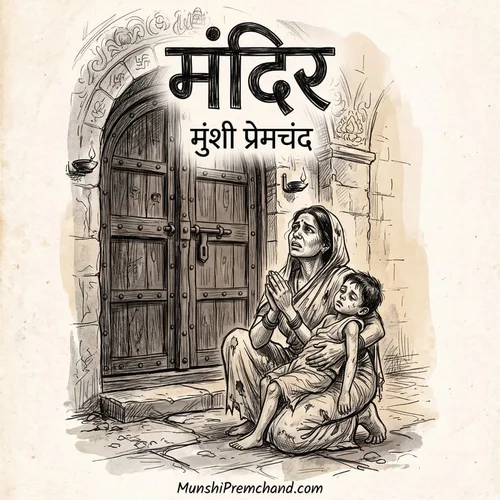
Complete English Translation: Mandir (The Temple)
Maternal love, glory be to you! Everything else in this world is illusory, hollow, and transient; maternal love alone is true, inexhaustible, and immortal.
For three days, not a single grain of food nor a drop of water had passed down Sukhiya's throat. Before her, lying upon a bed of straw, her little darling was groaning in fever. For three days, he had not opened his eyes. Sometimes she would cradle him in her lap; sometimes she would gently lay him back upon the straw. What had suddenly struck this laughing, playful child? No one could tell. Under such agony, where could a mother find room for hunger or thirst? Once, she had taken a sip of water into her mouth, but she could not force it past her parched throat.
There was no end to the misfortunes of this grieving woman. Within a single year, she had surrendered two infants to the sacred lap of Mother Ganga. Her husband had already departed this world before them. Now, the sole foundation, the only anchor of this unfortunate woman's life was this little boy. Alas! Did God intend to snatch even him from her lap? The very imagination caused a torrential flood of tears to stream from the mother's eyes.
She never left the child alone for even a moment. She took him along when she went to cut grass in the fields. When she carried the bundles of grass to sell in the market, the boy rode upon her hip. For his small hands, she had even fashioned a tiny sickle and a miniature basket. Jiyavan would cut grass beside his mother and boast with childish pride, "Amma, get me a big sickle made too! I will cut heaps of grass; you just sit at home on the wooden cot at the door, Amma, and I will go and sell the grass in the market!"
The mother would ask, "What will you bring for me, my son?"
Jiyavan would promise bright red saris for his mother. For himself, he wished to bring home lumps of sweet jaggery. Those very innocent, sweet prattles now pierced the mother's heart like sharp, poisonous daggers.
Whoever saw the child said that an evil eye had fallen upon him. But whose evil eye? Did this destitute widow have an enemy in the world? If only she knew the enemy's name, Sukhiya would go, fall at their feet, and place the child in their lap. Would not their heart melt with compassion? But nobody could name anyone. Alas! Whom could she ask? What could she do?
Three-quarters of the night had slipped away. Sukhiya's grief-stricken, restless mind wandered in frantic search from chamber to chamber of her soul. To which goddess's sanctuary should she flee? To which deity should she make a vow? Pondering this in her exhausted torment, a brief slumber overcame her.
What did she see? Her late husband came and stood at the head of the boy's bed. Stroking the child's head gently with his hand, he said, "Do not weep, Sukhiya! Your child will recover. Offer a worship to Thakurji tomorrow; He alone will be your savior."
Saying this, he departed. Sukhiya's eyes flew open. Most certainly, it was her husband who had visited! Not a shred of doubt lingered in Sukhiya's mind. He still remembers me! At this thought, her heart was inundated with boundless hope. Her eyes shone with deep reverence and renewed love for her departed husband.
Lifting the child into her lap and gazing toward the heavens, she pleaded, "O God! If my child recovers, I will offer a worship at Your feet. Have mercy on this helpless widow!"
At that very moment, Jiyavan's eyes fluttered open. He asked for water. The mother hurried, brought water in an earthen bowl, and held it to the child's lips. Having drunk the water, Jiyavan asked, "Amma, is it night or day?"
Sukhiya replied, "It is still night, my son. How do you feel?"
Jiyavan said, "I feel good, Amma! Now I am well."
Sukhiya cried, "May your mouth be filled with sugar and ghee, my child! May God make you well soon! Do you feel like eating something?"
Jiyavan said, "Yes, Amma, give me a little piece of jaggery."
Sukhiya said, "Do not eat jaggery, my boy; it will do you harm. If you like, shall I prepare some light khichdi for you?"
Jiyavan pleaded, "No, my dear Amma, give me just a tiny lump of jaggery, I beg at your feet!"
The mother could not deny his desperate pleading. Taking out a small lump of jaggery, she placed it in Jiyavan's little hand. She was just about to replace the earthen lid on the pot when someone called out from beyond the door. Leaving the pot open where it sat, she hurried to open the door. In her absence, Jiyavan extracted two large balls of jaggery and devoured them in rapid gulps.
Throughout the following day, Jiyavan's condition appeared much improved. He ate a little khichdi, walked slowly out to the doorway once or twice, and although he could not run and play with his playmates, watching them romp about brought cheer to his little spirit. Sukhiya believed her boy had recovered. In a day or two, when she had gathered some money in her hands, she would go to offer worship to Thakurji.
The short winter daylight hours slipped away in sweeping the yard, washing, bathing, and preparing food. But when twilight descended, Jiyavan's body grew heavy with fever once more, and Sukhiya was seized with panic. Instantly, the terrifying suspicion struck her heart: It is because I delayed the promised worship that my child has withered again!
A little daylight still remained. Laying the boy down, she began preparing the sacred offerings. Flowers were gathered from the landlord's orchard. Sacred tulsi leaves grew right beside her doorstep. But sweetmeats were needed for Thakurji's consecrated food (bhog); otherwise, what would she distribute to the village folk? At least one copper anna was required as an offering at the altar.
She scoured the entire village, but nowhere could she obtain a loan of a few copper coins. Now she was plunged into absolute despair. Alas, what wretched days! Not a soul will lend even four copper annas!
Finally, she pulled the silver bangles from her wrists and ran desperately to the baniya's shop. She pawned her bangles, purchased sweet batasas, and came running back home.
When the worship materials were ready, she lifted the child onto her hip, took the worship platter in her other hand, and hurried toward the village temple.
Inside the temple, the evening prayer bell was clanging loudly for the aarti. Five or ten devout worshippers stood singing devotional hymns. Just then, Sukhiya arrived and stood before the temple steps.
The priest demanded sharply, "What is it? What have you come here for?"
Stepping onto the raised stone platform, Sukhiya said, "I had made a vow to Thakurji, Maharaj; I have come to offer worship."
The priest spent his days offering 'worship' to the landlord's tenants by extracting taxes, and mornings and evenings worshipping Thakurji. At night he slept right inside the temple; his meals were cooked inside the sanctuary as well, which had blackened the temple's plaster with thick soot. In disposition, he was considered very kind; so devout that no matter how severe the cold or how freezing the wind, he would never let a drop of water pass his lips before taking his ritual bath. If, despite this, thick layers of grime remained caked upon his hands and feet, it was hardly his fault!
He barked, "So will you barge inside? The worship is already over. You have come here to pollute everything!"
One of the high-caste devotees piped up, "Has she come to purify Thakurji Himself?"
Sukhiya pleaded with immense humility, "I have come to touch Thakurji's holy feet, Sarkar! I have brought all the sacred offerings."
The priest scolded, "What senseless madness are you speaking, woman? Have you lost your wits? How on earth could you ever touch Thakurji?"
Until this day, Sukhiya had never had an opportunity to visit the temple. In wide-eyed astonishment, she asked, "Sarkar, He is the Lord of the entire universe! Even the gravest sinner attains salvation through His divine sight; how could my touch ever defile Him?"
The priest asked, "Arre, are you not an untouchable Chamar woman?"
Sukhiya asked, "Did God not create the Chamars as well? Is there a separate God for the Chamars? It is a sacred vow for my dying child, Sarkar!"
At this, that same pious gentleman who had just concluded his devotional singing shouted fiercely, "Beat the witch and drive her away! She has come to defile the sanctuary—hurl her platter into the dirt! The world is already consumed by calamities; if Chamars begin worshipping Thakurji, will the earth remain in its orbit or sink into the netherworld?"
Another devout worshipper chimed in, "Now poor Thakurji will also have to eat food offered by the hands of Chamars! There is nothing left now to prevent the final apocalypse (pralaya)!"
The bitter cold bit deep; Sukhiya stood shivering in the dark, while here the self-appointed contractors of religion offered intellectual critiques on the decline of the modern age. The sick child pressed himself deep against her chest for warmth; yet Sukhiya showed no intention of leaving. It seemed as though both her feet were rooted into the earth like stone pillars.
Again and again, a fierce surge rose from the depths of her soul urge her to charge forward and fling herself at Thakurji's feet. Does Thakurji belong exclusively to these men? Do we poor folk have no claim upon Him? Who are these people to stop me? But the dread seized her: What if these men truly snatch my worship platter and smash it into the dust? What will I do then? Her heart knotted in agonizing helplessness.
Suddenly, an idea struck her. Moving a short distance away, she hid herself in the darkness beneath a sprawling tree, waiting for these devout worshippers to depart.
Following the aarti and hymns, the devotees sat for a long time listening to recitations from the Srimad Bhagavata. Over by the fire, the priest lit the hearth and began preparing his meal. Seated before the hearth, he murmured 'Hunh-hunh' in assent to the verses, chiming in with occasional philosophical remarks.
Until ten o'clock at night, the holy discourse continued, while Sukhiya stood motionless beneath the tree in meditative vigil.
At last, one by one, all the devotees took the road toward their homes. The priest was left entirely alone.
Now Sukhiya walked over and stood before the temple veranda, where the priest sat comfortably on his mat, entranced by the appetite-stirring sizzle of his cooking pot. Hearing a footstep, the priest raised his neck, and seeing Sukhiya standing there, barked with irritation, "What, are you still standing here?"
Sukhiya set the platter on the ground, stretched out one begging palm, and pleaded with tears in her eyes, "Maharaj-ji, I am an unfortunate wretch. This child alone is the sole support of my life; have mercy on me! He hasn't lifted his head for three days. You will earn great spiritual renown, Maharaj-ji!"
Saying this, Sukhiya began to weep bitterly.
The priest was considered a charitable man; yet how could he commit the unheard-of, monstrous sin of allowing an untouchable Chamar woman near Thakurji? Who knew what divine wrath Thakurji might unleash? After all, he had children of his own. What if Thakurji grew enraged and brought ruin upon the entire village?
He said, "Go home and take the name of God; your child will get well. I will give you these sacred tulsi leaves—feed them to the boy, and apply this holy water (charanamrit) to his eyes. If God wills, all will be well."
Sukhiya pleaded, "Will you not let me fall at Thakurji's feet, Maharaj-ji? I am in bitter agony; I gathered these worship offerings through debt. Yesterday I saw in a dream that if I offered worship to Thakurji, my child would recover. Only for that did I come running. I have a silver rupee with me; take it from me, Maharaj, but grant me just one fleeting moment to prostrate myself at Thakurji's feet!"
This monetary temptation caused the priest's resolve to waver for a second; yet, out of ingrained superstition, a lingering dread of divine retribution remained in his mind. Steadying himself, he said, "You foolish woman, does Thakurji look at a devotee's inner devotion, or does He look at falling at His feet? Have you not heard: 'If the heart is pure, the Ganges flows within a wooden bowl'? If there is no devotion in the soul, one may fall at God's feet a million times and nothing will come of it. I possess a sacred amulet (jantar). Its true price is very high, but I will give it to you for just one rupee. Tie it around the child's neck; tomorrow the boy will be running about and playing!"
Sukhiya asked, "Will you not let me worship Thakurji?"
The priest answered, "For you, this much worship is more than enough! If I permit what has never been done in history, and some calamity befalls the village, what then? Think of that! Take this amulet; if God wills, the child's misery will vanish this very night. Someone's evil eye has fallen upon him. He is such a lively boy; he looks like he belongs to a warrior clan."
Sukhiya said, "Ever since this fever gripped him, my soul is trapped in agony."
The priest remarked, "He is a very promising child. If God preserves his life, he will wipe away all your sorrows. He used to come playing around here so often; I hadn't seen him these past two or three days."
Sukhiya asked, "How shall I tie the amulet, Maharaj?"
The priest said, "I will bind it in a scrap of cloth and give it to you. Just hang it around his neck. Where will you search for fresh cloth at this ungodly hour?"
Sukhiya had pawned her silver bangles for two rupees. One had already been broken for supplies; the remaining silver rupee she surrendered to the priest. Taking the amulet and comforting her anxious heart with false hopes, she returned home.
Arriving home, Sukhiya tied the amulet around the child's neck; yet as the night deepened, his fever climbed higher and higher—until, by three in the morning, his hands and feet began turning icy cold!
Now wild terror seized her. She thought to herself: Alas! I squandered precious time in cowardly hesitation and returned without beholding Thakurji! Had I stepped straight inside and fallen at the feet of the Lord, what could anyone have done to me? At most, they might have shoved me out; perhaps they would have beaten me; but my soul's desire would have been fulfilled! If I had drenched Thakurji's holy feet with my tears and laid my dying child at His feet, would He not have shown mercy? He is the all-merciful God, the protector of the destitute—would He not have taken pity on me?
At this realization, Sukhiya's soul grew frantic. No, this was not the time for delay! She would go—she would go right now, and fall weeping at Thakurji's feet! For this helpless woman's terrified heart, there remained no other shelter, no other refuge in the universe. If the temple doors were locked, she would smash the locks to pieces! Has Thakurji been sold into someone's private ownership that they can keep Him locked behind iron bars?
It was three o'clock in the morning. Sukhiya wrapped the child in a rough blanket, lifted him into her arms, took the worship platter in her other hand, and stepped out toward the temple.
The moment she walked out of the house, freezing blasts of winter wind made her heart shudder. Her feet grew numb with cold. Above all, pitch-black darkness blanketed the earth. The distance was no less than two furlongs. The narrow footpath wound beneath dense trees. A little distance to the right lay an old pond; further on stood thick groves of bamboo. A washerman had drowned in the pond, and witches were said to inhabit the bamboo thicket. To the left lay open green fields. Desolate winds whistled through the night; the darkness hummed with eerie stillness.
Suddenly, a pack of jackals began howling in harsh, spine-chilling wails. Alas! Had someone offered her a hundred thousand rupees, she would never have stepped onto that path at this hour; yet maternal desperation for her dying child crushed every terror. Murmuring, "O Lord! You alone are my refuge!", she pressed forward toward the temple.
Reaching the temple entrance, Sukhiya felt along the iron chain. A heavy padlock was locked fast. The priest was asleep inside the adjoining chamber, the door bolted from within. Darkness swallowed everything.
Sukhiya picked up a heavy brick from beneath the stone platform and began striking the lock with violent, frantic blows. Where had such immense strength entered her frail arms? In just two or three ferocious blows, both the padlock and the brick shattered, falling upon the stone threshold!
Sukhiya pushed the wooden doors open and was just about to step inside when the priest, startled awake by the racket, flung his door open and rushed out into the veranda, screaming frantically: "Thief! Thief!"—and dashed toward the village.
In winter, villagers often wake in the early predawn hours. Hearing the frantic cries, several men emerged from various quarters carrying lanterns, shouting: "Where is he? Where is he? Which way did he run?"
The priest cried, "The temple doors are lying wide open! I heard the sound of hammering!"
Suddenly, Sukhiya stepped out of the veranda onto the platform and called out, "There is no thief! It is I; I came to offer worship to Thakurji. I haven't even stepped inside yet, and you have raised such an uproar!"
The priest shrieked in horror, "A monstrous sacrilege has been committed! Sukhiya has entered the temple and defiled Thakurji!"
In an instant, pandemonium broke loose! Several enraged men surged forward, and a rain of kicks and fist-blows began crashing down upon Sukhiya!
Sukhiya held the child pressed tightly with one arm while attempting to shield his little head with the other. Suddenly, a muscular, powerful Thakur shoved her with such violent force that the child slipped from her arms and crashed upon the stone ground!
Yet the child did not weep; he did not utter a sound; he did not draw a breath.
Sukhiya too had crashed to the stones. Regaining her senses, she reached out to gather her child into her arms, and her eyes fell upon his face. It appeared like a pale reflection upon water. A piercing scream tore from her throat.
She touched the child's forehead. His entire body was stone cold.
Drawing a long, deep breath, she rose to her feet. No tears welled in her eyes. Her face blazed with the roaring flames of wrath; sparks of fire seemed to rain from her eyes. Clenching both fists, she ground her teeth and cried:
"You sinners! Having taken my child's life, why do you stand at a distance now? Why don't you slaughter me alongside him? Did my touch pollute Thakurji? When iron touches the philosopher's stone, it turns to gold—the philosopher's stone never becomes iron! Will Thakurji become defiled by my touch? When He created me, was He not defiled?
"Take Him! Now I will never come to touch Thakurji again! Keep Him locked in your cages, post armed sentries over Him!
"Alas, not a shred of pity ever touched your hearts! How cruel you are! Having wives and children of your own, you could feel no mercy for an unfortunate mother! And yet you parade yourselves as the contractors of religion! You are all murderers—vicious, cold-blooded murderers! Do not fear, I will not drag you to the police station. My justice will be delivered by God Himself; I will present my petition directly in His court!"
Not a man dared utter a whisper; not a voice whimpered in defense. Like statues carved of stone, every single man stood with his head bowed in guilt.
By now, the entire village had gathered at the temple steps.
Sukhiya looked down once more at the child's face. From her lips escaped the words: "Alas, my precious darling!"
Then she collapsed unconscious upon the stone threshold. Her life departed. She surrendered her life for her child.
O Mother, glory be to you! Such unwavering faith, such pure devotion, such boundless trust as yours is rare even among the gods in heaven!
Summary of Mandir (The Temple)
In Mandir (The Temple), Munshi Premchand presents an agonizing tragedy of caste discrimination, untouchability, maternal devotion, and religious hypocrisy. Sukhiya, a destitute Dalit widow belonging to the Chamar community, lives only for her little son Jiyavan, having already lost her husband and two infant children to illness. Jiyavan is a cheerful boy who helps his mother cut grass and innocently promises to buy her red saris and jaggery when he grows up. Suddenly, Jiyavan falls gravely ill with a debilitating fever that leaves him unresponsive for three days.
Desperate and lacking money for medical treatment, Sukhiya is visited in a vision by her deceased husband, who instructs her to offer worship at Thakurji's village temple for the boy's recovery. Sukhiya pawns her only possessions—her silver bangles—to buy sweet batasas and flowers. Carrying the sick child in her arms and a worship platter in her hand, she arrives at the village temple during the evening aarti. However, the conservative temple priest and high-caste devotees violently bar her from entering, declaring that an untouchable woman's touch will defile the deity and bring divine ruin upon the village. Exploiting her desperation, the priest refuses to let her touch the altar, pockets her last silver rupee, and gives her a useless copper amulet instead.
Back home, the child's fever worsens, and by three o'clock in the morning, his limbs turn stone cold. Realizing that the amulet is useless and that God cannot belong exclusively to the privileged, Sukhiya wraps the boy in a blanket and braves the freezing, pitch-black night, navigating ghostly ponds and howling jackals to reach the temple. Finding the temple padlocked and the priest asleep, she smashes the lock with a brick. The priest wakes, hysterically screaming "Thief! Thief!", and mobilizes the villagers. When Sukhiya clarifies that she is a mother seeking God's blessing, the crowd accuses her of desecrating the sanctum and unleashes a brutal assault. During the beating, a powerful villager violently shoves her; Jiyavan is hurled from her arms onto the stone floor and dies instantly.
Confronted with her dead child, Sukhiya's grief transforms into righteous fury. She delivers a searing indictment of the gathered worshippers, denouncing them as hypocrites and child-murderers who reduce God to a captive behind padlocks. Refusing to seek worldly justice from the police, she pledges to bring her grievance directly before God's throne. Clasping her dead child with the final lament, "Alas, my precious darling!", Sukhiya collapses dead on the temple threshold, immortalizing maternal love over religious orthodoxy.
Publication History
Mandir (मंदिर) was written by Munshi Premchand and first published in Hindi in 1927. It was subsequently collected in Volume 5 of Premchand's celebrated anthology Mansarovar. Written during the height of the Indian anti-untouchability and temple-entry movements led by social reformers, the story remains one of Premchand's most incisive and devastating critiques of institutionalized caste discrimination, ritual purity, and the monopolization of divine spaces by the orthodox elite.
This unabridged English translation was published in 2026 by MunshiPremchand.com as part of the MunshiPremchand.com English Translation Series.
Themes & Critical Significance
- The Brutality of Untouchability and Religious Exclusion: Premchand exposes the grotesque moral contradiction at the core of feudal Hinduism: an institutional system that venerates stone idols while treating living, suffering human beings as sources of pollution. Sukhiya's exclusion from the temple illustrates how religious orthodoxy weaponizes ritual 'purity' to enforce social subjugation.
- The Sanctity of Maternal Devotion: The story opens and closes with a profound hymn to maternal love (matru-prem). Sukhiya's willingness to pawn her bangles, brave nocturnal terrors, and physically smash temple locks elevates her maternal instinct into a supreme spiritual force, transcending all man-made laws and dogmas.
- Hypocrisy of the 'Contractors of Religion': The priest and the devotees are depicted not as men of spiritual enlightenment, but as greedy, callous hypocrites. While claiming to protect Thakurji from pollution, they commit the ultimate sin: beating an innocent mother and causing the death of a child.
- Divine Ownership and Human Dignity: Sukhiya's fiery philosophical rebuttal—arguing that iron turns to gold upon touching the philosopher's stone rather than polluting it, and asking if God did not create the Chamars too—articulates a radical egalitarian theology. Premchand asserts that God belongs to the oppressed, and that confining the divine behind padlocks is an act of spiritual cowardice.