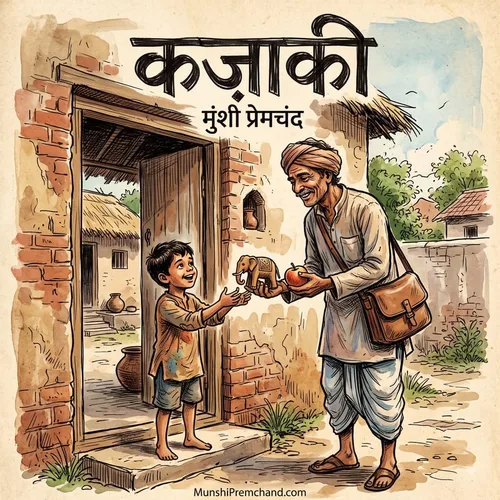
Complete English Translation: Kazaki
In the tapestry of my childhood memories, Kazaki remains an indelible figure. Forty years have slipped away since then, yet Kazaki's image still dances vividly before my eyes. In those days, I lived with my father in a small tehsil town in the district of Azamgarh. Kazaki belonged to the Pasi caste; he was exceptionally cheerful, exceptionally brave, and brimming with boundless vitality. Every evening he would arrive bearing the mailbag, spend the night at the tehsil post office, and set out early the next morning carrying the outgoing mail. By evening, he would return once more carrying the mail from the other end.
All day long, I would wait for him in an agitated state of longing. The moment four o'clock struck, restless with excitement, I would hurry to the road and stand waiting. Before long, Kazaki would be seen sprinting from afar, his brass-tipped spear resting upon his shoulder, its attached metal rattles (jhunjhuni) chiming merrily in the wind. He was a muscular, dark-complexioned, tall young man. His physique was cast in such a flawless mold that even an expert sculptor could not have detected the slightest defect in his form. His neat, trimmed mustache sat remarkably well upon his handsome face.
The moment he caught sight of me, he would run even faster, the chime of his bells ringing out with greater speed, and my heart would throb with frantic bursts of joy. In an excess of ecstasy, I too would sprint toward him, and in an instant, Kazaki's broad shoulder would become my royal throne! That perch was the heaven of all my boyhood desires. Even the denizens of Paradise perhaps never experienced the undulating thrill that I enjoyed upon Kazaki's massive shoulders. The entire world shrank into insignificance before my eyes, and when Kazaki sprinted with me on his shoulders, I felt as though I were flying through the sky mounted upon a steed of wind!
When Kazaki reached the post office, he would be drenched in sweat; yet he had no habit of resting. The moment he set down the mailbag, he would take us children out into the open fields—sometimes playing games with us, sometimes singing folk ballads (birhas), and sometimes telling captivating stories. He possessed a vast treasury of hundreds of tales about thefts, dacoities, brawls, and wandering ghosts. Listening to these tales, I would be plunged into a state of wondrous delight; the thieves and dacoits in his stories were genuine warrior-heroes who plundered the wealthy only to sustain the wretched, impoverished folk. Far from hating them, I felt deep reverence for those outlaw champions!
One day, Kazaki was late arriving with the mailbag. Sunset came, and still he was nowhere to be seen. Lost in despair, I stood on the road straining my eyes far into the distance; but that familiar silhouette did not appear. I pricked up my ears; that merry, rhythmic jhun-jhun chime remained unheard. With the fading light, my hope too grew dim. Whenever I saw someone approaching from that direction, I would ask, "Is Kazaki coming?" But people either paid no heed or merely shook their heads.
Suddenly, the jhun-jhun chime reached my ears! In the dark, I was terrified of ghosts—to such an extent that even a sweet placed on a shelf in Mother's room became untouchable to me after nightfall. Yet the moment I heard that sound, I broke into a furious sprint toward it. Yes, it was indeed Kazaki! But the instant I saw him, my frantic worry turned into sheer fury. I began striking him with my little fists, and then, pouting with indignation, stood aloof with my back turned.
Kazaki laughed and said, "If you beat me, I will not give you the thing I have brought for you."
Gathering my courage, I snapped, "Go on, don't give it! I won't take it anyway!"
Kazaki coaxed, "If I show it to you right now, you will come running and leap straight into my arms!"
Softening slightly, I said, "Very well, show it to me."
Kazaki replied, "Then come, sit on my shoulder and let me run! It is already very late today. Babu-ji will be furious."
I stood stubbornly and demanded, "First show it to me!"
Victory was mine. If Kazaki had not been in dread of being late and could have paused for even a minute longer, the tables might have turned. He uncovered something that he was holding pressed against his chest with one hand: it had a long snout and two glittering eyes.
I dashed forward and scooped it out of Kazaki's arms. It was a fawn—a baby deer! Ah! Who could ever measure the ecstatic bliss I felt at that moment? Since that day, I have passed difficult examinations, attained high official ranks, and even been honored with the title of Rai Bahadur; but never again did I experience the pure, unadulterated joy of that evening! Cradling the creature in my arms, savoring the heavenly touch of its soft body, I raced toward the house. The thought of why Kazaki was so late completely vanished from my mind.
I asked, "Where did you find this, Kazaki?"
Kazaki answered, "Bhaiya, a little distance from here lies a small forest. Many deer dwell in it. I longed with all my heart to find a fawn to give you. Today, this little one was grazing with the herd. As I ran toward them, the whole herd bolted. This baby ran too, but I never gave up the chase. The other deer fled far ahead, but this one fell behind. I caught it. That is what caused the delay."
Chattering away like this, both of us arrived at the post office. Babu-ji did not notice me, nor did he notice the fawn in my arms; his furious gaze locked onto Kazaki alone. Exploding with rage, he shouted, "Where have you been idling all this time? You bring the mailbag now—what am I supposed to do with it? The dispatch mail has already departed! Speak, where did you squander all these hours?"
Not a whisper of an answer could escape Kazaki's lips.
Babu-ji raged, "You no longer care for your livelihood! A low-born wretch, that's what you are—your belly gets full and you grow insolent! When you begin starving to death, only then will your eyes open!"
Kazaki stood in total silence.
Babu-ji's fury mounted further. He barked, "All right, throw down the bag and take the road to your home! You swine, bringing the mail at this ungodly hour! What will you lose? You can go and do coolie labor wherever you please. But the blame falls on my head; an explanation will be demanded from me!"
Tearful and trembling, Kazaki pleaded, "Sarkar, I will never be late again."
Babu-ji shouted, "Give an answer as to why you were late today!"
Kazaki had no answer to offer. The astonishing thing was that my own tongue was struck completely dumb. Babu-ji possessed an explosive temper. He was buried under an immense workload, and for that reason he flared up at the slightest irritation. I never dared go near him. Nor did he ever show me affection. He returned home only twice a day for barely an hour each time to take his meals; the rest of the day he was perpetually writing in the office. He had repeatedly petitioned the higher officials for an assistant clerk, but to no avail. Even on official holidays, Babu-ji remained confined to the office. Only Mother knew the secret of calming his fiery temper; but how could she step into the public office?
Before my very eyes, poor Kazaki was dismissed on the spot! His spear, his brass badge (chaprās), and his turban (sāfā) were snatched from him, and he was issued a despotic decree of immediate expulsion from the postal service.
Ah! At that moment, I wished with all my heart that I possessed the golden kingdom of Lanka, so that I could hand it all over to Kazaki and show Babu-ji that his dismissal hadn't harmed a single hair on Kazaki's head! Just as a proud warrior cherishes his sword, Kazaki cherished his official badge with equal pride. When he began unclasping the badge, his hands trembled violently, and tears streamed down his cheeks.
And the root cause of all this catastrophe was the tender, innocent creature resting its head so peacefully in my lap, as though nestled against its mother's breast!
When Kazaki turned and walked away, I followed slowly behind him. Arriving at the doorway of my house, Kazaki turned and said, "Bhaiya, go inside now; evening has set in."
I stood in stony silence, exerting every ounce of my little strength to suppress the torrent of tears rising in my throat.
Kazaki spoke again, "Bhaiya, I am not going far away into exile! I will return again and make you gallop upon my shoulders. Babu-ji has taken away my job, but can he forbid me even that much? I will never abandon you, Bhaiya! Go and tell Mother that Kazaki is leaving, and ask her to forgive any offense I may have committed."
I ran crying into the house, but instead of telling Mother anything, I broke into inconsolable sobs. Stepping out of the kitchen, Mother asked anxiously, "What has happened, my son? Who has beaten you? Did Babu-ji say something? Just wait until he comes home today, I will confront him! Whenever he looks at my boy, he lashes out. Hush now, my child, you must never go near him again."
Struggling to steady my trembling voice, I uttered, "Kazaki..."
Mother assumed that Kazaki had struck me. She flared up, "Just let that Kazaki come! See if I don't have him dismissed on the spot! A mere mail-runner daring to strike my prince of a son! This very day I will have his turban and spear confiscated! The audacity!"
I cried in haste, "No, no! Kazaki didn't strike me! Babu-ji has dismissed him; he snatched away his turban, his spear, and his badge too!"
Mother softened instantly: "Your Babu-ji has acted very badly. That poor fellow is always so diligent in his work. Why dismiss him then?"
I said, "He was late today."
Saying this, I set the fawn down on the floor. Within the four walls of the house, there was no danger of its escaping. Until that moment, Mother's gaze had not fallen upon it. Seeing it suddenly hop across the room, she gasped in fright and seized my arm, terrified that this strange, ferocious beast might bite me! Where a moment ago I had been crying my heart out, Mother's terrified commotion made me burst into a hearty laugh.
Mother exclaimed, "Arre, this is a baby deer! Where did it come from?"
I recited the fawn's entire history and its disastrous consequence from beginning to end: "Amma, it ran so fast that nobody else in the world could have caught it! Whoosh—it flew like the wind! Kazaki ran after it for five or six hours! Only then could he catch the baby. Amma-ji, nobody in the whole wide world can sprint like Kazaki; that was why he was delayed! And for that, Babu-ji dismissed the poor man—snatched his badge, his turban, and his spear! Now what will the poor fellow do? He will starve to death!"
Mother asked, "Where is Kazaki? Go call him inside."
I said, "He is standing outside at the door. He told me to ask Amma-ji to forgive any offenses."
Until that moment, Mother had assumed my tale was half playful exaggeration. She thought Babu-ji had merely scolded Kazaki; but my final words made her realize that Kazaki had truly been fired. She hurried out to the door, calling, "Kazaki! Kazaki!" But Kazaki was nowhere to be found. I called out his name repeatedly, yet Kazaki was gone.
I ate my dinner—children do not forfeit their meals over grief, especially when creamy rabri is served before them; yet lying in bed late into the night, I kept turning over thoughts in my head: If only I had money, I would give a hundred thousand rupees to Kazaki and tell him never to speak to Babu-ji again! The poor man will starve to death! Let me see whether he comes tomorrow or not. What reason does he have to come now? Yet he promised he would come. Tomorrow I will share my meals with him. Building these castles in the air, I finally fell asleep.
The next day, I spent the entire morning engrossed in caring for my baby deer. First came the naming ceremony: he was christened "Munnu." Then I introduced him to all my playmates and schoolfellows. Within a single day, he became so attached to me that he trotted behind me everywhere I went. In that short span, I granted him an indispensable place in my life. In the grand palace I planned to build in my adulthood, I even decided upon a dedicated private chamber for Munnu, complete with his own cot and a horse-drawn carriage for our afternoon strolls!
Yet as twilight gathered, I abandoned everything and ran to stand on the roadside, waiting for Kazaki. I knew full well that Kazaki had been dismissed and that he had no official duty bringing him here. Yet somehow I clung to the stubborn hope that he was coming.
Suddenly, a thought struck me: Kazaki must be starving to death!
I dashed back into the house immediately. Mother was busy lighting the evening lamps. I quietly scooped a basketful of flour from the kitchen bin; with flour smeared all over my hands and a white trail sifting from the woven basket onto the courtyard, I bolted outside.
I had barely reached the road when I saw Kazaki walking toward me! He carried his spear, the brass badge was buckled around his waist, and the turban was tied upon his head! Even the mailbag was strapped to the staff of his spear!
I ran forward and threw my arms around his waist, crying in astonishment, "Where did you get your badge and spear back, Kazaki?"
Lifting me up and settling me upon his shoulders, Kazaki replied, "What use was that official badge anyway, Bhaiya? That was a badge of slavery; this old one is the badge of joy! Before, I was the government's servant; now I am your personal servant!"
Saying this, his eyes fell upon the basket sitting on the dirt. He asked, "What is this flour, Bhaiya?"
Blushing shyly, I replied, "I brought it for you. You must be starving—what did you eat today?"
I could not see Kazaki's face, for I was perched high upon his shoulders; yet from the tremor in his voice, I could tell that his throat was choked with tears. He murmured, "Bhaiya, will I eat dry chapatis alone? There is no lentils (dal), no salt, no ghee—nothing else."
I felt intensely ashamed of my oversight. It was so true—how could the poor man eat plain, dry bread? But how could I procure salt, dal, and ghee? Mother would be in the kitchen by now. I had barely managed to sneak out with the flour (unaware as yet that my theft was already discovered and the white flour trail had betrayed me). How could I fetch three separate items now? If I asked Mother, she would never give them. She made me cry for hours over a single copper penny; why would she part with all those provisions?
Suddenly, an idea flashed in my mind. I had tucked away several annas' worth of copper coins inside my school satchel! I used to derive enormous pleasure from hoarding coins. I do not know why that childhood habit abandoned me; if I still had that tendency today, perhaps I would not be living in such cheerful improvidence! Babu-ji never showed me affection, but he gave me coins freely—probably because, consumed by his endless paperwork, he found this the easiest prescription to rid himself of my interruptions. To refuse me meant enduring my weeping and tantrums, a disturbance he preferred to avert from afar. Mother's temperament was the exact opposite: she was never perturbed by my crying disrupting any chores. A person resting idly can tolerate weeping all day long, but when calculating financial ledgers, loud noises shatter one's concentration! Mother loved me dearly, but the mere mention of money made her brow furrow with displeasure.
I had no textbooks; I merely possessed a cloth satchel in which a few folded post-office forms were bound to resemble books. I thought to myself: Won't all those coins be enough to buy dal, salt, and ghee? Why, they won't even fit in my clenched fist! Having resolved this, I said, "Very well, put me down, and I will bring dal and salt. But you must promise to come every day, won't you?"
Kazaki said, "Bhaiya, if you feed me, why wouldn't I come?"
I said, "I will feed you every single day!"
Kazaki said, "Then I will come every single day!"
I slid down and raced inside, bringing out my entire hoarded fortune. To ensure Kazaki's visits every day, had I possessed the Koh-i-Noor diamond at that moment, I would not have hesitated for a heartbeat to lay it at his feet!
Kazaki asked in wonder, "Where did you get these coins, Bhaiya?"
I answered with swelling pride, "They are mine!"
Kazaki said, "Your Amma-ji will beat you; she will think Kazaki coaxed you into stealing them. Bhaiya, buy sweets with these coins and hide them in an earthen jar. I will not starve. I have two strong hands. How could I ever starve to death?"
I insisted repeatedly that the money was mine, but Kazaki refused to take a single coin. He carried me around the countryside for a long while, singing songs to entertain me, and finally escorted me home. Before leaving, he set the basket of flour right at my doorstep.
The moment I stepped inside the house, Mother barked fiercely, "You thief! Where did you carry that flour? Have you started learning to steal now? Tell me, whom did you give the flour to, or I will flay the skin off your back!"
My grandmother's ghost seemed to summon me! When enraged, Mother turned into a roaring tigress. Flustered, I stammered, "I didn't give it to anyone."
Mother shouted, "You didn't take the flour? Look at how much flour lies scattered across the whole courtyard!"
I stood petrified. No matter how she threatened or coaxed, my lips remained sealed. My soul withered in dread of the impending storm. I did not even possess the courage to say, "Why are you raging? The flour is sitting right at the front door!" Nor could I summon the strength to step out and fetch it, as though all power of action had vanished and my legs were paralyzed.
Suddenly, Kazaki's voice called out from outside, "Bahu-ji, the flour is resting at the doorway. Bhaiya had brought it to give to me."
Hearing this, Mother hurried toward the door. She observed no veil (purdah) before Kazaki. Whether she spoke to him or not, I do not know; but Mother returned inside carrying the empty basket. Then she went into the inner storeroom, took something out of an iron trunk, and walked back toward the front door. I noticed that her fist was tightly closed. I could no longer remain standing where I was; I followed behind her.
Mother called out at the door several times, "Kazaki! Kazaki!" But Kazaki had already departed.
I asked with great eagerness, "Shall I run and search for him, Amma-ji?"
Shutting the wooden doors, Mother said, "Where will you go in the dark? He was standing right here a moment ago. I told him to wait until I returned, but he slipped away into thin air! How bashful and proud he is! He wouldn't take the flour at all; I had to forcibly tie it into his shoulder cloth. I feel so deeply for the poor man. Who knows whether there is any food in his home or not! I brought some silver rupees to give him, but he vanished."
Emboldened by her tender mood, I confessed the entire saga of my theft. Parents can exert far greater educational influence and moral teaching upon their children when they become understanding companions rather than stern elders.
Mother said gently, "Why didn't you just ask me? Would I have refused to give a little flour to Kazaki?"
I offered no reply to this. In my heart I thought: At this moment you are overflowing with pity for Kazaki and will give whatever you please; but had I asked you then, you would have rushed to thrash me! Still, my spirit rejoiced at the thought that Kazaki would no longer starve. Mother would feed him every day, and he would let me ride his shoulders across the fields every evening!
The following day, I spent the entire morning playing with Munnu. In the evening, I ran to the road and stood waiting. But darkness fell, and Kazaki was nowhere to be seen. Lamps were lit, desolate silence claimed the path; yet Kazaki never came!
I returned home weeping bitterly. Mother asked, "Why are you crying, my son? Did Kazaki not come?"
I wept even more loudly. Mother drew me tightly against her chest. I could feel that her own voice was choked with emotion. She said soothingly, "Hush, my boy, hush. Tomorrow morning I will dispatch another mail-runner to fetch Kazaki."
I fell asleep drenched in tears. The moment my eyes opened the next morning, I said to Mother, "Send for Kazaki!"
Mother replied, "A man has already been sent, my child! Kazaki must be on his way."
Cheered by this promise, I ran off to play. I knew that whatever Mother promised, she unfailingly fulfilled. She had dispatched a postal peon at the crack of dawn. But at ten o'clock, when I returned home cradling Munnu, I learned that Kazaki had not been found at his dwelling. He had not returned home the previous night either. His wife was weeping inconsolably, terrified that he had fled in despair.
No adult can truly fathom how tender a child's heart is. Children lack words to articulate their deepest turmoil. They cannot even identify what thorn is pricking their soul, why tears repeatedly well up in their eyes, why they sit brooding in listless sorrow, or why their games bring no delight. Such was my exact state. Now I darted inside the house, now outside, now back onto the open road. My searching eyes sought Kazaki everywhere. Where had he gone? Had he run away?
By late afternoon, I stood upon the road feeling utterly desolate. Suddenly, I glimpsed Kazaki standing in an alley! Yes, it was definitely Kazaki! Shouting his name, I sprinted toward the alley; but there was no sign of him—he had vanished into the maze of lanes. I searched the alley from one end to the other, but could not catch even the scent of Kazaki. Returning home, I reported this to Mother. Hearing my words, she appeared deeply troubled.
For the next two or three days, Kazaki remained unseen. Gradually, I began to forget him. Children can be as cruel as they are loving: the very toy for which they would surrender their lives is tossed against the stones and smashed to pieces a few days later!
Ten or twelve days slipped by. It was midday. Babu-ji was having his lunch. I was tying tiny tinkling bells (paijaniyān) around Munnu's slender legs. A woman draped in a modest veil entered the courtyard and stood quietly. Her clothes were tattered and soiled, but she was fair-skinned and handsome.
She asked me, "Bhaiya, where is Bahu-ji?"
Approaching her, I looked up at her face and asked, "Who are you? What are you selling?"
The woman said, "I am selling nothing; I have brought these lotus seeds (kamalgatte) for you. Bhaiya, you love lotus seeds, don't you?"
Looking eagerly at the bundle hanging from her hand, I asked, "Where did you bring them from? Let me see."
The woman said, "Your mail-runner has sent them, Bhaiya!"
I leaped in joy, "Kazaki sent them?"
The woman nodded 'yes' and began unfastening the bundle. In that moment, Mother emerged from the kitchen. The woman bent low and touched Mother's feet.
Mother asked, "Are you Kazaki's wife?"
The woman lowered her head.
Mother asked, "What is Kazaki doing these days?"
Tears spilled from the woman's eyes: "Bahu-ji, ever since the day he took that flour from your doorstep, he has been lying sick in bed. All day long, he murmurs 'Bhaiya, Bhaiya!' His heart and soul dwell with Bhaiya alone. Startled out of his sleep, he leaps up shouting 'Bhaiya! Bhaiya!' and runs toward the door. I know not what has come over him, Bahu-ji! One day, without a word to me, he dragged himself out of the house and hid inside an alley just to gaze at Bhaiya. When Bhaiya caught sight of him, he ran away. He feels too ashamed to face you."
I shouted, "Yes, yes, Amma-ji! That was what I told you that day!"
Mother inquired, "Is there food to eat in your house?"
The woman answered, "Yes, Bahu-ji, by your blessings there is no scarcity of food. This morning he woke up and dragged his feet toward the lake. I pleaded with him repeatedly, 'Do not go outside, the cold wind will strike you!' But he would not listen! His legs trembled violently from sheer weakness, yet he waded deep into the lake and plucked these lotus seeds. Then he told me: 'Take them and give them to Bhaiya. He loves lotus seeds dearly. And inquire after his well-being.'"
I had already extracted the fresh lotus seeds from the bundle and was munching them with great relish. Mother glared at me severely, but where did I have the patience to heed her reprimand!
Mother said, "Tell him that everyone here is well."
I chimed in, "And tell him that Bhaiya has summoned him! If he does not come, I will never speak to him again—never!"
Babu-ji had finished his meal and emerged into the veranda. Wiping his face and hands with a towel, he said, "And tell him that the postal superintendent has reinstated him! Tell him to report to duty quickly, or another man will be appointed in his place."
The woman picked up her bundle and hurried away. Mother called after her repeatedly, wishing to give her grain and rations, but she did not halt.
Mother turned to Babu-ji and asked, "Has he truly been reinstated?"
Babu-ji replied, "Would I summon him under a falsehood? I submitted the report for his reinstatement on the fifth day itself."
Mother smiled, "You did a very good deed."
Babu-ji remarked, "That is the only medicine that will cure his illness."
When I woke the next morning, what did I see? Kazaki was walking toward our house, leaning upon a bamboo staff! He had grown terribly emaciated, appearing as withered as an old man. The lush, verdant tree had turned into a dry stump.
I sprinted toward him and threw my arms around his waist. Kazaki kissed my cheeks and made an effort to lift me onto his shoulders, but his weakened frame could not raise me. Then he dropped onto the ground upon his hands and knees like a four-legged creature, and mounting his back, I rode him triumphantly toward the post office! I was bursting with pride and joy at that moment, and Kazaki was perhaps even happier than I was.
Babu-ji said, "Kazaki, you have been reinstated. Never be late again."
Weeping tears of profound gratitude, Kazaki fell at my father's feet.
Yet perhaps it was not written in my destiny to savor both joys together. When I gained Munnu, I lost Kazaki; and when Kazaki returned, Munnu slipped from my hands—and slipped away in such a manner that the sorrow of his departure haunts me to this day!
Munnu used to eat from my own platter. Until I sat down to dine, he refused to touch food. He possessed an immense fondness for cooked rice, but unless it was drenched in generous dollops of pure ghee, he was never satisfied. He slept beside me and woke beside me. He was so fastidious about cleanliness that he always trotted out into the open fields beyond the compound to relieve himself. He held an intense aversion to dogs, never allowing a stray dog to step into the house. The moment he spotted a dog, he would leap up from the food platter and chase the animal out of the gate.
Having accompanied Kazaki to the post office, when I returned home to eat my meal, Munnu came and sat beside me as usual. I had barely swallowed two or three mouthfuls when a large, shaggy dog appeared in the courtyard. The moment Munnu saw it, he charged. In another creature's territory, a dog turns into a timid mouse; seeing Munnu charge, the shaggy dog turned tail and fled. Munnu ought to have returned then; but that dog was an emissary of Yama, the God of Death!
Munnu was not satisfied with merely chasing him out of the courtyard. He continued pursuing him out into the open fields. Munnu perhaps forgot that his sovereign rule did not extend beyond the home! He had entered a domain where the shaggy hound possessed as much right and power as he did. In his habit of driving off cowardly strays, Munnu had perhaps grown conceited about his own strength. He failed to comprehend that inside the house, it was the dread of the human master that backed his charge!
The instant they reached the open ground, the shaggy dog whirled around and sank its fangs into Munnu's slender throat. Poor Munnu could not even utter a whimper. When the neighbors raised an alarm, I dashed out.
When I reached the field, Munnu lay dead upon the earth, and the shaggy dog was nowhere to be seen.
Summary of Kazaki
In this poignant, autobiographical childhood memoir, the narrator recalls his profound attachment to Kazaki, a young, muscular mail-runner (harkara) belonging to the Pasi community in Azamgarh. Kazaki arrived every evening carrying the postbag and a brass-tipped spear with jingling bells, departing early the next morning. The young narrator adored him, eagerly waiting by the road to ride upon Kazaki's broad shoulders—a perch he considered superior to heaven. After delivering the mail, Kazaki entertained the children with folk songs (birhas) and thrilling tales of honorable bandits who robbed the wealthy to succor the poor.
One evening, Kazaki arrives unusually late. The furious boy pouts, but Kazaki wins him over by presenting a live fawn he had chased through the jungle for hours just to gift to the child. However, when they arrive at the post office, the narrator's father—a short-tempered, overburdened postal official—is enraged that the dispatch mail has been missed. Disregarding all pleas, the father dismisses Kazaki on the spot, stripping him of his spear, badge, and turban.
Devastated by his friend's dismissal, the young narrator attempts to sneak flour from the kitchen and offers his entire secret stash of savings to Kazaki. Demonstrating immense self-respect and dignity, Kazaki refuses the boy's money, stating that he has two strong hands and will never starve, and quietly returns the flour to the doorstep. When the boy's mother learns of the incident, she is deeply moved by the runner's integrity and scolded her son only for not asking her directly.
Shortly thereafter, Kazaki disappears, driven by shame and illness. Days later, his wife arrives with a bundle of fresh lotus seeds (kamalgatte), explaining that despite suffering from a debilitating fever and calling out the boy's name in delirium, Kazaki had waded into a freezing pond to pluck the treat for his beloved "Bhaiya." Overhearing this, the remorseful father reveals that he had already recommended Kazaki's reinstatement days earlier. A frail, emaciated Kazaki returns to duty, joyfully carrying the boy to the office on his back. However, the boy's joy is abruptly cut short: Munnu, the beloved fawn, chases a stray dog into the open fields beyond the compound and is tragically mauled to death, leaving the narrator with an enduring childhood grief.
Publication History
Kazaki (कज़ाकी) was written by Munshi Premchand and first published in Hindi in 1926 in the prominent literary periodical Madhuri. It was subsequently collected in Volume 5 of Premchand's celebrated eight-volume anthology Mansarovar. Drawing heavily upon Premchand's own childhood recollections of rural eastern Uttar Pradesh where his father served as a postal clerk, the story is regarded as one of the finest portrayals of childhood innocence, cross-caste companionship, and the innate nobility of the rural working class.
This unabridged English translation was published in 2026 by MunshiPremchand.com as part of the MunshiPremchand.com English Translation Series.
Themes & Critical Significance
- Childhood Innocence and Cross-Caste Affection: The narrative highlights a pure, tender relationship between an upper-caste clerk's son and a low-caste Pasi mail-runner. Unencumbered by feudal caste prejudices, the child views Kazaki's shoulder as a royal throne and a paradise of absolute joy, demonstrating that human empathy naturally precedes social conditioning.
- Labor Dignity and Self-Respect (Swabhiman): Despite his crushing poverty and abrupt dismissal, Kazaki refuses to accept the child's hoarded coins. His assertion—that he possesses two strong hands and will never starve—exemplifies the proud self-reliance and moral integrity of the working poor.
- Bureaucratic Rigidity vs. Human Warmth: The father represents the unyielding, mechanical discipline of colonial administration, where missing a mail dispatch warrants immediate ruin. Yet, the narrative shows the redemption of authority: confronted with Kazaki's selfless devotion, the father quietly rectifies his injustice by securing Kazaki's reinstatement.
- The Ephemerality of Joy and Dual Loss: The story is structured around a tragic symmetry: acquiring the fawn costs Kazaki his livelihood, and regaining Kazaki is immediately followed by the brutal death of the fawn. Munnu's overconfidence outside the safe domestic perimeter reflects the harsh realities of the wider world, leaving the child with an indelible lesson in mortality and sorrow.