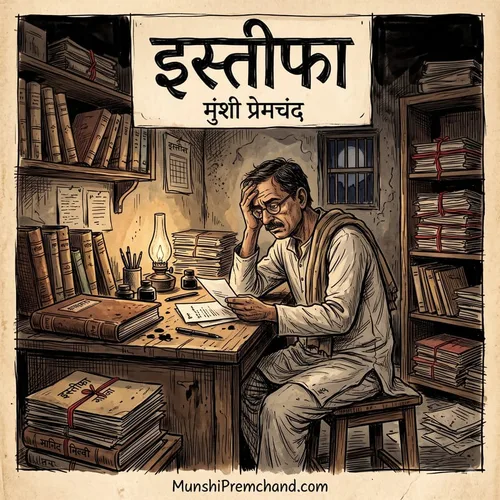
Complete English Translation: Istifa (The Resignation)
1
An office clerk is truly a mute, defenseless creature.
If you glare threateningly at a manual laborer, he will scowl right back and square his shoulders. Scold a coolie, and he will fling your luggage down from his head and walk away along his own path. Snarl at a street beggar, and he will cast a furious glance at you before departing. Even a donkey, when tormented beyond endurance, will occasionally lash out with its hind legs!
Yet as for the poor office clerk—glare at him, scold him, insult him, or kick him—not a single wrinkle of resentment will ever appear upon his brow. The mastery he exercises over his inner passions is such as perhaps not even a self-restrained ascetic saint could match. He is an image of contentment, an idol of infinite patience, an embodiment of absolute obedience; in short, every human virtue imaginable is present within his meek frame!
Even an abandoned ruin witnesses a day of good fortune: on Diwali night, an earthen lamp is lit upon its broken walls; during the monsoon rains, lush green grass carpets its cracks; it too receives its modest share in the beauties of nature.
Yet the luck of this wretched clerk never awakens. Across his dark, overcast destiny, no luminous ray of joy ever shines. Upon his pale, sunken cheeks, the light of a smile is never seen. For him, every season is a dry, sunburnt drought; never does a refreshing green shower fall upon his life.
Lala Fatehchand was precisely such a mute, suffering creature.
They say that a man’s name exerts an influence upon his nature and fortune; but in Fatehchand’s case, this adage was completely falsified. If he were called Harchand—the Man of Perpetual Defeat—it would perhaps be no exaggeration whatsoever.
Defeat in the office, defeat in life, defeat among relatives—everywhere he turned, disappointment and failure stared him in the face. He had not a single son, but three daughters; not a single brother, but two widowed sisters-in-law to maintain. He had not a copper coin in his pocket, yet his heart overflowed with boundless sympathy, delicacy, and accommodation. He had not a single genuine friend—whoever befriended him cheated him.
To crown it all, his health was utterly ruined. At thirty-two years of age, his hair had turned into a salt-and-pepper grey. His eyesight was dim, his digestion shattered, his face pale and bloodless, his cheeks hollow and sunken, his spine bent, and his spirit crushed. He possessed neither courage in his heart nor strength in his breast.
At nine o'clock in the morning he departed for the office, and at six o'clock in the evening he trudged back home. After that, he lacked the energy even to step outside his doorway. What went on in the wider world was something of which he had no inkling. Whatever world he possessed—whether in this life or the next—was that government office. He prayed daily for the safety of his employment and merely completed the numbered days of his existence. He had nothing to do with religion, nor any connection with worldly amusements. He had neither hobbies nor games. It was an age since he had even played a casual hand of cards.
2
It was a chilly winter evening. The sky was lightly overcast with grey clouds.
When Fatehchand returned from the office at half-past five, the street lamps had already been lit. Returning from the office, he spoke to no one. He quietly lay down on his charpoy and remained motionless for fifteen or twenty minutes without stirring a limb; only then could a sound issue from his lips.
Today, as on any ordinary day, he was lying silent and motionless, when barely a minute later someone shouted from outside the front entrance.
His youngest daughter went out to inquire and returned saying that the office orderly had arrived.
Sharda, his wife, was scouring a brass tumbler and pot to fetch warm water so her husband could wash his face and hands. She grumbled:
"Tell him: what is the business? He has only just walked through the door from the office, and already another summons has arrived?"
The orderly called out from the courtyard: "Tell him to come out immediately! The Sahib has summoned him back—there is some extremely urgent work!"
Fatehchand’s exhausted silence broke. He lifted his head from the pillow and asked:
"What is the matter?"
Sharda said: "It is nobody—just the office orderly."
Fatehchand sat up in dread: "The office orderly! Has the Sahib called me?"
Sharda: "Yes, he says the Sahib is calling you. What kind of a Sahib is this of yours? Whenever he pleases, he summons you! You left at nine in the morning and have only just returned, and already another summons has arrived!"
Fatehchand gathered his strength and said: "Let me just hear what he has called me for. I finished every single bit of work before leaving. I will return in a moment."
Sharda said: "At least eat a few mouthfuls of refreshment first! If you get into conversation with that orderly, you won't even remember to come back inside."
Saying this, she brought a small brass bowl filled with a little dalmoth and sev snacks. Fatehchand stood up, but seeing the food, he sat back down upon the cot. Glancing at the bowl with eager eyes, he asked timidly:
"Have you given some to the girls?"
Sharda raised her eyebrows and answered: "Yes, yes! I have given them their share. You go ahead and eat."
Just then, the orderly called out again from outside: "Babu Ji! We are getting very late!"
Sharda: "Why don't you tell him that you cannot come at this hour?"
Fatehchand quickly tossed two or three handfuls of the savory snack into his mouth, gulped down a glass of water, and rushed toward the door. Sharda remained behind preparing the betel leaf.
The orderly said: "Babu Ji! You took a very long time. Now step along quickly, otherwise the moment you arrive, he will shower you with abuses!"
Fatehchand took two running steps and said: "Brother, we can only walk like human beings, whether he showers abuses or bares his teeth. I cannot run. He is at his bungalow, isn't he?"
The orderly laughed: "Why on earth would he come to the office at this hour? Is he a king or a clown?"
The orderly was accustomed to walking briskly. Poor Babu Fatehchand dragged his feet slowly behind. Walking only a short distance, he began panting heavily. Yet after all, he was a man; how could he bring himself to say: Brother, walk a little slower? Summoning his courage, he kept forcing his legs forward, until his thighs began aching intensely. By the time half the distance was covered, his legs flatly refused to lift from the ground.
His entire body was drenched in cold sweat. His head swam with dizziness. Swarms of bright specks danced before his eyes.
The orderly urged him on: "Pick up your pace a bit, Babu!"
Fatehchand managed to gasp with great difficulty: "You go ahead; I am coming."
He collapsed onto the roadside curb, holding his head between his trembling hands to catch his breath.
Seeing his wretched state, the orderly strode ahead. Fatehchand took fright: If this devil reaches first and tells the Sahib heaven knows what lies, a terrible disaster will follow!
Bracing his hands against the dusty ground, he struggled to his feet and resumed walking. But his exhausted body shook with weakness. At that moment, even a small child could have knocked him flat to the earth. Stumbling and dragging his limbs, the poor clerk somehow reached the Sahib’s bungalow.
The Sahib was pacing up and down the wide veranda. Every few moments, he glared toward the driveway gate, seething with fury that no one was in sight.
The instant he saw the orderly, he rolled his bloodshot eyes and barked:
"Where were you all this time?"
Standing on the bottom step of the veranda, the orderly replied: "Huzoor! Only when he comes can I bring him! I have come running ahead as fast as my legs could carry me."
The Sahib stamped his booted foot hard upon the floor and demanded: "What did the Babu say?"
Orderly: "He is coming, Huzoor! It took him an entire hour just to step out of his house."
Just then, poor Fatehchand squeezed through the wire fencing of the compound, approached the veranda, and bowed low in salutation.
The Sahib roared with thunderous fury: "Where were you until now?"
Seeing the Sahib’s flushed, inflamed countenance, the blood froze in Fatehchand’s veins. He stammered:
"Huzoor, I have only just returned home from the office. The moment the orderly called out, I presented myself."
The Sahib screamed: "You are telling lies! You are telling lies! I have been standing here waiting for an hour!"
Fatehchand: "Huzoor, I do not tell lies. There may have been a little delay in walking here, but in leaving my house, I did not delay for a single instant."
The Sahib brandished the cane in his hand and shouted:
"Shut up, you swine! I have been standing here for an hour! Hold your ears!"
Fatehchand swallowed this bitter draught of humiliation and said:
"Huzoor, I have served this department for ten years, yet never..."
The Sahib cut him short: "Shut up, you swine! I tell you: hold your ears!"
Fatehchand: "When have I ever committed a fault?"
The Sahib turned to the orderly: "Orderly! Grab this swine by his ears!"
The orderly said in a low, respectful yet firm voice: "Huzoor, he is my superior officer as well. How can I pull his ears?"
The Sahib raged: "I command you: grab his ears, otherwise I will thrash you with this hunter whip!"
The orderly replied with dignity: "Huzoor, I took service here to work, not to be beaten! I too am a respectable man. Huzoor may take back his job! Whatever lawful order you give, I am ready to carry out; but I cannot destroy another man’s honor. This employment lasts only four days; why should I ruin my relations with the whole world for the sake of four days' employment?"
The Sahib could no longer contain his fury. He lunged forward with his whip.
Seeing that it was unsafe to remain standing, the orderly turned on his heel and bolted out the gate.
Fatehchand still stood there, frozen and silent. Finding that the orderly had escaped, the Sahib stepped toward Fatehchand, seized both his ears with his bare hands, and shook him violently!
He barked: "You swine, you dare commit impertinence? Go to the office this instant and bring the file!"
Fatehchand, rubbing his throbbing ears, asked: "Which file?"
"Are you deaf? Can't you hear? I want the file!"
Fatehchand plucked up courage and asked: "Which file are you demanding, Huzoor?"
The Sahib shouted: "The very file that I want! Bring that file! Bring it right now!"
Poor Fatehchand had no courage left to ask another word. The Sahib Bahadur was notoriously hot-tempered by nature; on top of that was the arrogance of imperial power; and crowning everything was the intoxication of heavy liquor. Had he charged forward with his whip, what could the poor clerk have done? He turned silently and began walking toward the office.
The Sahib shouted after him: "Run! Run as fast as you can!"
Fatehchand turned and said: "Huzoor, I cannot run."
The Sahib yelled: "Oh, you have become very lazy! I will teach you how to run! Run!" (Giving him a violent shove from behind) "Will you still not run?"
Saying this, the Sahib turned back to fetch his hunter whip.
Although Fatehchand was an office clerk, he was nonetheless a human being of flesh and blood. Had he possessed physical strength, he would have drunk that scoundrel's blood right then and there! Had he carried a weapon, he would certainly have struck him down! But in his current helpless condition, taking a beating was all that destiny had written for him.
He ran wildly, dashed out through the iron gates, and collapsed onto the public road.
3
Fatehchand did not go to the office. What would he do by going there? The Sahib had not even named the file. In his drunken haze, he had forgotten it entirely.
Slowly, Fatehchand turned his steps toward home. But this monstrous humiliation felt like heavy iron fetters clamped upon his ankles.
Granted, he was far inferior to the Sahib in physical strength; granted, he held no weapon in his hands; but could he not at least have answered the brute with words? He had shoes upon his feet—could he not have made use of his shoes? Why then had he endured such unspeakable degradation?
Yet what remedy was there? If the officer had shot him in a fit of rage, what loss would the officer have suffered? At most, a month or two of simple imprisonment, or perhaps a fine of two or three hundred rupees! But Fatehchand's entire family would have been wiped out. Who in this wide world would look after his wife and three young daughters? Before whose door would they beg for crusts of bread?
Had he possessed enough wealth to support his family, he would never have endured such humiliation today. He would either have perished on the spot, or taught that devil an unforgettable lesson! He had no fear for his own life. What joy had life ever offered him that he should cling to it in terror? His only agonizing thought was the total ruin of his dependent family.
Today, Fatehchand felt a deeper grief over his physical frailty than he had ever experienced in all his thirty-two years. If only he had paid attention to his health from the beginning, practiced gymnastics, learned the art of staff-fighting—would that brute have dared lay a hand upon his ears? He would have gouged the devil's eyes out! At the very least, he ought to have carried a knife from his home! If nothing else, he could have landed two or three solid blows—whatever followed could be dealt with later: going to prison, or whatever else!
As he trudged forward, his soul raged more and more bitterly against his own cowardice and spinelessness. If I had leaped forward and slapped him two or three times across the face, what would have happened? At worst, his cooks and bearers would have pounced upon me and beaten me senseless! Whatever was to fall upon the children's heads would have fallen. But at least the Sahib would have learned that humiliating a poor, innocent man is no easy game! After all, if I die this very night, what will happen? Who will feed my children then? Whatever calamity is destined to strike them then—if it had struck today, what difference would it have made?
This final thought filled Fatehchand's heart with such a blazing rush of fury that he halted in his tracks! He took two or three steps back toward the Sahib's bungalow to avenge his insult!
Yet the next instant, the cold reality returned: whatever humiliation was to happen had already taken place. Who knew whether the Sahib was still at the bungalow or had driven off to his club? At the same moment, the pitiful faces of Sharda and the helpless, fatherless children rose before his eyes.
He turned around once more and trudged home.
4
The moment he stepped across the threshold, Sharda asked:
"Why did he summon you? You were away a very long time!"
Collapsing upon the charpoy, Fatehchand replied:
"It was the whim of drunkenness—what else? The devil hurled filthy abuses at me, degraded me, and kept screaming: 'Why did you delay?' The merciless brute ordered the orderly to hold my ears!"
Flushing red with fury, Sharda cried:
"And you didn't take off your shoe and thrash the swine?"
Fatehchand: "The orderly is a thoroughly honorable man. He said flatly: 'Huzoor, I cannot do this work. I did not take service here to strip respectable men of their honor!' He saluted and walked away on the spot."
Sharda: "That is true courage! And why didn't you rebuke that Sahib?"
Fatehchand: "Why wouldn't I rebuke him? I gave him a piece of my mind! He rushed at me with a cane—I brandished my shoe! He landed blows with his cane—and I struck him with several good blows of my shoe!"
Overjoyed, Sharda asked: "Truly? His face must have shrunk to the size of a thumb!"
Fatehchand: "A broom seemed to have swept across his face!"
Sharda: "You did wonderfully well! You should have beaten him even more! Had I been in your place, I would not have left without taking his very life!"
Fatehchand: "I have beaten him, but now matters will not end peacefully. Look at the consequences: my job will certainly go, and I may have to serve a prison sentence as well."
Sharda: "Why should you serve a prison sentence? Is there no one left in the world to administer justice? Why did he hurl abuses? Why did he strike with a cane?"
Fatehchand: "Who will listen to me against him? The court too will take his side."
Sharda: "Let it take his side, let whatever happen happen! But mark my words: from this day forward, no Sahib will ever dare hurl abuses at an Indian clerk! You should have landed a shoe across his mouth the very second a foul word escaped his lips!"
Fatehchand: "Then I would not have returned alive tonight. He would certainly have shot me dead."
Sharda: "We would have faced that when it came!"
Fatehchand smiled faintly: "And where would you and the children have gone?"
Sharda looked at him with blazing eyes and said:
"Wherever God willed! For a human being, the greatest treasure in this world is HONOR! One does not maintain children by bartering away one’s self-respect! Had you beaten that devil and returned home, I would have been bursting with pride! But if you had taken his beating and slunk back home, I would have looked upon your very face with utter disgust! In words I might not have said anything, but in my heart, all respect for you would have died forever! Now, whatever calamity falls upon our heads, I shall bear it with joy... But where are you going? Listen to me! Where are you going?"
Fatehchand walked out of the house like a man possessed by a divine madness. Sharda kept calling after him, but he did not pause.
He was heading back toward the Sahib’s bungalow—not trembling with terror, but with his head held high in proud defiance! An unshakeable resolve shone from his countenance. In his legs there was no longer any fatigue; in his eyes, no helplessness. A complete metamorphosis had come over him. In place of that frail, emaciated, pale-faced office clerk, there strode a manly figure, brimming with courage, resolute, muscular, and young!
He walked first to a friend’s house, borrowed a heavy wooden lathi, and strode boldly toward the Sahib’s bungalow.
5
It was nine o'clock at night. The Sahib was seated at his dining table.
Tonight, Fatehchand did not wait for him to rise from the table. The bearer came out carrying dishes, and Fatehchand lifted the chick curtain and strode straight inside!
The room was ablaze with electric light. Upon the floor was spread a luxurious carpet such as had not been laid even on Fatehchand’s wedding day.
The Sahib looked up at him with furious eyes and barked:
"Why have you come? Go outside! Why did you walk in?"
Fatehchand stood firm, resting both hands upon his heavy staff, and said:
"You demanded a file from me a little while ago. I have brought that very file with me! Finish your dinner, and then I will show it to you. Until then, I shall sit right here. Eat in peace—for this may very well be the last meal of your life! Therefore, eat until your belly is full."
The Sahib was struck dumb with shock. Glancing at Fatehchand with a mixture of terror and fury, he began to tremble. An unshakeable resolve blazed from Fatehchand’s face.
The Sahib understood that this man had come prepared to kill or be killed! In mere physical strength, Fatehchand was not a fraction of the Sahib. But it was abundantly clear that he was prepared to answer a brickbat not with a stone, but with solid iron! If the Sahib insulted him now, there was no doubt the clerk would charge forward with his staff.
Granted, in a physical struggle the Sahib had no doubt of his own victory; but to invite a heavy blow from a staff without warning was hardly an act of wisdom. You may strike a dog with a stick, kick it, do as you please—so long as it does not growl. But once it bares its fangs and lunges, where does your courage go?
Such was the condition of the Sahib Bahadur at that moment. So long as he believed that Fatehchand would endure threats, abuses, whips, and kicks in silence, he was a roaring lion. But now, with furrowed brows, staff in hand, the clerk stood poised like a cat ready to pounce! A single harsh word from the mouth, and the staff would crash down. At most, the Sahib could dismiss him. If they came to blows, there was the danger of being thrashed, and the scandal of a criminal lawsuit. Even if his power and prestige landed the clerk in jail, he could never escape the public humiliation and disgrace.
Like a shrewd and calculating man, the Sahib forced a smile and said:
"Oh-ho! I understand—you are angry with me! Did I say something to you? Why are you angry with me?"
Fatehchand drew himself up to his full height and said:
"Only half an hour ago, you twisted my ears and hurled hundreds of vile abuses at me! Have you forgotten so soon?"
The Sahib chuckled nervously: "I grabbed your ears? Ha-ha-ha-ha! What a joke! Am I mad or insane?"
Fatehchand: "So you mean to say I am telling lies? The orderly is a witness. Your own servants were watching!"
Sahib: "When did this happen?"
Fatehchand: "Just now, half an hour ago! You summoned me and, without any reason, twisted my ears and shoved me!"
The Sahib: "Oh, Babu Ji! At that time, I was heavily drunk! The bearer gave me far too much liquor! I had no idea what happened—my God! I had no idea whatsoever!"
Fatehchand: "If you had shot me dead in your drunkenness, would I not be dead? If you were drunk and everything is forgiven to a drunken man, then I too am drunk tonight! Now hear my judgment: either hold your own ears and swear that you will never treat any respectable gentleman in this manner again, or I shall step forward and twist your ears myself! Do you understand or not? Do not stir an inch from your seat! If you leave your place, I shall bring this staff down upon you—and if your skull is shattered, it will not be my fault! Do whatever I command you: hold your ears!"
The Sahib laughed a strained, hollow laugh: "Well, Babu Ji, you are very fond of joking! If I said bad words to you, I ask your pardon!"
Fatehchand weighed the heavy lathi in his grip: "No! Hold your ears!"
The Sahib could not endure such humiliation easily. He leaped up from his chair, intending to wrest the wooden staff from Fatehchand’s hands.
But Fatehchand was wide awake!
Before the Sahib could fully rise from the table, Fatehchand swung the heavy lathi with a full, measured, thunderous blow!
The Sahib was bareheaded. The heavy staff struck him squarely across the head. His skull buzzed with agony.
Clutching his throbbing head between his hands for a full minute, he groaned:
"I will dismiss you from service!"
Fatehchand said: "I care nothing for that! But tonight, I shall not leave without making you hold your ears! Hold your ears and swear that you will never show such insolence to a respectable man again—otherwise, my second blow is about to land!"
Saying this, Fatehchand raised the staff once more.
The Sahib had not forgotten the agonizing pain of the first blow. If a second blow landed, his skull might well crack wide open!
Placing his hands upon his ears, he gasped: "Are you happy now?"
"Will you ever hurl abuses at anyone again?"
"Never!"
"If you ever do so again, remember this: I am not very far away!"
"I will never abuse anyone again."
"Very well. Now I am leaving. Here is my resignation! Tomorrow I shall send my formal resignation in writing, stating clearly: 'Because you hurled filthy abuses at me, I refuse to serve under you!' Do you understand?"
The Sahib stammered: "Why do you resign? I am not dismissing you!"
Fatehchand looked down at him with supreme disdain and said:
"I refuse to serve as a subordinate under a vile scoundrel like you!"
Having uttered these words, Fatehchand turned, strode out of the room, and walked home in complete peace and tranquility.
Tonight, he experienced the boundless joy of a genuine, immortal victory. Never in his entire life had he known such profound happiness.
This was the very first victory of his existence.
Summary of Istifa (The Resignation)
Istifa ("The Resignation") is Munshi Premchand’s celebrated short story exploring the psychological awakening, human dignity, and anti-colonial resistance of an ordinary Indian clerk during the British Raj.
The protagonist, Lala Fatehchand, is an overworked, undernourished, and chronically ill government clerk who has spent his entire life in meek submission. Supporting a large dependent family comprising his wife Sharda, three daughters, and two widowed sisters-in-law, he endures daily harassment and browbeating from his superiors without ever raising his voice.
One cold winter evening, immediately after Fatehchand returns home exhausted, an orderly arrives summoning him back to the British officer's bungalow. Fatigued and breathless, Fatehchand hurries to the bungalow, only to be confronted by the officer pacing the veranda in a drunken rage over a minor delay. The officer calls Fatehchand a "swine," demands that he hold his own ears, and orders the orderly to twist them. When the principled orderly refuses to humiliate a fellow countryman and flees, the officer violently twists Fatehchand's ears himself, shoves him, and threatens him with a whip. Overcome by terror and physical weakness, Fatehchand flees into the night.
Returning home in deep emotional distress, Fatehchand confides the incident to his wife, Sharda. Sharda reacts with fierce indignation. She rejects the idea that a family should be sustained on the bread of humiliation, declaring that human self-respect is far more precious than life itself, and that she would have been proud had he struck the officer with a shoe, rather than slinking home in shame.
Sharda's words act as an electric catalyst, shattering Fatehchand's lifelong conditioned cowardice. Borrowing a heavy wooden lathi from a friend, Fatehchand marches back to the officer's bungalow. He walks straight into the brightly lit dining room where the officer is having dinner. When the officer attempts to assert authority, Fatehchand raises his stick and warns him that he has come prepared to kill or die. When the officer tries to snatch the weapon, Fatehchand strikes him across the head with a powerful blow. Terrified and nursing his bruised skull, the officer catches his own ears, apologizes, and swears never to insult another respectable Indian.
Fatehchand declares his immediate resignation from government service, refusing to work under a cowardly oppressor. Walking back under the starlit sky, he experiences the exhilarating freedom of true self-respect—marking the very first, glorious victory of his life.
Publication History
Istifa (इस्तीफ़ा) was written by Munshi Premchand in 1928, a period marked by rising nationalist mobilization, labor strikes, and the Non-Cooperation movement across India. It was first published in contemporary Hindi periodicals and later included in Premchand's definitive collection, Mansarovar, Part 5 (मानसरोवर भाग 5).
This unabridged English translation was published in 2026 by MunshiPremchand.com as part of the MunshiPremchand.com English Translation Series.
Themes & Critical Significance
- The Awakening of Self-Respect (Aatm-Samman): Premchand demonstrates that physical weakness, poverty, and bureaucratic conditioning can crush the human spirit only so long as an individual consents to degradation. Once the spark of self-respect is ignited, even the most timid clerk becomes invincible.
- Critique of Colonial Bureaucracy and Racial Arrogance: The story exposes the systemic abuse and racism inherent in colonial governance, where British officers exercised unchecked despotic power over Indian subordinates through intimidation, insults, and physical violence.
- The Domestic Catalyst and Female Agency: Sharda plays a crucial role as the moral conscience of the family. Refusing to prioritize economic survival over human honor, her fearless indictment of cowardice shatters Fatehchand’s passivity and impels him toward heroic action.
- The Political Symbolism of the Resignation: Fatehchand's resignation (istifa) mirrors the national philosophy of Non-Cooperation (Asahyog). By refusing to serve the tyrant and forcing the oppressor to apologize, Premchand illustrates that colonial power crumbles the moment the colonized withdraw their fear and obedience.