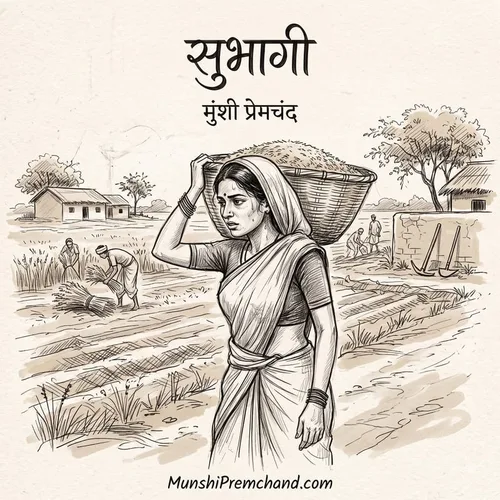
Whatever might happen in other households, Tulsi Mehto loved his eleven-year-old daughter Subhagi not a grain less than his son Ramu.
Ramu, though a grown youth, was as lazy as a wooden block. Subhagi, even as an eleven-year-old girl, was so exceptionally skilled at domestic chores and field labor that her mother Lakshmi lived in constant fear lest the evil eye fall upon her child. After all, even the gods love good children! Lest anyone praise Subhagi too loudly, Lakshmi often scolded her without cause—not out of anger, but out of fear of the evil eye.
Yet tragedy struck when Subhagi was barely eleven—she became a widow.
The household echoed with lamentation. Lakshmi beat her chest in agony, while Tulsi wept in helpless sorrow. Seeing her parents weep, little Subhagi cried too, repeatedly asking her mother: "Amma, why are you crying? I won't go anywhere leaving you behind—why do you weep?" Her innocent words tore at her mother's heart even more deeply.
What was little Subhagi thinking? She imagined having a room full of money so that she could secretly run to the market, buy beautiful clothes for her mother, and hand money to her father whenever moneylenders came demanding debts!
Years passed, and Subhagi grew into a graceful young woman.
Seeing her grown, well-meaning neighbors began pressuring Tulsi Mehto: "Tulsi, arrange a household for the girl somewhere. A young widow staying at home is not proper. Since our community permits widow remarriage without stigma, why hesitate?"
Tulsi replied helplessly: "Brothers, I am ready; but Subhagi refuses completely."
An elder neighbor, Harihar, tried to counsel Subhagi: "Child, we speak for your own good. Your parents are old—how long can they protect you? How long will you sit like this?"
Subhagi bowed her head with quiet dignity: "Uncle, I understand your words, but my heart does not wish to marry. I am not worried about personal comfort—I am ready to face every hardship. Ask me to do any hard labor and I shall obey with all my heart; but do not ask me to remarry. If I am the true daughter of an honest father, my character shall remain spotless."
Her brother Ramu grumbled insolently: "If you think your brother will earn while you sit and enjoy luxuries, don't stay in that illusion! No one has taken a lifetime contract to feed you!"
Ramu's wife, even more sharp-tongued, sneered: "We haven't taken anyone's loan to feed an extra mouth all our lives!"
Subhagi replied with proud composure: "Sister-in-law, I have never depended on your shelter, and by God's grace, I never shall! Mind your own affairs and do not worry about me."
When Ramu's wife realized Subhagi would not leave, her harassment intensified. Yet Subhagi paid no heed.
She woke up hours before dawn—grinding grain, cleaning the courtyard, preparing cow-dung cakes, and rushing to the fields. At noon, she returned to cook for the entire family. At night, she massaged her mother's aching limbs and served her father his tobacco pipe. As far as her strength allowed, she refused to let her aging parents lift a single finger for work.
Ramu, however, felt bitter. Subhagi's untiring devotion made his own laziness obvious to the whole village!
One day, Ramu picked a quarrel with his father: "If you love your daughter so much, live separately with her! I will not share my earnings with her!"
Tulsi Mehto was furious: "As long as I am alive, you cannot speak to my daughter like that! A caring daughter is ten times better than a worthless, selfish son!"
Ramu demanded a complete family partition.
The village elders assembled. Village headman Sajan Singh scolded Ramu: "Are you not ashamed to abandon your aging parents merely because your wife dislikes them?"
Subhagi stepped forward before the council and bowed: "Elders, let there be no quarrel because of me. I shall live separately with my mother and father and feed them through my own labor!"
Tulsi embraced her with tears: "No, child! I would rather lose my son than part from you!"
The partition took place. Ramu took his share of property and walked away, leaving the elderly couple with Subhagi.
Subhagi effectively became the sole breadwinner for her parents.
Through untiring field labor and thrift, she saved money and purchased a fine milch buffalo so that her old parents could enjoy fresh milk and curd daily. When her father worried that the extra work would exhaust her, Subhagi smiled: "Father, I cannot enjoy my own food unless you have your daily milk!"
The whole village marveled at her devotion. People said: "She is not an ordinary woman; she is a living goddess! She works like two men and worships her parents like deities!"
Yet peace did not last. Two years later, Tulsi Mehto fell severely ill with high fever.
Subhagi ran to her brother Ramu's house, weeping: "Brother, Father is critically ill—come see him once!"
Ramu sneered callously: "He chose you over me—now go take care of him yourself!"
Subhagi ran to headman Sajan Singh. Sajan Singh rushed to Tulsi's bedside, bringing medicines and comfort. Sensing his end, Tulsi held Sajan Singh's hand: "Thakur Sahib... I leave my Subhagi and Lakshmi in your care..."
Sajan Singh promised with tears: "Tulsi, rest in peace. As long as I live, no harm shall touch them."
Tulsi passed away without seeing his selfish son's face.
Ramu refused to even light his father's funeral pyre, claiming his father had rejected him. Thus, Lakshmi performed the rites, while Subhagi took charge of the entire funeral arrangements.
To everyone's astonishment, Subhagi organized a grand thirteenth-day ceremony (terahi), feeding the entire village with dignity. Ramu stood disgraced in the corner, realizing his sister had accomplished what he could never do.
The ceremony cost three hundred rupees—a sum advanced as a loan by Sajan Singh.
Sajan Singh told her gently: "Child, Tulsi was my brotherly friend. Do not worry about repaying this money."
Subhagi insisted firmly: "No, Thakur Sahib! A father's debt is a sacred obligation. I shall repay every single copper coin with my own hands!"
Fifteen days later, heartbroken by the loss of her companion of fifty years, mother Lakshmi passed away as well. Before dying, Lakshmi held Subhagi to her chest: "My child... having a daughter like you has made my life blessed. May God give me you as my daughter in every birth!"
Subhagi organized her mother's funeral, taking on an additional two hundred rupees debt, bringing her total debt to five hundred rupees.
Now completely alone in the world, Subhagi had one single mission in life: To repay her five-hundred-rupee debt to Sajan Singh through her own labor.
She did not despair. For three long years, she worked relentlessly day and night.
By day, she tilled the fields and harvested crops; by night, she ground four sers of grain into flour. Every single month, without a single day's delay, she walked to Sajan Singh's house and deposited fifteen rupees!
Her perseverance became legendary across the district. Seeing her untiring strength, pure character, and self-respect, marriage proposals began arriving from wealthy households across neighboring villages. But Subhagi politely declined them all: "Until my debt is cleared, I belong to no one."
Finally, after three years of relentless toil, the day arrived!
Subhagi walked to Sajan Singh's house, laid down the final installment of rupees, and folded her hands with tears of joy:
"Thakur Sahib, today your five hundred rupees are fully paid! My parents' souls are free from debt!"
Sajan Singh gazed at the young woman with deep reverence and tears in his eyes.
He said gently: "Subhagi, today you owe me nothing. You are completely free. Now, as an elder, I ask one favor of you—not as a creditor, but as a father."
Subhagi bowed: "Command me, Thakur Sahib."
Sajan Singh said with emotion:
"I used to take pride in my high caste and wealth; but your spotless character, your devotion, and your untiring self-respect have shattered all my narrow pride! My son respects you deeply. Will you accept my home and become my daughter-in-law?"
Subhagi looked at the noble old man who had stood by her parents in their darkest hours. Tears of gratitude filled her eyes. She bowed low and touched his feet in quiet acceptance.
Sajan Singh placed his hand on her head, blessing her warmly:
"My home is blessed today! A daughter like you is not a burden—she is the priceless jewel of any family!"
Significance & Themes
- Challenging Son-Preference: Premchand completely overturns traditional agrarian prejudices that view sons as natural assets and daughters as economic burdens. The selfish son Ramu brings disgrace, while the widowed daughter Subhagi becomes the moral pillar and savior of the family.
- Female Self-Reliance & Dignity: Subhagi's strength does not stem from wealth or dependence on men, but from her honest physical labor, thrift, and unyielding self-respect.
- True Redemption vs. Dependency: Subhagi's eventual remarriage is not presented as a rescue of a helpless widow, but as a public recognition of a woman who has already established total financial independence and moral victory through her own labor.