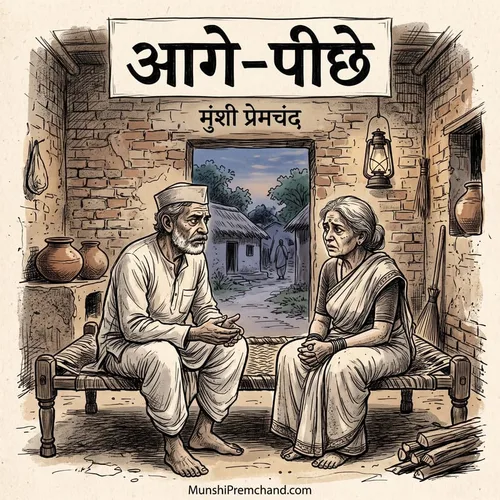
Complete English Translation: Aaga-Peechha
After the fleeting, restless pleasures of youth and beauty had passed, Kokila was now washing away the stains of that tainted life with her tears. Whenever the memory of her past arose, her heart would writhe in agony, and overcome with despair and remorse, she would cry aloud: Alas! Why was I ever born into this world?
Through charities and solemn religious vows, she strove to cleanse that blackness, squandering all the accumulated treasures of her life's springtime in this fruitless endeavor. Yet was this moral awakening the blessing of some sage, or the fruit of some religious ritual? No, it was the divine grace bestowed by the very first sight of that newborn infant whose birth, fifteen years ago, had illuminated her empty lap.
The moment she looked upon the baby's face, a faint, mournful, tender smile flickered across her pale lips—but only for an instant. In the next breath, that smile dissolved into a deep, heavy sigh. That feeble, tender, helpless cry altered the entire course of Kokila's life. The pure flame of maternal love became for her a sacred commandment and a silent sermon.
Kokila named that newborn baby girl Shraddha—Faith—for it was her birth that had awakened faith within her own soul. She regarded Shraddha not merely as her daughter, but as the incarnation of a goddess. Her old companions and acquaintances would come to congratulate her, but Kokila concealed the child from their sight; she could not bear the thought that even their sinful gaze should fall upon her. Shraddha was now her wealth, her soul, the lamp of her existence. Sometimes, taking the infant into her lap, she would gaze upon her with eyes brimming with yearning, wondering: Will this sacred flame, too, fall prey to the violent onslaughts of base desire? Will all my penances come to naught? Alas! Is there no medicine on earth that can erase the inherited traits of birth? She prayed unceasingly to God that her Shraddha might never become entangled in thorns. In word and deed, in thought and conduct, she would set before the child the highest ideals of womanhood. Shraddha was so sweet-tempered, so bright, so quick-witted that sometimes Kokila, overwhelmed by maternal reverence, would press the soles of the child's little feet against her forehead, shedding tears of mingled joy and repentance.
Sixteen years rolled by. The innocent child of earlier days had blossomed into a proud, composed, modest young maiden whose very sight brought tranquility to the eyes. She was a devout worshipper of learning, but completely estranged from the world around her. The girls who studied alongside her in school refused even to speak to her. Nurtured exclusively within the cloistered atmosphere of maternal devotion, she had grown fiercely aloof and self-respecting.
If Shraddha developed a profound sense of self-esteem amidst this atmosphere of tender sheltering, the ostracism of companions, and day-and-night immersion in books, what wonder was there? She possessed no right to converse freely with anyone. In the school, daughters of respectable households considered their honor compromised by her mere presence. On the streets, passersby would point fingers and sneer: "Look, that is the courtesan Kokila's daughter!" Her head would bow; for an instant her cheeks would flush crimson with humiliation, and in the next moment turn white as chalk.
Shraddha loved solitude. She regarded marriage as a divine curse. Whenever Kokila broached the subject, a furrow would appear upon Shraddha's brow, a dark cloud would settle over her bright face, and tears would stream from her eyes, compelling Kokila into silence. Their life ideals were in sharp opposition: Kokila was a devout worshipper of the god of social convention, while Shraddha harbored a profound disdain for society, for conventional religion, and for the hypocrisies of mankind.
If there was anything dear to her in the world, it was her books. Shraddha passed her days in the company of great thinkers and scholars, where distinctions of high and low do not exist, where caste holds no sway, and where all souls possess equal rights. The essence of Shraddha's character was captured by that couplet of the great poet Rahim:
Better to die with love and honor, if one invites and offers poison,
Than to receive nectar offered with contempt.
Had someone called her with genuine affection and offered poison, she would have bowed her head and accepted it reverently; but even the nectar of immortality held no value in her eyes if offered with condescension.
One day, with tears in her eyes, Kokila said to Shraddha: "Tell me truly, Munni—you must surely feel deep shame at being born my daughter! Had you been born into a high and noble family, would these dark thoughts ever enter your heart? In secret, you must surely curse me."
Shraddha looked into her mother's face. Never before had such reverence for her mother welled up within her heart. In a trembling voice, she said: "Amma-ji, why do you ask me such a question? Have I ever shown you disrespect?"
Kokila replied with emotion, "No, my child. I pray to the merciful Lord that He grant everyone a daughter as noble and gentle as you. Yet the thought often crosses my mind that you must surely grieve over being my daughter."
Shraddha replied in a calm, steady tone: "Amma, this feeling of yours is utterly groundless. I tell you the honest truth: the reverence and devotion I feel toward you, I feel toward no one else on earth. To be called your daughter is not a matter of shame for me, but a matter of pride. Man is a creature of circumstances. The atmosphere in which you were raised was bound to leave its mark; but to be caught in the mire of sin and yet pull oneself out of it by one's own will is truly a glorious achievement. To steer a boat with the current is very easy; but the boatman who rows against the fierce torrent is the only true navigator."
Kokila smiled gently and asked, "Then why do you shrink in disgust at the very name of marriage?"
Lowering her eyes, Shraddha answered: "Can life not be lived without marriage? I wish to spend my life as a maiden. After finishing school, I shall enter college, and in two or three years both of us can live independently. I can become a doctor, or study law; all avenues are open to women today."
Kokila asked hesitatingly, "Tell me, does no other desire ever stir in your heart? Does the longing to love someone never awaken within you?"
Shraddha drew a long breath. "Amma-ji, who in this world is truly devoid of love? Love is the supreme essence of human life. If the divinity of God is visible anywhere, it is only in love. When I find a man who does not consider his honor demeaned by taking my hand, I shall worship him with my body, mind, and wealth. But before whom should I stretch out my hands to beg for love? If someone marries me out of a momentary impulse of social reform, I could never be happy. It is a thousand times better that I abandon the thought of marriage altogether."
Around this time, an annual gathering of the Women's Association (Mahila Mandal) took place. A large number of college students attended, and the hall was packed so tightly that not an inch of space remained. Shraddha came and stood quietly in the very last row of women. To her, all this pomp seemed like mere theatrical show; today was the first time she had ever attended such a public assembly.
The proceedings began. Following the presidential address, resolutions were moved and speeches delivered in their support. But the ladies forgot their prepared speeches, or perhaps the imposing authority of the gathering overwhelmed them so completely that their powers of oratory deserted them. They stammered a few broken sentences and sat down in confusion. The spirit of the meeting began to deteriorate. Several fashionable ladies stepped onto the platform with great elegance, but could not utter more than two or three words. The young men found an opportunity for mockery: laughter erupted and sarcastic clapping resounded.
Seeing this discourtesy, Shraddha's blood boiled, and every nerve in her body quivered with indignation. Stepping onto the platform, she began speaking with such majestic poise that a hush fell over the entire hall. The clamor ceased; people gazed at her spellbound. Shraddha spoke with the fluent, effortless grace of a celestial maiden. Every word resonated with freshness, vitality, and unyielding conviction. The fragrant aura of her youthful dignity held the assembly in silent awe.
When the meeting concluded, the crowd broke into animated discussion.
One youth asked, "Who was that girl, brother?"
Another answered, "Why, the courtesan Kokila's daughter!"
A third added, "No wonder there is such sweetness and clarity in her voice! It is pure magic—living, breathing magic! And why shouldn't it be? Her mother held the entire city captive in her day. Ever since she abandoned the profession, the town has become lifeless. It looks as though the daughter will take her mother's place."
At this, a dark-skinned young man clad in homespun khadi spoke up sharply: "What marvelous appreciation of talent you have displayed, sir! Bravo!"
The other retorted, "Why does it sting you so? Do you have some private connection with her?"
The khadi-clad youth replied with mounting indignation, "Are you not ashamed to let such vile words cross your lips?"
"What shame is there, sir?" the man sneered. "If the daughter of a courtesan turns out to be one, what surprise is there?"
The youth said in a tone of profound disgust: "That may be true according to the wisdom of gentlemen like you! But a woman from whose lips such noble ideals flow is a goddess, not a seller of beauty!"
Shraddha was leaving the hall at that very moment, and these final words reached her ears. Startled and thrilled, she paused in her tracks. She cast a look of deep gratitude toward the dark young man, and then walked briskly away. But all through the journey home, those words echoed in her ears. Until today, the only person who had ever praised or encouraged her was her mother Kokila; everywhere else lay only neglect, scorn, and contempt. Today, the face of this stranger—dark-skinned, but with a pure and luminous soul—danced constantly before her eyes. The question arose in her mind: Who is he? Will I ever see him again?
On her way to college, Shraddha's eyes would search for that young man in the crowds. At home, she watched the street through the bamboo blinds, looking at the passersby; but the young man was nowhere to be seen.
Some weeks later, an announcement appeared for the second meeting of the Women's Association. Four days remained before the gathering. Shraddha spent all four days preparing her speech. She wrestled for hours in search of the exact word, reading every sentence aloud repeatedly. She studied the speeches of great statesmen and attempted to model her prose upon them. When the speech was finished, she went to her room and rehearsed it aloud, addressing the chairs and tables as her audience. Every grace of oratory was present. The peroration was so magnificent that hearing it from her own lips, she was enchanted. What music it contained, what passion, what revolutionary fervor!
The day of the meeting arrived. With a pounding heart, Shraddha entered the hall. It was even more crowded than before. The moment Shraddha appeared, the audience welcomed her with enthusiastic applause. A cheer arose, and voices called out in unison: "Please begin your address!"
Stepping onto the dais, Shraddha cast a swift glance across the sea of faces. The dark young man was standing in the very last row, having found no seat. A sweet tremor passed through Shraddha's heart. In a voice trembling with emotion, she began her address.
In her eyes, the entire hall was filled with lifeless wooden puppets; if there was a single living human soul present, it was that dark youth standing at the back. Her face was turned toward him; it was from him that she sought appreciation for her words. One expects a diamond to be valued only by a true jeweler. For half an hour, a shower of flowers fell from Shraddha's lips. Rarely had the audience heard such an inspiring discourse.
When the meeting ended and Shraddha walked home, she noticed that the dark young man was walking rapidly behind her. Shraddha knew that the public had acclaimed her speech, but she had not yet had the opportunity to hear this young man's verdict. She slowed her pace. Within moments, the youth caught up with her. For several paces, both walked on in silence.
At last, the young man said with slight hesitation, "You worked wonders today!"
Suppressing her delight, Shraddha replied, "Thank you! It is your kindness."
The youth said, "What worth do I possess? It was not only I; the entire assembly was spellbound."
"Do you reside here?" Shraddha asked.
"Yes, I am studying for my M.A. God knows how long this ghost of high and low birth will ride upon our heads! By misfortune, I too belong to those whom the world considers untouchable. By caste, I am a Chamar. My father was an orderly to the school inspector, and through his recommendation, I secured admission to school. Since then, I have been fighting against fate. In the beginning, the schoolmasters would not even touch me. That humiliation is no longer there, but the students still keep their distance from me."
Shraddha looked at him and said, "I judge nobility not by birth, but by righteous conduct (dharma)."
The youth said, "That was evident from your speech, and that alone gave me the courage to speak to you; otherwise, where are you, and where am I!"
Shraddha lowered her eyes and murmured, "Perhaps you do not know my background."
"I know it very well," the youth answered warmly. "If you could grant me the privilege of meeting your mother, I would be deeply grateful."
"She will be delighted to meet you! May I know your good name?"
"People call me Bhagatram."
This introduction deepened day by day, and their friendship grew into an intimate bond. In Shraddha's eyes, Bhagatram was a noble soul; in Bhagatram's eyes, Shraddha was a living goddess in human form.
A year went by. Bhagatram visited the shrine of his goddess every day. The two would sit and converse for hours. Whenever Shraddha was invited to speak, Bhagatram set aside all work to attend. Their ambitions were identical, their ideals of life one, their tastes one, their thoughts in complete harmony.
Bhagatram now spoke eloquently on love and its deepest mysteries. Never had his conversation possessed such poetic beauty and emotional depth. He had become a master at hinting at his feelings. Yet on those very occasions when Shraddha's heart would begin to flutter with sweet anticipation and her cheeks flushed with joy, Bhagatram would abruptly change the subject, invent an excuse, and take his leave.
After he departed, Shraddha would shed tears of longing, wondering: Does he not love me from the depths of his heart?
One day, Kokila called Bhagatram into a quiet corner and said: "Son, it would be wonderful if your marriage with Munni were settled now. What certainty is there in human life? If I should die, this cherished wish will remain unfulfilled in my grave."
Bhagatram shook his head and said, "Amma, let me pass this examination first. Marriage is fitting only after the question of earning a livelihood has been resolved."
"All that I possess is yours," Kokila replied. "Will I carry it with me to the next world?"
"That is your generosity, Amma-ji," Bhagatram answered, "but do not make me so shameless. I am already yours; even if you drive me away, I cannot leave your doorway. Who in the world is as fortunate as I? But before entering the temple of the goddess, one must have some flowers and offerings ready in one's hands."
Another year slipped away. Bhagatram earned his Master's degree and was appointed a lecturer in economics at his own college. On that joyous day, Kokila distributed generous charities. When Bhagatram came and touched her feet, she embraced him to her breast. She was certain that today Bhagatram would broach the question of marriage.
Shraddha stood waiting like an image of eager hope. Every nerve in her body seemed to vibrate like a hundred musical strings. A sweet intoxication enveloped her mind; her feet scarcely touched the ground. The moment she saw Bhagatram, she said to her mother, "Amma, buy us a small motorcar now!"
Kokila smiled and said, "Why a small one? Buy a large one! But first select a fine house."
Shraddha led Bhagatram into her room. Sitting together, they began planning the decoration of their future home. Curtains, carpets, paintings—everything was discussed. Shraddha said, "We will take the money for this from Amma-ji."
Bhagatram replied, "I would feel ashamed to take money from her."
Shraddha smiled playfully, "After all, she will give it as my dowry!"
For an hour they continued talking. But that decisive word, which Shraddha's heart was yearning to hear, did not cross Bhagatram's lips, and he took his departure.
When he left, Kokila asked apprehensively, "What was decided today?"
Understanding her mother's implication, Shraddha cried out: "If I have become such a heavy burden to you, why don't you push me into a well?"
With these words, the dam of her patience broke. All the anguish and sorrow that had been festering within her breast spilled forth, and she broke down in bitter, uncontrollable weeping.
Kokila said in exasperation, "When he has no intention of settling matters, why does he come here every single day? His family is not of great nobility, nor is he some wealthy prince!"
Wiping her eyes, Shraddha pleaded: "Amma-ji, please do not say anything against him before me! What lies in his heart, I know full well. He may utter nothing with his lips, but with his soul he has already spoken; and though my ears have heard nothing, my heart has heard everything."
Kokila said nothing further to Shraddha; but the next day, she asked Bhagatram directly: "What are your intentions now, son?"
Scratching his head in embarrassment, Bhagatram said: "Amma-ji, I am ready; but my parents will not agree under any circumstances. If I can find a little leisure, I will travel home and persuade them. It is not right to displease one's parents!"
Kokila could find no answer.
Bhagatram's parents lived far away in a rural village. He was their only son, and all their hopes and ambitions were centered upon his wedding. Several times they had arranged matches for him, but Bhagatram had always slipped away on the pretext that he would not marry until he secured employment.
Now that he was employed, both parents arrived laden with bundles at Bhagatram's lodgings on a freezing morning in the month of Magh. Bhagatram rushed forward, touched their feet, and after inquiring about their journey, said: "Why did you take the trouble of traveling in this biting frost? You should have sent for me."
Chaudhary turned to his wife and remarked, "Do you hear that, Bachcha's mother? When we summon him, he writes that he has an examination, or this, or that; and when we arrive in person, he asks why we didn't call him! Your marriage has been settled. Now you must take a month's leave and accompany us home. That is why we have come."
The Chaudharain added, "We knew that without coming in person, nothing would be accomplished. Submit your leave application today. The girl is beautiful, educated, and of an honorable family."
Bhagatram said bashfully, "My marriage is already arranged here with someone, if you both agree."
Chaudhary looked puzzled: "Who from our community lives in this city, Bachcha's mother?"
"There is no one from our biradari here," the mother replied.
Bhagatram said, "There is a mother and a daughter. They have ample wealth. The girl is of such noble character that you will be delighted the moment you see her. The marriage will cost us nothing."
Chaudhary asked, "Is the girl's father dead? What was his name? Where did he come from? What is their family lineage? Until all these things are known, how can a marriage take place, Bachcha's mother?"
"We have lived here more than twenty years," the mother said.
Bhagatram said, "Their house is located near the Nakhas market."
"Which side of the Nakhas?" Chaudhary inquired.
"In the lane facing the Nakhas, theirs is the very first house. It is visible from the main road."
Chaudhary's brow furrowed. "The first house is that of Kokila the courtesan! Painted in pink, isn't it?"
Blushing with acute embarrassment, Bhagatram said, "Yes, that is the house."
"Then doesn't Kokila the courtesan live there?"
"Of course she lives there. Mother and daughter both live there."
Chaudhary exploded: "So you want to marry the daughter of Kokila the courtesan? Have you set out to cut off our noses? Not a single person in our community will drink water from our hands!"
The Chaudharain screamed, "I will thrust a burning brand into the hussy's mouth! Have you been bewitched by her fair face?"
Bhagatram replied, "I consider it my supreme good fortune that she has agreed to marry me. If she wished, she could marry into the wealthiest aristocratic household today!"
Chaudhary retorted, "An aristocrat will not marry her; he will keep her as a concubine! If God grants you wealth, keep not one, but four concubines—who stops a man? But as for marriage, a marriage is only that which takes place within one's own community!"
The Chaudharain snapped, "Too much book-learning turns a man's brain mad!"
Chaudhary said, "We are simple, illiterate folk, but we cannot comprehend how such an evil thought entered your head! The daughter of a courtesan, even if she were a celestial fairy from Indra's court, remains a courtesan's daughter! We will never permit your marriage there. If you dare marry her, both of us will take our lives before your eyes! Understand that clearly—isn't that right, Bachcha's mother?"
"Marry her, indeed—as if it were child's play!" the Chaudharain shouted. "I will beat the wretch with a broom and chase her away! Let her keep her daughter in her own house!"
Bhagatram said quietly, "If you do not grant your permission, I will not marry; but I will never marry any other woman either."
"Yes, remain a bachelor; we accept that gladly!" the mother snapped. "We will never accept a bride from a dancing woman's house!"
Bhagatram said in exasperation: "Why do you repeatedly call her a dancing woman? In some bygone era, that may have been her trade. Today, the purity and virtue with which she lives is unmatched by anyone. I have never seen conduct so spotless in all my life!"
All of Bhagatram's pleadings proved futile. The Chaudharain clung to her obstinate refusal, refusing to budge a barley-corn from her position.
That night, when Bhagatram reached the temple of his love, his face was pale and haggard. Every limb radiated defeat and despair. Shraddha had been waiting anxiously, wondering why he had not arrived so late into the night.
Kokila had remark, "I told you that his demeanor has changed, but you refuse to listen. There must be some limit to this endless procrastination!"
Shraddha had answered in sorrow: "Amma-ji, I have pleaded with you a thousand times: though in the eyes of worldly law I may remain unmarried, in the court of my heart I am already his wedded wife. If such a man is not worthy of trust, then I do not know who in this world can ever be trusted!"
Just then, Bhagatram entered the room, looking like the very embodiment of despair. Both women looked at him: in Kokila's eyes was accusation, in Shraddha's eyes profound anguish. Kokila's eyes asked: What kind of behavior is this? Shraddha's eyes asked: Why such cruelty?
In a low, pain-filled voice, Bhagatram said: "You had to wait for me for a very long time tonight, but I was helpless. My mother and father have arrived from home; I was in conversation with them."
Kokila asked, "Is all well at home?"
Lowering his head, Bhagatram said: "Yes, all is well. The question of my marriage was before us. They are people of old-fashioned orthodoxy; they will not agree under any circumstances."
Kokila's face burned with fury. "Yes, why should they agree? We are inferior even to them, aren't we? But when you were a slave to their wishes, you should have sought their permission before coming here! What did you gain by humiliating us like this? Had I known you were such a spineless servant of your parents, would matters ever have come to this pass?"
Shraddha saw tears falling from Bhagatram's eyes. In a gentle, humble tone, she said: "Amma-ji, to honor the wishes of one's parents is no sin. If I were to disregard your wishes, would you not feel pain? The same is true for them."
Saying this, Shraddha walked toward her private room and beckoned Bhagatram to follow. Sitting in the room, both stared silently at the floor for several minutes. Neither had the courage to break that heavy stillness.
At last, Bhagatram mustered his voice and said: "Shraddha, a tumultuous war is raging within my soul at this moment. Words cannot express my agony. My heart urges me to take poison and end my life! Separated from you, I cannot live; I can only writhe in torment. I cannot tell you how much I flattered them, how much I wept, how much I pleaded; but both remained unyielding. Time and again they swore: If this marriage takes place, we will end our lives before your eyes. They are willing to accept my death, but they will not accept you as the queen of my heart!"
Shraddha comforted him with sublime tenderness: "Dearest, their aversion toward me is entirely natural. Even among educated people, how many are free from such prejudice? There is no fault in them. I shall go to pay my respects to them in the morning; perhaps seeing me, their hearts will soften. I will serve them in every possible way: I will wash their clothes, massage their feet, and do everything that a bride of their choice would do. What shame is there in this? I will press the soles of their feet; I will sing devotional hymns for them; I know many rustic village songs. I will pick the grey hairs from Amma-ji's head. I do not seek their charity; I am the humble servant of love! For your sake, I will do everything—everything!"
To Bhagatram, it seemed as though the light in his eyes had doubled, or as if a radiant, celestial soul had entered his body. All the adoration, faith, and devotion of his heart seemed to pour through his eyes toward Shraddha's feet—like cheerful, curly-haired children dressed in fine silk running out of a home into the sunshine to play.
Two weeks passed since Chaudhary and the Chaudharain had arrived in the city. Every day they prepared to leave, yet each day they stayed on; Shraddha would not permit them to depart.
In the morning, when their eyes opened, Shraddha was already heating water for their bath; Chaudhary found his hookah prepared and glowing with coals. The moment they finished their bath, Shraddha would begin rinsing and wringing their dhotis. Both were astounded by her tireless service and devotion. A woman so beautiful, so sweet-spoken, so cheerful, and so accomplished Chaudhary had never seen even in the household of the school inspector. To Chaudhary she appeared like a goddess; to the Chaudharain she seemed like Lakshmi herself.
Both marvelled at Shraddha's love and tireless care; yet the barrier of social stigma and community judgment still sealed their lips.
On the fifteenth night, after Shraddha had returned home at ten o'clock, Chaudhary turned to his wife and said: "The girl is truly Lakshmi incarnate!"
The Chaudharain said, "When she begins wringing my dhoti, I shrink with shame! A woman like us would be her maidservant."
"Then what do you advise?" Chaudhary asked. "In our entire community, we will never find a girl of such grace."
The Chaudharain said, "Take the name of Lord Rama and let the marriage take place! At most, we will have to give a community feast. A feast costs barely a hundred rupees; it won't take fifty-six fortunes! Earlier, we harbored doubts about what a courtesan's daughter might be like; but now all those doubts have vanished."
"When she speaks," Chaudhary smiled, "it seems as if flowers are showering from her lips."
"I sing the praises of her mother," the Chaudharain declared, "in whose womb such a jewel was born!"
"Tomorrow, let us visit Kokila and settle everything," Chaudhary proposed.
"I feel bashful going to her house," the wife hesitated. "She sits there like a queen; I will look like her servant."
"Then send for some cosmetic powder and rub it on your face; you will become fair!" Chaudhary teased. "The inspector's lady used to apply powder every day. Her skin was dark, but when she powdered it, her face would shine."
"If you make fun of me, I will scold you!" she laughed. "Can dark skin change its color with powder? You will look like her watchman yourself!"
Chaudhary chuckled: "Then let us set out early tomorrow before dawn. If Shraddha arrives, she will not let us go. We will tell Bachcha to consult the pandit and fix the auspicious date." He added with a wink, "He must be impatient enough himself!"
Recalling their own youth, the Chaudharain smiled warmly.
Having secured the consent of Chaudhary and the Chaudharain, Kokila threw herself into grand preparations for the wedding. Fine silks were ordered; brass and copper merchants were visited; orders for lavish ornaments were placed with the master goldsmiths.
Yet, for reasons no one could fathom, not a trace of joy appeared upon Bhagatram's face.
He visited Shraddha's house daily as before, but sat gloomy, distracted, and lost in thought. For hours, in a state of self-forgetfulness, he would stare blankly at the sky or down at the floor. Shraddha would display her expensive clothes and gem-studded ornaments, radiant with joyful anticipation; and in that blissful intoxication, she failed to notice the silent tears hidden within Bhagatram's eyes.
Meanwhile, Chaudhary too was busy making arrangements, frequently visiting the city to purchase wedding supplies. Bhagatram's progressive college friends envied his extraordinary good fortune: a woman beautiful as a celestial nymph, and wealth like the treasures of Croesus—who ever secured both at once?
Yet he—who was the object of his friends' envy, the source of Kokila's happiness, the fulfillment of Shraddha's deepest prayers, and the pride of his aging parents—wept in secret, tormented by his own soul. Darkness lay beneath the lamp. No one possessed the slightest inkling of the raging tempest that was tearing his heart to pieces.
As the wedding day drew near, Bhagatram's forced cheerfulness faded entirely. Four days before the ceremony, a mild fever seized him, and he was unable to visit Shraddha's house. Chaudhary, the Chaudharain, and several relatives from their village had arrived, but all were so absorbed in the festive excitement that no one paid attention to his illness.
On the second day, he could not leave his bed. Shraddha assumed he was detained by pre-wedding rituals.
On the third day, the Chaudharain went into Bhagatram's room to call him, only to find him staring into a corner with terrified, dilated eyes, his hands thrust forward defensively, shrinking back as if trying to ward off a deadly peril. He cried out in terror: "Take them away! Take them away! They will bite me!"
The mother rushed to him, clasped his head, and asked, "What is it, son? Who will bite you?"
Bhagatram whispered in a trembling voice, "Shraddha is standing there holding two black venomous snakes in her hands! She wants to coil them around my neck! Take her away, Amma, or she will kill me!"
The Chaudharain screamed in terror. Chaudhary came running. Relatives gathered in the room. They concluded that some evil spirit had possessed the boy. Chaudhary began reciting sacred mantras and blowing over him to exorcise the phantom.
The Chaudharain pleaded, "Why don't you call a doctor? Medicine might bring relief. The wedding is tomorrow, and today he is in this state!"
Chaudhary replied with superstitious obstinacy: "What will a doctor do? It is the spirit of the old Peepal tree! Calling a doctor and giving English medicines will only provoke the spirit further. Let the night pass; at dawn we will sacrifice a goat and offer a bottle of liquor at the shrine. That is all that is needed. Does a doctor cure illnesses caused by evil winds? There is no disease in him; the ancestral deities have been angered by marrying outside our lineage!"
At dawn, Chaudhary procured a goat. The women set off toward the shrine, singing hymns.
When they returned, they found that Bhagatram's condition had grown desperate. His pulse was failing; the shadow of death hung over his face. From both eyes, tears were rolling down his hollow cheeks, as though delivering the final, unfulfilled message of a dying soul to a heartless world. What an agonizing spectacle of human grief were those two silent drops of tears!
Now Chaudhary panicked. He immediately sent word to Kokila and dispatched a messenger to summon a doctor. The doctor—one of Bhagatram's close friends—was delayed; but Kokila and Shraddha arrived with the messenger at once.
Shraddha stood before Bhagatram's bed, tears streaming from her eyes.
After a few moments, Bhagatram opened his heavy eyes, looked toward Shraddha, and whispered:
"You have come, Shraddha... I was waiting for you. Accept this final gift of my love. Today, all the wavering doubts—the aaga-peechha—that began three years ago will come to an end. The spiritual torment I have endured in these three years, my heart alone knows. You are a goddess of fidelity; yet time and again, the dark delusion haunted me: Can you ever destroy the taint of blood? Can you abandon the heritage of your ancestry all at once? Can you shatter the natural laws of birth?
"Do not grieve over these deluded thoughts of mine. I was never worthy of you—in no way could I ever match the greatness of your noble soul. Yet ensnared by this doubt, I am departing from this world with my deepest desires unfulfilled. The memory of your boundless, pure, and spotless love will remain with me forever. But alas... what tragedy..."
As he spoke these words, Bhagatram's eyes closed once more.
A deep, burning flush rushed to Shraddha's face. Her tears dried instantly. Her bowed neck stiffened. Her brow furrowed, and a flash of fierce pride flared in her eyes. She stood motionless for a single second, and in the next moment, she turned, walked down the stairs, and seated herself in her carriage.
Kokila came running down behind her, crying: "Daughter, this is no time for anger! What will people say? His condition is worsening by the minute! Your presence will give courage to the old parents!"
Shraddha gave no answer. She said coldly to the coachman: "Drive home."
Kokila climbed into the carriage beside her.
A biting, merciless cold gripped the city. Dark clouds covered the sky; an icy wind was blowing. It was the final days of Magh. The trees and shrubs stood stiff with frost. Though it was eight in the morning, people remained huddled beneath their quilts.
Yet Shraddha's body was drenched in sweat! It seemed as though all the fiery heat of the sun had surged into the veins of her body. Her lips were parched—not from thirst, but from the searing flames of the raging fire within her soul. Every limb burned with that terrible heat. Burning gasps escaped her mouth, like the blast from a blazing furnace.
By the time she reached home, her blossom-like face had withered, and her lips had turned pale, as if bitten by a black serpent. Kokila looked at her repeatedly with tearful eyes, but could find no words to console her.
Reaching the house, Shraddha moved toward her upstairs room, but she had scarcely the strength to climb the stairs. Clutching the banister rope firmly, she dragged herself up to her chamber.
Alas! Barely half an hour ago, every object in this room had borne the stamp of joy, delight, and radiant hope; now, everything seemed to be wailing in grief. The great wooden chests stood open, filled with richly embroidered bridal garments. Looking upon them, a violent pang tore through Shraddha's heart, and she collapsed to the floor—like a graceful deer bounding across a meadow, struck down by a hunter's arrow.
Suddenly, her gaze fell upon the portrait that had been the anchor of her life for the past three years. How many times had she kissed that portrait! How many times had she embraced it, pressing it passionately to her heart! All those memories returned one by one; yet today she felt she had lost the right even to remember them.
Deep within her soul arose an agony far more fatal, far more terrifying than any storm.
Alas! What excruciating torment she had inflicted upon the heart of that dying man! What a horrifying, heart-rending response she had given to Bhagatram's confession of doubt! How could she have been so utterly cruel? Her beloved was drawing his last breath before her very eyes, and not a single word of comfort had escaped her lips!
Is this not the taint of blood? she thought with shattering self-reproach. What else could it be?
Today, for the very first time in her life, Shraddha felt bitter shame at being Kokila's daughter. How selfish, how cold-hearted she had proven to be! That sacrifice, that devotion, those noble ideals in which she had taken such pride collapsed into dust before her eyes, and she looked upon herself with profound self-loathing. Who except the daughter of a courtesan could give such a cruel, despairing answer to divine love?
At that very instant, Shraddha rushed out of the room. Flying down the stairs like the wind, she ran out into the street toward Bhagatram's lodgings. She wished to embrace him for the last time, to behold his face once more! She would fulfill the solemn bonds of eternal love, remaining his and his alone until her final breath!
No carriage was to be found on the road. Shraddha was exhausted, bathed from head to foot in sweat. Countless times she stumbled and fell upon the rough road, only to scramble to her feet and run again! Her knees were bleeding, her sari torn in several places; but she held no awareness of her body. Every pore of her being had become a thousand voices praying desperately to God that the flame of that morning lamp might flicker a little longer.
Her soul writhed in agony merely to hear the word "Shraddha" from his lips just once more. If only she could hear that single word, no desire of hers would remain unfulfilled; all her hopes would find their consummation.
The moment the Chaudharain saw Shraddha arrive, she caught her hand and cried through her tears: "Daughter, where had you gone? Twice he has called out your name!"
Shraddha felt as though her heart had been torn asunder. Her eyes turned to stone. It seemed to her that she had been swept into the whirlpool of a bottomless ocean.
Rushing into the room, she laid her head upon Bhagatram's cold feet, weeping hot tears upon them, striving desperately to warm them with her grief. Here was the grave of all her hopes and unfulfilled dreams!
Bhagatram opened his eyes and whispered, "Is that you, Shraddha? I knew you would come... that is why my breath was still lingering. Lay your head upon my heart. Yes... now I know that you have forgiven me. My soul is sinking. I wish to ask something of you, but with what face can I ask? When I could not claim it while living, what right have I now?
"Our final hours conceal every unfulfilled yearning within the depths of our hearts. Death first destroys all our jealousies, all our prejudices, all our hatred. Toward those whose very faces we once shunned, we yearn to extend our old affection, our old friendship, longing to clasp them to our breast. What we could have done and failed to do remains behind only as an unfulfilled longing."
In a broken, mournful whisper, Bhagatram reiterated his love before Shraddha. Having obtained that heavenly treasure, he might have lived in joy, he might have savored its sweetness; but alas! today he was departing, carrying only the memory of unfulfilled yearnings!
Shraddha lay weeping against Bhagatram's chest. Bhagatram raised his head and kissed her tear-washed cheeks—it was the final smile of a dying soul's earthly desire.
In a choked whisper, Bhagatram said:
"This is our true marriage, Shraddha... this is my final gift to you."
With these words, his eyes closed forever. The yearning, too, sank into eternal silence.
Shraddha's eyes were red with weeping. It seemed to her as though Bhagatram was smiling before her, beckoning her into a loving embrace. She forgot her condition, forgot time, forgot space, forgot the entire world. A wounded soldier, hearing the news of victory, forgets all his agony and wounds; for a glorious moment, even death becomes trivial. Such was Shraddha's state. She stood ready to immolate her life upon the cruel altar of love, upon which not only Laila and Majnun, Shirin and Farhad, but countless thousands have offered their lives.
Returning his kiss, she whispered into the eternal silence:
"My beloved, I am yours, and yours alone I shall remain forever."
Summary of Aaga-Peechha
Aaga-Peechha (Wavering Doubts / Hesitation) by Munshi Premchand is a poignant tragedy of caste prejudice, social stigma, unfulfilled love, and psychological conflict. Kokila, a former courtesan, abandons her profession upon giving birth to her daughter Shraddha, resolving to raise her with moral purity, self-respect, and rigorous education. Shraddha grows into an articulate, principled young woman who defines nobility by virtuous conduct (dharma) rather than birth.
At a meeting of the Women's Association, Shraddha delivers a brilliant speech. When vulgar onlookers sneer at her mother's past, a dark-skinned, khadi-clad Dalit youth named Bhagatram defends her honor with fiery conviction. A deep, mutual love blossoms between them. Bhagatram completes his Master's degree in economics and becomes a college lecturer. However, whenever the prospect of formal marriage arises, Bhagatram hesitates and wavers (aaga-peechha karta hai).
When his conservative parents arrive from their village and arrange a traditional match, Bhagatram confesses his desire to marry Shraddha. Upon discovering that Shraddha is a courtesan's daughter, his parents erupt in ferocious opposition, threatening suicide. Rather than condemning them, Shraddha visits their lodgings daily and wins them over completely through weeks of humble, tireless domestic service. His parents come to revere her as Lakshmi and happily consent to the wedding.
Yet the ultimate tragedy stems from Bhagatram's own subconscious mind. Despite his progressive education, he remains poisoned by internalized doubts regarding hereditary stigma: Can she truly escape the taint of her lineage? The mental agony causes a fatal breakdown, high fever, and hallucinations. On his deathbed, he confesses his secret mistrust to Shraddha, admitting his unworthiness of her noble soul. Though initially stung by pride, Shraddha overcomes her hurt and runs through the freezing dawn to his bedside. In his dying breath, Bhagatram kisses her cheek and proclaims their final embrace as their true marriage. The story presents a devastating critique of how societal prejudice and masculine doubt can destroy the most sacred human love.
Publication History
Aaga-Peechha was first published in Hindi in 1928. It was later collected in Munshi Premchand's renowned short story series Mansarovar, Volume 4.
This unabridged English translation was published in 2026 by MunshiPremchand.com as part of the MunshiPremchand.com English Translation Series.
Themes & Critical Significance
- Social Prejudice and Hereditary Stigma: The story exposes society's cruelty in visiting the sins of the parents upon the innocent child, demonstrating how entrenched prejudices deny individuals their earned moral identity despite education and spotless character.
- The Psychological Tragedy of Wavering Doubts (Aaga-Peechha): While Bhagatram champions progressive ideals outwardly, his subconscious mind remains captive to hereditary dogma. This inner ambivalence and secret mistrust poison his relationship, ultimately driving him to psychosomatic collapse.
- Dignity, Autonomy, and Moral Strength of Women: Shraddha embodies Premchand's ideal of female agency—independent, intellectual, and morally upright. She disarms hatred not with anger, but through quiet dignity, empathy, and sublime self-respect.
- Redemption Through Motherhood: Kokila's complete moral transformation demonstrates Premchand's belief that love and maternal responsibility possess the spiritual power to redeem any fallen life.
- Love Beyond Earthly Conventions: The climax elevates love above rituals, caste boundaries, and even death itself. In their final embrace, love achieves a spiritual permanence that defies the limitations of an intolerant society.