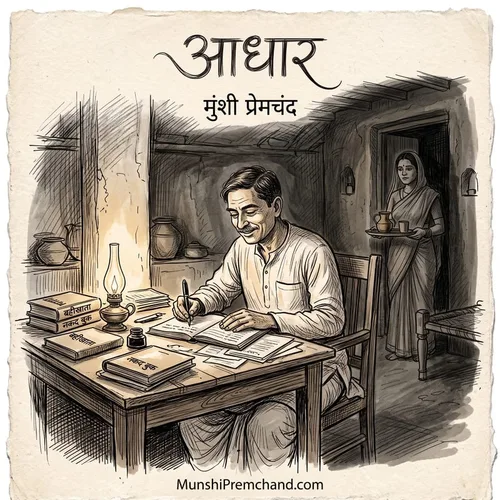
Complete English Translation: Aadhar
1
In the entire village, there was not a strapping, well-built youth like Mathura. He was about twenty years old; the dark down of a young mustache was just beginning to moisten his upper lip. He grazed the cattle, drank fresh milk, practiced gymnastics, wrestled in the arena, and wandered through the village market all day playing sweet melodies on his bamboo flute. He was married, but as yet had no children.
The household possessed several plows' worth of farmland, and there were several brothers, both older and younger. Together, they all managed the farming and cultivation in harmony. The whole household took immense pride in Mathura. He was given the finest food and was required to do the least amount of labor. Whenever he needed money for wrestling briefs, loincloths, heavy stone weights, or wooden clubs, the cash was handed to him without a moment's hesitation. The sole ambition of the entire family was that Mathura should become a renowned champion wrestler and vanquish any opponent in the arena who dared challenge him.
All this pampering had made Mathura somewhat headstrong and obstinate. His cows would stray and graze in someone else's standing crops while he himself was busy performing deep-knee bends and push-ups in the wrestling arena. If anyone came to complain, his brow would darken instantly. He would roar back: "Do whatever enters your head! Mathura will certainly not leave the arena to go chasing after cows!" Yet seeing his towering height and muscular frame, no one possessed the courage to tangle with him; people simply swallowed their grievance and walked away in silence.
It was the peak of summer. Ponds and waterholes lay bone-dry and cracked under the blazing sun. Scorching heatwaves (loo) had begun to sweep violently across the plains. From somewhere outside, a rogue bull wandered into the village and attached itself to the herd of cows. All day long it roamed alongside the cows; at night, it barged into the settlement, goring the working bullocks tied to their tethering posts. Sometimes it would dig its horns into a neighbor's wet mud wall; at other times, it tossed piles of household refuse into the air with its horns.
Several farmers had planted vegetable patches, working themselves half to death watering them from dawn to dusk. Every night, this bull would invade those lush green plots and lay waste to field after field. The villagers would beat it with wooden sticks and drive it beyond the outskirts of the settlement, but within a few moments, the beast would circle back and reappear among the cows. No one's wits could devise a way to avert this calamity. Because Mathura's house was situated right in the center of the village, his own bullocks suffered no harm from the bull. The whole village was in an uproar, yet Mathura did not have the slightest worry.
At last, when the final cord of patience snapped, the villagers gathered one day, surrounded Mathura, and said: "Brother, tell us plainly whether we should continue living in this village or pack our belongings and leave! When our very crops are destroyed, what will we accomplish by staying here? Our ruin is being wrought on account of your cows, and you remain lost in your own carefree merriment! If God has endowed you with strength, you ought to use it to protect others, not to crush everyone underfoot and drink their blood. The bull comes because of your herd, and driving it away is your duty; yet you sit with oil poured into your ears, as if none of this has anything to do with you!"
Mathura felt compassion at their desperate plight. A strong man is often generous at heart. He said, "Very well, go on home. I will drive the bull away today."
One farmer warned, "Chase him far, brother, or he will return again!"
Shouldering his heavy wooden staff (lathi), Mathura replied, "He will not return this time."
2
It was a blistering afternoon, the sun beating down like fire, and Mathura was driving the rogue bull before him. Both were drenched in sweat. Time and again, the bull attempted to swing back toward the village, but Mathura, anticipating its intent from afar, blocked its path. Driven wild with rage, the beast would occasionally turn about, lowering its horns to charge Mathura; but slipping adroitly aside, Mathura would rain blow after relentless blow upon its flanks with his heavy lathi, forcing the beast to turn and flee once more.
Sometimes both raced across prickly pigeon-pea (arhar) fields; sometimes they tore through dense brambles and thorny thickets. The sharp stalks of the harvested arhar tore into Mathura's bare feet until they were bloody; the thorny bushes ripped his dhoti to shreds. Yet at that moment, he held no consciousness of anything in the world except pursuing that bull. Village after village appeared on the horizon and receded into the distance. Mathura had firmly resolved: I will not draw breath until I have driven him across the river.
His throat was parched like dust and his eyes burned bloodshot. Sparks seemed to fly from every pore of his body; his breath came in ragged, choking gasps. Yet he did not pause even for a single second to rest.
After two and a half hours of frantic running, the river finally shimmered in the distance. Here the verdict of victory and defeat was to be settled; here both contenders had to display the ultimate skill of their craft.
The bull thought: If I wade into the river, this man will surely kill me; I must make one desperate, all-out effort to turn back!
Mathura thought: If he turns back now, all this grueling labor will be wasted, and the village folk will mock me to my face!
Both watched each other with predatory vigilance. The bull tried hard to sprint forward and wheel around behind him, but Mathura gave it no opening to turn. His very life hung on the tip of a needle: a single misstep, a single missed blow, and he was a dead man; a single slip of the foot, and he would never rise from the dust again.
At last, the intelligence of man triumphed over the brute force of the beast. Seeing no other escape, the bull plunged headlong into the river. Mathura waded straight in after him, raining such furious blows with his lathi that the thick wooden staff snapped in two.
3
Now a raging, uncontrollable thirst seized Mathura. He pressed his mouth directly to the river water and began gulping it down in great gasping draughts, as though he intended to drink the entire river dry! Never in his life had water tasted so sweet, nor had he ever drunk so prodigiously. Whether he swallowed five seers of water or ten seers, he could not tell. Yet the water was warm from the scorching sun, and his thirst remained unquenched. A few moments later, he dipped his mouth into the river once more and drank until his belly had no room left even to draw breath.
Then, tossing his soaked dhoti over his broad shoulder, he set off toward home.
He had walked barely ten or a dozen paces when a dull, sweet cramp began to ache deep inside his abdomen. He thought: Such pain often happens when one drinks water immediately after running; it will pass in a little while. But the pain grew steadily worse, until taking another step became impossible.
He sank down beneath the shade of a solitary tree. Writhing in agony, he began rolling on the bare ground. Sometimes he pressed hard against his belly, sometimes he struggled to his feet, sometimes he collapsed back down; but the agonizing colic only intensified. At last, he began to groan and weep aloud.
Yet who was there in that wilderness to look after him? For miles around, there was no village, no traveler, not a soul of Adam's race. In the desolate silence of that blazing afternoon, writhing in helpless torment, the poor youth died.
We can bear the deepest and sharpest physical wounds, but against the slightest violation of nature's laws, the body cannot endure. That towering youth, built like a demi-god, who had chased a wild bull over miles of rugged country, could not withstand a single assault from the clash of the natural elements.
Who could have guessed that this race would be his race to death? Who could have known that Death itself had assumed the guise of a bull merely to lead him this fatal dance? Who could have imagined that the water, without which his life was hovering on his very lips, would act upon his body as a fatal poison?
Toward evening, his family members arrived in search of him. When they found him, he was already immersed in eternal sleep.
4
A month slipped by. The villagers returned to their daily toil. The bereaved family wept their tears, bowed their heads, and accepted their fate with quiet endurance; but how could the tears of the wretched young widow ever be wiped away?
Anupa wept incessantly. Her eyes might close in exhaustion, but her heart wept day and night. How will my life be spent in this house now? she thought. Upon what foundation shall I live?
To live entirely for oneself is an art known either to holy ascetics or to unprincipled scoundrels. How could Anupa know such an art? For her, life required an anchor (aadhar)—someone she could cherish as her all, someone for whose sake she could live, someone in whom she could take pride.
Her in-laws could not bear the thought of her marrying into another household. There was dishonor in it. Moreover, that a woman so gentle, so skilled in household management, so clever in everyday affairs, and of such admirable grace and character should pass into a stranger's house was utterly intolerable to them.
On the other hand, Anupa's parents and brothers were negotiating an alliance elsewhere. When everything was settled, Anupa's brother arrived one day to escort her back to her natal village.
At this, an uproar erupted in the household. Mathura's family declared, "We will not let her go!" The brother retorted, "We will not leave without taking her with us!" The villagers assembled, and an informal panchayat was convened. It was finally decided to leave the choice entirely to Anupa: if she wished to leave, she might go; if she wished to remain, she might stay.
Her in-laws were confident that Anupa would never agree to enter another home so soon, for she had said as much on several occasions. But when she was asked at that moment, she expressed her readiness to depart.
At last, preparations for her farewell began. The covered litter (doli) arrived at the door. All the women of the village gathered to bid her farewell. Anupa rose, cast herself at the feet of her mother-in-law, and with folded hands, said: "Amma, forgive whatever harsh words I may have spoken. My heart wished to remain in this house until my last breath, but God has willed otherwise."
As she spoke these words, her voice choked and her speech failed.
The mother-in-law was overcome with grief. Weeping, she said: "Daughter, wherever you go, may you live in happiness! Our own fortune has shattered; otherwise, why would you have to leave this house? By God's grace, we have everything, but where He has denied us, what power do we possess? Had your youngest brother-in-law been grown today, this broken home would have been mended! If it finds a place in your heart, consider this child your own: nurture him, raise him, and when he grows up, I shall arrange your engagement with him!"
Saying this, she turned to her youngest son, Vasudev, and asked: "Well, will you marry your sister-in-law (bhabhi)?"
Vasudev was barely five years old. He was playing nearby. He asked, "Then she won't go away to another house, will she?"
The mother replied, "No, when you marry her, why would she leave?"
"Then I will marry her!" Vasudev declared.
"Go and ask her if she will marry you," the mother said.
Vasudev climbed straight into Anupa's lap and, smiling bashfully, said: "Will you marry me?"
Saying this, the child began to laugh. But Anupa's eyes brimmed with hot tears. Clasping Vasudev tightly to her breast, she turned to her mother-in-law: "Amma, do you speak from the bottom of your heart?"
"God is my witness!" the mother-in-law replied solemnly.
"From this day forth, is he mine?" Anupa asked.
"Yes, the entire village is witness to it."
Anupa turned toward her family: "Then send word to my brother that he may return home; I shall not go with him."
Anupa needed an anchor for her life, and that anchor had been found. Service is the natural instinct of human beings; selfless service was the true foundation of her soul.
Anupa began the upbringing of Vasudev. She massaged his little limbs with oil and scented herbal paste; she crumbled bread into warm milk and fed him with her own hands. When she went to bathe at the village pond, she took him along and bathed him. When she went into the fields, she carried him with her. Within a short time, the boy became so deeply attached to her that he would not leave her side for a single moment. He forgot his own mother. If he craved something to eat, he demanded it from Anupa; if he was hurt while playing with other children, he came running to Anupa in tears. It was Anupa who put him to bed, Anupa who woke him in the morning; and if he fell sick, it was Anupa who carried him in her arms to Badlu the physician and administered the bitter medicines.
The men and women of the village watched this penance of selfless love and bit their fingers in astonishment. At first, hardly anyone had believed in it. People had whispered: In a year or two she will tire of this and choose another path; how long can a young woman sit waiting in the name of an infant at the breast? Yet all their cynical misgivings proved utterly groundless. No one ever saw Anupa waver from her vow.
In a heart where the spring of selfless service flows—unfettered, willing service—where is there any room for base desires? The arrows of lust strike only those helpless creatures who are despairing, empty, and devoid of purpose. The thief operates only in the darkness, never in the full light of day.
Vasudev also developed a passion for physical exercise. In countenance and build, he closely resembled Mathura. He revived the village wrestling arena, and once again, the sweet melodies of his flute echoed through the open fields.
In this manner, thirteen years slipped quietly away. Preparations for the formal engagement ceremony between Vasudev and Anupa began.
5
Yet Anupa was no longer that Anupa who, fourteen years ago, had looked upon Vasudev with the potential sentiment of a future wife. In her soul, that feeling had been entirely supplanted by the profound, sacred emotion of a mother.
For some days now, she had remained immersed in deep reflection. As the day of the engagement drew closer, her heart sank lower and lower. The mere thought of such an unnatural transformation in her relationship filled her soul with dread. At the prospect of making a husband of the boy she had nurtured in her lap like her own child, her face burned crimson with shame.
Outside the doorway, the festive kettledrums were thundering. The brotherhood of the caste had assembled. Festive songs echoed from within the house. Today was the auspicious day of the engagement.
Suddenly, Anupa walked into her mother-in-law's room and said: "Amma, I am dying of utter shame!"
The mother-in-law asked in astonishment, "Why, daughter? What is the matter?"
"I cannot go through with this engagement," Anupa answered firmly.
"What talk is this, child?" the mother-in-law gasped. "All the preparations are complete! If people hear of this, what will they say?"
Anupa looked up with serene, unshakeable clarity:
"Let them say whatever they please! In whose name I have lived with honor for fourteen years, in his name I shall continue to live. I had once believed that a woman could not survive without a husband. But God has carried me through life with dignity and honor. When the days of my youth have passed away safely, what worry is left now? Search for a young maiden and arrange Vasudev's marriage with her. Just as I have raised him until today, so shall I spend the rest of my days nurturing his children!"
Summary of Aadhar
Aadhar (The Anchor / Support) by Munshi Premchand examines the acute vulnerability of young widowhood, societal restrictions, and a woman's fundamental psychological need for purpose and emotional grounding. Mathura, the village's beloved champion wrestler, dies suddenly of heat exhaustion and colic cramps after heroically chasing a rogue bull across the river to protect his neighbors' crops.
His young widow, Anupa, is left devastated and purpose-less. When her natal family insists on arranging a second marriage, her mother-in-law desperately proposes that Anupa raise her five-year-old brother-in-law, Vasudev, with the intention of eventually marrying him. Seeking a living anchor (aadhar) for her existence, Anupa chooses to remain and dedicates fourteen years of selfless service to Vasudev's upbringing. Over the years, her devotion completely sublimates any romantic or spousal impulse into pure, unshakeable maternal love. On the day of the formal engagement, Anupa courageously rejects the marriage, declaring that she will continue living with honor as a motherly guardian to Vasudev and his future family. The story redefines the true foundation of life as rooted not in rigid marital codes, but in noble love, dignity, and selfless service.
Publication History
Aadhar was first published in Hindi in 1926 in the story collection Prem-Pramod. It was subsequently included in Munshi Premchand's celebrated anthology Mansarovar, Volume 3, published in 1938.
This unabridged English translation was published in 2026 by MunshiPremchand.com as part of the MunshiPremchand.com English Translation Series.
Themes & Critical Significance
- The Quest for a Life Anchor (Aadhar): The central philosophical question of the story is what truly sustains the human spirit. Through Anupa's journey, Premchand demonstrates that a person's life is anchored not merely by social status or marriage, but by a living object of selfless devotion and purposeful service.
- The Transformation of Service into Motherhood: Rather than viewing Vasudev as a future husband, Anupa nurtures him from infancy with complete purity, resulting in the organic evolution of maternal affection that supersedes societal expectations.
- Widowhood and Patriarchal Surveillance: The story critiques the feudal social order that views a young widow either as family property or as a source of community scandal, denying her personal agency. Anupa's final decision asserts her own moral autonomy within that oppressive framework.
- Physical Strength vs. Fragility of Life: Mathura's physical prowess makes him an asset to his village, yet his sudden collapse after drinking cold water highlights the vulnerability of the human body against the forces of nature, shifting the narrative from rustic triumph to tragedy.
- Human Relationships Beyond Formal Labels: Premchand emphasizes that relationships cannot be confined to rigid societal or marital categories; the bond between Anupa and Vasudev illustrates how genuine love transcends conventional social convenience.