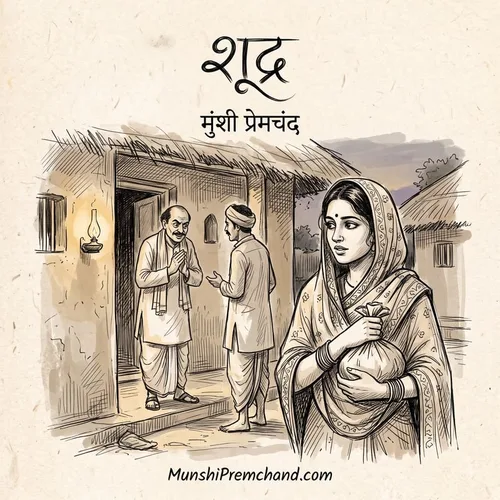
A mother and her young daughter lived in a small thatched hut on the outer edge of the village.
The daughter, Gaura, gathered dry leaves from the neighboring orchards, while her widowed mother, Ganga, stoked the grain-roasting furnace for local villagers. That was their entire livelihood—a handful of coarse grain earned after a full day's sweat.
Ganga had been consumed with anxiety for years about getting her daughter married. But in their small rural caste circle, nasty rumors floated around: How do this mother and daughter manage to survive comfortably without a male breadwinner? There must be some hidden scandal!
Because of these cruel, baseless rumors, no young man in the neighboring villages was willing to marry Gaura.
Ganga took her daughter on long pilgrimages all the way to Puri in Odisha, hoping to clear her reputation, but the village tongues remained vicious. Yet Gaura was a picture of modest grace and beauty; her eyes never strayed, nor did a loose word ever cross her lips.
One evening, a young traveling worker named Mangru arrived in the village looking for a place to rest. Seeing Ganga's warm hospitality and catching a glimpse of Gaura's bashful grace, Mangru's heart was won over.
The marriage was arranged. Mangru brought a few silver ornaments from his sister's house, bought clothes on credit, and wedded Gaura.
For the first time in her life, Gaura experienced true happiness! Mangru was loving, courageous, and gentle. He taught Gaura how to read simple Hindi and left behind a small book of devotional hymns, which she sang with a melodious voice.
However, within a month, the toxic village rumors reached Mangru's ears. When Mangru went to his sister's village, his brother-in-law refused to sit and eat with him on the same mat, snapping: "You married an outcast woman without consulting the caste elders! We cannot eat with you until a caste panchayat decides your status."
Heartsick and humiliated, Mangru returned to his in-laws' hut. That very night, while Gaura lay fast asleep, Mangru vanished into the dark without leaving a word.
Seven years passed.
Not a single letter or message arrived from Mangru. Yet Gaura never lost her faith or her love! She continued to apply bright vermilion (sindoor) to the parting of her hair, wore colorful saris, and sang hymns from the book Mangru had left behind.
When village women mockingly asked: "Why doesn't your husband write to you? Has he abandoned you?"
Gaura would smile with proud devotion: "Why would a real man rot in his in-laws' village? He is out in the world earning a living! If I knew where he was, I would fly to his side in an instant!"
One afternoon, an elderly Brahmin man arrived at Ganga's door from Calcutta. He claimed to be a close neighbor of Mangru in the city:
"Mangru has earned good money in Calcutta! He has sent me to bring Gaura to him!"
The old man produced two expensive saris and travel cash as proof. Overjoyed tears streamed down Gaura's cheeks! Her seven years of painful waiting were finally over!
She bade a tearful farewell to her mother and the village women and boarded the train to Calcutta alongside the old Brahmin.
When they reached Calcutta, Mangru was nowhere to be found. The old man took her to a rented room, telling her that Mangru had been temporarily sent on an assignment by his employer and that they would need to board a ship to reach him.
Innocent and trusting, Gaura agreed to everything for the sake of reuniting with her husband. The old man placed her on a large ocean-going vessel and vanished into the crowded port.
As the ship sailed into the deep blue ocean, terror gripped Gaura's heart! She looked back at the receding shores of India, weeping bitter tears as she realized she had been cut off from her mother and her homeland forever!
After weeks at sea, the ship dropped anchor at a distant colonial island—Mauritius.
Gaura was marched off the ship alongside hundreds of poor Indian indentured laborers (Girmitiyas).
There, standing amidst the administrative supervisors, she suddenly spotted a familiar face—it was Mangru!
"Mangru! Mangru!" she cried out, rushing toward him!
Mangru looked up, stunned beyond belief! When he recognized his wife, his face turned pale with horror:
"Gaura! How on earth did you get here?"
Gaura wept with joy: "The old Brahmin brought me! He said you sent for me!"
Mangru put his hands to his head in agonizing despair:
"That evil recruiter lied to you! I never sent for you! Seven years ago, recruiters tricked me with false promises of high wages and trapped me on this island as an indentured slave! I have been bound here by colonial laws, unable to return home! Why did you come to this hell?"
Gaura's heart shattered. She realized that she and her husband had been victims of an international human trafficking syndicate!
The sugar plantation was a lawless nightmare for Indian laborers—especially for women. Female workers were treated as defenseless property, subject to racial humiliation and sexual coercion by colonial overseers.
Mangru took Gaura to his small thatched quarters, determined to protect her honor with his life.
The very next evening, a ruthless British plantation overseer rode up to Mangru's hut on a horse. Seeing Gaura's striking beauty, the overseer's eyes gleamed with lust. He barked at Mangru:
"Send this new woman to my plantation bungalow tonight!"
Mangru stepped forward, folding his hands with fierce dignity: "Sahib, she is my lawful wife! She is not a plantation laborer!"
The British officer sneered, striking Mangru across the face with his riding crop: "Every laborer on this estate belongs to me! Hand her over!"
Mangru shouted: "Kill me if you wish, Sahib, but I will never surrender my wife's honor!"
Enraged, the British officer called his armed native constables. They stripped Mangru to the waist, tied him to a wooden post, and began flogging him mercilessly with heavy leather whips!
Blood spurted from Mangru's back with every strike! Yet with every stroke of the whip, Mangru groaned: "I will never surrender her..."
Hearing her husband's agonizing screams, Gaura broke out of the hut and threw her body over Mangru's bleeding back!
"Stop! Stop!" she screamed, weeping over her bleeding husband. "Don't kill him! Strike me instead!"
The British officer held back his whip, smirking evilly: "If you agree to come to my bungalow willingly, I will spare your husband's life."
Looking at her dying husband covered in blood, Gaura made a quick, desperate decision. She looked at the officer and said quietly:
"I will come to your bungalow... but only after my husband recovers from his wounds."
The officer agreed, ordering Mangru to be taken to the plantation hospital.
For five days and nights, Gaura sat beside Mangru's hospital bed, nursing his wounds, wiping his feverish brow, and weeping in silence.
On the sixth day, Mangru opened his eyes. The bleeding had stopped, and his strength began to return.
Gaura looked at her husband's face one last time—the man she had loved with pure, undying devotion for seven long years.
She knew what lay ahead. The British overseer would arrive at dusk to claim his prize. She could never bear the shame of becoming a colonial officer's sexual captive, nor could she live seeing her husband humiliated every day of his life.
She quietly stepped out of the hospital room and walked toward the plantation river flowing behind the hospital. The afternoon sun shone brightly over the deep, rushing waters.
Standing on the high riverbank, Gaura closed her eyes, prayed to the heavens, and plunged into the roaring currents!
A moment later, a hospital worker ran inside shouting: "Mangru! Your wife has jumped into the river!"
Stumbling out of bed with all his remaining strength, Mangru dragged his bandaged body to the riverbank. He saw Gaura's colorful sari swirling in the white foam of the deep rapids.
Without a second's hesitation, Mangru leapt off the high cliff into the roaring river after her!
The two lovers—separated by geography, deceit, and seven long years of pain—were reunited at last, bound forever in the eternal peace of death.
Significance & Themes
- Historical Critique of Indentured Labor (Girmit System): Written for Chand magazine's 1926 issue on overseas Indians, the story is a landmark literary critique of the human trafficking, false promises, and colonial exploitation that forced Indian laborers into plantation slavery in Mauritius and Fiji.
- Intersection of Caste, Gender, and Colonial Violence: Premchand shows how rural poverty, caste prejudices, and village gossip make lower-caste women vulnerable to internal deceptive recruiters (like the old Brahmin) and external colonial overseers.
- Indomitable Integrity and Moral Resistance: Neither physical flogging nor colonial authority could break Mangru's refusal to surrender his wife, nor could sexual coercion force Gaura into submission. Their tragic end becomes an act of supreme moral resistance against colonial dehumanization.