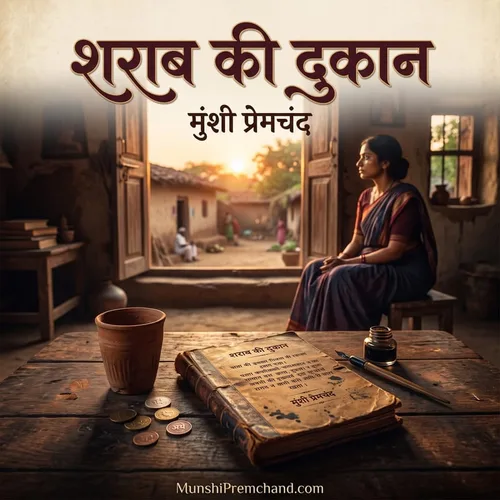
The local Congress committee faced a daunting dilemma: Who would go to picket the liquor and toddy shops?
Twenty-five committee members sat with bowed heads in deep silence. Facing police arrest was easy—police officers understood law and order, and rarely behaved brutally toward respectable freedom fighters. But dealing with hardened drunkards outside filthy taverns was a completely different matter! Intoxicated brawlers recognized neither logic nor manners. If they hurled insults or raised their fists, non-violent volunteers could neither fight back nor flee.
In the back row sat a noble lady—Mrs. Saxena.
She was the widow of a dedicated Congress leader who had passed away three years prior. Over the past year, Mrs. Saxena had stepped into public life, inspiring women in their homes to embrace Swadeshi khadi. Though gentle and soft-spoken, she possessed a fierce, burning courage in her soul.
Mrs. Saxena stood up and asked the committee president quietly: "Can women picket the liquor shops?"
The president replied hesitantly: "Mahatma Gandhi has urged women to lead the anti-liquor campaign, but... the drunkards in this town are ill-mannered."
Mrs. Saxena declared with calm resolve: "Then send me to lead the picketing."
A young activist named Jairam—who had previously served a prison sentence for anti-colonial speeches—stood up in protest: "Mrs. Saxena, you are a noble woman! Let me take the first batch of volunteers instead."
The next afternoon, Jairam led five khadi-clad volunteers to the main liquor and toddy shop in Begumganj.
The tavern was packed with drinkers sitting under thatched sheds and along the roadside. Men were bragging, shouting, and squandering their hard-earned copper coins while their families starved at home.
Jairam planted the tri-color national flag in the ground and addressed the crowd with folded hands:
"Brothers! Mahatma Gandhi has commanded us to give up liquor and toddy! Think of the money you pour into this tavern every evening—if you spent that money feeding your hungry children and clothing your wives, how happy your homes would be! Why starve your loved ones for a few minutes of poisonous intoxication?"
An old, veteran drinker named Chaudhury looked up from his bottle. He turned to his companion Kallu: "Brother... the Congressman speaks the truth. Alcohol destroys our homes. But we have been drinking all our lives—how can we stop now?"
Jairam stepped closer, speaking with warmth: "Chaudhury! This is the exact age to stop! In youth, a man's mind is wild; but in old age, wisdom must awaken!"
A dark, heavy-whiskered man named Khansama snapped angrily: "If drinking is bad, why do the British Sahibs drink? Are we your slaves?"
Jairam replied brilliantly: "That is a fine question, brother! The forefathers of the British were plunderers two centuries ago; but our ancestors were sacred rishis and sages who taught righteousness to the world! Why should the children of sages copy plunderers? We surrendered our moral virtue, and that is why we became slaves! But today, we have decided to break the chains of slavery!"
Just then, the British police sub-inspector arrived with five armed constables, glaring angrily at Jairam: "Are you threatening these citizens?"
Old Chaudhury stood up and declared boldly to the police officer: "No, Huzoor! He is not threatening us! He is explaining to us with such love and truth that my eyes have opened!"
Seeing the crowd side with the volunteers, the police officer turned to the tavern keeper: "Drive these picketers away with your thugs!"
As the police left, old Chaudhury turned to his companion: "Look how angry the police officer got! The British government wants us to drink ourselves to death so that liquor tax flows into their treasury!"
Chaudhury picked up his bottle, looked at Jairam, and shouted: "If I touch a drop of liquor again, may I be cursed forever!"
CRASH!
Chaudhury smashed his liquor bottle onto the cobblestones! Half a bottle of dark liquor spilled into the dust.
The volunteers cheered with joy! Touched by Chaudhury's moral courage, two toddy drinkers raised shouts of "Mahatma Gandhi ki Jai!" and smashed their clay pots onto the ground! A volunteer stepped forward and placed fresh flower garlands around their necks!
Within an hour, six veteran drinkers smashed their bottles, swore solemn oaths, and walked home sober!
The following day, the tavern owner hired ruthless thugs to break the blockade.
When volunteers arrived, thugs armed with wooden clubs hurled filthy abuses, shoved volunteers into gutter mud, and threatened to beat anyone who stood near the tavern doors.
Seeing the danger, Mrs. Saxena herself arrived at the frontlines.
She wore a simple white khadi sari, her face serene and fearlessly radiant. She walked straight past the scowling thugs, planted the national flag before the tavern entrance, and folded her hands in peaceful prayer.
A drunkard spat betel juice near her feet and growled: "Woman, go home and cook! This is no place for ladies!"
Mrs. Saxena replied with gentle dignity: "Brother, my place is wherever my brothers are destroying their lives and starving their children. If you must strike someone, strike me—but do not poison your soul."
Her quiet, divine dignity paralyzed the thugs! Men who had never hesitated to raise a club stood frozen, unable to look into her clear, fearless eyes.
When a customer tried to push past her, Mrs. Saxena stood immovably in his path. The tavern owner struck her shoulder with a wooden staff, causing blood to seep through her white sari; yet she did not utter a cry of pain nor step back an inch!
Seeing a noble woman shed blood for their moral redemption, the crowd of onlookers erupted in moral outrage!
Drinkers dropped their glasses in shame; tavern customers turned around and walked away; and by evening, the liquor shop was forced to shut its doors completely!
Not a single bottle was sold in Begumganj that day.
As Mrs. Saxena stood under the tri-color flag, her white sari stained with blood and her face glowing with quiet victory, the entire town realized that no colonial power or physical violence could ever defeat the invincible moral strength of India's women!
Significance & Themes
- Prohibition as Anti-Colonial Resistance: Premchand presents the anti-liquor campaign not merely as temperance reform, but as a key economic and moral plank of the Indian National Movement against British tax extraction.
- The Transformative Power of Non-Violence: The story contrasts physical intimidation with Gandhian moral persuasion (Satyagraha), demonstrating how genuine love and moral appeal can reform even hardened addicts.
- Women's Leadership in the Freedom Struggle: Mrs. Saxena's character showcases the decisive role played by Indian women who stepped out of domestic seclusion to lead front-line political resistance with unmatched moral courage.