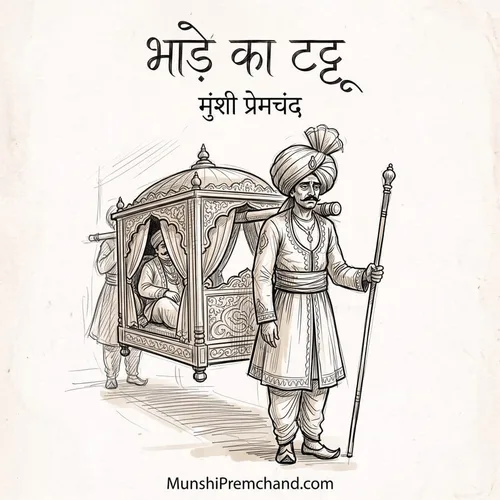
Complete English Translation: Bhade Ka Tattoo (The Hired Pony)
At twilight on the grounds of Agra College, two young men were strolling hand in hand. One was named Yashwant, and the other Ramesh. Yashwant was tall, robust, and heavily built; upon his countenance shone the glow of self-restraint and radiant health. Ramesh was short of stature, lean, frail, and lacking in physical luster. The two were engaged in a heated debate on a certain subject.
Yashwant said: "Before the soul, I consider wealth to be utterly worthless."
Ramesh replied: "That is wonderful news indeed!"
Yashwant: "Yes, you shall see. You are mocking me now, but I will prove to you how contemptible I consider money to be."
Ramesh: "Well, go ahead and prove it. As for me, I do not consider money contemptible at all. It is for money that I have been devouring books for fifteen long years; it is for money that I have left parents, brothers, and kin behind to languish here; God alone knows how many formal salutations I shall have to make, how much groveling and sycophancy I shall have to endure! Will that not constitute a degradation of the soul? I cannot live up to such lofty ideals. In my case, if I were offered a handsome bribe in a legal case, I might well be unable to refuse it. Would you refuse it?"
Yashwant: "I would not even lift my eyes to look at it! And I am convinced that you are not nearly as base as you pretend to be."
Ramesh: "I am far baser than I claim to be."
Yashwant: "I cannot believe that for the sake of self-interest you would ever deliberately harm another person."
Ramesh: "Brother, in this world, only an ascetic hermit can live up to ideals; I certainly cannot. I believe that if by giving you a shove I could win the race against you, I would surely knock you down! And if you don't take offense, let me tell you: you too would surely knock me down. To renounce self-interest is an exceedingly difficult thing."
Yashwant: "Then I say that you are nothing but a hired pony (bhade ka tattoo)!"
Ramesh: "And I say that you are a wooden owl—a hollow blockhead!"
Yashwant and Ramesh entered school together, and together they graduated with their degrees from college. Yashwant was somewhat dull-witted, but he was extraordinarily, fiercely hardworking. Whatever task he took in hand, he clamped onto it like a leech and refused to leave it until it was finished. Ramesh was exceptionally brilliant, but terribly lazy; to sit studying steadily for even an hour was an ordeal for him. Up to the Master of Arts examinations, Ramesh remained ahead and Yashwant trailed behind—sheer hard labor was repeatedly vanquished by raw intellect.
However, in the Civil Service examination, the dice rolled the other way. Yashwant cast aside every other pursuit and threw himself headlong upon his books. Strolls, outings, excursions, circus shows, theatrical plays, companions, and friends—he turned his back on them all and shut himself away in his solitary cloister. Ramesh, on the other hand, spent his days chatting with friends and playing cricket. Now and then, merely for recreation, he would glance through a textbook. He probably harbored the confidence that his innate brilliance would carry the day this time as well. He would frequently drop in to pester Yashwant, shutting his book and asking: "Why are you killing yourself? The Civil Service is not spiritual salvation (moksha) that you should sever all ties with the living world for it!" Things reached such a pass that whenever Yashwant spotted him approaching, he would bolt his door from the inside.
At last, the day of the examination arrived. Yashwant had memorized everything, yet whenever he attempted to formulate an answer to a question, he felt that everything he had studied had vanished from his mind. He was in a state of severe panic. Ramesh was not in the habit of worrying beforehand; he thought that whatever came before him on the examination paper would be dealt with on the spot. He strutted about puffed up with self-assurance.
When the examination results were announced, the slow tortoise had outrun the swift hare.
Now Ramesh's eyes were opened, yet he did not lose heart. For a capable man, there was never any shortage of fame or fortune—such was his firm conviction. He began preparing for the law examination, and although he did not exert himself unduly, he passed in the first division. Yashwant sent him a telegram of congratulations. By then, Yashwant had already been appointed an officer of a district.
Ten years went by. Yashwant worked with his whole heart and soul, and his superior officers were exceedingly pleased with him. Yet to the exact degree that the officers were pleased, his subordinates remained thoroughly disgruntled. He demanded the same grueling toil from his subordinates that he himself performed; as scrupulously upright and unyielding as he was himself, he wanted his subordinates to be equally unyielding. Such men are regarded as formidable administrators. The stamp of Yashwant's efficiency grew deeper upon his superiors. Within a span of merely five years, he was elevated to the post of District Judge.
Ramesh was not so fortunate. In whatever court he appeared to plead, he met with failure. If the presiding magistrate was late in taking the bench at the appointed hour, Ramesh would pack his papers and leave, refusing to return even when summoned. He would say: "If the magistrate does not observe punctuality, why should I? What need have I to stand in his courtroom for hours awaiting his pleasure?" He argued his cases with such fearless audacity that in the eyes of colonial officers accustomed to obsequious flattery, his boldness appeared as sheer insolence. Tolerance had never touched him. Whether it was the judge or the opposing counsel, whoever dared cross words with him received a stinging thrashing. Things went so far that on one occasion he clashed fiercely with the District Judge himself. The consequence was that his license to practice law was revoked. Yet in the hearts of his clients, his esteem remained undiminished.
He then secured a post as a lecturer at Agra College. But here too, misfortune refused to part company with him. On the very first day, he fell out with the English Principal. The Principal's guiding principle was that students must keep strictly aloof from politics; he never permitted any student of his college to participate in any political assembly. From his very first day, Ramesh began openly defying this injunction. His contention was that if anyone ought to participate in political assemblies, it was the student. It formed an integral part of his education! In other nations, students had ushered in new historical epochs—why, then, was their speech gagged in this country? The result was that before the academic year could draw to a close, Ramesh was forced to submit his resignation. Yet his influence upon the students was not diminished by a single grain.
In this manner, partly due to his own temperament and partly driven by circumstances, Ramesh was forged into a crusader. First, taking the side of his clients, he had fought against the courts; next, championing the students, he had picked a quarrel with the college Principal; and now, taking up the cause of the subject people, he threw down the gauntlet to the British Raj! By nature he was fearless, idealistic, devoted to truth, and intensely proud of his dignity. For such a soul, what alternative remained except to become a servant of the people?
His articles on the current political situation began appearing in newspapers. His critiques were so incisive, so comprehensive, and so penetrating that his renown spread like wildfire. People recognized that a new force had arisen in the arena. Colonial officials seethed with rage upon reading his writings. His aim was so unerring that escape was impossible. Exaggerations and hollow rhetoric flew whistling over their heads; from a distance they could look upon such antics with amusement, or they could ignore uneducated blunders, for such weapons never reached them and fell by the wayside. But Ramesh's missiles struck straight at their heads, throwing the officialdom into utter turmoil and consternation.
The political atmosphere of the country was growing alarming. Yashwant trembled with apprehension whenever he read the articles written by his old friend. He was terrified that Ramesh might fall into the clutches of the law. Time and again he urged him to exercise restraint, pleading with him repeatedly: "Moderate your pen a little; why do you deliberately thrust your finger into the mouth of the venomous serpent of the law?" But Ramesh was drunk on the wine of leadership; he did not even deign to reply to these letters.
In the fifth year of his judgeship, Yashwant was transferred and posted as the District Judge of Agra.
The political state of the country was turning grave. The secret intelligence police had kicked up a veritable storm. Hearing their fabricated, fantastical concoctions, the souls of the authorities were terrified. Newspapers were muzzled in one place, popular leaders silenced in another. To grind their own axes, the secret police poisoned the ears of the rulers to such an extent that every individual who harbored independent thoughts appeared to them as a bloody assassin.
Ramesh was not the sort of man to sit quietly in the face of such tyranny. As the high-handedness of the officials mounted, his fervor surged in equal measure. Every day he delivered speeches somewhere or other, and nearly all his speeches were brimming with seditious sentiments. To speak plain, unvarnished truths was itself branded as sedition! If anyone's political speech was not deemed seditious, you could be sure that he had concealed his innermost convictions; he lacked the courage to bring to his tongue what lay in his heart. Ramesh had never learned to hide his feelings. What was there for a leader of the people to fear from prison or the gallows? Let whatever calamity come, come! He sat prepared to endure everything. In the eyes of the authorities, he was the biggest thorn in their flesh.
One day, Yashwant sent word summoning Ramesh to his residence. Ramesh felt inclined to retort: "Do you feel ashamed to come to me? After all, you are nothing but a slave!" Yet upon second thought, he sent word: "I shall come tomorrow evening." The following day, at precisely six o'clock, he arrived at Yashwant's bungalow. He mentioned this visit to no one—partly out of concern that people might say he was courting official favor, and partly out of fear that it might cause some harm to Yashwant.
When he reached Yashwant's bungalow, the lamps had already been lit. Yashwant stepped forward and embraced him warmly. Until midnight, the two friends chatted profusely. Yashwant recounted all the experiences he had gathered in his official service. Ramesh was astonished to discover that on many subjects, Yashwant's private political opinions were even more radical and independent than his own! His assumption that Yashwant must have changed completely and spent his time singing paeans of imperial loyalty was entirely mistaken.
Ramesh remarked: "My good fellow, when your heart is so deeply scorched, why don't you resign from service? If nothing else, you would at least preserve your own soul!"
Yashwant replied: "Worry about me later; at this moment, worry about yourself. I called you here to warn you. In the eyes of the government, you are an intolerable eyesore right now. I fear you may be arrested at any moment."
Ramesh: "I sit fully prepared for that."
Yashwant: "After all, what is the gain in leaping into the fire?"
Ramesh: "To weigh profit and loss is not my business. My only duty is to perform my obligation."
Yashwant: "You have always been obstinate, but the hour is delicate; it is better to remain cautious. If I saw genuine awakening among the populace, I would enter the arena ahead of you. But when I see that one must die oneself to glimpse heaven, my courage fails me before taking a step forward."
The two friends talked late into the night. College memories were revived. For former classmates, old collegiate recollections are an inexhaustible fountain of entertainment and mirth. Critiques of professors were shared, and discussions held regarding what each of their old peers was doing. It felt entirely as though both were still college students; not a trace of formality or gravity remained.
The night deepened. It was one in the morning by the time they finished dinner. Yashwant said: "Where will you go at this hour? Sleep here tonight, and we can talk more. You never visit me anyway."
Ramesh was an unfettered wanderer by nature; having dined, he fell asleep in the midst of conversation. When he awoke, it was nine in the morning. Yashwant was standing before him, smiling.
That very night, a terrible dacoity had taken place in Agra.
When Ramesh reached his home at ten o'clock, he found the police surrounding his residence. The moment they saw him, an officer produced a warrant. A search of the house commenced immediately. Inexplicably, a pistol was discovered inside the drawer of Ramesh's desk! What more was needed? Handcuffs were snapped onto his wrists on the spot. Who could now doubt his participation in the dacoity? Calamity descended upon several other individuals as well; all the prominent leaders were rounded up, and the trial began.
God alone knew the truth about the others, but Ramesh was completely innocent. He possessed proof so unassailable that no one could possibly deny its truth. But could he make use of that proof?
Ramesh thought: "Yashwant will himself propose through my defense counsel that his name be entered in the list of defense witnesses. Knowing me to be innocent, he will never allow me to go to prison. He is not so heartless." But the days rolled by, and no such proposal came from Yashwant's side; and Ramesh himself shrank from naming him out of sensitive delicacy. Who knew what professional obstacle it might pose for him? To save himself, he did not wish to thrust his friend into jeopardy.
Yashwant was not devoid of heart, nor was he devoid of emotion; but he was certainly devoid of courage to act. To see his dearest friend destroyed while innocent caused him excruciating anguish; at times he wept in secret; yet he could not muster the courage to testify in his defense and deliver him. Who could tell what his British superiors would think? What if they suspected that he too harbored sympathy for conspirators, that he too maintained secret ties with them? "This is the penalty of being an Indian! I am forced to swallow poison with open eyes. The police have struck such terror into the minds of the authorities that even if my testimony secures Ramesh's acquittal, and even if they do not openly express distrust in me, how can the suspicion ever be erased from their hearts that I gave false testimony merely to rescue a fellow countryman? And what a countryman! One indicted for high sedition!"
A whole month passed in this agonizing deliberation. Meanwhile, the Magistrate committed the case for trial to Yashwant's own court! Several murders had been committed during the dacoity, and the Magistrate lacked the power to inflict sentences as severe as he deemed warranted.
Yashwant was now caught in a terrible crisis. He applied for leave, but it was rejected. The Civil Surgeon was an Englishman; hence, Yashwant lacked the nerve to obtain a medical certificate. Calamity had landed squarely upon his head, and no way of escape presented itself.
Behold the cruel mockery of fate! Two friends who had played together and studied together stood face to face, separated only by the wooden railing of the prisoner's dock. Yet the life of one lay clenched in the fist of the other. Their eyes never met; both kept their heads lowered. Although Yashwant occupied the exalted seat of justice and Ramesh stood as the accused, in reality, the positions were reversed: Yashwant's soul writhed in shame, guilt, and mental agony, while Ramesh's countenance shone radiant with the light of pristine innocence.
What a gulf separated the two friends! One was magnificent in nobility; the other, how abjectly selfish! Had Ramesh wished, he could have blurted out the truth of that night in open court. But Yashwant knew well that even to save his neck from the gallows, Ramesh would never take refuge in an alibi that his friend wished to keep secret.
As long as the hearings continued, Yashwant suffered insufferable torment of the soul. A daily war raged between his conscience and his self-interest; but on the day of judgment, his condition resembled that of a condemned murderer. He lacked the nerve to step onto the bench. He reached the courthouse at three in the afternoon. The accused stood waiting to hear their fate. Ramesh too was more somber than usual today. The moment had arrived in his life's struggle when his head would be beneath the edge of the sword. Hitherto fear had existed in an abstract form; today it had assumed concrete reality.
Yashwant pronounced the verdict in a voice that strove to be firm. But when the words passed his lips that Ramesh Chandra was sentenced to seven years' rigorous imprisonment, his voice choked. He placed the written judgment on the table. Sitting back in his chair under the pretense of wiping away perspiration, he wiped the tears that welled up in his eyes. Beyond that, he could not read another word of the judgment.
Upon emerging from prison, Ramesh had become a hardened, radical revolutionary. During his days in the dark prison cell, after grueling hard labor, he used to scheme plans for the uplift and reformation of the wretched. He would reflect: "Why does man commit sin? Is it not because there is such glaring inequality in the world? One man dwells in palatial mansions, while another cannot obtain even the shade of a tree. One is draped in silk and jewels, while another possesses not even a tattered rag. In such an unjust world, if there is theft, murder, and unrighteousness, whose fault is it?"
He dreamed of establishing an organization whose mission would be to eradicate this inequality from the earth. The world belonged to all, and everyone possessed an equal right to enjoy happiness within it. Neither was robbery a robbery, nor theft a theft! If a rich man refused to distribute his wealth willingly, what sin was there in seizing it against his will? If the wealthy called it sin, let them! If the law crafted by them sought to punish, let it! "Our court shall be separate. Before our tribunal, all those men shall be criminals who possess luxuries in excess of their needs. We too shall punish them; we too shall extract grueling labor from them!"
The moment he stepped out of prison, he proclaimed this social revolution. Secret societies were formed, weapons were accumulated, and within a short period, a wave of dacoities swept across the region. The police began hunting for clues; meanwhile, the revolutionaries began striking at the police itself. Their strength grew day by day. The operations were executed with such cunning that no one could find the slightest trace of the perpetrators.
Ramesh opened charitable dispensaries for the poor in one place, and cooperative banks in another. With the plunder of the robberies, he began purchasing landed estates. Wherever an estate was put up for auction, he bought it. Within a short span, a vast zamindari came under his control. The entire income was spent on the welfare of the poor. The crowning irony was that everybody knew this was Ramesh's doing, yet no one had the courage to open their lips against him.
In the eyes of respectable society, there was no creature on earth more abominable than Ramesh. People plugged their ears with their fingers at the mere mention of his name. If they saw him dying of thirst, perhaps not one of them would pour a single drop of water into his mouth; yet no one had the courage to point an accusing finger at him.
In this manner, several years slipped by. The colonial government announced massive bounties for the capture of the dacoits. Expert criminal investigators were summoned from Europe and assigned to the task. But these were extraordinary rebels whose ingenuity baffled every trap.
Yet Ramesh himself could not live up to his own ideals. As the days wore on, he began to perceive that discontent was spreading among his followers. Those among them who were more clever and daring began throwing their weight around, refusing to distribute equal shares of the looted booty to the rest. Matters reached such a pass that some followers grew envious of Ramesh himself. He lived in regal splendor. People began to grumble: "What right has he to squander our hard-earned spoils in this royal fashion?" The inevitable result was that internal dissension broke out.
It was nighttime, and dark, menacing clouds blanketed the sky. A young rebel said: "Why do you select me time and time again? Everyone takes a share; why should I alone risk my life repeatedly?"
Ramesh replied firmly: "It is my prerogative to decide who should be sent where. Your duty is solely to obey my command."
The youth: "If more labor is demanded of me, why am I not given a larger share?"
Ramesh noticed the defiance in his eyes, quietly slipped his hand onto his pistol, and said: "That shall be decided after you return from the mission."
The youth: "I want it decided before I depart!"
Ramesh gave no answer. He was about to finish him off with his pistol when the youth leaped out of the window and fled into the night. In jumping and climbing, the youth had no equal; leaping from a speeding train was child's play for him.
He went straight to the Chief of the Secret Intelligence Police.
Meanwhile, Yashwant had retired on a pension and taken up legal practice. He enjoyed warm friendships with everyone in the judicial department. His practice flourished with dazzling speed. Yashwant possessed wealth running into hundreds of thousands of rupees. He received a handsome pension as well. Had he wished, he could have spent the remainder of his days in leisure and ease at home. It would not have been difficult for him to render some selfless service to the nation and the community. It is from such men that selfless devotion can be expected. But Yashwant had spent his entire life amassing money, and he could no longer perform any work whose reward was not manifested in the shape of cold cash.
Although the entire respectable society abhorred Ramesh, Yashwant surpassed them all in vehement condemnation. He would proclaim: "If Ramesh is ever brought to trial, I will prosecute him on behalf of the Crown without charging a single pie of fee!" He openly hurled venomous insults at Ramesh: "He is not a human being; he is a demon! A monster! One shouldn't even look upon such a creature's face! Good heavens, how many noble households have been ruined at his hands! How many worthy men have lost their lives! How many women have been widowed! How many innocent children orphaned! He is not a man; he is a fiend! If I had my way, I would shoot him down with a bullet or have him entombed alive!"
A deafening clamor erupted throughout the city: "Ramesh Babu has been captured!"
The news was true. Ramesh had been arrested without a struggle. That very youth who had leaped from Ramesh's window had laid the entire sordid ledger before the Chief of Police. What a blood-curdling, fiendish, and sinful tale of kidnapping, robbery, and murder it was!
The respectable elite patted their thighs in glee. In the mansions of wealthy merchants, lamps of clarified butter were lit. A naked sword had hung suspended over their heads; today it had been removed. Now they could sleep in peace.
Newspapers began publishing accounts of Ramesh's exploits. Things that hitherto no one had dared utter out of sheer terror were now splashing across the front pages. Reading them, one realized what an reign of terror Ramesh had established. Several rajahs and wealthy aristocrats had been paying him regular monthly tributes. The moment his slip of paper arrived—stipulating that so many thousands of rupees must be dispatched by such-and-such a date—who possessed the nerve to defy his order? Even for the philanthropic works he performed for the public, he levied subscriptions upon the rich. It was Ramesh's prerogative to fix the amount; the wealthy man was compelled to hand over the sum without so much as twitching an ear or tail!
Yet to the exact degree that the respectable class rejoiced, the common folk were plunged into deep mourning. Who would now protect them from the brutalities of the police? Who would shield them from the oppression of the wealthy merchants? Who would establish vocational schools for their children? On whose strength would they stand proud now? They were now left orphaned. He had been their sole refuge. Whose face would they look upon now? To whom would they carry their cries for justice?
The police were gathering evidence. The Crown Prosecutor was making feverish preparations to push the trial forward with maximum severity. But not a single lawyer stood forward to defend Ramesh. In the entire district, there was only one man who possessed the skill to deliver him from the clutches of the law—and that was Yashwant! But would Yashwant, who plugged his ears at the mere mention of Ramesh's name, ever agree to appear as his defense counsel? Impossible!
It was nine o'clock at night. A woman entered Yashwant's study. Yashwant was perusing a newspaper. He asked: "What do you want?"
The woman: "A lawyer for my husband."
Yashwant: "Who is your husband?"
The woman: "He who studied alongside you, and against whom a false charge of dacoity is about to be brought."
Yashwant asked with a start: "You are Ramesh's wife?"
The woman: "Yes."
Yashwant: "I cannot appear for him."
The woman: "That is your prerogative. You belong to our district, and you were once my husband's friend. That was why I thought: why summon outsiders? But now I shall bring someone from Allahabad or Calcutta."
Yashwant: "Will you be able to pay the legal fee?"
The woman said with proud dignity: "What can be the fee of the greatest lawyer?"
Yashwant: "Three thousand rupees a day."
The woman: "Is that all? If you accept this brief, I will pay you three thousand rupees every day."
Yashwant gasped: "Three thousand rupees a day!"
The woman: "Yes. And if you succeed in securing his acquittal, I will give you an additional fifty thousand rupees as a bonus!"
Yashwant's mouth watered. If the trial lasted even two months, a clean hundred thousand rupees would flow straight into his pocket! The bonus would be on top of that—a grand game of a full two hundred thousand rupees! In his entire lifetime of labor, he had never managed to accumulate such a vast fortune at one stroke.
Yet what would the world say? His own conscience gave no sanction. To rescue such a man from the clutches of the law was tantamount to murdering countless innocent souls! But the stake was two hundred thousand rupees! Besides, Ramesh's conviction would hardly wipe out the revolutionary gang; his disciples and henchmen would remain anyway, and perhaps create even greater havoc. Why, then, should he let a prize of two hundred thousand rupees slip through his fingers?
True, he would have no place left to show his face. Let it be! Whosoever wished to be pleased might be pleased, and whosoever wished to take offense might take offense—two hundred thousand rupees could not be tossed away! "After all, I am not throttling anyone; I am not committing a theft! To defend the accused is my legitimate professional duty!"
Suddenly the woman asked: "Will you give me your answer?"
Yashwant: "I will give you my answer tomorrow. Let me consider the matter."
The woman: "No, I do not have so much time. If you have any hesitation, say so plainly, and I shall make other arrangements."
Yashwant had no time left for further reflection. A hurried decision invariably tilts toward self-interest, for there no possibility of financial loss exists.
Yashwant: "Can you pay some money in advance?"
The woman: "Do not speak of money to me repeatedly! What worth has money before his life? Take whatever sum you desire. Even if you cannot secure his acquittal, you must certainly shatter the government's teeth!"
Yashwant: "Very well, I shall take the brief myself. After all, one must honor an old friendship!"
The police strained every nerve, presenting hundreds of witnesses. The approver narrated the entire epic from beginning to end; but Yashwant advanced such brilliant arguments, demolished the prosecution witnesses so thoroughly, and cross-examined the police informant with such devastating skill that Ramesh was acquitted without a blemish! Not a single crime could be proved against him. The mere fact that a lawyer of such sober repute and unimpeachable standing as Yashwant stood in his defense was taken as incontrovertible proof that the government had erred!
It was evening. A grand marquee was pitched outside Ramesh's door. The poor were being fed a feast, and an entertainment was held for friends. It was a celebration of Ramesh's liberation. Yashwant was receiving congratulations and expressions of gratitude from every side. Felicitations were being showered upon Ramesh.
Yashwant repeatedly attempted to engage Ramesh in conversation, but Ramesh continually turned his face away. Up to that moment, not a single word had passed between the two men.
Finally, Yashwant snapped with annoyance: "You act so stiff and haughty with me, as though I have done you some grave injury!"
Ramesh replied: "And do you imagine that you have done me a favor? First, you destroyed my life in this world; now, you have destroyed my life in the hereafter! Had you administered justice the first time, my earthly life would have been reformed; and had you allowed me to go to the gallows or prison this time, my eternal soul might have found redemption!"
Yashwant: "Will you not even acknowledge what immense courage it took on my part to handle this case?"
Ramesh: "You acted not out of courage, but out of gross self-interest! You are a devotee of your own selfish gain. I consider you nothing more than a 'hired pony' (bhade ka tattoo)! I squandered and misused my life terribly, but under no circumstances would I ever exchange my life for yours. Do not expect any gratitude from me!"
Summary of Bhade Ka Tattoo (The Hired Pony)
The story opens on the grounds of Agra College, where two young students, Yashwant and Ramesh, argue about wealth and morality. Yashwant proudly claims that he values the soul far above money, while Ramesh pragmatically admits that he studies solely to acquire wealth and status, asserting that self-interest governs human actions and that anyone would betray another for personal advantage. Disgusted, Yashwant brands Ramesh a "hired pony" (bhade ka tattoo)—someone who works only when paid—while Ramesh calls Yashwant a foolish blockhead.
Despite their opposing temperaments, both complete their education together. Yashwant, though mediocre in intellect, is doggedly hardworking and secures selection into the prestigious Civil Service, eventually rising to become a strict District Judge. Ramesh, brilliant but impatient, qualifies as a lawyer; however, his uncompromising defiance of arrogant judges costs him his legal license. He turns to teaching at Agra College, but resigns when the British Principal bans students from political meetings. Becoming a prominent anti-colonial writer and public orator, Ramesh is targeted by the colonial administration and secret police.
When Yashwant is posted as District Judge in Agra, he invites Ramesh to his bungalow to warn him of impending arrest. Ramesh spends the night at Yashwant's house. That exact night, a major dacoity takes place in Agra. The following morning, police plant a pistol in Ramesh's desk and arrest him for robbery and murder. Ramesh is innocent and has an airtight alibi—having spent the night at the judge's residence. Confident that Yashwant will step forward as a defense witness, Ramesh refuses to involve his friend to protect the judge's official standing. Yashwant, however, lacks the moral courage to testify, terrified that defending a suspected seditionist will jeopardize his judicial career. The trial is transferred to Yashwant's own court, and despite agonizing guilt, Yashwant sentences his innocent friend to seven years' rigorous imprisonment.
In prison, Ramesh's ideology hardens into radical communism: he views private wealth in an unequal society as robbery and resolves to violently expropriate the rich to finance welfare for the poor. Upon release, he organizes an underground revolutionary army, staging daring dacoities to fund free hospitals, banks, and public schools for the marginalized. While the poor venerate him as a savior, the wealthy and respectable elite view him as a terrifying monster. Eventually, internal friction over the distribution of loot leads one of his men to betray the organization to the secret police, and Ramesh is captured.
Yashwant, now retired on a lavish pension and practicing as a lucrative private advocate, leads the public condemnation of Ramesh, calling him a fiend and vowing to prosecute him for free. But when Ramesh's wife visits Yashwant and offers him a staggering legal fee of three thousand rupees per day plus a fifty-thousand-rupee acquittal bonus (totaling nearly two lakh rupees), Yashwant's moral posturing instantly collapses before his insatiable greed. Rationalizing the defense as a lawyer's duty, Yashwant takes the case and brilliantly secures Ramesh's unconditional acquittal.
At the victory celebration, Yashwant expects praise and gratitude, but Ramesh treats him with utter contempt. Ramesh points out that Yashwant ruined his earthly life years ago by cowardly withholding the truth out of self-preservation, and has now corrupted his spiritual redemption by rescuing him purely for filthy lucre. Ramesh exposes Yashwant as the true "hired pony"—a man devoid of genuine courage or friendship, driven exclusively by money.
Publication History
Bhade Ka Tattoo (भाड़े का टट्टू) was published by Munshi Premchand in 1925 in the renowned Hindi literary journal Madhuri (माधुरी) and was subsequently included in Volume 3 of his classic collection Mansarovar (मानसरोवर भाग 3). Written during the height of India's freedom struggle, the story provides an incisive psychological study of the Indian elite serving the British colonial apparatus.
This unabridged English translation was published in 2026 by MunshiPremchand.com as part of the MunshiPremchand.com English Translation Series.
Themes & Critical Significance
- Idealism vs. Practical Hypocrisy: The central dramatic arc exposes the hollow self-righteousness of the educated middle class. Yashwant begins by professing noble asceticism and disdain for money, but repeatedly acts out of rank cowardice and avarice. Conversely, Ramesh's initial cynical honesty foreshadows the tragic moral compromises of real life.
- The Moral Corruption of the Colonial Machinery: The story demonstrates how the British colonial administration castrates the moral spine of Indian civil servants. Yashwant's terror of official displeasure paralyzes his conscience, forcing him to knowingly send his innocent friend to prison rather than risk his judicial standing.
- Revolutionary Ethics and Violent Redistribution: Ramesh's Robin-Hood-style movement reflects early 20th-century Indian revolutionary thought. While Premchand sympathizes with Ramesh's passion for eradicating economic inequality, he does not romanticize violence, showing how underground armed movements inevitably fall victim to internal greed, paranoia, and betrayal.
- The Lawyer as Mercenary: Premchand delivers a scathing critique of the legal profession. Yashwant vehemently damns Ramesh as a bloodthirsty demon until two lakh rupees are placed on the table, instantly transforming the "monster" into a paying client whose acquittal must be secured by legal gymnastics.
- The Meaning of the 'Hired Pony': The title serves as a devastating irony. The term Bhade Ka Tattoo, initially hurled by Yashwant at Ramesh during their college years, ultimately rebounds upon Yashwant himself. Despite his judicial robes, wealth, and aristocratic status, Yashwant is nothing more than a hired hack whose conscience and abilities are bought and sold in the marketplace.