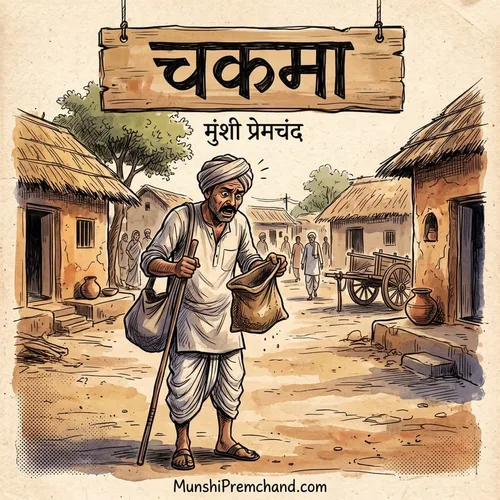
Complete English Translation: Chakma (The Trick)
1
Seth Chandumal was a cloth merchant in Delhi's Chandni Chowk. A mountain of foreign cloth lay stacked in his shop. Bank interest was piling up, the shop's rent was accumulating day by day, and clerks and servants were clamoring for their monthly salaries. Yet from morning till night, sales were entirely zero.
If this state of affairs continued for another month or two, bankruptcy was an absolute certainty.
And the sole root of this catastrophe consisted of two frail, skeletal volunteers who stood before his shop from morning until evening with folded hands, pleading with every customer who approached:
"Babuji, please buy swadeshi. Have pity on the poor of your country. Do not buy foreign cloth."
Hearing this humble petition, prospective buyers would turn around and walk away.
When the boycott movement had first begun, Sethji had puffed out his chest in sheer arrogance and refused to sign the Congress pledge form.
"I don't care a fig for anyone!" he had declared haughtily. "The police and the district officials dance in my pocket. Let us see who dares picket my shop!"
He was on intimate terms with senior police officers, contributed generously to government funds, and held the prestigious post of Treasurer in the loyalist Aman Sabha—the Peace Association.
The police officers had reassured him with broad smiles: "Lalaji, do not worry in the least! Don't you dare sign that pledge. Let us see which rascal comes to picket your threshold!"
Now three full months had elapsed. Sethji's pride had crumbled to dust. He was at his wit's end. If he signed the pledge now, he would be disgraced before the British authorities, stripped of his honors, and mocked by his fellow merchants. If he did not sign, total financial ruin was staring him straight in the face.
2
One evening, Seth Chandumal sat brooding in his shop, tossing and turning in despair. His head clerk, the Munim, was tallying the account ledgers nearby.
Chandumal asked in exasperation, "Munimji, isn't there any way out of this trap?"
The Munim closed his ledger and replied, "Sethji, there are only two paths open. Either sign the pledge form and pack away the foreign cloth, or file an insolvency petition in the court and declare bankruptcy."
"Is there no third way?" Chandumal pressed.
"None that I can see," the Munim said despondently. "The Congress volunteers have tied our hands. Customers dare not step onto our wooden dais. Even our old clients slip away into adjacent alleys."
Chandumal stroked his mustache thoughtfully. A shrewd glimmer appeared in his eyes.
"What if we make the volunteers leave of their own accord?"
"How could that ever happen?" the Munim scoffed. "They have been beaten with canes, shoved into police vans, and locked up in jail, yet as soon as two are arrested, four new ones take their place. They are stubborn as mules."
"Listen to me," Chandumal whispered, leaning closer. "A merchant's brain does not run on brute force; it runs on cunning. I have conceived a maneuver that will kill the snake without breaking the stick. The picket will be lifted, our foreign cloth will be sold, and yet we shall neither sign their pledge nor lose our honor before the officials!"
The Munim looked at him with wide, skeptical eyes. "If you can accomplish that, Sethji, I shall consider you the king of tacticians."
"Just watch the game unfold tomorrow," Chandumal chuckled softly.
3
The following morning at ten o'clock, the usual scene resumed in front of the shop. Two young Congress volunteers in khadi caps stood at the entrance. Whenever a passerby paused to look at the shop's display, they would fold their hands and offer their gentle entreaty.
Presently, a police constable arrived on patrol. Seeing the volunteers discouraging a customer, he strode forward aggressively, twirling his baton.
"Move aside, you loafers!" the constable barked, shoving one of the young men roughly by the shoulder. "Clear the road! You have blocked the entire bazaar!"
The volunteer stood his ground peacefully. "Brother, we are standing on the public street, causing no obstruction to traffic. We are merely requesting our brothers to wear swadeshi."
"Teach law to your father, not to me!" the constable snarled, raising his wooden staff and landing a vicious blow across the boy's back. The young volunteer stumbled and fell onto the pavement, his khadi cap rolling into the gutter.
A crowd instantly gathered around the spot, murmuring in anger at the unprovoked brutality.
Just then, Seth Chandumal leaped down from his shop's elevated wooden platform. His face seemed flushed with righteous indignation. Pushing through the onlookers, he grabbed the constable's raised arm and shouted at the top of his voice:
"Stop this at once, Constable! Who gave you the authority to strike this boy?"
The constable was taken aback. "Sethji, I am clearing the path for your customers!"
"I do not need your violent help!" Chandumal bellowed dramatically so that every person in the bazaar could hear him clearly. "This boy was doing nothing unlawful. He was merely speaking with folded hands. Is this your law and order? Is this how you protect the peace? Beating innocent, unarmed children of respectable families? Shame on such governance! Go away from here at once, or I shall report your misconduct directly to the Police Superintendent!"
The crowd broke into cheers: "Bravo, Sethji! Look at Lalaji's sense of justice! Even though his own shop is picketed, he will not tolerate tyranny!"
The constable, humiliated and outnumbered, muttered an oath and slunk away into the crowd.
Chandumal turned to the fallen volunteer, helped him up with great tenderness, picked up his khadi cap, dusted it with his own hands, and placed it back on the youth's head.
"Son," Chandumal said with profound sympathy, "I may disagree with your methods, but I revere your courage. May God protect you."
The young volunteers were overwhelmed with gratitude. Tears welled in their eyes as they bowed to the merchant.
That evening, a summons came from the police station. Seth Chandumal was escorted into the private office of the Police Inspector.
The Inspector's face was dark with fury. He slammed his fist on the mahogany desk.
"What drama was that you enacted this morning in Chandni Chowk, Sethji? You insulted my constable before a mob of thousands! We deploy forces to protect your business, and you stab us in the back?"
Chandumal bowed respectfully and said in a calm, measured voice, "Huzoor, I am always at your service. But what occurred this morning was sheer tyranny. If the public had turned violent, my shop would have been looted in the riot. I intervened only to avert bloodshed."
"Never mind that now," the Inspector said curtly, pulling a sheet of paper from his drawer. "A case of rioting and obstructing public servants has been registered against those picketers. Tomorrow morning, you must appear in the Magistrate's court as our chief prosecution witness."
Chandumal blinked. "What will I have to state, Huzoor?"
The Inspector replied, "The statement has already been prepared. You will testify under oath that the volunteers were hurling filthy abuses at the constables, pushing and shoving customers, indulging in scuffles, and threatening to burn down your establishment. Darogaji, bring the written deposition I had drafted for Sethji!"
Chandumal folded his hands and shook his head firmly. "Huzoor, I cannot utter such blatant falsehoods in an open courtroom."
The Inspector stared at him, astonished. "What did you say?"
"I said that thousands of respectable citizens who know me personally will be present in that courtroom," Chandumal replied. "How could I ever look them in the face again? Where would I hide my shame? I have to live and die in this city."
"Sethji, these squeamish scruples belong to private disputes," the Inspector snapped impatiently. "In political matters, neither truth nor falsehood, neither shame nor modesty has any place! It is a question of state authority."
"My face would be blackened forever," Chandumal insisted.
"In the eyes of the British Government, your honor will increase fourfold!"
Chandumal paused, appeared to reflect deeply for a moment, and then said with quiet resolve: "No, Huzoor. I cannot give false witness. Please find someone else for your deposition."
The Inspector's eyes narrowed dangerously. He leaned forward and hissed, "Remember, Lalaji, this defiance will grind all your honor to dust!"
"Let it turn to dust, Huzoor. I am helpless."
"You will be stripped of your post as Treasurer of the Aman Sabha!"
"Does that post supply bread to my family?" Chandumal countered calmly.
"Your firearm license will be confiscated!"
"Let it be seized! Good riddance!"
"The authorities will order a complete, ruthless reassessment of your Income Tax returns!"
"Please do have it reassessed," Chandumal smiled wryly. "That matches my heart's wish—since I have made nothing but staggering losses, perhaps the government will refund my taxes!"
"You will never again be offered a chair of honor at the Commissioner's Durbar!"
"What shall I do by licking a chair, Inspector Sahib, when bankruptcy is already knocking at my door?"
The Inspector glared at him, trembling with rage. "Very well! You may leave. But mark my words—sooner or later, you will fall into our claws!"
4
At that very hour the following morning, the executive committee of the City Congress was meeting in their office to plan the day's boycott program.
The Congress President looked at the duty roster and said, "Send two fresh volunteers to picket Seth Chandumal's shop in Chandni Chowk."
The General Secretary looked up and intervened, "In my considered opinion, there is no longer any need to picket his shop."
The President frowned. "Why? Has he signed the boycott pledge form?"
"He has not signed the pledge yet," the Secretary explained with intense enthusiasm, "but he has certainly become our steadfast friend! His refusal to give false testimony on behalf of the police proves it beyond a shadow of doubt. You can imagine the immense pressure the colonial authorities must have exerted on a wealthy merchant of his standing! Such defiance cannot emerge without a profound transformation of moral courage."
The President conceded, "Yes, some transformation has certainly taken place."
"Some transformation, you say?" the Secretary exclaimed passionately. "My dear sir, it is nothing short of a complete revolution! Do you realize what it means for an establishment merchant to defy the police and the district magistrate in these times? It is tantamount to an open declaration of sedition! In terms of sacrifice, it is no less exalted than taking the vows of a sanyasi. Today every colonial officer in the district is thirsting for his blood. It would not surprise me if a report has already been wired to the Governor himself!"
The President remained cautious: "Even so, if only to uphold our organization's discipline, he ought to put his signature to the pledge form. Invite him here by some means, so that our principle is maintained."
"He is an immensely self-respecting man," the Secretary argued. "He will never come if summoned like a supplicant. On the contrary, if he sees that we still harbor suspicion after all his sacrifice, he might feel insulted and driven back into the arms of the loyalists."
"Very well," the President relented. "If you place such complete faith in him, withdraw the picket from his shop. Nevertheless, I still advise you to keep a discreet watch on him under the pretext of paying friendly visits."
"You harbor unnecessary doubts, Mr. President," the Secretary smiled with righteous satisfaction.
At nine o'clock that morning, when Seth Chandumal arrived at his shop, he found the entrance completely clear. Not a single volunteer was to be seen.
A triumphant smirk spread across his lips. He climbed onto the platform, turned to his head clerk, and whispered gleefully:
"The cowrie has landed face up, Munimji! The coin turned in our favor!"
The Munim looked out into the bazaar, astonished. "It certainly appears so, Sethji. Not a single gentleman in a khadi cap has shown up."
"They didn't come, and they never will come!" Chandumal chuckled, rubbing his hands together in delight. "The game is ours! What a masterstroke I played—knocked them flat on all four corners!"
"You certainly outwitted them, Sethji," the Munim smiled admiringly. "Yet those Congress leaders were singing your praises all over the city this morning, calling you a national hero. How quickly they became your admirers!"
"It takes only a moment to twist such simpletons around one's finger," Chandumal scoffed dismissively. "Say the word, and I could summon them right now to dust my shoes! They are slaves to their own sentimental illusions—neither true friends nor dangerous enemies. Tell me honestly, didn't I give them the ultimate trick (chakma)?"
The Munim bowed with genuine awe. "I truly feel like kissing your hands, Sethji! The snake was killed, yet the stick never broke! Still, won't the Congress workers keep an eye on us?"
"Let them watch!" Chandumal laughed aloud with boundless contempt. "If they walk along the branches, I shall skip across the leaves! Call the porters at once! Haul out the hidden bales of English cloth from the basement and start distributing them to the wholesale dealers. Within a single week, our ship will sail safely across the storm!"
Summary of Chakma (The Trick)
'Chakma' is a sharp political satire set against the backdrop of the Indian independence movement and the Swadeshi boycott campaign, exposing the mercenary opportunism of the merchant class and the gullible idealism of political workers. Seth Chandumal is a wealthy cloth merchant in Delhi's Chandni Chowk who thrives on his proximity to colonial officials and serves as the treasurer of the loyalist Aman Sabha. When the Indian National Congress launches an unyielding boycott against imported British textiles, Chandumal arrogantly refuses to sign the boycott pledge, confident that the police will protect his business. However, peaceful Congress volunteers stage an unbroken, three-month picket outside his threshold, successfully dissuading customers and driving Chandumal to the verge of bankruptcy.
Caught between the financial ruin of an unsold mountain of foreign cloth and the humiliation of signing the nationalist pledge, Chandumal devises a masterly trick (chakma). When a police constable assaults a defenseless volunteer outside his shop, Chandumal publicly intervenes and loudly condemns police brutality, instantly earning the applause of the gathered public. Later that evening, when the tyrannical Police Inspector demands that Chandumal give fabricated testimony in court to frame the volunteers, Chandumal steadfastly refuses to commit perjury, laughing off threats of losing his gun license, facing tax audits, and being stripped of loyalist honors.
The local Congress leaders misinterpret Chandumal's shrewd refusal as a sublime moral awakening and a heroic patriotic sacrifice. Convinced that Chandumal has embraced the national cause at great personal peril, the Congress committee withdraws the picketers without requiring him to sign the pledge form or surrender his stock. The next morning, finding his shop unpicketed, Chandumal gleefully mocks the naivety of the nationalists and immediately orders his clerks to unpack and distribute the hoarded bales of foreign cloth, proving that for an unprincipled trader, even patriotism and truth are mere tools for commercial profit.
Publication History
'Chakma' was written during the height of the Civil Disobedience and Swadeshi Boycott movements in the early 1930s, first published in 1931 and subsequently included in Premchand's premier short story anthology, Mansarovar.
This unabridged English translation was published in 2026 by MunshiPremchand.com as part of the MunshiPremchand.com English Translation Series.
Themes & Critical Significance
- Commercial Opportunism and the Dual Face of the Merchant Class: Through the character of Seth Chandumal, Premchand ruthlessly critiques the mercantile bourgeoisie who pay lip service to national honor while remaining entirely motivated by profit and loss. For Chandumal, principles are commodities to be bartered according to the shifting winds of power.
- Satire of Political Naivety: The story contrasts the crafty realism of the trader with the innocent romanticism of the Congress leadership. The party functionaries mistake pragmatic self-preservation for spiritual conversion, demonstrating how easily high-minded political movements can be duped by theatrical gestures.
- The Mechanics of Colonial Oppression: Premchand provides an authentic depiction of the colonial administrative apparatus—its reliance on police intimidation, arbitrary tax reassessments, selective licensing, and honorary titles to keep the wealthy elite subservient.
- The Paradox of Truth as a Weapon of Deception: In a brilliant ironic twist, Chandumal speaks the absolute truth—refusing to commit perjury in court—not out of moral nobility, but as a deliberate gambit to orchestrate a 'trick' that frees his illegal commercial operations from public scrutiny.