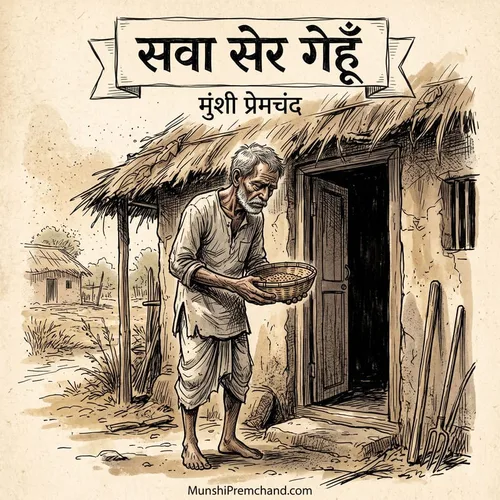
In a certain village lived a simple Kurmi farmer named Shankar.
He was a quiet, harmless man who minded his own business—neither borrowing from anyone nor lending to anyone. He knew nothing of trickery, bargaining, or deceit; the art of cheating was alien to his soul. He held no fear of being cheated, nor did he possess the cunning to cheat others. If food was available, he ate; if not, he made do with parched grain (chabena); and if even parched grain was unavailable, he drank water and went to sleep taking the name of Lord Ram.
However, whenever a guest arrived at his doorstep, Shankar felt compelled to abandon this austere lifestyle. Particularly when holy ascetics visited, he was forced to seek the ways of the world. He could gladly sleep on an empty stomach himself, but how could he let a holy man go hungry? After all, they were the devotees of God!
One evening, an ascetic arrived and pitched his camp outside Shankar's door. He was a striking figure—wrapped in yellow robes, with matted hair, a brass water-pot (kamandal) in hand, wooden sandals (khadaun) on his feet, and spectacles on his eyes—bearing the complete attire of those grand renunciates who perform penance in rich men's mansions, tour holy shrines in motorcars, and eat rich delicacies to attain yogic powers.
There was only coarse barley flour in Shankar's house. How could he feed barley to such a holy man? Whatever importance barley might have held in ancient times, in the modern age, barley food was considered indigestible by refined holy men!
Shankar grew deeply anxious. What should he feed the Mahatma? Finally, he resolved to borrow a little wheat flour from somewhere. But in the entire village, not a grain of wheat flour could be found. The village was inhabited entirely by ordinary mortals—there were no divine beings—so how could the food of gods be easily available?
Fortunately, at the house of Vipra Maharaj, the village Brahmin priest, a little wheat was available. Shankar borrowed one and a quarter seers (sava ser) of wheat from him and asked his wife to grind it.
The Mahatma ate to his heart's content, slept soundly through the night, blessed the family in the morning, and departed.
Vipra Maharaj customarily collected seasonal grain dues (khalihani) from the village farmers twice a year at harvest time.
Shankar thought to himself: Why bother returning a mere one and a quarter seers of wheat separately? At the next harvest, I'll give him a little extra grain beyond his customary dues—he will understand, and I will understand.
When the harvest season arrived in the month of Chait, Shankar handed Vipra Maharaj nearly one and a half panseris (about seven and a half seers) of wheat, considering himself fully free of the debt. He mentioned nothing about the small loan, and Vipra Maharaj asked for nothing. Simple-hearted Shankar had no idea that to settle those one and a quarter seers of wheat, he would have to surrender his very freedom in another birth!
Seven years passed.
During these seven years, Vipra Maharaj transformed from a simple priest into a wealthy village moneylender; while Shankar fell from a independent farmer to a landless wage laborer.
His younger brother Mangal had separated from him. As long as they lived together, both brothers were prosperous farmers; once separated, both became impoverished laborers. Shankar had tried his best to prevent the fire of sibling division from igniting, but circumstances forced his hand.
On the day separate hearths were lit in the house, Shankar wept bitterly. From today, brothers would become strangers—if one wept, the other would laugh; if mourning struck one home, sweet fried breads (gulgulas) would be cooked in the other! The bond of love, the bond of blood, the bond of mother's milk was broken today.
He had planted the tree of family honor with immense labor and watered it with his blood; seeing it uprooted tore his heart to pieces. For seven full days, he couldn't swallow a single grain of food. All day he labored under the scorching June sun, and at night lay down covering his face in grief. This severe emotional agony consumed his strength. When he fell ill, he lay bedridden for months.
How was the household to survive?
His five bighas of land shrank to two and a half; only one ox remained. How could agriculture thrive under such conditions? Eventually, farming became nothing more than a token effort to maintain family dignity, while the actual burden of livelihood fell on daily wage labor.
Seven years had elapsed. One evening, as Shankar returned home from a long day of manual labor, Vipra Maharaj stopped him on the road:
"Shankar! Come tomorrow and settle your seed account! You have five and a half maunds of wheat outstanding against your name for years, and you make no effort to pay! Do you intend to swallow my debt?"
Shankar stared at him in utter shock: "When did I borrow wheat from you that has grown to five and a half maunds? You must be mistaken, Maharaj! I don't owe a single pinch of grain or a single copper coin to anyone in the world!"
Vipra Maharaj sneered: "It is precisely because of this dishonest intention that you are starving today!"
Saying this, Vipra Maharaj reminded him of the one and a quarter seers of wheat he had borrowed seven years ago.
Shankar stood tongue-tied with astonishment. O Lord! How many times did I give him extra grain at harvest? How many times did he visit my doorstep for horoscope readings and auspicious dates, taking away customary cash offerings (dakshina)? Such greed! To hatch a handful of wheat for seven years like an egg, turning it into a monster that will swallow me whole! Had he demanded it once in all these years, I would have weighed the wheat and handed it to him. Did he keep silent all this time with this sinister intention?
Shankar pleaded: "Maharaj, I didn't return that grain by name, but I gave you several extra seers at every harvest! Now you demand five and a half maunds—where can a poor man like me bring such a huge quantity?"
Vipra Maharaj replied coldly: "Accounting is grain by grain; charity is by the hundred! Whatever extra you gave was a gift—it has no place in the ledger. In my ledger, five and a half maunds are written against your name. Have it calculated by whomever you like! Pay it off and I'll clear your name, otherwise the debt will keep growing!"
"Pandeji, why do you torment a poor man? I don't even have food for tonight—where will I bring so much wheat from?"
"Bring it from wherever you like! I won't forgive a single pinch. If you don't pay me here, you will have to pay me in the court of Almighty God!"
Shankar trembled with fear.
Had he been an educated man, he might have replied: "Very well, I shall pay in God's court—the scales there won't be larger than yours!" But Shankar was neither logical nor worldly-wise. A debt—and that too owed to a Brahmin! If his name remained in the ledger, he believed he would go straight to hell. The mere thought sent shivers down his spine.
He folded his hands humbly: "Maharaj, whatever I owe, I shall pay you right here in this life! Why should I leave debts for the next life? I am already stumbling in poverty in this birth—why should I sow thorns for the next? But this is blatant injustice! You turned a molehill into a mountain. Being a Brahmin, you shouldn't have done this. Had you demanded it then, would I be facing such a crushing burden today? I will pay you, but you will have to answer to God!"
Vipra Maharaj laughed callously: "You worry about God's court—why should I worry? Everyone there belongs to my community—sages, saints, and gods are all Brahmins! Whatever goes wrong, they will manage it for me! Now tell me, when are you paying?"
"I don't have it lying in my house. I'll have to beg and borrow from others to pay you!"
"I won't accept excuses. Seven years have passed, and I won't grant a single day's extension. If you can't give wheat, sign a legal debt bond (dastavej)!"
"I have to pay anyway—whether in wheat or by bond. At what rate will you calculate the price?"
"The market rate is five seers per rupee; I'll calculate it for you at five and a quarter seers."
When calculated, the price of the wheat came to sixty rupees.
A legal bond for 60 rupees was drawn up at an interest rate of 3% per month. If unpaid within a year, the interest rate would rise to 2.5% compounding per month. On top of that, Shankar was forced to pay eight annas for stamp paper and four annas for the scribe's fee!
The entire village condemned Vipra Maharaj's greed in hushed tones, but no one dared speak to his face. Everyone needed to borrow money from the moneylender at some point—who would risk earning his enmity?
Shankar undertook a year of severe self-denial. He swore a solemn vow to clear the sixty rupees before the deadline.
Earlier, his family ate only one meal a day and survived on parched grain at noon; now even parched grain was stopped. Only a few dry flatbreads were kept for his young son at night.
Smoking tobacco was his one lifelong habit—the single luxury he had never given up; now even that habit was sacrificed to his vow. He smashed his clay bowl, broke his wooden pipe (hookah), and crushed his tobacco pot to pieces. His clothing had already reached the extreme limits of poverty; now it shrank to a bare loincloth. He braved the bone-chilling winter cold simply by sitting near a bonfire.
The fruit of this extraordinary sacrifice exceeded expectations. By the end of the year, Shankar had accumulated 60 rupees!
He believed that by handing these sixty rupees to the priest, he could say: "Maharaj, take this principal amount; I shall bring the remaining fifteen rupees of interest very soon." Surely the priest would agree!
He took the hard-earned money and laid it respectfully at the priest's lotus feet.
Vipra Maharaj looked at the coins in surprise: "Did you borrow this from someone?"
"No Maharaj, by your blessings, I earned good wages this year."
"But this is only sixty rupees!"
"Yes Maharaj, take this much for now. I will pay the remaining fifteen rupees in two or three months—please free me from this burden!"
Vipra Maharaj sneered: "You will be freed only when you pay every single copper coin! Go fetch my remaining fifteen rupees!"
"Maharaj, show some mercy! We don't even have evening meals in the house. I live in the same village—I will surely pay you!"
"I don't entertain such excuses! If I don't get my full money, interest at 3% per month will continue on the entire amount from today. Keep your money or leave it here—it's up to you!"
"Take what I have brought for now. I'll go and try to borrow fifteen rupees from somewhere."
Shankar searched the entire village, begging for a loan of fifteen rupees, but no one gave him a single copper coin—not because they disbelieved Shankar, nor because they lacked money, but because no one dared tamper with the moneylender's prey!
Action and reaction is a law of nature.
When Shankar failed to free himself even after a year of grueling self-denial, his discipline collapsed into deep despair. He realized that if extreme starvation could yield only sixty rupees in a year, there was no way he could ever clear a debt that doubled every year!
When the burden of debt is destined to crush your head, what difference does it make whether it weighs a maund or a maund and a quarter?
His spirit was broken; his enthusiasm vanished. Hope is the mother of effort—hope brings vigor, strength, and life. Deprived of hope, Shankar became completely indifferent.
Those needs which he had suppressed for a year now returned not as quiet beggars, but as demanding demons. He stopped saving his daily wages. Sometimes he bought clothes; sometimes he bought food. Where he had once smoked only tobacco, he now took to intoxicants like ganja and charas. He stopped worrying about the debt—acting as though he owed nothing to anyone. Earlier, even when shivering with fever, he would drag himself to work; now he actively sought excuses to skip work.
Three years passed in this manner.
Vipra Maharaj did not issue a single reminder during these three years. Like a cunning hunter, he waited for the trap to spring fully. Disturbing the prey prematurely went against his strategy.
One afternoon, Panditji summoned Shankar and presented the account ledger. After deducting the 60 rupees previously paid, Shankar's outstanding debt now stood at 120 rupees!
Shankar said quietly: "I can pay such a huge sum only in the next birth, Maharaj—it is impossible in this life."
Vipra Maharaj barked: "I will have it in this birth! If not the principal, you must pay the interest!"
"I have one ox left—take it! What else do I possess?"
"What will I do with an ox? You have something far more valuable to give me."
"What else do I have, Maharaj?"
"You have yourself! You go out to do manual labor for others anyway, and I have to hire laborers for my fields. Work off the interest in my fields! Whenever convenient, pay off the principal. Truth be told, you cannot work anywhere else until my debt is fully cleared! You have no property—on what assurance should I leave such a large sum? Who will guarantee that you'll pay me monthly interest?"
Shankar asked in despair: "Maharaj, if I work to pay off the interest, what will I eat?"
"Don't you have a wife and children? Are they going to sit idle with cut hands? As for you, I will give you half a seer of coarse barley every day for breakfast. Once a year, you'll get a blanket and a jacket. What more do you need? True, others pay six annas a day, but I am keeping you to recover my money!"
After a long, agonizing silence, Shankar whispered: "Maharaj... this is lifelong slavery!"
Vipra Maharaj replied callously: "Call it slavery or call it labor—I will never let you go without recovering my money! If you run away, your son will pay it!"
There was no appeal against this verdict. Who would stand surety for a poor laborer? Where could he flee?
From the next day, Shankar began working as a bonded laborer in Vipra Maharaj's fields. On account of one and a quarter seers of wheat, the shackles of lifelong slavery were bolted onto his ankles!
If the unfortunate man found any mental comfort, it was the fatalistic belief that this was the result of sins committed in a past life. His wife was forced to undertake grueling field labor she had never done before; his children whimpered for food; but Shankar could do nothing except watch in silent agony.
Those few grains of wheat hovered over his head like a curse from a deity for the rest of his life.
After serving twenty years as a bonded slave at Vipra Maharaj's house, Shankar departed from this cruel world.
Yet the debt of 120 rupees still stood against his name!
Panditji did not consider it proper to trouble the poor soul in God's court—he was not so unjust after all! Instead, he caught Shankar's young son by the neck.
To this day, Shankar's son works as a bonded laborer at Vipra Maharaj's house. When his deliverance will come—or whether it will ever come at all—only God knows!
Dear Reader! Do not regard this narrative as a fictional tale. This is a true story. The world is not empty of such Shankars and such Vipras!
Significance & Themes
- Hereditary Debt Bondage (Begar): Premchand exposes how trivial rural debts, combined with compound interest and usury, are systematically manipulated to transform free farmers into lifelong bonded slaves.
- The Weaponization of Religious Fear: The moneylender uses Shankar's deep religious faith and fear of a Brahmin's curse (narak) to trap him into signing an unpayable legal bond.
- Failure of Community Solidarity: Though villagers sympathize with Shankar, their economic dependence on the village moneylender prevents anyone from offering help, leaving the victim isolated.