It has been a long time since I last went to watch a Ramleela performance.
Seeing men wearing awkward monkey masks, half-length trousers, and black tunics running about shouting "Hoo! Hoo!" brings a smile to my face nowadays rather than joy. The Ramleela of Kashi is famous across the world, but when I went to see it, I found no difference between it and a crude rural performance. Yet, huge crowds assemble to watch it every year.
However, there was a time in my childhood when Ramleela brought me intoxicating bliss!
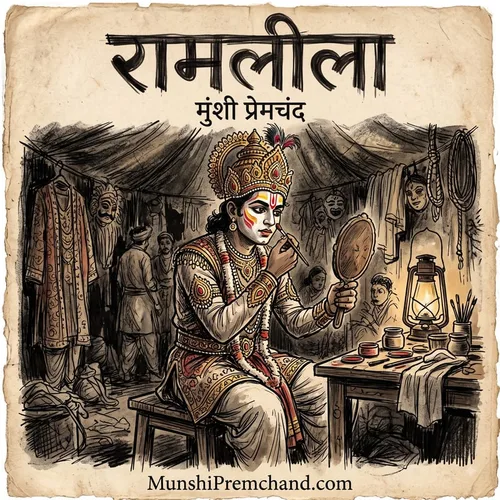
In those days, the Ramleela ground was barely a few steps from my house, and the room where the actors applied their makeup was right next door. By two in the afternoon, makeup preparations would begin. I would rush there with boundless excitement, running small errands with a joy I wouldn't feel today even if I went to receive my pension!
In a small room, the makeup of Lord Rama was prepared. Yellow ramraj paste was ground and applied to his skin, white powder dusted over his cheeks, and red, green, and blue dots painted across his forehead and cheeks. Fetching water in clay bowls, grinding the colors, and fanning the young actors was my solemn duty.
When the sacred chariot (vimaan) rolled out into the streets, sitting behind Lord Rama filled my heart with an ecstatic thrill, a pride, a shiver of divine joy that sitting on a governor's plush chair could never recreate!
The actor who played Lord Rama was a boy named Ramchandra.
In my innocent eyes, Ramchandra was not merely a student in a red tunic—he was the living incarnation of Lord Rama Himself!
Though older than me, Ramchandra studied in a lower grade and struggled with his lessons. Out of pure devotion, I neglected my own studies to tutor him every afternoon so he wouldn't fail his exams. Whenever my mother gave me a sweet or a piece of fruit at home, I would run out wildly into the village square, searching for Ramchandra. Feeding him brought me ten times more joy than eating the sweet myself!
On the grand day of the Coronation Procession (Rajgaddi), a massive decorated canopy was erected on the grounds. Ramchandra's royal chariot paraded through the town streets, stopping at every doorway where families performed aarati and offered donations.
My father was a stern police officer. When the chariot stopped outside our house, my father performed the aarati but did not place a single copper coin into the offering tray!
I felt a surge of deep shame. My maternal uncle had gifted me a silver rupee before Dussehra, which I had saved like a precious treasure. I immediately ran inside, fetched my silver rupee, and dropped it into the aarati tray!
My father glared at me with fierce, angry eyes, his face twisting in rage as though my humble gift had insulted his grand police authority.
By ten at night, the procession concluded. The offering tray overflowed with several hundred rupees.
However, the chief organizer, Chaudhary Sahib, had spent heavily on decorations and wanted to raise a large personal profit. His solution was to hire Abadijan, a young and beautiful courtesan, to perform at the midnight gathering and coax money from wealthy spectators.
I accidentally overheard Chaudhary Sahib bargaining with Abadijan behind the tents:
Chaudhary Sahib pleaded: "Abadijan, take your hundred-rupee fee and give me half of whatever extra money you coax out of the audience!"
Abadijan laughed flirtatiously: "Why should I hand over my extra earnings to you? Do you think I am a fool?"
Chaudhary Sahib yielded to her terms.
The dance performance began under brilliant lanterns. Abadijan danced gracefully, swaying her hips and moving from one wealthy gentleman to another, holding their wrists flirtatiously until they handed over five-rupee notes in embarrassment.
Then, to my horror, Abadijan walked over and sat directly before my father!
My heart froze! I felt a wave of cold terror. I was certain my stern, moral father would shove her away and scold her sharply.
But what was I witnessing? O Lord! Were my eyes deceiving me?
My father was smiling a soft, tender smile—a smile I had never seen on his face in my entire life! His eyes overflowed with romantic adoration; his entire body shivered with delight!
Abadijan gently held his wrist, her arms wrapping near his shoulder. A neighbor teased: "Your tricks won't work here, Abadijan! Look elsewhere!"
Hearing the neighbor's joke, my father's ego flared up. He scowled at the neighbor, reached deep into his pocket, pulled out a gleaming coin, and handed it to Abadijan with a proud flourish!
It was a gold sovereign (asharfi)!
The crowd erupted in wild applause!
My father sat back with an arrogant, triumphant smile, overflowing with pride.
I stood frozen in the dark, my heart shattered into a thousand pieces.
This was the very same father who had glared at me like a monster when I dropped a single silver rupee into Lord Rama's sacred aarathi tray! Giving a rupee to God had hurt his dignity—yet handing a gold sovereign to a courtesan filled him with immense pride and joy!
A wave of deep disgust swept over my soul. I bowed my head in profound shame and slipped away into the night.
At dawn the next morning, I ran to the village square to see Ramchandra before he departed.
Outside the square, horse carriages were parked to carry the courtesans away in luxury. But inside the thatched shed sat Ramchandra, Lakshmana, and Sita—sitting on the dirt floor, weeping in silence.
Ramchandra held a small brass pot and rope over his shoulder.
I ran to him with a choking voice: "Ramchandra! Are you leaving? Did Chaudhary Sahib give you your money and clothes?"
Ramchandra wiped a tear from his cheek and whispered softly:
"No... Chaudhary Sahib says there is no profit left in the funds. He gave us not a single rupee—not even money for our travel tickets! He told us to walk back thirty miles on foot."
"He gave you nothing? Not even a copper bit?"
"Not a single piece of copper," Ramchandra replied sadly. "I had hoped to buy my schoolbooks with my earnings... but we got nothing."
A fierce, burning rage erupted in my heart!
Hundreds of rupees squandered on courtesans! Gold sovereigns handed out to dancers! Yet for the poor children who played Lord Rama, Lakshmana, and Sita, there was not even a single copper coin for travel fare!
I ran home to my father, who was mounting his horse for official work. I cried out: "Father! Ramchandra and the actors are leaving! Chaudhary Sahib gave them no money for travel tickets!"
My father glared down at me coldly: "Why are you worrying about that? Go read your books! I have no money to throw away on them!"
He whipped his horse and rode away.
From that tragic morning on, every ounce of respect I held for my father evaporated forever.
I reached into my pocket. All I possessed in the world were two copper bits (do aane).
I ran back to the thatched shed, took out the two copper coins with trembling, embarrassed hands, and placed them softly into Ramchandra's palm.
Seeing those two small copper bits, Ramchandra's eyes lit up with intense, tearful gratitude—like a dying man receiving a drop of water!
With those two copper coins as their sole treasure, the three innocent children carrying the roles of Rama, Lakshmana, and Sita began their long, weary walk back home.
I walked beside them to the edge of the town. As I bade them farewell under the morning sun, tears streamed down my cheeks; yet my young heart overflowed with a pure, divine joy that no adult hypocrisy could ever tarnish.
Significance & Themes
- Childhood Faith vs. Adult Hypocrisy: Premchand presents a devastating critique of bourgeois religious hypocrisy, contrasting a child's selfless, pure devotion with adult society's ostentatious, commercialized display of religion.
- The Commercialization of Sacred Festivals: The story exposes how community festivals (Ramleela) are often hijacked by wealthy organizers for social prestige, profit, and sensual entertainment, while poor artists are exploited and discarded.
- Moral Awakening: The narrator's loss of respect for his father marks a crucial coming-of-age moment—discovering that true moral nobility lies in the quiet generosity of the poor rather than the hollow status of authority figures.