Complete English Translation: Eidgah
After thirty full days of Ramadan fasts came the joyous morning of Eid.
What an enchanting, delightful morning it was! The trees wore an extraordinary green, the fields possessed an unusual splendor, and the sky shone with a tender crimson glow. Look at today's sun—how sweet, how tranquil, as though it were extending its heartfelt Eid greetings to the entire universe!
What bustle and excitement filled the village! Preparations to march to the Eidgah mosque were under way. Someone found a missing button on his kurta and went sprinting to a neighbor's house for needle and thread. Another found the leather of his shoes stiff and hard, and rushed to the oilman's house to have them oiled. People hurried to feed and water their bullocks with grain and hay. Returning from the Eidgah would take until midday. A three-mile trek on foot, followed by embracing and greeting hundreds of acquaintances—returning before afternoon was utterly out of the question.
The children were the happiest of all. Some had kept a fast—and that too only until noon; some had not even managed that; but the sheer joy of going to the Eidgah was their birthright. Fasts were for the elders and the old; for the children, there was only Eid! They had chanted the name of Eid day in and day out, and today it had finally arrived! Now their only impatience was: why weren't the adults moving faster?
What did these youngsters care about domestic anxieties? Whether there was milk and sugar in the house to cook the sweet sewaiyan was none of their concern—they only knew that they would feast upon sewaiyan! How could they comprehend why their fathers were rushing in frantic agitation to the house of Chaudhary Qaim Ali? Little did they know that if the Chaudhary were to turn his favor away today, this entire joyous Eid would turn into mournful Muharram! In their own little pockets, they carried the fabulous wealth of Kubera. Over and over again, they would pull their treasures from their pockets, count them with gleaming eyes, and tuck them joyfully away.
Mahmood counted: "One, two, ten, twelve..." He had twelve copper paise. Mohsin had one, two, three, eight, nine, fifteen paise. With these countless coins, they planned to purchase countless wonders—toys, sweets, bugles, balls, and who knew what else!
And happiest of all was Hamid. He was a frail, impoverished-looking boy of barely four or five years, whose father had fallen victim to cholera the previous year, and whose mother had grown paler and paler by the day until she too passed away. No one ever discovered what illness had consumed her. If she had spoken, who was there to listen? Whatever torment afflicted her heart, she endured in silence; and when it could be borne no longer, she departed from this world.
Now Hamid slept in the lap of his elderly grandmother, Amina, and was just as happy as any prince. He believed that his Abba-jaan had gone across the rivers to earn money and would return with many sacks overflowing with silver; and that his Ammi-jaan had gone to the house of Almighty Allah to bring back wondrous, beautiful treasures for him. That was why Hamid was so cheerful. Hope is indeed a wondrous thing, especially the boundless hope of a child! A child's imagination can transform a grain of mustard into a mighty mountain. Hamid had no shoes upon his feet; upon his head sat an old, faded cloth cap whose gold tinsel border had turned black with grime; yet his spirit was joyous. When his Abba-jaan returned with sacks of silver and his Ammi-jaan with heavenly gifts, he would fulfill every longing of his heart! Then he would see where Mahmood, Mohsin, Noorey, and Sammi could ever produce such wealth!
In her dark, lonely hut, unfortunate Amina sat weeping. Today was the festive morning of Eid, and in her house there was not a single grain of food! If only her son Abid were alive today, would Eid have arrived and departed in such bitter sorrow? She felt herself drowning in black despair. Who had invited this wretched, accursed Eid? There was no place for it in this desolate home.
Yet Hamid! What concern had he with life or death, sorrow or grief? Within him shone radiant light; outside him bloomed hope. Let adversity march forth with all its formidable armies—Hamid's cheerful, joyous gaze would scatter them all to the winds!
Hamid stepped inside the hut and comforted his grandmother: "Do not be afraid, Amma! I will be the very first to return from the fair. Do not worry in the least!"
Amina's heart throbbed with excruciating pain. The other children of the village were heading out with their fathers. Who was Hamid's father except Amina? How could she let him venture alone into the teeming fair? What if the little boy got lost in that vast, surging crowd? No, Amina could not bear to let him go like that. Such a tiny, fragile soul! How would he walk three long miles? Blisters would erupt upon his tender feet. He did not even have shoes. She would have carried him in her arms every few furlongs; but then, who would stay behind to cook the sewaiyan? If they had money, she could have gathered all the ingredients quickly upon returning and prepared the dish in a flash. Here, it would take hours just to beg and gather scraps of provisions. Everything depended on borrowing!
Just the other day, she had stitched clothes for Faheeman and earned eight annas. She had guarded that half-rupee coin like her own honor for this very festival of Eid; but yesterday, the milkwoman had stood demanding her dues at the doorstep, and what could she do? Even if nothing else was bought for Hamid, two paise worth of milk was essential every day. Now, only two annas remained in total: three paise in Hamid's pocket, and five paise in Amina's cloth purse. That was her entire worldly fortune for the festival of Eid! May Allah steer their boat safely to the shore!
The washerwoman, the barber's wife, the sweeper woman, and the bangle-seller would all arrive demanding their festival share. Everyone would expect sewaiyan, and no one would look kindly upon a meager offering. How could she turn her face away from them? And why should she hide? It was a festival that arrived but once a year. As long as life was preserved in health, their fortunes would endure with it. If God kept the child safe, the hard days would pass too.
The festive caravan set out from the village. Hamid walked along among the other children. Sometimes they would all burst into a sprint and run ahead; then they would halt beneath the shade of a tree to wait for the slower adults. Why are these grown-ups walking so slowly? To Hamid, it felt as though wings had grown upon his little feet. How could he ever grow weary?
Soon the outskirts of the town came into view. On both sides of the road stretched the sprawling orchards of the wealthy, enclosed within solid masonry walls. Mango and litchi trees hung heavy with ripening fruit. Occasionally, a mischievous boy would pick up a pebble and aim it at a hanging mango. The gardener would rush out from inside, hurling loud curses. The boys, already a furlong ahead, laughed uproariously: what a fine fool they had made of the gardener!
Massive buildings began to appear. This is the Court of Law; that is the College; there is the Officers' Club! How many boys must be studying in such an enormous college? "They are not mere boys!" Mohsin explained. "They are grown-up men, truly! Many of them have long moustaches! They have grown so big, and yet they still go to school! Who knows how many years they will keep studying, and what they will ever do with so much learning!"
In Hamid's village madrasa, there were two or three overgrown boys—utterly worthless fellows who were thrashed every day and shirked all work. This college must surely be filled with the same sort of fellows, Hamid thought.
And the Officers' Club! They said wondrous magic was practiced inside! Rumor had it that the skulls of dead men ran across the floor in the dark! Grand spectacles took place, but no commoner was permitted within. In the evening, the English sahibs played games there—big, grown men with beards and moustaches. And the English memsahibs played too, truly! If our Amma were given that thing—what is its name, a racket?—she couldn't even hold it! The moment she swung it, she would tumble flat on the ground!
Mahmood said: "By Allah! Our mother's hands would begin to tremble just holding it!"
Mohsin protested: "Nonsense! She grinds maunds of grain upon the heavy millstone every day! Would her hands tremble holding a feather-light bat? She draws hundreds of earthen pots of water from the deep well daily. Your buffalo drinks five huge pots of water all by herself! If an English lady had to draw a single pot of water, her eyes would turn black with dizziness!"
Mahmood argued: "Yes, but can she run and leap about like them?"
Mohsin shot back: "No, she might not leap about, but the day our cow broke loose and bolted into the Chaudhary's field, Amma ran so fast that I couldn't catch up with her, honestly!"
They walked on further. The sweetmeat shops began to appear, dazzlingly decorated for the festival. Who could ever eat so many sweets? Look, there were maunds upon maunds piled high in every single stall!
"They say the Jinnat come at midnight and purchase them all," Mohsin whispered solemnly. "My father told me that at midnight, a spirit visits every shop, has all the leftover sweets weighed out, and pays for them in real, solid silver rupees—just like genuine government coins!"
Hamid was skeptical: "Where on earth would the Jinnat find real silver rupees?"
Mohsin replied: "What lack of money could Jinnat ever have? They can enter any royal treasury they please! Even massive iron gates cannot bar their way! They possess mountains of diamonds and rubies. If they take a liking to anyone, they shower him with baskets of gems! Sitting right here, they can reach Calcutta in five minutes!"
Hamid asked again: "Are the Jinnat very large?"
Mohsin: "Each one is as tall as the sky itself! If one stands upon the earth, his head scrapes the heavens; yet if he chooses, he can shrink and crawl inside a brass lota!"
Hamid: "How do people manage to please them? If someone would teach me that magic incantation, I too would please a Jinn!"
Mohsin: "Well, that I do not know; but Chaudhary Sahib has many Jinnat under his complete command. If any article is stolen, Chaudhary Sahib discovers its whereabouts and names the thief on the spot! The other day, Jumrati’s calf went missing. They searched for three days in vain; then, beaten and exhausted, they went to Chaudhary Sahib. The Chaudhary told them instantly: 'It is locked in the cattle pound'—and there it was found! The Jinnat come and bring him reports of all the happenings across the world."
Now Hamid understood why Chaudhary Sahib possessed such boundless wealth and commanded such immense respect.
They moved on past the Police Lines. Here the constables were drilling—Right-turn! Left-wheel! Fire! At night, the poor fellows walked the rounds on patrol, lest robberies take place.
Mohsin contradicted him scornfully: "Patrol? As if you know anything! My good sir, they are the ones who arrange the robberies! All the thieves and bandits of the city are in league with them. At night, they instruct the thieves to loot, while they themselves march through another neighborhood shouting, 'Stay awake! Be on your guard!' That is why they amass so much money. My maternal uncle is a constable in a police station. His salary is twenty rupees a month, yet he sends fifty rupees home every month! By Allah! I once asked him: 'Uncle, where do you get so much money?' He laughed and said: 'Son, Allah provides it.' Then he added himself: 'If we wished, we could loot millions in a single day. We take only enough so that our reputation is not ruined and our job is not lost.'"
Hamid asked: "If they arrange the robberies, does no one ever arrest them?"
Mohsin looked at his childish ignorance with pity: "You simpleton! Who would ever arrest them? They are the very ones who do the arresting! But Allah punishes them severely too. Ill-gotten wealth vanishes in ill-gotten disasters. Only a short while ago, a fire broke out in my uncle's house. All his accumulated belongings were reduced to ashes—not a single cooking pot was saved! For days they had to sleep beneath a tree—by Allah, beneath a tree! Then he had to borrow a whole hundred rupees from someone before they could buy pots and pans again."
Hamid asked: "Is a hundred rupees more than fifty?"
"What comparison is there between fifty and a hundred? Fifty fills a small pouch; a hundred would not fit into two large bags!"
The town grew denser. Processions of people heading toward the Eidgah came into view, adorned in dazzling, flamboyant attire. Some rode in horse-drawn carriages, some in motorcars; all were perfumed with fragrant attar, and the hearts of all swelled with exuberant joy. This little band of village folk, heedless of their poverty, marched forward in quiet patience and contentment.
To the village children, every sight in the city was an astounding wonder. Whatever caught their gaze, they stared at open-mouthed, utterly unconscious of the blaring motorcar horns behind them. Hamid narrowly escaped being crushed beneath the wheels of an automobile.
Suddenly, the Eidgah rose before their eyes. Above spread the deep, cool canopy of ancient tamarind trees. Below lay a smooth, paved courtyard covered with striped rugs. The rows of worshippers stretched far into the distance, one behind another, reaching out beyond the covered pavilion to the bare brick terrace where there were no carpets. New arrivals quietly took their places in the rear rows; there was no room in front.
Here, no one inquired about wealth or station; in the eyes of Islam, all men are equal. The village boys performed their ablutions and joined the rearmost line.
What a sublime, majestic spectacle it was! What flawless discipline, what magnificent harmony! Hundreds of thousands of heads bowed in prostration (sijdah) at the very same instant, and then all rose together as one single body. They bowed together, knelt together, and repeated the rhythm over and over again—as though hundreds of thousands of electric lamps were illuminated simultaneously and extinguished together in an unbroken, eternal cadence!
It was an unprecedented sight, whose collective majesty, vastness, and infinite harmony filled every heart with reverence, pride, and divine ecstasy, as though a single thread of universal brotherhood had strung all these diverse souls into one seamless garland.
The prayers concluded. The worshippers embraced one another warmly. Then a joyous assault was launched upon the sweet stalls and toy booths. The village adults were no less enthusiastic than the children!
Look, there was the giant Ferris wheel! Pay one copper paisa and climb aboard: one moment you seemed to soar into the heavens, the next plunging into the depths of the earth! And there was the wooden carousel, with carved horses, elephants, and camels suspended from iron rods. Pay one paisa and relish twenty-five dizzying spins!
Mahmood, Mohsin, Noorey, and Sammi mounted the wooden horses and camels. Hamid stood watching from a distance. He had only three paise in his entire fortune; he could not part with a third of his worldly treasury for a few fleeting spins!
Everyone dismounted from the carousels. Now came the purchase of toys. A long line of stalls stretched across the grounds, displaying all manner of clay figures: soldiers and milkmaids, kings and lawyers, water-bearers, washerwomen, and holy ascetics. Ah, what magnificent toys! They looked as though they were poised to speak at any second!
Mahmood selected a policeman, resplendent in khaki uniform and red turban, carrying a miniature musket upon his shoulder, looking for all the world as though he had just marched off the parade ground.
Mohsin fell in love with the water-bearer (bhishti): his back was bent under the weight of his water-skin; one hand held the mouth of the skin; his face beamed with cheerful joy, as though he were humming a song, on the very verge of pouring out refreshing water!
Noorey was captivated by the lawyer. What scholarly dignity sat upon his countenance! A black gown over a white achkan, a gold watch-chain gleaming from his front pocket, holding a weighty volume of the law under his arm—looking as though he had just stepped out of a fiery cross-examination in the High Court!
Each of these toys cost two paise. Hamid possessed a mere three paise in all—how could he afford such expensive luxuries? If a toy were to slip from his grasp, it would shatter into dust; if a single drop of water fell upon it, its vibrant colors would dissolve away. What would he do with such fragile playthings? What purpose could they ever serve?
Mohsin boasted: "My water-bearer will sprinkle water at my doorstep every morning and evening!"
Mahmood bragged: "And my policeman will guard my home! If a thief appears, he will instantly fire his gun!"
Noorey said: "And my lawyer will fight grand court cases for me!"
Sammi added: "And my washerwoman will wash my clothes every single day!"
Hamid spoke disparagingly of the toys: "They are made of mere clay! If they fall, they will shatter into pieces!"
Yet his eyes lingered upon the toys with hungry longing. He wished he could hold them in his hands for just one fleeting moment. His little hands instinctively reached out; but boys are not so generous, especially when their prized possessions are brand new. Hamid was left gazing wistfully.
After the toys came the sweetmeat stalls. Someone bought sesame rewris, another bought gulab-jamuns, another fragrant sohan halwa. They relished their sweets with evident delight.
Hamid was excluded from their feast. The unfortunate boy had three paise, yet why didn't he buy something and eat? He gazed at them with longing eyes.
Mohsin called out: "Hamid, take a rewri! See how fragrant it is!"
Hamid suspected it was a cruel joke—Mohsin was never that generous—yet despite knowing it, he stepped closer. Mohsin extracted a crisp sweet from his leaf-bowl and held it out. Hamid extended his hand. In an instant, Mohsin popped the sweet into his own mouth!
Mahmood, Noorey, and Sammi clapped their hands and burst into mocking laughter. Hamid felt crestfallen and embarrassed.
Mohsin teased: "Truly, Hamid! By Allah, I will give you one this time! Come and take it!"
Hamid replied proudly: "Keep it to yourself! Do you think I have no money?"
Sammi mocked: "You have only three paise! What can you buy with three measly paise?"
Mahmood offered: "Take a gulab-jamun from me, Hamid. Mohsin is a rogue."
Hamid retorted: "Sweets are no great blessing! The books are full of warnings about how ruinous they are for your health!"
Mohsin sneered: "Yet in your heart, you must be dying to eat them! Why don't you take out your money?"
Mahmood laughed: "I understand his cunning! When all our money is spent, he will buy something and eat it before our eyes to make our mouths water!"
Beyond the sweetmeat stalls lay shops selling ironware, nickel-plated household goods, and imitation jewelry. There was nothing there to tempt young boys, so they all marched right past.
Hamid, however, came to a dead halt before an ironmonger's shop.
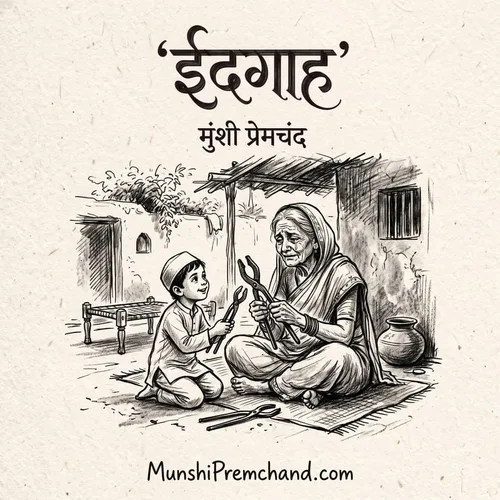
Several pairs of iron tongs (chimta) lay displayed on the counter. A sudden thought struck him: Grandmother does not possess a pair of tongs! Whenever she bakes rotis on the iron griddle, she burns her fingers. If I buy a pair of tongs and give them to her, how overjoyed she will be! Her fingers will never burn again. It will be a truly useful article in the house. What good are clay toys? They waste money for nothing. The joy lasts for just a fleeting moment; then no one even lifts an eye to look at them. Before one even reaches home, they might fall and break to pieces. But a pair of tongs—what an indispensable tool! You can lift hot rotis from the griddle; you can turn embers in the hearth; if someone comes asking for fire, you can quickly lift live coals from the hearth and hand them over. Where does poor Amma ever find the time to visit the bazaar, and where would she ever get so much money? She burns her hands every single day!
Hamid's companions had moved far ahead; they were gathered at a roadside stall sipping sweet sherbet. Look how greedy they all are! Hamid thought. They bought so many sweets, yet not one had the heart to give me a single piece! And yet they say: 'Come and play with me! Run this errand for me!' If any of them asks me to do an errand now, I shall tell them off! Let them gorge on sweets—their mouths will rot, boils and sores will erupt upon their tongues, and their palates will become slaves to gluttony. Then they will steal money from home and get thrashed by their elders. Schoolbooks don't print lies! Why should my tongue become corrupted? The moment Amma sees these tongs, she will run, take them from my hands, and declare: 'My dear child has brought tongs for his old grandmother!' She will shower thousands of blessings upon me. Then she will display them to all the women of the neighborhood. The whole village will buzz with praise: 'Hamid brought tongs for his grandmother! What a noble, thoughtful boy!' Who will ever give blessings for those fragile clay toys? The prayers of elders ascend directly to the court of Allah and are granted without delay! I have no wealth—that is why Mohsin and Mahmood strut with such arrogance. I will show them! Let them play with toys and gorge on sweets. I refuse to play with fragile toys—why should I endure anyone's condescension? I may be poor, but I do not go begging from anyone. One day, my Abba-jaan will surely return; my Ammi-jaan will come back too. Then I shall ask these boys: 'How many toys do you want?' I will give each of them baskets full of toys and demonstrate how true friends treat one another—not like buying a paisa worth of sweets and teasing your companions while you gobble them up! Let them all laugh because Hamid bought tongs! Let them laugh—what do I care?
He addressed the shopkeeper: "How much for this pair of tongs?"
The shopkeeper looked at him, and seeing no grown-up with him, replied dismissively: "It is of no use to you, boy."
"Is it for sale or not?"
"Why wouldn't it be for sale? Why else would I have carted it all the way here?"
"Then why don't you tell me the price—how many paise?"
"It will cost six paise."
Hamid's heart sank.
"Tell me the fair, honest price!"
"The honest price is five paise. Take it if you wish, or move along."
Hamid gathered all his courage and asked in a firm voice: "Will you take three paise?"
Saying this, he began to walk away, dreading that the merchant would snap at him with insults. But the merchant did not snap. He called Hamid back and handed him the iron tongs for three paise!
Hamid hoisted the tongs proudly upon his shoulder, as though it were a soldier's rifle, and strutted back toward his companions with triumphant arrogance. Let me hear what criticisms they have to offer now!
Mohsin laughed mockingly: "Why did you buy these tongs, you fool? What on earth will you do with them?"
Hamid hurled the iron tongs forcefully onto the ground and challenged: "Try throwing your water-bearer onto the ground like that! Every single rib in the rascal's body will shatter to dust!"
Mahmood sneered: "So, are those tongs supposed to be some kind of toy?"
Hamid retorted: "Why isn't it a toy? Sling it across your shoulder, and it becomes a rifle! Hold it in your hands, and it becomes the iron tongs of a wandering dervish! If I wish, I can use it as a pair of musical cymbals! One sharp strike from my tongs, and the life will be knocked clean out of all your clay toys! However much strength your toys may exert, they cannot harm a single hair of my tongs! My tongs are a fearless lion—the true Rustam-e-Hind!"
Sammi, who had purchased a small tambourine (khanjari), was deeply impressed. He offered: "Will you trade with my tambourine? It cost two whole annas!"
Hamid looked at the tambourine with scorn: "If my tongs so desires, it could rip open the belly of your tambourine with one jab! It is nothing but a scrap of parchment stretched over wood that goes dhab-dhab. A drop of water, and it is finished forever! But my valiant tongs will stand resolute in fire, in water, in wind, and in tempest!"
The iron tongs cast a spell of enchantment over them all! Yet who among them had any money left? And they had already walked far beyond the fairgrounds; the clock had struck nine long ago, the morning sun was growing scorching, and everyone was in a hurry to reach home. Even if they threw a tantrum before their fathers now, no tongs could be bought. Hamid was a master strategist—that was why the cunning rascal had held his three paise in reserve until the very end!
Now the boys were divided into two opposing camps. Mohsin, Mahmood, Sammi, and Noorey on one side; Hamid standing victorious on the other. A fierce battle of rhetoric ensued. Sammi had already defected to the other side; but Mohsin, Mahmood, and Noorey—despite being a year or two older than Hamid—quailed before the blows of Hamid's devastating logic.
Hamid commanded the moral force of justice and the invincible power of truth. On one side stood fragile clay; on the other stood solid iron, which had now proclaimed itself tempered steel! It was indestructible, lethal. If a real lion were to leap forth right now, Miyan Water-bearer would collapse in terror, Miyan Policeman would fling down his clay rifle and bolt, and the Lawyer Sahib would faint dead away, pulling his black gown over his face to cower in the dust! But these iron tongs—this valiant Rustam-e-Hind—would leap straight onto the lion's throat and tear out its eyes!
Mohsin strained every nerve and tried a desperate blow: "Well, your tongs cannot fetch water!"
Hamid planted the tongs upright like a commander and retorted: "One stern bark from my tongs, and your water-bearer will come running, fetch water, and sprinkle it at my doorway!"
Mohsin was vanquished. Mahmood rushed to his rescue: "What if you get arrested, my boy? You will be dragged bound to the court of law! Then you will have to fall at the feet of the Lawyer Sahib!"
Hamid was momentarily silenced by this formidable argument. He asked: "Who will come to arrest us?"
Noorey puffed out his chest: "This policeman with the gun!"
Hamid pulled a mocking face: "This wretched clay doll is going to arrest the mighty Rustam-e-Hind? Come on, let us have a wrestling match right now! Just one look at my tongs, and he will run for his life! Arrest us, indeed—the poor coward!"
Mohsin struck another blow: "Your tongs will have its face thrust into the burning fire every single day!"
He thought this would leave Hamid utterly speechless; but it was not to be. Hamid retorted instantly: "Only the truly valiant leap into the fire, sir! Your lawyers, policemen, and water-bearers will cower inside their houses like timid women! Leaping into a roaring fire is a heroic deed that only Rustam-e-Hind can perform!"
Mahmood made one final, desperate thrust: "The Lawyer Sahib will sit upon a grand table and chair, while your tongs will lie discarded upon the kitchen floor amidst the soot and ash!"
This argument electrified Sammi and Noorey. What a devastating point Mahmood had scored! What else could tongs do except lie upon the kitchen floor?
Hamid could find no clever reply, so he resorted to sheer, outrageous bravado: "My tongs will not lie upon the floor! If Lawyer Sahib dares sit upon his chair, my tongs will knock him flat onto the ground and shove all his law books right down his throat!"
It was completely absurd, of course; but the notion of stuffing the law down the lawyer's belly was such a hilarious, stunning blow that all three champions were left staring in dazed defeat—like a kite cut down by a champion string! The law was something that came out of a man's mouth; stuffing it back into his stomach was utterly nonsensical, yet it possessed a stroke of dazzling novelty. Hamid had conquered the field! His tongs was undisputed Rustam-e-Hind. Neither Mohsin, nor Mahmood, nor Noorey, nor Sammi could raise the faintest whisper of objection.
The homage that a victor naturally commands from the defeated was accorded to Hamid in full measure. The others had squandered three or four annas each, yet had brought away nothing of enduring value. Hamid had established his undisputed supremacy with three small copper coins! It was undeniable truth: what trust could anyone place in clay toys? They would break today or tomorrow; but Hamid’s tongs would endure for generations!
Soon, terms of peace were negotiated.
Mohsin pleaded humbly: "Let me hold your tongs for a moment, Hamid, and see it! You may hold my water-bearer."
Mahmood and Noorey also offered their toys.
Hamid had no objection to these agreeable terms. The tongs passed courteously from hand to hand; and each clay toy in turn came into Hamid’s hands. How breathtakingly beautiful those toys were!
Hamid wiped away the tears of the vanquished: "I was only teasing you, truly! How could these humble iron tongs ever compare with such exquisite toys? They look as though they might start speaking at any moment!"
Yet Mohsin’s faction could derive no genuine consolation from these polite words. The sovereign majesty of the iron tongs was permanently established. The stamp was glued fast; no water could wash it away now.
Mohsin sighed: "Yet no one's mother will give us blessings for these clay toys."
Mahmood added: "Blessings? We will be thrashed instead! Amma will surely scold: 'Is this cheap clay junk all you could find at the fair?'"
Hamid had to admit within his heart that no mother would be as overjoyed at the sight of clay toys as his grandmother would be upon beholding the iron tongs. Within three copper paise, he had achieved everything; and he had not the slightest cause for regret over how he had spent his fortune. Above all, the tongs was now Rustam-e-Hind—the king of all toys!
On the way home, Mahmood felt hungry. His father gave him bananas to eat. Mahmood shared his bananas with Hamid alone; his other companions were left staring with watering mouths. Such was the grace and majesty of the iron tongs!
By eleven o'clock, the village was buzzing with excitement as the fair-goers returned.
Mohsin's little sister came running out, snatched the water-bearer from his hand, and leaped with ecstatic joy—whereupon Miyan Water-bearer slipped from her grasp, crashed to the earth, and departed straight for the heavenly realm! A furious battle erupted between brother and sister; both wept bitterly until their mother, infuriated by the racket, administered two resounding slaps to each of them.
The end of Miyan Noorey's lawyer was far more dignified, as befitted his exalted status. A lawyer could hardly be placed upon the bare floor or a dusty shelf; due regard had to be paid to his dignity. Wooden pegs were driven into the wall, a wooden board was placed across them, and a paper carpet was laid out. Lawyer Sahib was enthroned upon his seat like King Bhoj. Noorey began fanning him with a hand-fan.
In the courts, there were cooling screens of vetiver grass (khas) and electric ceiling fans; was Lawyer Sahib to be denied even a common fan here? The legal heat would surely ascend to his brain! A bamboo fan was procured, and Noorey began fanning him with vigorous zeal. Whether from the gust of the fan or an accidental blow from its edge, Lawyer Sahib tumbled down from his celestial perch to the mortal earth, and his clay frame dissolved back into dust! A loud, passionate mourning ensued, and Lawyer Sahib’s shattered remains were ceremoniously cast upon the village rubbish mound.
Now remained Mahmood's policeman. He was immediately assigned the charge of guarding the village gate. But a police officer was no ordinary creature to walk upon his own two feet—he required a palanquin! A small wicker basket was brought, lined with scraps of old red rags, and Miyan Policeman was laid inside to recline in royal comfort. Noorey picked up the basket and began patrolling the courtyard, while his two little brothers marched alongside as constables, shouting: "Sleepers, stay awake!"
But a night watch must needs be dark. Mahmood stubbed his toe against a stone; the basket slipped from his hands, and Miyan Policeman crashed to the ground with his rifle, suffering a severe compound fracture in one of his legs!
Mahmood discovered today that he was a surgeon of extraordinary skill. He found a miraculous balm—the sticky white sap of the wild fig tree—with which a broken leg could be mended in an instant. The fig milk was applied, the fractured limb was reattached; but the moment the policeman was stood upon his feet, the leg gave way completely! The surgical operation having failed, Mahmood broke the other leg as well! At least now the policeman could sit down in comfort in one place. With only one leg, he could neither walk nor sit; now he had become a holy ascetic, sitting permanently upon his post, keeping watch. Occasionally, he was transformed into a household deity; the frills of his turban were scraped away, and he could be adapted into whatever divine form the children fancied. At times, he was even pressed into service as a standard balance-weight!
And now, hear the tale of Miyan Hamid!
The moment Amina heard his tender voice, she rushed out of the hut, lifted him into her arms, and showered him with kisses. Suddenly, her eyes fell upon the iron tongs in his hand. She started in astonishment.
"Where did you get these tongs?"
"I bought them, Amma."
"For how many paise?"
"I gave three paise."
Amina struck her breast in despair! What a senseless, thoughtless child! It was past midday; he had eaten nothing, drunk not a drop of water—and what had he brought home? A pair of iron tongs! "In the entire fair, couldn't you find anything else to buy, that you carried home this heavy piece of iron?"
Hamid replied in a quiet, apologetic tone, his head hanging low: "Your fingers burned on the iron griddle every day when you baked rotis; that is why I bought it for you."
The old woman's anger dissolved into overwhelming tenderness in an instant—not that superficial, garrulous affection that exhausts all its emotion in words, but a profound, silent, overflowing love, solid, sweet, and boundless. What incredible self-sacrifice, what tender thoughtfulness, what mature wisdom in a little child!
Seeing the other boys buying colorful toys and relishing sweets, how his little heart must have yearned! How could he have exercised such supreme self-restraint at such a tender age? Even amidst the glittering temptations of the fair, he had kept the memory of his poor old grandmother in his heart! Amina's soul swelled with ecstatic emotion.
And then a wondrous thing took place—something far more miraculous than Hamid's iron tongs. The little child Hamid had played the role of the mature elder; and the old grandmother Amina had become a weeping, helpless child!
She spread the hem of her apron, showered endless blessings upon Hamid, and tears the size of pearls streamed down her wrinkled cheeks.
And Hamid—how could a little child ever comprehend the sublime mystery of those tears?
Summary of Eidgah
Eidgah is Munshi Premchand's timeless masterpiece of Indian short fiction, portraying the triumph of empathy, self-restraint, and unconditional love over material vanity through the actions of a four-year-old orphan named Hamid.
On the joyous morning of Eid following the thirty days of Ramadan, the villagers prepare for the annual pilgrimage to the Eidgah mosque, situated three miles away. Four-year-old Hamid, an orphan whose parents have died of poverty and disease, lives with his impoverished grandmother, Amina. Devoid of shoes and dressed in a faded cap, Hamid remains full of innocent hope, believing that his father will return with sacks of silver and his mother with heavenly gifts from God. Amina gives him her last three copper paise for the festival fair, while his friends—Mahmood, Mohsin, Noorey, and Sammi—carry pockets full of coins given by their well-to-do parents.
At the Eidgah, the boys witness the sublime, democratic majesty of the collective Eid prayers, where hundreds of thousands of worshippers bow together in perfect equality and brotherhood. Following prayers, the children rush to the fair. Hamid's friends indulge in rides on the merry-go-round, purchase beautiful painted clay toys (a policeman, a water-bearer, a lawyer, and a washerwoman), and feast upon sweets while teasing Hamid for his poverty and refusing to share. Hamid exercises heroic self-discipline, refusing to squander his meager three paise on transient pleasures.
Passing the hardware stalls, Hamid notices a row of iron tongs (chimta). Remembering how his grandmother burns her fingers on the hot iron griddle every day while baking rotis, he bargains with the blacksmith and purchases the tongs for his three paise. Hoisting the tongs onto his shoulder like a soldier's rifle, Hamid confronts his friends. Through brilliant wit, psychological agility, and rhetoric, he christens his tongs Rustam-e-Hind (the Champion of India) and proves its absolute superiority over their fragile clay toys, leaving his friends spellbound and envious.
Back in the village, the delicate clay toys shatter one by one within hours due to careless handling and accidents. When Hamid presents the tongs to his grandmother, Amina is initially furious that he spent his money on an iron utensil instead of food or toys. But when Hamid softly explains that he bought it because her fingers burned every day, Amina’s anger melts into profound, overwhelming love. In an unforgettable role reversal, the four-year-old boy becomes the protective caregiver, while the elderly grandmother weeps like a grateful child, spreading her apron to shower heavenly blessings upon him.
Publication History
Eidgah ("The Eid Prayer Ground") was written by Munshi Premchand in 1933 and was first published in the prestigious Hindi literary journal Chand. It was subsequently included in Volume 1 of Premchand's definitive collection, Mansarovar.
Recognized universally as one of the greatest masterpieces of world literature and a crown jewel of Indian short fiction, Eidgah has been translated into dozens of Indian and world languages, adapted repeatedly for radio, television, stage, and cinema, and included in school curricula across South Asia.
This unabridged English translation was published in 2026 by MunshiPremchand.com as part of the MunshiPremchand.com English Translation Series.
Themes & Critical Significance
- Poverty and Accelerated Maturity: Premchand explores how extreme economic deprivation forces children of the poor to mature before their time. While affluent children remain absorbed in consumerist play, Hamid displays the foresight, practical wisdom, and sacrificial love of a mature adult.
- Consumerism vs. Enduring Utility: The contrast between fragile clay toys (which bring momentary joy before dissolving into dust) and the sturdy iron tongs symbolizes the victory of practical utility, authentic care, and enduring human values over superficial, disposable consumerism.
- The Psychological Armor of the Impoverished: Hamid’s dazzling rhetorical defense of his tongs reveals the psychological coping mechanisms of poor children, who use imagination, dignity, and intellectual wit to shield themselves against the humiliation of wealth disparity.
- Spiritual Equality in Communal Worship: Premchand’s luminous description of the Eidgah prayer highlights the democratic essence of Islam, where rich and poor, landlord and laborer, kneel side by side in unbroken rows, offering an idealized vision of universal human brotherhood.
- The Sublime Mystery of Love: The concluding image—where four-year-old Hamid becomes the protective patriarch and elderly Amina becomes a tearful, praying child—captures the transformative, spiritual depth of familial love that transcends words and material poverty.