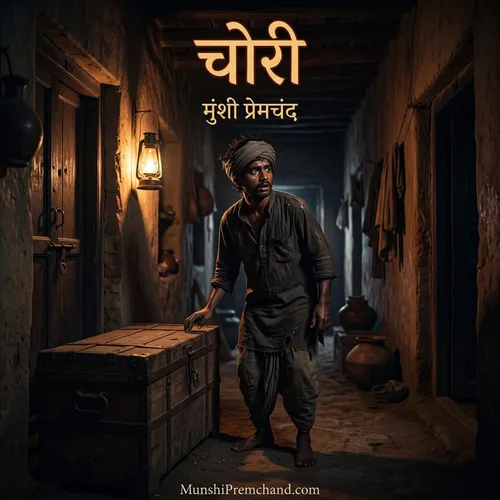
Complete English Translation: Chori (The Theft)
1
Ah, childhood! The sweet, unforgettable memory of childhood!
That dilapidated mud hut with its thatch roof, that bed of loose straw; roaming bare-chested and barefoot across the green fields; scrambling up high mango trees—every single scene dances before my eyes today with breathtaking clarity.
What boundless delight we found in wearing crude, country-cured leather shoes—a joy that the finest imported Flex boots fail to bring me now! The sweet, invigorating warmth of freshly drawn sugarcane juice had a nectar-like zest that the most expensive rose sherbet cannot rival; the rustic flavor of parched grains and tart green berries offered a bliss that grapes and royal sweetmeats like kheer-mohan can never bestow.
Every morning, I used to walk with my elder cousin Haldhar to a neighboring village to study under a Maulvi Sahib. I was eight years old at the time; Haldhar (who now resides in the heavens) was two years my senior.
At dawn, both of us would finish off our breakfast of cold, leftover rotis, pocket a handful of parched barley and peas for our midday meal, and set out on our way. After that, the entire day belonged exclusively to us!
Maulvi Sahib maintained no formal attendance register, nor did anyone ever have to pay a fine for being absent. What was there to fear?
Sometimes we would stand transfixed outside the local police outpost, watching the constables perform their drill; sometimes we spent hours trailing behind a street juggler who danced a bear or a performing monkey; at other times, we wandered off toward the railway station to gaze with wonder at the thundering trains. We possessed far more accurate knowledge of the arrival and departure of every train than the railway's printed timetable itself!
Along our daily path, a wealthy merchant from the town had begun planting an extensive orchard. A deep masonry well was being excavated there. That, too, provided an endlessly fascinating spectacle for us.
The aged gardener would invite us warmly into his thatched hut and seat us with great affection. We would fight among ourselves to do his chores for him! Now we were carrying buckets of water to irrigate the tender saplings; now we were crouched down with small trowels, weeding the vegetable patches; now we were busy with shears, trimming the climbing vines. What unadulterated joy there was in those tasks!
That old gardener was a profound scholar of child psychology. He extracted hard labor from us, but did so in a manner that made us feel as though he were conferring a great favor upon us. The amount of work he would take an entire day to complete, we two boys would finish off in less than an hour!
That gardener is no longer in this world; but the orchard stands green and flourishing. Whenever I pass by that way, my heart yearns to run forward, embrace those tall trees, and weep upon their barks: My beloved friends, you have forgotten me, but I have never forgotten you; in my heart, your memory remains as fresh and green as your leafy boughs. You are the living embodiments of selfless love!
Sometimes we stayed absent from our lessons for weeks on end; yet we would fabricate such ingenious excuses before Maulvi Sahib that his furrowed brows would instantly smoothen.
If I possessed that same fertile power of imagination today, I would write such a magnificent novel that the whole world would marvel! As things stand now, it is only after cudgeling my brain for hours that a meager short story presents itself.
Well, our Maulvi Sahib was actually a tailor by trade; he taught school purely out of personal hobby. We two brothers used to sing his praises relentlessly among the Kurmi farmers and Kumhar potters of our village. In truth, you could say we were Maulvi Sahib's roving business agents. Whenever Maulvi Sahib secured tailoring orders through our enthusiastic advocacy, our joy knew no bounds!
On days when no clever excuse came to mind for our absence, we would carry some little gift for Maulvi Sahib. Sometimes we plucked half a seer of fresh green pea pods from the fields; sometimes five or ten juicy stalks of sugarcane; at other times, a handful of tender green ears of wheat or barley. The moment he caught sight of these agrarian offerings, Maulvi Sahib's fiery wrath would evaporate into thin air.
When these agricultural bounties were out of season, we devised entirely different strategies to escape punishment. Maulvi Sahib had a passionate fondness for songbirds. The schoolroom was hung with cages of shyama birds, bulbuls, dahiyal robins, and crested larks. Whether we students memorized our lessons or not, the birds certainly memorized theirs—they recited their verses alongside us! We showed immense enthusiasm in grinding roasted gram flour to prepare bird feed for them. Maulvi Sahib was constantly urging the boys to capture live moths and grasshoppers from the fields, for these birds took supreme delight in feasting upon insects. Often our impending doom was transferred onto the heads of those unfortunate grasshoppers—by sacrificing them, we succeeded in mollifying Maulvi Sahib's terrifying wrath!
2
One morning, the two of us went down to the village pond to wash our faces. Haldhar held out his tightly clenched fist and whispered mysteriously, "Look what I have!"
I eagerly pried open his fingers; there, resting on his palm, was a brand-new silver rupee!
Astounded, I asked, "Where did you get this rupee?"
Haldhar grinned. "Amma had placed it up on the high wall-niche. I stood my charpai upright against the wall and climbed up to fetch it."
There was neither an iron safe nor a wooden almirah in our house; whatever money arrived was simply tucked onto a high earthen niche in the wall. The day before, Uncle had sold a harvest of raw hemp, and that money had been set aside to pay the landlord's rent. Heaven knows how Haldhar had noticed it. When everyone in the household was busy with morning chores, he stood his cot on end, climbed up like an acrobat, and extracted a silver coin.
Until that moment, neither of us had ever touched a whole rupee in our entire lives!
The waves of exhilarating joy and spine-chilling terror that surged through our hearts upon beholding that coin remain vivid in my memory to this day. For us, a silver rupee was an unattainable treasure of mythical proportions. Our household paid Maulvi Sahib a monthly fee of merely twelve annas, and at the end of each month, Uncle himself walked over to deliver the coins. Who could possibly measure the sheer magnitude of our pride?
Yet the looming terror of a thrashing cast a dark shadow over our ecstasy. The coins on the shelf were not uncounted. That the theft would be discovered was a foregone conclusion. Haldhar had already had firsthand experience of Uncle's terrifying temper, even if I had not. Ordinarily, there was no simpler, gentler man on earth than Uncle; had his brother not taken upon himself the burden of managing his affairs, any petty shopkeeper in the bazaar could have cheated him blind. But once his fury was aroused, he lost all reason. Even Aunt trembled with fright at the prospect of facing his rage.
We debated the matter for several minutes, and in the end, we arrived at the unanimous verdict: Goddess Lakshmi had stepped into our hands of her own accord, and we must not let her depart! In the first place, suspicion would never fall upon us; and even if it did, we would deny everything with brazen innocence. We would ask, What would we little children ever do with a rupee?
Had we paused to reflect a little more deeply, that foolish decision would have been overturned, and that gruesome spectacle which unfolded later would never have taken place. But at that tender age, we lacked the capacity for cool, balanced deliberation.
Having washed our faces and hands, we crept back home and stepped inside with pounding hearts. If a search of our pockets were conducted at that moment, God alone could save us! But everyone was absorbed in their daily chores. No one paid us the slightest heed.
Without touching breakfast or taking our daily portion of parched grain, we tucked our schoolbooks under our arms and raced out toward the maktab.
It was the rainy season. Dark clouds blanketed the sky. We trotted along toward school in high spirits. Even had we been granted a ministerial portfolio in the Viceroy's Executive Council that morning, we could hardly have felt greater euphoria! We wove thousands of ambitious plans, building castles in the air. Such an extraordinary opportunity had come to us through monumental good fortune; in all our lives, we might never witness its like again. Therefore, we wanted to disburse the rupee in such a calculated manner that its joy would last for days on end.
In those days, excellent sweetmeats sold for five annas a seer, and half a seer of sweets would have left the two of us bursting at the seams; but the thought crossed our minds that if we squandered it on sweets, the entire rupee would vanish before the sun set. We needed something inexpensive that was delicious, filled the belly, and consumed only a fraction of our capital.
Finally, our eyes fell upon a basket of ripe guavas. We agreed instantly. We purchased two copper pice worth of guavas from a fruit-seller woman. Those were inexpensive times; for two pice, she gave us twelve magnificent, plump guavas! The laps of both our kurtas were overflowing.
When Haldhar placed the silver rupee in the woman's hand, she scrutinized the coin with deep suspicion and asked:
"Where did you get a silver rupee, little masters? You haven't stolen it, have you?"
Our reply was ready on the tip of our tongues. After all, we had studied two or three Urdu primers; the polish of education had already begun to take effect!
I blurted out without missing a beat: "We have to pay Maulvi Sahib's monthly fee. There was no small change at home, so Uncle gave us a silver rupee."
This smooth explanation dispelled the fruit-seller's doubts.
We sat down upon the stone ledge of a roadside culvert and devoured the guavas with relish.
Now, however, a new dilemma arose: what were we to do with fifteen and a half annas in loose copper coins? Hiding a single silver rupee was easy enough, but where on earth could we conceal a mountainous heap of copper coins? There was no room around our waists, nor did our tiny pockets possess such capacity. Carrying them on our persons was tantamount to beating a drum and announcing our theft to the world!
After extensive agonizing, we reached a resolution: twelve annas would be paid to Maulvi Sahib in advance, and the remaining three and a half annas would be squandered on sweets and treats at leisure!
Having settled this policy, we arrived at the maktab. We were attending school after an absence of several days.
Maulvi Sahib flared up in anger: "Where have you two been wandering all these days?"
I replied meekly, "Maulvi Sahib, there was a death in our family."
Even as I spoke, I placed twelve annas in loose change before him upon his low desk.
What more was there to ask? The moment his eyes fell upon the gleaming coins, Maulvi Sahib's face blossomed into a radiant smile! There were still several days left before the month ended. Ordinarily, his fees were realized only well after the month had passed, and then too only after repeated reminders and entreaties. Receiving his money so early this time, his unbounded delight was hardly unnatural.
We cast triumphant, haughty glances at the other boys, as though proclaiming: Look at yourselves—even after repeated demands, you cannot bring your fees; and look at us—we pay in advance!
3
We were still busy reciting our morning lessons when news arrived that a grand fair was being held that afternoon beside the village pond, and that school would be dismissed early so that Maulvi Sahib could take his prize bulbuls to participate in the bird-fighting tournament!
Hearing this news, our joy knew no bounds. Twelve annas were already securely deposited in the bank; the remaining three and a half annas were reserved for the fair. What a glorious outing it would be! We would feast on crisp rewaris, gorge on spicy golgappas, ride the spinning wooden ferris wheel, and return home only at twilight.
However, Maulvi Sahib imposed one stringent condition: every student must recite his day's lesson faultlessly before being granted leave. Whoever failed to recite would not be permitted to leave the room!
The result was that I recited my lesson smoothly and obtained my dismissal; but poor Haldhar stumbled, and was sentenced to detention!
Several other boys had successfully recited their lessons, and they all set off toward the fairground together. Having the money in my own pocket, I did not wait for Haldhar. It had been agreed between us that the moment he was released, he would run straight to the pond, where we would tour the fair together. I gave him my solemn word of honor that until he arrived, I would not spend a single copper pice.
Little did I suspect what cruel drama misfortune was orchestrating behind our backs!
More than an hour passed after I reached the fair, yet there was no sign of Haldhar. Had Maulvi Sahib still refused to release him, or had he lost his way? I strained my eyes, staring anxiously down the dirt road. Touring the fair alone brought no pleasure. A gnawing dread began to torment my heart: Could the theft have been discovered at home? Has Uncle caught Haldhar and dragged him away?
Finally, as twilight fell, I purchased a small packet of rewaris, ate a few, slipped Haldhar's share of the coins safely into my pocket, and turned toward home with slow, dragging steps.
Along the way, it occurred to me that I should check the maktab; perhaps Haldhar was still detained there. But the schoolroom was deserted and silent.
Presently, I met a village schoolmate playing in the dust. The moment he caught sight of me, he burst into a loud, mocking laugh:
"Aha, my friend! Just wait till you get home—see what a merciless thrashing is waiting for you! Your Uncle arrived at the maktab. He dragged Haldhar away while beating him black and blue! Heavens, he landed such a vicious punch that Master Haldhar fell flat on his face in the mud! He dragged him by the scruff of the neck all the way home! And that twelve-annas fee you paid Maulvi Sahib? Uncle snatched that back as well! You had better think of some clever excuse right now, or you will receive a beating you will remember for seven lifetimes!"
My wits deserted me; the blood drained completely from my face.
The very nightmare I had been dreading had materialized. My legs turned heavy as maunds of lead. Taking even a single step toward home felt impossible. I began reciting vows to every god and goddess whose name I could remember—promising laddus to one, pedas to another, sweet batashas to a third.
Reaching the outskirts of our village, I invoked the blessings of the Deeh, the village guardian spirit, for in his own territory, the Deeh's supreme will reigned supreme over all matters.
I did all this, yet the nearer I drew to our house, the more violently my heart hammered against my ribs. Ominous rain clouds were rolling across the darkening sky; it seemed as though the heavens were about to tear open and collapse. I noticed villagers abandoning their fields and running homeward; cattle with tails held high were leaping along toward their stalls; birds were fluttering frantically back to their nests. Yet I trudged along with agonizing slowness, as though all strength had vanished from my limbs.
I desperately wished that a raging fever would strike me down that very instant, or that I might slip and break an arm or leg! But wishing does not make the washerman ride his donkey. Death does not arrive when summoned. To say nothing of a sudden illness! Nothing happened, and despite my dragging steps, the front door of our house loomed before me.
What was I to do now?
4
Right outside our doorway stood a dense, shadowy tamarind tree. I concealed myself behind its thick trunk, planning to wait until night fell so that I could slip inside unnoticed and hide under my mother's wooden cot. Once everyone fell asleep, I would pour out the entire tale to Mother. Mother never raised her hand against me. If I shed a few fabricated tears before her, her heart would melt completely. Once the night passed, who would bother to interrogate me? By morning, everyone's fury would have cooled down.
Had that scheme succeeded, there is no doubt that I would have emerged without a scratch.
However, Providence had ordained otherwise. A neighborhood boy spotted me behind the trunk and ran into our courtyard, chanting my name at the top of his lungs!
Now all hope was extinguished.
Resigned to my fate, I stepped across the threshold, and an involuntary yelp escaped my lips—like a beaten cur that screams in terror the moment it sees someone approaching with a stick.
There in the outer vestibule sat my father.
His health had been somewhat delicate during those days, and he had taken leave from his office to convalesce at home. I cannot say precisely what ailment afflicted him; he ate only light moong dal, and in the evenings, he poured a dark liquid from a glass bottle into a tumbler and drank it slowly. Perhaps this was a medicinal tonic prescribed by some experienced physician. All medicines are foul-smelling and bitter; this tonic was certainly no exception. Yet heaven knows why Father drank this medicine with such immense relish!
When we children are forced to swallow medicine, we shut our eyes tight and gulp it down in a single shuddering draft; but perhaps the efficacy of this tonic lay in sipping it slowly and lingeringly. Two or three, and sometimes four or five other village 'patients' would gather around Father, and they would sit together sipping this medicine for hours on end, barely rising in time for dinner.
At that moment, too, he was partaking of his medicine. The circle of fellow patients was assembled around him. The instant Father laid eyes on me, his eyes flared red as burning coals:
"Where have you been wandering all this time?"
I stammered in a choked whisper, "Nowhere..."
"So you have begun learning the art of stealing!" he roared. "Speak up—did you steal that rupee or not?"
My tongue was paralyzed. A naked sword seemed to be dancing before my eyes. I was terrified even to utter a syllable.
Father shouted with thunderous fury: "Why don't you speak? Did you steal that rupee or not?"
Staking my very life on a desperate gamble, I croaked, "How could I..."
Before the complete sentence could leave my mouth, Father assumed a ferocious countenance. Grinding his teeth, he sprang to his feet with raised fist and charged straight at me!
I let out an ear-splitting, bloodcurdling shriek and began wailing at the top of my voice!
I screamed with such sheer hysteria that even Father was taken aback. His raised hand remained frozen in midair. Perhaps he feared that if the boy was in such a wretched state already, a single heavy blow might extinguish his frail life entirely! Seeing that my tactical maneuver had hit its mark, I tore my throat screaming even louder.
Just then, two or three men from the gathering leaped up, caught hold of Father, and signaled to me: Run inside!
Children often turn obstinate in such crises and needlessly invite a beating; but I acted with wisdom. I bolted through the inner doorway.
However, the scene that greeted me inside the courtyard was ten times more horrifying!
The blood froze in my veins.
Haldhar's hands were tied securely to a wooden pillar with coarse rope. His entire body was covered in dirt, and he was sobbing convulsively. It appeared that he had rolled all over the courtyard floor in agony; the earth seemed dampened with his tears.
Aunt was standing over him, showering him with furious curses, while Mother sat nearby grinding spices on a stone slab.
Aunt's eyes fell upon me first. She snapped: "Look, here comes the other one! Tell me, did you steal the rupee, or did this wretch?"
Without a single heartbeat of hesitation, I declared boldly:
"Haldhar did!"
Mother looked up and asked, "If he stole it, why didn't you come straight home and inform us?"
Now, escaping without telling a blatant lie was an absolute impossibility.
In my philosophy, when a man's very life is at stake, telling a lie is entirely forgivable! Haldhar was thoroughly accustomed to receiving beatings; a few extra punches would not diminish his health in the least. As for myself, I had never tasted a beating in my life; two solid blows from Uncle or Father would have finished me off forever!
Furthermore, Haldhar had clearly tried to implicate me to save his own skin; otherwise, why would Aunt have asked, Did you steal the rupee, or Haldhar? By every tenet of practical self-preservation, my lie was, if not praiseworthy, certainly pardonable.
I blurted out instantly: "Haldhar warned me that if I dared tell anyone, he would kill me!"
Mother exclaimed triumphantly: "Look! Didn't I tell you that was the truth? I kept saying that my child has no such wicked habit! He never touches money with his hands—yet everyone was trying to make a fool out of me!"
Haldhar cried out in desperate protest: "When did I ever tell you that I would kill you if you told?"
I retorted firmly, "Right there, beside the village pond!"
Haldhar wailed, "Amma, it is an absolute lie!"
Aunt turned upon Haldhar with blazing eyes: "No, it is the absolute truth! You are the born liar, while the rest of the world is truthful! Your guilt has already been proven! If your father held a respectable job and brought home bags of cash, and four respectable men sang his praises, you too would be deemed truthful. As things stand, you alone are the liar! He whose destiny held sweets ate sweets; while your wretched destiny was written only for boots and beatings!"
Saying this, Aunt untied Haldhar from the pillar and led him inside by the hand.
By delivering that affectionate, biased testimonial in my defense, Mother had completely reversed the roll of the dice; otherwise, heaven alone knows what brutal thrashing the poor wretch would have endured!
I sat down beside Mother and sang my tune of injured innocence with great flourishes. My simple-hearted mother regarded me as the very incarnation of truth (satya ka avatar). She became utterly convinced that the entire crime rested squarely on Haldhar's shoulders.
A moment later, I emerged from the pantry clutching a bowl of jaggery and roasted barley.
At that very instant, Haldhar also emerged from the opposite chamber, munching on a handful of flattened rice (cheewda).
The two of us stepped out into the courtyard together, and began sharing our adventures with boundless childhood camaraderie. My tale was a story of triumphant bliss; Haldhar's was a saga of tragic sorrow.
Yet the grand finale for both of us was identical: sweet jaggery and parched grain!
Summary of Chori (The Theft)
'Chori' is a delightful, autobiographical short story that captures the innocence, mischief, and practical self-preservation of childhood with profound psychological insight. The narrator reminisces about his eight-year-old childhood in a rural village, where he and his ten-year-old cousin Haldhar were supposed to attend a village maktab run by a kindly tailor-maulvi. Rather than studying, the boys routinely spent their days wandering behind animal charmers, watching police drills, gazing at steam trains, and eagerly assisting an old gardener in a nearby orchard, mollifying their teacher with gifts of fresh peas, sugarcane, and live grasshoppers for his pet songbirds.
The plot pivots when Haldhar steals a silver rupee from a high earthen wall-niche at home—money set aside by their uncle to pay the landlord's rent. Overjoyed yet terrified by the prospect of an inevitable beating from their hot-tempered uncle, the boys resolve to enjoy the fortune: they purchase two pice worth of fresh guavas, pay twelve annas in advance to their astonished and delighted Maulvi to ensure his goodwill, and retain the remaining three and a half annas to indulge in treats at the village pond fair. However, their plans unravel when Haldhar is detained at school for failing his lesson, while the narrator heads to the fair alone. Back home, the theft is discovered; the uncle catches Haldhar, thrashes him, reclaims the twelve annas from the schoolmaster, and drags him home tied with ropes.
Returning late at dusk, the narrator discovers the catastrophe. He narrowly escapes a beating from his father by staging an ear-splitting theatrical scream that paralyzes his father's raised hand. Running inside the courtyard, he finds Haldhar tied to a pillar and covered in dust. When questioned, the narrator shamelessly shifts the entire blame onto Haldhar, fabricating a lie that Haldhar had threatened to kill him if he spoke. Supported by his doting mother, who regards him as the 'incarnation of truth', the narrator escapes completely scot-free while Haldhar absorbs the blame. Remarkably, the story ends not in bitterness, but in pure childhood resilience: moments later, both boys emerge into the courtyard sharing bowls of jaggery, parched barley, and flattened rice, trading their escapades without an ounce of resentment.
Publication History
'Chori' was written in 1927 and first published in contemporary literary periodicals before being collected in Mansarovar (Volume 5), standing as one of Premchand's most beloved autobiographical sketches of rural childhood.
This unabridged English translation was published in 2026 by MunshiPremchand.com as part of the MunshiPremchand.com English Translation Series.
Themes & Critical Significance
- Child Psychology and Innocent Rationalization: Premchand masterfully captures the cognitive world of children, where a single stolen rupee represents unimaginable wealth rather than criminal intent. The boys' frantic calculations—choosing cheap guavas over expensive sweets and advance-paying school fees—reveal how children attempt to negotiate between temptation and guilt.
- Self-Preservation and Situational Morality: The narrator's brazen lie—accusing Haldhar of threatening his life—is presented not as malicious evil, but as an instinctive mechanism of survival. His candid admission that Haldhar was accustomed to beatings while he himself would perish under two blows highlights the comic yet desperate logic of childhood fear.
- Parental Bias and Domestic Dynamics: The story humorously exposes the subjective nature of maternal faith. The narrator's mother instantly defends her son as incapable of touching money, while Haldhar's mother resignedly accepts that her son is destined for thrashings, demonstrating how parental favoritism shapes domestic justice.
- Childhood Resilience and Absence of Grudge: The concluding image—where both boys sit together eating jaggery and parched grain despite the day's beatings and betrayals—celebrates the purity of childhood. Unlike adults, children do not harbor lingering malice or existential guilt; their world resets the moment shared food and companionship return.