Halku came inside the house and said to his wife, "Sahna has arrived. Fetch whatever money is put away so I can pay him off and get him off my back once and for all."
Munni was sweeping the floor. She turned around and said, "There are only three rupees in the house. If you give those away, where will a blanket come from? How will you survive the freezing nights of Magh and Poos out in the fields? Tell him we will pay after the harvest. Not right now."
Halku stood in indecision for a moment. The month of Poos was already upon them, and without a blanket, going out to watch the field at night was impossible. But Sahna would not listen; he would hurl insults and curses. Let me freeze to death in the winter, Halku thought, at least this calamity will pass from over my head. Thinking this, he stepped closer to his wife with his heavy, sturdy frame—which belied his fragile circumstances—and pleaded, "Go on, give it to me, let us get rid of him. I will think of some other way for the blanket."
Munni stepped back, her eyes flashing with anger. "Oh, indeed! Another way! Let me hear what great plan you have! Will someone hand you a blanket in charity? Who knows how much debt is still unpaid—it seems it will never end. I tell you, why don't you just give up farming altogether? You slave away day and night; whatever grows goes straight into paying debts, and we are left with empty hands! Were we born only to pay off debts? Work as a laborer for food instead. I've had enough of such farming! I will not give you the money—I won't!"
Halku said dejectedly, "So should I just sit here and swallow his abuses?"
Munni snapped back, "Why should he abuse you? Is it his kingdom?"
Yet even as she spoke, her furrowed brow softened. The grim truth in Halku's words stared back at her like a menacing beast.
She went to the alcove, retrieved the three rupees, and placed them in Halku's palm. Then she said, "Give up farming this season. At least as a manual laborer, you will eat a piece of bread in peace. You won't have to endure anyone's threats. What kind of farming is this—work yourself to the bone, throw every penny back into the field, and get cursed on top of it!"
Halku took the money and walked out as though he were handing over his very heart. He had saved those three rupees penny by penny from his wages to buy a blanket. Today they were gone. With every step, his head bowed lower under the weight of his own helplessness.
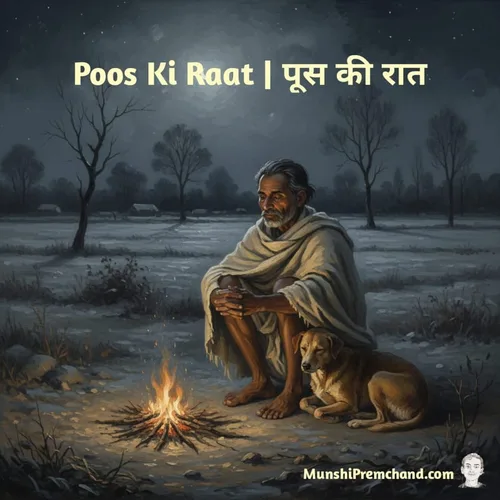
A dark, freezing night in the month of Poos! Even the stars in the sky seemed to be shivering. Halku lay trembling on his bamboo cot under a makeshift canopy of sugarcane leaves at the edge of his field, wrapped in a thin, worn cotton sheet. Beneath the cot, his companion dog, Jabra, curled his head into his belly, whimpering with cold. Neither man nor dog could catch a wink of sleep.
Halku tucked his knees up to his chin and said, "What's the matter, Jabra? Feeling cold? I told you to stay indoors on the straw, but no, you had to run out here with me. Now take the cold! What can I do? You thought I was coming here to feast on halwa and puris, so you ran ahead of me. Now go on, cry about it!"
Jabra wagged his tail while lying down, let out a long yawn, and fell silent. His canine intellect had perhaps realized that his whimpering was disturbing his master's rest.
Halku reached out his hand, stroked Jabra's cold back, and said, "Don't come with me tomorrow, or you'll freeze to death. This cursed westerly wind is blowing as if it's carrying ice straight from the mountains. Let me get up and light a pipe. At least it will help pass the night! I've already smoked eight pipes. Ah, the joy of farming! And look at the rich folk—if winter tries to touch them, it runs away in fear of their warmth. Thick mattresses, heavy quilts, plush blankets! Winter wouldn't dare get near them. What a stroke of fate—we do the work, and others reap the pleasure!"
Halku stood up, pulled a few embers from a hollow in the ground, and filled his clay pipe. Jabra sat up as well.
Halku took a drag and offered, "Want a smoke? It won't drive away the cold, but it takes your mind off it."
Jabra looked into his master's face with eyes overflowing with affection.
"Just endure tonight's cold," Halku said. "Tomorrow I'll spread straw for you here. You can burrow into it, and you won't feel a bit of cold."
Jabra placed his paws on Halku's knees and brought his snout close to his face. Halku felt his warm breath.
After finishing his pipe, Halku lay down again, determined to sleep no matter what. But in an instant, his body began to shiver violently. He turned from side to side, but the cold sat upon his chest like a demon.
When he could bear it no longer, he gently lifted Jabra, patted his head, and pulled the dog into his lap. The dog's body gave off a strange odor, yet Halku hugged him tight, experiencing a warmth and comfort he had not felt in months. Jabra seemed to feel he had reached heaven, while Halku's pure soul held not a trace of disgust for the dog. He would have embraced his closest friend or brother with the very same affection. He felt no humiliation in his poverty today—this unique bond of friendship seemed to open every window of his soul, illuminating every atom of his being.
Suddenly, Jabra caught the scent of an animal. This new sense of intimacy infused him with fresh vigor that mocked the icy wind. He leaped up, ran out from under the canopy, and began to bark. Halku called him back several times with gentle whistles, but Jabra refused to return. He ran around the field in all directions, barking fiercely. Duty throbbed in his heart like an ardent desire.
Another hour passed. The night fanned the cold wind into a fiercer chill. Halku sat up, pressed both knees against his chest, and buried his head between them, but the freezing cold did not relent. It felt as if his blood had frozen solid, as if ice ran through his veins instead of blood. He leaned back and looked up at the sky—how much of the night was left? The Seven Sages constellation had not even crossed half the sky. It would be morning only when they reached the zenith. Over three hours of night still remained.
A short distance from Halku's field lay a mango grove. Autumn had arrived, and the ground was covered with thick layers of fallen leaves. Halku thought: I should go gather those leaves and burn them to make a grand bonfire. If anyone sees me gathering leaves at night, they might think I'm a ghost! Who knows if some wild beast is hiding there, but I cannot sit here shivering any longer.
He went to a nearby pulse field, pulled up several dry stalks to make a broom, and walked toward the orchard holding a smoldering piece of cow dung cake in his hand. Seeing him move, Jabra came along, wagging his tail.
Halku said, "I can't stand it any longer, Jabru. Let's go to the orchard, gather leaves, and warm ourselves. Once we're nice and warm, we'll come back and sleep. There's still plenty of night left."
Jabra whimpered in agreement and ran ahead into the orchard.
The orchard was shrouded in deep darkness, and an unmerciful wind crushed the dry leaves underfoot. Dewdrops dripped continuously from the trees like heavy tears.
Suddenly, a gust of wind arrived carrying the fragrance of henna flowers.
Halku remarked, "What a sweet scent, Jabru! Can you smell it too?"
Jabra had found a bone on the ground and was busy gnawing at it.
Halku set the smoldering ember on the ground and began gathering leaves. In a short while, he had built a mountain of leaves. His hands were numb, his bare feet felt frozen, yet he kept piling up the leaves. In this fire, he would burn the cold to ashes!
Soon, the bonfire blazed up. The flames leaped high, reaching for the overhead branches. In that flickering light, the giant trees of the orchard seemed to hold up the vast darkness on their heads. In that boundless sea of dark, the fire shone like a trembling boat.
Halku sat before the fire, soaking in the warmth. After a moment, he took off his thin sheet, tucked it under his arm, and stretched out his legs as if daring the winter: Do whatever you can! Having conquered the immense power of the cold, he could not hide his triumphant pride.
He asked Jabra, "Well, Jabbar? Feeling cold now?"
Jabra whimpered as if to say, "How could I feel cold now?"
"If only we had thought of this earlier, we wouldn't have suffered so much!"
Jabra wagged his tail.
"Come on, let's jump over the fire and see who wins! But listen, if you get singed, don't blame me!"
Jabra looked at the blazing fire with timid eyes.
"Don't tell Munni tomorrow, or she'll throw a fit!"
Saying this, Halku leaped cleanly over the flames. A stray spark touched his feet, but it was nothing. Jabra ran around the fire and stood by his side.
Halku laughed, "No, no! That doesn't count! Jump over it like I did!" He jumped again and landed safely on the other side.
The leaves had burned to ashes. Darkness returned to the orchard. Beneath the ash layer, a few embers still glowed, waking briefly whenever a gust of wind passed before closing their eyes again.
Halku wrapped himself in his thin sheet once more and sat near the warm ashes, humming a tune. Warmth had returned to his body, but as the cold deepened, a heavy laziness washed over him.
Suddenly, Jabra barked loudly and dashed toward the field. Halku heard the distinct sound of a herd of animals trampling through his crop. It seemed to be a herd of wild blue bulls (nilgai). The sound of their leaping and galloping was clear, followed by the steady crunching of animals devouring the crop.
He thought to himself: No, with Jabra out there, no animal can enter the field. He would tear them apart. I must be imagining things. There's nothing now. How easily I was deceived!
He called out loudly, "Jabra! Jabra!"
Jabra kept barking in the distance and did not return.
Again came the sound of the crop being munched. Now he could no longer deceive himself. Yet moving from his spot felt like poison. It was so cozy near the ashes! To go out into the freezing frost and chase wild animals felt unbearable. He did not budge.
He called out from where he sat: "Liho! Liho! Shoo! Shoo!"
Jabra barked frantically. The animals continued to ruin the field. The crop was fully grown, a bountiful harvest, and those wild beasts were destroying everything.
Halku made a firm resolve and stood up. He took two or three steps, but suddenly a sharp, icy wind struck him like a scorpion's sting. He retreated to the dying embers, stirred the ashes, and warmed his freezing body once more.
Jabra was barking himself hoarse, the wild cattle were flattening the entire field, and Halku sat peacefully by the warm ashes. A overwhelming apathy had bound him hand and foot like heavy ropes.
Wrapped in his sheet, he lay down on the warm earth beside the ashes and fell fast asleep.
When he woke up the next morning, the sun was high in the sky. Munni was standing over him, saying, "Are you going to sleep all day? You're resting here comfortably while the entire field has been ruined!"
Halku sat up and asked, "Are you coming from the field?"
Munni replied bitterly, "Yes! The whole field is destroyed! Is this why you built a hut here—to sleep like a log? What was the point of coming here at all?"
Halku made an excuse: "I nearly died of a stomach ache last night—only I know how I survived! You worry about the field!"
Both walked over to the edge of the field. The entire field lay trampled and devoured. Under the canopy, Jabra lay flat on his side, as though life had left his body.
They both gazed at the ruin. Munni's face was heavy with grief, but Halku looked strangely content.
Munni said anxiously, "Now we will have to work as manual laborers to pay off the land tax!"
Halku smiled and said, "At least I won't have to sleep out here in the freezing cold night anymore."
Significance & Themes
- The Tragedy of Feudal Exploitation: Premchand exposes how crushing debt and unfair land taxation drive small farmers into hopeless poverty, making manual wage labor feel like relief compared to the torture of agricultural subsistence.
- Human-Animal Bond: The deep, unconditional affection between Halku and his dog Jabra provides the story's emotional heart, showing how even in extreme destitution, empathy and companionship survive.
- Apathy as a Defense Mechanism: Halku's refusal to leave the warm ashes while wild cattle ruin his crop is not mere laziness, but a psychological breakdown where extreme physical suffering forces a man to abandon his livelihood just to feel warm.