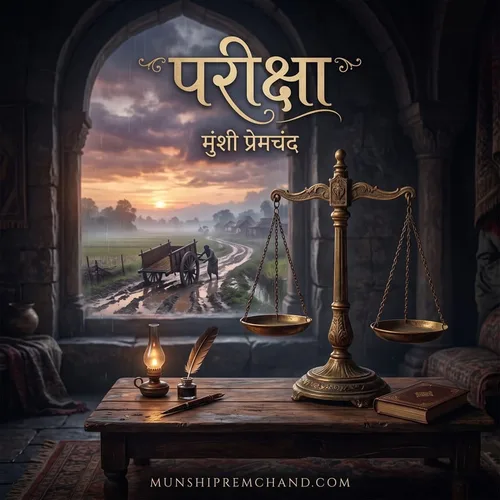
Sardar Sujan Singh had served as the Prime Minister (Dewan) of Devgarh princely state for forty long years.
Now, old age had overtaken his body. He approached the ruling Prince (Raja) and humbly requested permission to retire: "Your Highness, I have served this estate for forty years. Now my physical strength is failing. I fear lest in my old age I commit some error that might stain the reputation I have built over a lifetime."
The Raja respected Sujan Singh deeply. He attempted to persuade him to stay; but seeing the old man's firm resolve, he eventually accepted his resignation on one condition: Sujan Singh himself must choose his successor.
The next day, a nationwide announcement was published in all major newspapers:
"The princely state of Devgarh requires a new Dewan. Candidates need not possess high university degrees; rather, selection will be based on character, moral integrity, physical stamina, and a deep sense of human duty. Candidates are invited to reside at Devgarh for one month at state expense, during which their conduct and habits will be observed."
The advertisement created a sensation throughout the country.
From all corners of India—from Punjab, Bengal, Madras, and the United Provinces—hundreds of ambitious candidates poured into Devgarh. Among them were university graduates, lawyers, aristocrats, and scholars. Some arrived dressed in fashionable Western suits, while others wore simple traditional robes to display humility.
Sardar Sujan Singh arranged luxurious lodging and hospitality for all the guests. However, he kept the exact method of evaluation a complete secret!
The candidates immediately began performing virtue.
A candidate who normally slept until nine in the morning now woke up at dawn to walk gracefully in the garden, reciting sacred verses.
A man who treated his domestic servants harshly at home now addressed state attendants with extreme politeness as "Aap" and "Janaab".
Those who loathed reading now sat in the library for hours holding massive leather-bound treatises. Hypocrisy, artificial politeness, and calculated modesty reigned supreme in Devgarh!
Every candidate believed that if he could maintain this performance for thirty days, the coveted Prime Minister's throne would be his.
Sujan Singh, however, watched them like an experienced jeweler examining precious stones. He knew that virtue performed under observation tells very little about a man's true soul. Character reveals itself only in an unguarded moment when no reward is expected!
Towards the end of the month, some of the athletic candidates organized a competitive hockey match.
The match was played with fierce passion and athletic energy. It ended at dusk without a decisive victory, leaving the players exhausted and drenched in sweat.
Not far from the sports field lay a deep, muddy ditch without a bridge.
As dusk fell, a poor farmer arrived driving a cart heavily laden with grain sacks. The weak bullocks struggled to pull the heavy cart up the steep, slippery embankment. The wheels sank deep into the thick mud.
The farmer whipped his oxen, pushed the wheels with all his strength, and shouted for encouragement; but every attempt failed. The cart slid back deeper into the mire. Exhausted, sweating, and helpless, the farmer sat by the roadside, staring at his trapped cart in despair. Night was falling, and he could neither abandon his grain nor pull the cart alone.
At that moment, the group of candidates marched past carrying their hockey sticks.
The farmer looked at them with hopeful, pleading eyes. Yet, no one stopped. The very candidates who had spent twenty-nine days displaying extreme politeness and charity walked past the struggling farmer without offering a hand! In the absence of an official audience, their performed virtue vanished completely.
However, trailing behind the group was one young candidate named Pandit Jankinath.
Jankinath had injured his ankle during the hockey match and was limping painfully behind the rest. He had every valid excuse to ignore the situation and walk home.
Yet, seeing the old farmer's distress, Jankinath halted immediately.
Without a second thought, he laid his hockey stick on the grass, removed his fine coat, and waded straight into the thick mud!
"Do not worry, brother!" Jankinath called out to the farmer. "Hold the reins of the bullocks and urge them forward—I will push the wheel from behind!"
Jankinath placed his shoulder against the muddy wheel and heaved with all his strength! His feet sank deep into the mire, and his injured ankle throbbed with intense pain; yet he refused to give up.
"Heave ho!" Jankinath roared.
With a powerful collective push, the heavy cart crested the muddy embankment and rolled onto firm ground!
Drenched in sweat, covered in mud from head to toe, and wincing from his injured ankle, Jankinath stood panting.
The overjoyed farmer folded his hands in tears: "May God bless you, young master! You saved me from spending the cold night in this ditch! If Providence wills it, the Dewan's crown will rest on your head!"
Jankinath smiled humbly, wiped the mud from his face, and limped away into the dusk, asking for nothing in return.
The thirty-day observation period concluded.
On the day of the final announcement, a grand royal court (Darbar) was convened. The Raja of Devgarh sat on his golden throne, surrounded by ministers, aristocrats, and hundreds of anxious candidates whose hearts pounded with anticipation.
Sardar Sujan Singh stepped forward to address the assembly:
"Gentlemen! I thank you all for gracing Devgarh with your presence. Devgarh did not merely seek a man of high academic learning; we sought a man who possesses a compassionate heart and immovable moral courage!"
"True intellect is useless without human sympathy. A man who possesses degrees may govern with cold efficiency; but a man who possesses a compassionate heart will govern with justice."
"I have found such a man among you—a man who, despite being injured himself, waded into deep mud to rescue a helpless farmer's cart, expecting no reward and unaware that anyone was watching!"
Sujan Singh raised his hand and pointed toward the back row:
"I appoint Pandit Jankinath as the new Dewan of Devgarh!"
A wave of astonishment swept through the court! Some candidates felt envious, while others bowed their heads in admiration.
Sujan Singh concluded with proud conviction:
"A man who risks his own pain to relieve the suffering of the poor will never oppress the weak. Devgarh's future is safe in his hands!"
Significance & Themes
- Character Over Credentials: Premchand presents a timeless critique of elite academic credentialism, arguing that true leadership requires moral integrity, empathy, and courage rather than mere degrees.
- The Unguarded Moment: True character cannot be faked through calculated public performance; it reveals itself spontaneously when helping others offers no personal gain.
- Ethical Governance: The story emphasizes that administrators who wield power over the poor must possess a compassionate heart so that authority never transforms into tyranny.