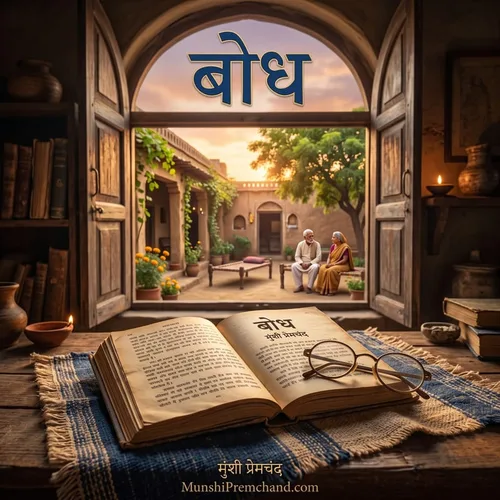
Complete English Translation: Bodh (Realization)
Pandit Chandradhar had taken up the profession of schoolmaster in an upper-primary school, yet he lived in constant, bitter regret, wondering from what cursed hour he had trapped himself in this wretched quagmire. Had he been employed in any other department, he would have had money in his hands by now and passed his days in comfort and ease. Here, only after waiting on tenterhooks for an entire month did he catch a glimpse of a paltry fifteen rupees. And even that vanished the moment it arrived—here one moment, gone the next. Neither was there the pleasure of fine food, nor the comfort of decent clothes. "Even common day-laborers are better off than us!" he would sigh.
In Panditji's neighborhood lived two other prominent gentlemen. One was Thakur Atibalsingh, who was a Head Constable at the local police station; the other was Munshi Baijnath, who was a revenue-records clerk (siyahe-navees) at the tahsil office. The official salary of these two gentlemen was not much higher than Panditji's, yet they lived in grand style and luxury.
In the evening, returning from the court or station, they would toss coins and sweetmeats to the children. Both gentlemen maintained domestic manservants. Their houses were furnished with chairs, tables, carpets, and all sorts of fine appointments. In the twilight hours, the Thakur would recline upon his easy chair, puffing on his aromatic, perfumed hookah. Munshiji was addicted to liquor and kebabs; seated in his well-decorated drawing room, he would empty bottle after bottle. When nicely intoxicated, he would play the harmonium.
Their awe and terror held sway across the entire neighborhood. Seeing either of these two gentlemen approaching, the grocers and grain-merchants would rise respectfully to offer formal salutations. For them, a separate, privileged price list existed in the marketplace. An item that sold to others for four pice a ser, they purchased for two. Firewood and fuel they obtained entirely free of cost.
Panditji would gaze upon their splendor, burning with jealousy and cursing his own misfortune. Those two knew so little that they could not even tell whether the earth revolved around the sun or the sun around the earth; they lacked even the most elementary knowledge of mountains or geography; yet Providence had bestowed upon them such absolute power and influence!
These two gentlemen condescended to bestow great favor upon Panditji. Now and then they would send him half a ser or a ser of milk, or a handful of fresh vegetables. But in return for these petty courtesies, Panditji had to supervise the studies of the Thakur's two sons and Munshiji's three boys.
The Thakur would say: "Panditji! These boys do nothing but play all the time; do keep an eye on them."
Munshiji would declare: "These boys are turning into vagabonds; do look after them."
These words were spoken with such an air of patronizing condescension, as though Panditji were their personal slave. Panditji found this treatment utterly intolerable, yet he lacked the courage to displease them. Thanks to their patronage, he occasionally enjoyed a bowl of curd or milk, or tasted savory chutneys and pickles. More than that, he could purchase goods from the market at cheaper rates. For these petty gains, the poor man swallowed their insolence like a bitter draught of poison.
To extricate himself from this wretched plight, he had made countless efforts. He drafted petitions, flattered superior officials, but his hopes were never realized. At last, completely disheartened, he resigned himself to his fate.
Yet in one respect he was unshakeable: he never permitted the slightest negligence in his work. He arrived precisely on time, stayed until late, and taught his pupils with wholehearted devotion. Consequently, his inspecting officers were thoroughly pleased with him. Every year they awarded him some token prize, and whenever an occasion for salary increments arose, they kept his name in mind. But in the education department, a salary increment is like harvesting barren wasteland—it falls into one's hands only by extraordinary luck.
The townsfolk, however, were deeply satisfied with him. The number of enrolled pupils had swelled, and the schoolboys adored him with all their hearts. One boy would run over to his house to fetch water, while another would pluck fresh leaves for his goat. Panditji considered even this humble affection a great treasure.
Once, in the auspicious monsoon month of Shravan, Munshi Baijnath and Thakur Atibalsingh resolved to undertake a pilgrimage to the holy shrine of Shri Ayodhyaji. It was a distant journey. Preparations commenced weeks in advance. It was the rainy season, and taking along their entire families presented serious logistical difficulties; but the womenfolk would not listen to reason. In the end, finding themselves helpless, both gentlemen took a week's leave from duty and set off for Ayodhya.
They also compelled Panditji to accompany them. In fairs, festivals, and bustling crowds, an extra man proves exceedingly useful for running errands. Panditji hesitated in a dilemma; but when they agreed to bear all his travel expenses, he could not refuse, nor could he bear to let slip so golden an opportunity to visit holy Ayodhya.
The train departed from Billhaur at one o'clock in the middle of the night. Having dined, the travelers arrived and sat waiting at the railway station. When the train steamed in, an utter stampede broke out. Thousands of pilgrims were traveling. In that frantic rush, Munshiji pushed ahead first. Panditji and the Thakur stayed together and managed to scramble into a compartment. In such a calamity, who could wait for whom?
There was an acute shortage of room in the carriages; yet in the compartment where the Thakur found himself, only four passengers were seated, all lying stretched out at full length. The Thakur wished that they would sit up so that room might be made for his party.
He barked at one passenger: "Sit up, fellow! Can't you see we are standing?"
The passenger, remaining flat on his back, replied: "Why should I sit up, mister? Have I taken a contract to provide you a seat?"
The Thakur: "Haven't we paid the railway fare?"
The passenger: "Go and demand a seat from whoever took your fare!"
The Thakur: "Speak with some sense! Ten passengers are permitted in this compartment."
The passenger: "This is not your police station; hold your tongue when you speak!"
The Thakur: "Who are you, fellow?"
The passenger: "I am that very man whom you framed on a false charge of dealing in contraband; from whose door you slunk away only after pocketing twenty-five rupees in hard cash!"
The Thakur gasped: "Aha! Now I recognize you! But after all, I showed you great leniency. Had I formally charged you in court, you would have ended up in prison."
The passenger: "And haven't I shown you leniency by letting you stand inside the train? Had I given you a shove, you would have landed on the tracks below, and not a single bone or rib of yours would have been found!"
Just then, another passenger lying nearby burst into a loud, mocking guffaw and said: "Well, Daroga Sahib, why don't you make me get up?"
The Thakur was turning crimson with boiling rage. He thought to himself: "Had this been my police station, I would have ripped your tongue out!" But at this moment, he was caught in a miserable trap. He was a physically powerful man, but both these passengers appeared equally strapping and sturdy.
The Thakur said: "Put your trunk down on the floor, and there will be room enough."
The second passenger retorted: "And why shouldn't you sit down on the floor yourself? What great disgrace will that bring upon you? This isn't a police station where your grand authority will be dented!"
The Thakur scrutinized him closely and asked: "Do you also harbor some grudge against me?"
"Yes, indeed! I am thirsty for your very blood!"
"What harm have I ever done to you? I haven't even seen your face before!"
The second passenger sneered: "You may not have seen my face, but I have seen yours! At the fair only yesterday, you showered several blows of your wooden lathi upon me. I was standing quietly watching the spectacle, but you stepped up and beat me to a pulp. I held my peace then, but the wound is burning deep in my heart! Today it shall find its medicine!"
Saying this, he stretched his legs out even wider and glared with blazing eyes.
Panditji had been standing silently all this while, terrified that a violent brawl might erupt. Seizing a favorable moment, he whispered counsel to the Thakur. As soon as the third railway station arrived, the Thakur hurriedly moved his wife and children out and boarded another compartment.
The two ruffians picked up his luggage and hurled it out onto the platform. When the Thakur was stepping down from the carriage, they delivered such a vicious shove that the poor constable went sprawling flat onto the platform. He scrambled up and ran to report the matter to the guard, but just then the engine blew its whistle. Swallowing his humiliation, he leaped into the other carriage.
Meanwhile, Munshi Baijnath was in an even more wretched plight. He spent the entire night awake. There was not room enough even to stretch a leg. Today he had filled a bottle with country liquor and kept it in his pocket! At every railway station, he had been imbibing "coal and water." The consequence was that his digestive system suffered a catastrophic breakdown.
He vomited violently, followed by agonizing abdominal cramps. The poor man was in desperate agony. He yearned to lie down somehow, but there was not enough space even to shift his feet. Up to Lucknow, he somehow controlled himself with grim endurance; beyond that, he could hold out no longer. At a small wayside station, he tumbled out of the carriage. He could not even stand upright and collapsed onto the platform.
His terrified wife hurried down with the children. She unloaded the luggage, but in the frantic hurry forgot to take down their iron trunk. The train steamed away.
Seeing his companion in this dire condition, the Daroga too stepped down. He realized at once that the gentleman had indulged far too heavily today. Upon examination, Munshiji's condition appeared truly alarming: high fever, excruciating stomach pain, muscle spasms, vomiting, and loose stools. Grave panic set in.
When the station master observed this spectacle, he assumed it was a case of deadly cholera (visuchika). He issued an immediate order: "Carry the patient outside the station premises this instant!"
Helpless, the companions lifted Munshiji and carried him under the shade of a tree outside. His wife began wailing. A frantic search for a doctor or hakim commenced. It was learned that the District Board maintained a tiny charitable dispensary nearby. The travelers breathed a sigh of relief. Someone also mentioned that the doctor in charge was a native of Billhaur. Hope surged in their hearts.
The Daroga raced to the dispensary. He narrated the entire misfortune to the doctor and pleaded: "Please come over and examine him at once."
The doctor's name was Chokhelal. In reality, he was merely a compounder, though people respectfully addressed him as "Doctor." Hearing the story, he replied with icy coldness: "In the morning hours, I am not permitted to go out on house calls."
The Daroga: "Then should we bring Munshiji here?"
Chokhelal: "Yes, bring him if you like."
The Daroga ran about frantically, managed to arrange a litter (doli), loaded Munshiji onto it, and brought him to the dispensary. The moment their feet touched the veranda, Chokhelal barked sharply: "Cholera patients are strictly forbidden from being brought up onto the veranda!"
Baijnath was not unconscious; hearing the voice, he recognized it. In a feeble whisper, he said: "Why, he belongs to Billhaur itself; he has a fine name... he often visits the tahsil. Tell me, sir! Do you recognize me?"
Chokhelal: "Yes, sir! I recognize you very well indeed."
Baijnath: "Recognizing me, you still display such cruelty? My life is slipping away! Please examine me; see what has happened to me!"
Chokhelal: "Yes, I will do all that—what else is my duty? But where is my fee?"
The Daroga protested: "What fee can there be in a government charitable hospital, my dear sir?"
Chokhelal: "The exact same kind of fee that this very Munshiji extracts at the tahsil, my dear sir!"
The Daroga: "What on earth are you talking about? I do not understand."
Chokhelal: "My home is in Billhaur. I own a small parcel of ancestral land there. Twice a year I must go to look after it. Whenever I go to the tahsil to deposit my land revenue, Munshiji barks at me and extracts his illegal 'customary due.' If I refuse to pay, I am made to stand waiting until evening! My receipt is never registered. So you see, sir: sometimes the cart is on the boat, and sometimes the boat is on the cart! Take out ten rupees as my fee. Only then shall I examine him and dispense medicine; otherwise, be on your way!"
The Daroga gasped: "Ten rupees?!"
Chokhelal: "Yes, sir! And if you wish to halt here, it will be ten rupees per day!"
The Daroga was utterly helpless. He asked Baijnath's wife for ten rupees. Only then did she remember her forgotten iron trunk containing all their money! She beat her breast in despair. The Daroga too did not have much cash on his person; somehow he scraped together ten rupees and handed them to Chokhelal.
Chokhelal dispensed the medicine. Throughout the day there was no noticeable improvement, but by nightfall the crisis passed. The next day, more medicine was required. An ornament belonging to Munshiji's wife, worth not less than twenty rupees, had to be pawned in the local bazaar to manage the expense. In their hearts, they heaped countless silent curses upon Chokhelal.
Arriving at holy Ayodhya at last, the search for lodging began. There was not an inch of room in the houses of the pilgrimage priests (pandas); every house was overflowing with travelers. They scoured the entire town, but could find no shelter anywhere.
In the end, it was resolved that they should pitch camp under a tree. But beneath whichever tree they went, they found other pilgrims already camped. No alternative remained except to lie exposed upon the open sands of the riverbed. Finding a clean spot, they spread their beddings and lay down.
Just then, dark clouds gathered across the sky. Raindrops began to patter down. Lightning flashed with blinding fury, and crashes of thunder were loud enough to burst their eardrums. The children wailed, and the hearts of the women trembled in terror. To remain there was intolerable, but where could they flee?
Suddenly, a figure carrying a lantern was seen approaching from the direction of the river. As he drew near, Panditji looked at him. The features seemed somewhat familiar, though he could not recall where he had seen them.
Stepping forward, Panditji asked: "Brother, is there no place to be found where pilgrims might shelter?"
The young man paused. Gazing intently at Panditji, he asked: "Are you not Pandit Chandradhar?"
Delighted, Panditji replied: "Yes, indeed! How do you know me?"
The young man reverently touched Panditji's feet with both hands and said: "I am your humble former pupil. My name is Kripashankar. For some time, my father was the postmaster at Billhaur; in those days, I had the privilege of studying at your feet."
Panditji's memory flashed: "Oh! You are Kripashankar! In those days you were a frail, slender little lad; it must be some eight or nine years ago!"
Kripashankar: "Yes, sir, it is the ninth year. After leaving Billhaur, I passed my Entrance examinations. Now I am employed here in the municipality. Tell me, sir, have you been keeping good health? What supreme good fortune that I have been blessed with your sight!"
Panditji: "It gives me boundless joy to meet you as well. Where is your father now?"
Kripashankar: "He has passed away, sir. Only my mother is alive. When did you arrive here?"
Panditji: "I arrived today. We could find no room in the priests' houses! Finding ourselves helpless, we decided to spend the night here on the sands."
Kripashankar: "Is your family with you as well?"
Panditji: "No, I have come alone; but the Daroga Sahib and the court revenue-clerk are with me, along with their wives and children."
Kripashankar: "How many persons are there in all?"
Panditji: "About ten in total; but we can manage in a very small space."
Kripashankar: "No, sir! Take plenty of room! My large house is lying vacant. Come along; stay in complete comfort for one, two, or three days! It is my supreme good fortune that I have obtained an opportunity to render some humble service to you!"
Kripashankar summoned porters, had all the baggage lifted, and led everyone to his residence. It was a spotlessly clean, spacious house. The servant promptly spread out comfortable string-cots. In the kitchen, fresh puris began frying in fragrant ghee.
With folded hands, Kripashankar ran about like a devoted personal attendant. His lotus countenance was radiant with the joy of his heart. His humility, modesty, and deep deference enchanted everyone.
The others ate their fill and drifted off to sleep, but Pandit Chandradhar could not close his eyes. His reflective mind was reviewing the events of this entire pilgrimage.
Against the violent brawl on the train and the heartless extortion at the dispensary, Kripashankar's pure-hearted generosity and noble reverence shone like a dazzling beacon of light!
Today, Panditji understood the true glory of a teacher! Today, he realized the magnificent greatness of his sacred calling!
The party remained in Ayodhya for three days. Not the slightest inconvenience touched them. Kripashankar personally escorted them to all the sacred shrines and holy spots.
On the third day, when the time came for their departure, he accompanied them all the way to the railway station. As the train engine blew its departing whistle, with tear-filled eyes he touched Panditji's feet once more and whispered: "Pray keep this humble servant in your kind remembrance from time to time."
When Pandit Chandradhar returned home, a profound transformation had taken place in his soul. Never again did he make the slightest attempt to leave the education department.
Summary of Bodh (Realization)
Pandit Chandradhar is an upper-primary schoolteacher in Billhaur who earns a meager fifteen rupees a month. Plagued by constant poverty, he bitterly resents his calling, believing that even common laborers live better lives. He constantly compares himself to his two neighbors—Thakur Atibalsingh, a police head constable, and Munshi Baijnath, a revenue-clerk at the tahsil. Although their official salaries are scarcely higher than his, both officials live lavishly by exploiting their positions to extract bribes, free groceries, and illegal favors. The two corrupt neighbors treat Chandradhar with patronizing condescension, giving him occasional scraps of milk or vegetables while forcing him to tutor their unruly children for free.
During the monsoon month of Shravan, the Thakur and Munshiji plan a pilgrimage to holy Ayodhya with their families and invite Pandit Chandradhar along, paying his expenses so that he can serve as a convenient helper. The journey exposes the brutal moral reality of the two corrupt officials. On the train, the haughty Thakur is confronted by passengers he had previously framed and beaten; the victims humiliate him, toss his luggage onto the platform, and violently push him out of the carriage. Meanwhile, Munshi Baijnath falls severely ill from excessive drinking and indigestion; at a wayside station, the local government dispensary compounder, Chokhelal—whom Baijnath had repeatedly extorted at the tahsil—ruthlessly avenges himself by refusing to treat the dying clerk without a exorbitant ten-rupee fee, forcing the family to pawn an ornament to pay for medicine.
Upon reaching Ayodhya in the middle of a torrential thunderstorm, the exhausted and penniless group finds no lodging in the overcrowded town and is forced to shiver upon the open river sands. In their moment of despair, a young municipal clerk carrying a lantern approaches. He recognizes Chandradhar as his revered former teacher from Billhaur: it is Kripashankar. Overjoyed, Kripashankar touches Chandradhar's feet and warmly invites the entire party of ten into his spacious home. For three days, Kripashankar tends to their every comfort with boundless devotion, reverence, and hospitality.
Contrasting the hostility faced by the abusive officials with the pure, enduring love showered upon him by his former pupil, Chandradhar experiences a profound spiritual awakening (bodh). He realizes that while administrative power extracts only temporary fear and secret hatred, a true teacher commands lifelong veneration and moral honor. Returning home, all his resentment vanishes, and he embraces his teaching profession with pride and contentment.
Publication History
Bodh (बोध) was written by Munshi Premchand around 1920 and was later compiled into Volume 8 of his celebrated short story collection Mansarovar (मानसरोवर भाग 8). The story reflects Premchand's own experiences as an underpaid schoolteacher and deputy inspector of schools, offering an authentic and affectionate portrayal of the teaching community in colonial India.
This unabridged English translation was published in 2026 by MunshiPremchand.com as part of the MunshiPremchand.com English Translation Series.
Themes & Critical Significance
- The Nobility of Teaching vs. Administrative Corruption: The primary thematic contrast lies between the quiet dignity of education and the hollow arrogance of administrative authority. While the police constable and the court clerk rely on coercive extortion, their power vanishes outside their jurisdiction, leaving them despised and vulnerable. In contrast, the influence of a sincere teacher endures forever in the hearts of his students.
- The Inevitability of Moral Retribution (Karma): The humiliating experiences of Thakur Atibalsingh on the train and Munshi Baijnath at the hands of Compounder Chokhelal illustrate the law of retributive justice. The very victims they bullied and extorted return to repay them in their moment of helplessness, demonstrating that ill-gotten power breeds only bitter harvest.
- The Sacred Ideal of Guru-Shishya Parampara: Kripashankar's conduct embodies the highest ideals of the traditional Indian teacher-disciple relationship. Years after leaving school, he views his teacher not as a hired instructor, but as a revered spiritual guide whose arrival at his door is a divine blessing.
- Inner Realization over Material Envy: The title Bodh ("Realization" or "Awakening") signifies the psychological turning point in Pandit Chandradhar's life. His chronic dissatisfaction and envy of materialistic neighbors are dissolved not by an increase in salary, but by an elevation of consciousness, recognizing that genuine respect cannot be bought with bribes.