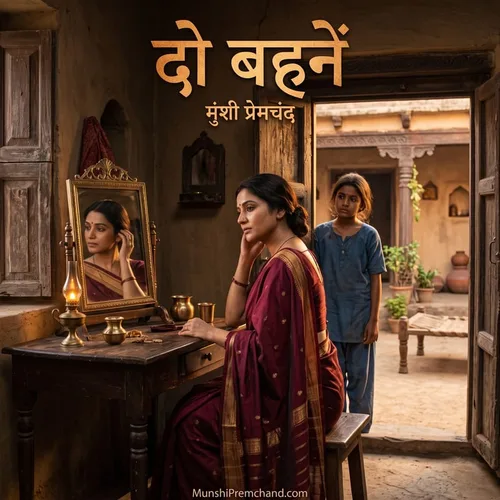
Complete English Translation: Do Bahanein (Two Sisters)
The two sisters met after two long years at the house of a mutual relative. After much weeping and embracing in joyful reunion, Rupkumari, the elder sister, noticed that Ramdulari, the younger one, was laden with gold ornaments from head to foot. Her complexion had brightened, her demeanor had acquired a certain poise and dignity, and she spoke with far greater cleverness than before. An expensive Banarasi silk sari and an embroidered jumper of rich plum-colored velvet accentuated her beauty—the very same Ramdulari who, in childhood, used to run about with disheveled hair, untidy and awkward.
Rupkumari had last seen her at her wedding two years ago. Even then, there had been little change in her appearance: she had grown taller, but remained just as scrawny, clumsy, and slow-witted, sulking at the slightest pretext. But today her condition was completely transformed, like a bud that had suddenly burst into full bloom. Where had she been hiding all this beauty?
No, Rupkumari told herself, her eyes were surely deceiving her. This was not genuine beauty; it was merely the deceptive power of adornment to dazzle the eye. On the strength of silk, velvet, and gold, one’s fundamental features do not alter. And yet, Ramdulari captivated the gaze of everyone present. Fifty women were gathered in the hall, but this charm, this hypnotic aura, belonged to no one else.
If only she could find a mirror, Rupkumari wished to examine her own reflection. She had looked into the mirror before leaving home, taking every possible care to enhance her appearance, applying whatever makeup she possessed. But now that image seemed wiped from her memory; only a faint, shadowy impression remained upon her heart. She grew frantic to behold herself once again. She wanted to look with a comparative eye, to discover where this magnetism in Ramdulari had sprung from, to unravel this mystery.
To be sure, she carried a small compact mirror alongside her cosmetics in her handbag, but she was not accustomed to preening herself or looking into a mirror in the midst of a crowd. Who knew what these women might think? Still, there had to be a mirror somewhere in this house. There was bound to be one in the drawing room.
She rose and slipped into the drawing room, standing before a full-length standing mirror to examine herself. At that moment, no one else was there. The men were outside in the courtyard, and the women were engrossed in singing and playing instruments.
With a critical, scrutinizing eye, Rupkumari inspected every limb, every line of her posture and facial contours. Her features and complexion were flawless. Yet that freshness, that intoxicating radiance, that captivating sweetness was missing. Yes, it was simply not there. She could not deceive herself. What was the reason? Simply that Ramdulari had bloomed today, while her own youth had blossomed long ago.
Yet this explanation brought no comfort to her soul. She could not bear to remain inferior to Ramdulari. How foolish men are! Not a single one of them possesses the ability to discern true beauty. All they crave is raw youth, coquetry, and playful airs. Despite possessing eyes, they remain blind! What does true beauty have to do with such superficial tricks? Those are merely the ephemeral amusements of age. True beauty is that which defies time. Clothe Ramdulari in ordinary garments, and see where all this magic flies! She would look like a veritable witch. But who could explain this to these blind fools?
And yet, Ramdulari’s in-laws were never particularly prosperous. The bridal trousseau and jewelry that had arrived from their side at the wedding had been utterly disappointing. There had been no other signs of affluence. Her father-in-law was merely an estate agent for a small principality, and the groom was still studying in college. Where on earth had this shower of gold rained down from during the past two years?
Who knows—perhaps she had borrowed these ornaments from someone? Even the clothes might be borrowed. Certain women have a pathological craving to project a grander status than they possess. Well, Ramdulari was welcome to her charade! Rupkumari was content to remain as she was.
How this disease of ostentation continues to spread! At home there is barely enough bread to eat, the husband scrapes a pen for twenty-five or thirty rupees a month; yet when Madame steps out of the house, she dresses up as if she were a royal princess! She will endure the dunning of peddlers and tailors, fold her hands before the cloth merchant, suffer her husband’s rebukes, weep and sulk, yet she cannot check this fever of display. Her own family must think: what a shallow, frivolous nature she has! But Madame has girded her loins with shamelessness. Let anyone laugh as they please; shame cannot touch the shameless. Her only obsession is that wherever she passes, people should clutch their hearts in wonder. Ramdulari had undoubtedly borrowed these jewels and garments from someone—shameless creature that she was!
A flush of self-respect rose in Rupkumari’s cheeks. What if she possessed neither expensive clothes nor gold ornaments? At least she never had to hang her head in shame before anyone! She did not have to hide her face from creditors. She possessed two fine sons, each worth a hundred thousand rupees. May God grant them long lives—she was completely happy in that! Wearing fine clothes and feasting on delicacies does not fulfill the true purpose of life. Her household was poor, but they had their honor; they did not wring anyone’s neck, nor did they bring upon themselves anyone’s curse!
Having thus consoled her heart, she stepped back onto the veranda. Ramdulari looked at her with eyes brimming with pity and asked: "Has brother-in-law had any promotion, Didi? Or is he still scraping his pen at seventy-five rupees?"
A fire blazed up inside Rupkumari’s body. Oh, what arrogant conceit! As though her own husband were the Viceroy himself! Straightening her spine, she retorted stiffly: "Why wouldn't he get a promotion? He is in the hundred-rupee grade now. Nowadays even that is a blessing, considering I see fine M.A. graduates whom nobody would hire for a copper coin. Your husband must be in his B.A. class by now?"
Ramdulari wrinkled her nose in disdain: "He gave up studying, Didi! What was the point of wasting one's time studying? He has become an agent for a commercial firm. Now he earns two hundred and fifty rupees a month, with commission on top of that. He also receives five rupees a day as traveling allowance. You can take it that his earnings average five hundred rupees a month. A hundred and fifty rupees is his personal pocket money, sister; for a high post, one must maintain an impressive appearance! He hands over three hundred and fifty spotless rupees at home. Out of that, a hundred rupees is given to me for my personal expenses, and the house runs in luxury on the remaining two hundred and fifty. What would he have gained by passing M.A.?"
Rupkumari desperately wished to dismiss this claim as nothing more than a fairy tale spun by a day-dreamer, but there was such convincing self-assurance in Ramdulari’s tone that, deep down in her subconscious, she felt crushed by it. The bitter gloom of defeat was plainly visible on her face. Yet, if she was not to lose her mind completely, she had to extinguish this burning flame from her heart. She had to cross-examine her sister and convince herself that there was not more than a quarter truth in this poetry. Up to a quarter she could tolerate; beyond that, she would break.
At the same time, her heart pounded with dread: what if this tale turned out to be true? How would she ever show her face to Ramdulari? She was terrified that tears might burst from her eyes. Where seventy-five, and where five hundred! Even if such a vast sum were acquired at the cost of murdering one's own conscience, it was unbearable for Rupkumari. The value of a conscience might be worth a hundred rupees at most—never five hundred under any circumstances!
Adopting an air of sarcastic banter, she asked: "If commercial agency pays such enormous salaries and allowances, why don't all the colleges shut down? Why do thousands of young men ruin their lives studying?"
Ramdulari, thoroughly enjoying her sister’s discomfiture, replied: "Didi, that is where you make your mistake! Anyone can pass an M.A. examination, but the talent for agency belongs to very few. It is a gift from God. A man might study his whole life, yet that does not mean he can become a successful agent. Earning money is one thing; becoming a scholarly bookworm is quite another. Inspiring trust in the excellence of your merchandise, convincing people that cheaper and more durable goods cannot be found in the entire market—that is no easy task!
"He has to deal with the shrewdest, craftiest clients. He has to change the minds of wealthy rajas and aristocrats before a single sale can be concluded. An ordinary man could not even gain an audience with rajas and nawabs; he would have no access. And even if he somehow reached them, his tongue would cleave to the roof of his mouth. In the beginning, my husband also felt nervous, but now he is an absolute crocodile in this ocean! He is due for another promotion next year."
The blood seemed to freeze in Rupkumari’s veins. Why did the merciless sky not fall upon her? Why did the stone-hearted earth not split open to swallow her? Where was the justice in this—that Rupkumari, who was beautiful, refined, skilled, devoted to her husband, loved her children more than life itself, and managed a home so impeccably on modest means, should suffer this humiliation; while this haughty, ill-mannered, luxury-loving, reckless, sharp-tongued chit, who until yesterday ran about with bare head and tangled hair, should reign as a queen?
Yet a sliver of hope lingered in her breast. Perhaps, as the conversation progressed, some path to soothe her wounded spirit might appear.
In the same mocking tone, she remarked: "Then perhaps he will start drawing a thousand rupees?"
"Not a thousand, but there is no doubt it will be six hundred."
"He must have ensnared some blind fool of an employer!"
"Businessmen are not blind fools, Didi! Their eyes are far sharper than yours or mine. Only when you earn them six thousand rupees do they give you six hundred. Who can make a fool of a man who grazes the whole world?"
Seeing that mockery had failed, Rupkumari reached for the weapon of contempt: "I personally do not consider it an honorable profession. Spinning webs of falsehood all day long—it is nothing but the art of swindling!"
Ramdulari laughed out loud. She had achieved a complete victory over her sister.
"In that case, Didi, every lawyer and barrister in the country practices the art of swindling! What do they not have to do for the sake of their clients? They even manufacture false evidence! Yet we call those very lawyers and barristers our national leaders, we elect them presidents of our political conferences, we draw their carriages through the streets, we shower them with flowers and gold sovereigns, and we name roads, statues, and institutions after them!
"Nowadays, the world looks only at money. And why only nowadays? Wealth has always enjoyed this supreme glory! How the money is acquired, nobody cares to ask. Whoever possesses wealth is worshipped. Those who are unfortunate, incompetent, or cowardly wipe their tears by preaching sermons on the soul and moral virtue. Otherwise, who gives a damn about the soul and moral virtue?"
Rupkumari fell silent. She now had to accept this truth with all its agonizing pain: Ramdulari was infinitely more fortunate than she. There was no escape from it. Any further mockery or disdain would merely display her own petty-mindedness. She would have to visit Ramdulari’s house under some pretext to investigate the reality with her own eyes. If Ramdulari had truly received the blessing of Goddess Lakshmi, Rupkumari would beat her forehead in resignation and sit quiet. She would conclude that there is no justice in this world, and that honesty carries no value anywhere.
Yet, would she genuinely find peace in that thought? Who is honest in this world? Only he who lacks the opportunity to be dishonest, and who possesses neither the intellect nor the daring to manufacture such an opportunity! Her husband earns seventy-five rupees; but if he were offered ten or twenty rupees under the table, would he not accept them with delight? His honesty and truthfulness last only as long as temptation remains out of reach. The day opportunity knocks, all his high-minded principles will be tossed out of the window.
And did Rupkumari herself possess enough moral strength to stop her husband from devouring tainted wealth? Stopping him would be out of the question; she would rejoice, and perhaps pat her lord upon the back! At present, when he returns from the office, she sits in sullen gloom. Then, she would stand at the doorway awaiting his arrival, and the moment he entered, she would search his pockets with eager anticipation!
In the courtyard, the singing and music continued. Ramdulari sang with lively enthusiasm, while Rupkumari sat alone on the veranda, despondent. For some unknown reason, a throbbing headache had begun to pound in her temples. Let anyone sing or dance—what did it matter to her? She was an unfortunate wretch, born only to weep.
At nine o'clock at night, the guests began to depart. Rupkumari also rose. She was about to send for an ekka when Ramdulari said: "Why send for an ekka, Didi? A car will be arriving to pick me up shortly. Come, stay at my house for a few days, and then you may return. I will send word to brother-in-law not to wait for you."
Rupkumari’s final scheme was instantly thwarted. Her desire to visit Ramdulari’s house to inspect the truth vanished. She would go straight home and lie down with a sheet pulled over her face. Why should she enter anyone’s house in this shabby, impoverished state?
She replied: "No, I have no time just now. The children will be anxious. I will come some other time."
"Won't you even stay for the night?"
"No."
"Well then, tell me when you will come. I will send the car for you."
"I shall send word myself."
"You will forget! A whole year has passed, and you never remembered me even by mistake. I was waiting all this time for you to invite me. We live in the very same city, yet so far apart that a whole year passes without our meeting once!"
What could Rupkumari say, other than that she found no respite from household chores? Several times she had intended to invite Dulari, but the opportunity had never presented itself.
Suddenly, Ramdulari’s husband, Mr. Gurusevak, entered and offered a polite greeting to his elder sister-in-law. He was impeccably dressed in English style, a cigar in his mouth, a gold watch upon his wrist, and gold-rimmed spectacles perched on his nose, looking for all the world like a senior civilian officer. Intelligence and gentlemanly breeding seemed to radiate from his countenance. Rupkumari had no idea that he was so handsome and elegant; his fine clothes seemed made for his physique.
Offering her blessings, she remarked: "Had I not come here today, would you ever have met me?"
Gurusevak laughed: "What an unfair complaint! Did you ever invite me and I failed to appear?"
"I did not know that you considered yourself an outside guest. That house is your home as well."
Ramdulari observed how, despite harboring bitter envy in her heart, Rupkumari’s words were becoming so sweet, so gentle, so eager for favor.
Gurusevak replied generously: "Yes, I admit it, Bhabhi Sahib! It was certainly my fault; I had not considered the matter from that viewpoint. But tonight, you must stay at our house."
"No, tonight I have no leisure at all. I shall come another time. The boys must be crying for me."
Ramdulari chimed in: "I pleaded with her so much, but she simply refuses to listen."
The two sisters sat in the back seat of the car. Gurusevak took the wheel. Within a short time, his grand house came into view. Ramdulari urged her sister once more to step down, but Rupkumari remained adamant: the boys would be frightened. At last, Ramdulari embraced her and went inside.
Gurusevak drove the car forward. Rupkumari cast a fleeting glance at Ramdulari’s mansion, and that solid, undeniable reality pierced her heart like a red-hot skewer.
After driving some distance, Gurusevak remarked: "Bhabhi, I have carved out a splendid path for myself. If I continue to work like this for another three or four years, I shall become a wealthy man."
Rupkumari said with forced sympathy: "Ramdulari told me everything. May God keep you happy wherever you are. But take care of your steps."
"I consider it a sin to take a single copper coin behind my employer's back, Bhabhi!" Gurusevak replied loftily. "The true joy of wealth exists only when one’s honesty remains intact. If money is gained by losing one’s integrity, what is it worth? I consider such wealth worthy of utter contempt! And behind whose back would I take anything? The entire management, black and white, is in my hands! The proprietor is no more; only his widow remains. She has entrusted everything to me. If I had not taken charge of her business, everything would have been ruined.
"The master lived for only three months after I joined, but he was a consummate judge of men. He started me on a hundred rupees and raised it to two hundred within a month. By the grace of your prayers, I conducted twelve thousand rupees' worth of business in the very first month!"
"What kind of business do you manage?" Rupkumari asked casually, without any particular intent.
"The same machinery agency—ordering and selling various types of industrial machines," came the cool, dismissive reply.
Soon, Rupkumari’s dreary, ill-omened house arrived. A single kerosene lantern flickered feebly at the entrance. Her husband, Umanath, was pacing up and down outside the door. Yet Rupkumari did not press Gurusevak to step inside. She extended a perfunctory courtesy, but did not insist, and Umanath did not even address Gurusevak.
To Rupkumari, that house now appeared like a graveyard, the very picture of shattered misfortune. There were neither carpets, nor fine furniture, nor potted plants. Two or three rickety teapoys, a lame table, four or five decrepit string cots—such was the total worth of the household. Until this morning, Rupkumari had lived happily in this very house. But tonight, the walls seemed to snap and bite at her.
Her little boys ran forward, shouting, "Amma! Amma!" but she snapped at them harshly. She had a splitting headache; she would speak to no one, and no one should disturb her.
Dinner had not yet been cooked. Who was there to cook it? The children had drunk milk, but Umanath had eaten nothing. He had waited all evening for Rupkumari to return and prepare the meal. But Rupkumari had a headache. There was no choice but to fetch fried puris from the bazaar.
Rupkumari lashed out in contemptuous fury: "Why did you keep waiting for me until now? Have I signed an agreement to be your bonded cook? What if I had stayed there overnight? Why don't you hire a cook (mahrajin)? Do you intend to grind me into dust for the rest of my life?"
Umanath looked at her with wounded astonishment. He could not comprehend the reason for her sudden rage. In Rupkumari, he had always found a safe, dependable companion—not merely safe, but deeply sympathetic. He had himself proposed several times to hire a cook, but she had consistently refused, saying: "What shall I do sitting idle all day? Why increase our expenditure by four or five rupees? That money is better spent buying butter for the children."
And today she was rebuking him with such venom, as if consumed by hatred!
Offering his defense, he said gently: "I have suggested hiring a cook to you several times myself."
"Then why didn't you go ahead and bring one?" Rupkumari flared up with redoubled fury. "If I had thrown her out, then you might complain! You only said it to test me, never from the bottom of your heart! I am not so naive that I cannot fathom your secret thoughts! The thought of my comfort never once entered your head. You were delighted to have found an obedient slave-girl who eats a dry roti and lies quietly in a corner, serving you for mere food and clothing—and that too, only if anything remains after meeting the household expenses!
"You place seventy-five paltry rupees in my hand and expect me to manage the expenses of the entire universe! Only my heart knows how much pinching and scraping I have to do! What clothes can I wear, what can I drape over my shoulders? My life has been ruined with you!
"There are men in this world who would pluck the stars from the sky for their wives! Look at Gurusevak—why look further? He is less educated than you, far younger than you, yet he brings home five hundred rupees every month, and Ramdulari sits like a queen! For you, these seventy-five rupees are an ocean! Content with gruel like a beggar widow! You were made a man for nothing; you should have been born a woman! What dreams women cherish in their hearts! But to you, I am merely stale wild greens! You suffer no deprivation. You must have fine clothes, you must have good food, because you are the lord of the house who earns money outside! As for me—I may rot as I please, for all you care!"
This barrage of verbal arrows continued unabated for several minutes, while Umanath listened in absolute silence.
To the best of his knowledge, he had never given Rupkumari cause for grievance. His salary was small, that was true, but it was beyond his power to alter. He performed his duties conscientiously and always strived to keep his superiors pleased; only this year, he had tutored the Head Clerk’s young son for six months without missing a single day, simply to keep the officer in good humor. What more could he do?
He understood the secret behind Rupkumari’s rage. If Gurusevak truly earned five hundred rupees, he was undeniably favored by fortune. But one does not smash one's own forehead merely because another possesses a loftier brow! By some stroke of luck, Gurusevak had found an opportunity. But such opportunities are not granted to everyone.
He resolved to investigate whether Gurusevak truly received five hundred rupees, or whether it was mere boastful fabrication. And even assuming he earned five hundred, did that give Rupkumari the right to shower him with insults and bitter sarcasm? If he were to begin cursing Rupkumari every time he encountered a woman more beautiful, gentle, and self-sacrificing than she, how would she feel? Rupkumari was lovely, sweet-spoken, and devoted, but the world was hardly devoid of women even lovelier, gentler, and more devoted than she. Did that justify treating her with disrespect?
There had been a time when, in his eyes, no woman on earth was more beautiful than Rupkumari; but that youthful infatuation had cooled long ago. An age had passed since he crossed from the realm of romantic idealism into the realities of practical life. He had gained ample experience of married life; each knew the virtues and failings of the other. Now their happiness could reside only in contentment. Yet Rupkumari, intelligent as she was, failed to grasp this fundamental truth!
And yet, he felt profound sympathy for her. He was a man of generous disposition and lively imagination. He offered no retort to her bitter words, swallowing them down like a cooling draft of sherbet. Having witnessed her sister's lavish splendor, it was entirely natural that such despairing, unjust, and painful thoughts should arise in Rupkumari’s breast for a fleeting moment. Rupkumari was neither an ascetic hermit nor a detached nun who could remain unruffled under all conditions.
Having thus pacified his mind, Umanath firmly resolved to uncover the truth about Gurusevak.
Part II
For an entire week, Rupkumari remained in a state of acute mental turmoil. She flared up at every trifle, scolded the children, cursed her husband, and wept over her wretched fate. The household chores had to be performed, but she no longer derived any joy from them; she dispatched them like an unwelcome chore imposed by force. The old, familiar household articles with which she had once shared an intimate affection, and in whose cleaning and arrangement she used to spend her days, she now refused even to look at.
There was a solitary domestic servant in the house. When he saw that the mistress herself was indifferent to the home, what need was there for him to sweep and clean? Whatever lay where it fell remained there; who was to pick it up and put it in order? The children were terrified of speaking to their mother, and Umanath fled from her very shadow. Whatever was placed before him on the plate, he shoveled into his stomach and hurried off to the office. Returning in the evening, he would take both boys by the hand and go out for long walks. To speak a word to Rupkumari was like applying a match to a powder keg.
Meanwhile, his private investigation was steadily proceeding.
One evening, when Umanath returned from the office, Gurusevak accompanied him.
Today, after several days of sullen rebellion, Rupkumari had made peace with her circumstances. She was holding a duster, wiping down the chairs and teapoys, when Gurusevak entered the room and greeted her.
Rupkumari was mortified to the core. A surge of rage against Umanath swept through her, fierce enough to tear him apart! Why had he brought this man and planted him here? Without a word of warning, without asking—he simply dragged him in! What must Gurusevak think, seeing her in this domestic, disheveled state? But when had Umanath ever possessed common sense? She went about trying to conceal their poverty, and he went about pulling off the veil! Not a shred of shame in him. He seemed to have donned the garb of utter shamelessness, going out of his way to humiliate her. What harm had she ever done to him?
Composing herself, she offered her blessings, inquired after his welfare, and placed a chair for him.
Taking his seat, Gurusevak said: "Bhai Sahib invited me to dinner tonight. I would not have come on his invitation alone; but when he said that my Bhabhi had insisted upon it, I had to find the time."
Rupkumari invented an excuse, hiding the domestic friction: "We could scarcely speak that night. My heart remained longing."
Gurusevak glanced around the room and remarked: "Living in this cramped cage must be terribly painful for you both!"
Rupkumari realized how thoroughly tasteless and insensitive this young man was. He seemed completely ignorant of how to respect the feelings of others. Did he not possess even the simple awareness that not everyone in this world is born with good fortune? Only one in a million emerges wealthy. And why should such a man be called fortunate at all? Where the majority cannot secure a handful of grain, what good fortune is there in the luxury of a privileged few? Where masses of people are starving to death, if two or four individuals gorge on rich sweetmeats, that is a mark of heartless shamelessness, never of true fortune!
Annoyed, she retorted: "Living in a cage is far better than living in an iron-barred pen. Harmless birds dwell in cages; iron pens are the residence of deadly beasts."
Gurusevak apparently failed to catch the barbed implication. He continued: "I would suffocate in a house like this! I will arrange a splendid house for you right next to mine—spacious, airy, and grand! No rent will be charged to you. The house belongs to our mistress. I live in one of her houses as well. She owns hundreds of houses, hundreds! Everything is under my control. Whomever I wish to give a house to, I give it. It is my prerogative whether to collect rent or not. I shall select the very finest house for you. I hold you in the highest esteem!"
Rupkumari now understood: the gentleman was completely drunk! That was why he was rambling so recklessly.
Looking at him closely, she noticed that his eyes were bloodshot and half-shut, his cheeks were flushed, and his tongue was beginning to stumble over words. A young, handsome, respectable countenance had suddenly become so boastful and shameless that it filled her with utter disgust.
After a moment's pause, Gurusevak began to rave again: "I respect you immensely, yes indeed! You are my elder sister-in-law. My life is at your service! Not one house, a hundred houses are ready for you! I am the absolute mukhtar of Mrs. Lohia. Everything is in my hands—everything! Whatever I say, she accepts with closed eyes. She looks upon me as her own son. I am the virtual master of her entire estate!
"Mr. Lohia hired me at twenty rupees a month—at twenty rupees! He was a fabulously wealthy man. But nobody knew where his immense fortune came from—nobody! No one knows except me! He was an undercover dealer. Don't breathe a word of this to anyone! He was illicitly smuggling cocaine! His income ran into hundreds of thousands!
"Now I run that very trade! We have secret agents planted in every major city! Mr. Lohia made me a master of this craft. Yes, indeed! No one has the guts to arrest me—I am on the most intimate terms with the highest police officers! I stuff thick wads of currency notes down their throats to choke their voices! Not a dog can bark! I sell openly in broad daylight. In the account books I write, 'Paid one thousand rupees in bribes.' I pay five hundred; the rest belongs to us boys! Money pours in without restraint, and I spend it without hesitation!
"The old widow cares only for chanting the name of Ram. Having devoured seventy mice, the cat has now set out on a pilgrimage to Mecca! There is no one to catch my wrist, no one to question me!"
Pulling a thick bundle of currency notes from his pocket, he tossed it onto the table: "Here—this is an offering at your feet! Bless me that my life may continue in this grand style!
"Those who worship the soul and moral virtue are kicked in the teeth by Kuber! Goddess Lakshmi embraces only those who are prepared to abandon their faith, their religion, and their conscience for her sake! Do not think ill of me! What makes a man wealthy? Every single rich man in this world is a robber—a thorough, hardened dacoit! Tomorrow, when I amass enough wealth, I shall build a grand dharmashala! Then watch how the world sings my praises! Who will bother to ask where my wealth came from? Name any holy Mahatma you wish, and I will summon him to chant my praises! Those greedy, sycophantic hypocrites conferred the title of 'Dharm Bhushan' upon old Mr. Lohia—upon an old scoundrel than whom a greater criminal never walked the earth!
"Life here is nothing but plunder! A lawyer argues for half an hour and pockets five hundred rupees; a surgeon makes a tiny incision with a scalpel and pockets a thousand; a gambler makes a fortune of hundreds of thousands in a single day through speculation! If their income is legitimate, then my income is legitimate too! Yes, entirely legitimate! In my eyes, the greatest millionaire possesses not a shred of honor. I know what an unscrupulous swindler he is!
"In this world, whoever can throw dust into the eyes of the public is hailed as a success! Robbing the poor to become rich is an ancient tradition of human society. I merely do what everyone else is doing! That is the true purpose of life! I shall loot with both hands, indulge in luxury to my heart's content, distribute lavish charities in my old age, and one day become a great public leader! Tell me, shall I count them for you? How many men have become multimillionaires by gambling? How many have become crorepatis by trafficking in women...?"
Suddenly, Umanath entered the room: "Mr. Gurusevak, what are you doing here? Come, have your tea. It is getting cold."
Gurusevak started violently, as though attempting to prove that he was in full possession of his senses. But his feet tangled beneath him, and he crashed heavily onto the floor!
Scrambling awkwardly to his feet, swaying from side to side and stumbling against the furniture, he staggered out of the house.
Rupkumari drew a long, deep breath of liberation. Sitting there, her heart had been seized by an icy dread; the very air in the room had grown heavy and suffocating.
The intoxicating illusions that had been parading through her mind in glamorous, seductive shapes during the past week now stood revealed in their true, grotesque, and abhorrent reality! Her entire life had been spent in an atmosphere of sacrifice, simplicity, and moral purity. The intrusion of such deceit, ruthless cunning, and degraded selfishness was like a herd of rampaging wild bulls trampling through a tranquil flowering garden.
At this price, she would not be willing to purchase all the riches and luxuries of the universe!
No! Never again would she exchange her destiny for Ramdulari’s. She was truly happy in her humble state.
She felt a wave of profound pity for Ramdulari, who, intoxicated by the craving for luxury and the vanity of being called rich, was willingly destroying her own soul. Yet what could the poor girl do? And was Gurusevak alone to blame? In a society where wealth is worshipped, where a human being’s worth is measured solely by his bank account and outward pomp, where nets of temptation are spread at every step, and where an unjust social order constantly incites jealousy, greed, plunder, and baseness in the human heart—if Gurusevak and Ramdulari were ensnared in that web and swept away by that current, it was hardly a matter of wonder.
Just then, Umanath returned to the room and asked: "What was Gurusevak rambling about as he sat here? I saw him off. My heart was in my mouth lest the police should be trailing him, in which case I too would be crushed like a weevil in the wheat!"
Rupkumari looked at him with eyes overflowing with humble, repentant apology, and replied: "He was bragging about his illicit cocaine trade."
"He told me to go and meet Mrs. Lohia as well."
"Certainly not!" she cried vehemently. "You go on with your clerkship! Our true welfare lies in that alone."
"Yet where is the luxury of that world to be found in clerkship?" Umanath smiled gently. "Why shouldn't I take a year's leave and explore that realm as well?"
"I no longer harbor the slightest desire for that luxury."
"Do you speak from your heart?"
"From the bottom of my soul."
Umanath remained silent for a minute. Then he said: "Tell me the truth: if I had come and told you this story myself, would you ever have believed me?"
"Never!" she confessed softly. "I could never have conceived that a man could feed poison to the entire world merely to satisfy his own selfish greed!"
"I learned the whole truth from a police sub-inspector," Umanath revealed. "I plied him heavily with liquor this evening, knowing full well that in a drunken state he would lose his senses and blurt out everything."
"Yet your heart was tempted too, wasn't it?"
"Yes, it was tempted, and it is still tempted even now," he admitted wryly. "But where would I find the craftiness required to indulge in such luxury?"
"May God forbid that such talent ever enters your soul!" Rupkumari said fervently. "I feel only profound pity for that unfortunate boy. Who knows whether he reached home safely or not!"
"He had his car. You need not worry."
Rupkumari stared at the floor for a long moment in deep contemplation. Then, looking up at her husband, she whispered:
"Please take me to Dulari’s house. Perhaps I may still be able to help her. In the garden where she is strolling so blissfully, nocturnal beasts of prey are lying in ambush on every side. Perhaps... perhaps I may still save her."
Umanath looked upon his wife, deeply moved by the radiant, tender light of compassion that now illuminated her countenance.
Summary of Do Bahanein (Two Sisters)
After two years of separation, two sisters—the elder Rupkumari and the younger Ramdulari—meet at a relative’s house. Rupkumari, whose husband Umanath is an upright clerk earning seventy-five rupees a month, is stunned to see Ramdulari adorned in heavy gold jewelry, expensive Banarasi silk, and velvet, exuding newfound poise and sophistication. Ramdulari boastfully explains that her husband Gurusevak abandoned college to work as a commercial machinery agent, earning an astonishing five hundred rupees a month through commissions and travel allowances.
Consumed by feelings of inferiority and envy, Rupkumari returns to her modest home, viewing her simple belongings as symbols of wretchedness. She vents her bitter frustration upon Umanath, reproaching him for his meager salary, calling herself his unpaid maidservant, and comparing him unfavorably to Gurusevak. Umanath listens patiently to her barrage of insults. Convinced that such easy fortune must hide a dark secret, he investigates Gurusevak's affairs.
A week later, Umanath invites Gurusevak to dinner and plies him heavily with alcohol. In a state of reckless intoxication, Gurusevak's polished facade collapses. He reveals to Rupkumari that his wealth does not come from selling machinery, but from running a massive illicit cocaine-smuggling syndicate across multiple cities. Defrauding his employer's naive widow, bribing police officials with thousands of rupees, and profiting from human addiction, Gurusevak cynically justifies his crimes by claiming that all wealth in society is built on robbery and deceit. He tosses a thick wad of currency notes at Rupkumari's feet before stumbling drunk onto the floor and staggering away.
Gurusevak's confession shatters Rupkumari's illusions. Horrified by the criminal, poisonous reality underlying Ramdulari's luxury, Rupkumari realizes that her husband's honest, modest clerkship is infinitely cleaner and more peaceful than ill-gotten riches. Her envy turns into profound relief, gratitude, and sisterly pity. Filled with compassion, she asks Umanath to take her to Ramdulari's house so that she may warn her sister of the moral destruction awaiting her.
Publication History
"Do Bahanein" (Two Sisters) is one of Munshi Premchand's most incisive psychological and social short stories from his later mature period, first published around 1930 and later collected in Mansarovar, Volume 6. Written during an era when consumerism, colonial commercialism, and urban materialism were increasingly eroding traditional ethical values in Indian middle-class households, Premchand used the domestic rivalry between two sisters to dissect the moral degradation behind corrupt wealth and the dignity of honest labor.
This unabridged English translation was published in 2026 by MunshiPremchand.com as part of the MunshiPremchand.com English Translation Series.
Themes & Critical Significance
- The Illusion of Material Grandeur vs. Moral Peace: Premchand contrasts the outward glamour of fast wealth with the inner squalor of moral corruption. While Ramdulari's household appears enviable on the surface, it rests upon the poisonous trade of cocaine trafficking, bribery, and exploitation. In contrast, Umanath's humble clerkship provides genuine dignity and a clean conscience.
- Psychological Anatomy of Domestic Envy: The story provides a masterclass in psychological realism, illustrating how comparing one's fortune to others breeds toxicity, domestic discord, and self-loathing. Rupkumari’s transformation from a loving, content homemaker into a bitter, scolding spouse demonstrates how unchecked envy corrodes human relationships.
- Systemic Critique of Capitalist Morality: Through Gurusevak's cynical monologue, Premchand delivers a scathing critique of modern society: a system that worships money regardless of how it is acquired. By comparing drug traffickers, corrupt lawyers, unethical surgeons, and market speculators, Premchand questions the very legitimacy of bourgeois wealth.
- Redemption Through Compassion and Sisterhood: The story avoids a self-righteous conclusion. Once Rupkumari's eyes are opened, she does not rejoice in her sister's impending downfall; instead, she feels profound compassion and resolves to rescue Ramdulari from the dangerous web of crime and delusion.