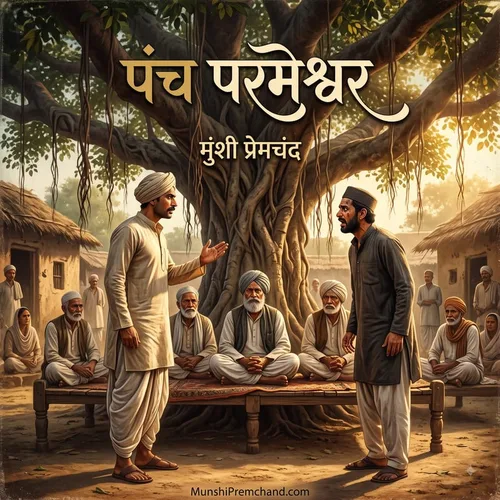
Jumman Sheikh and Algu Chaudhary shared a deep, unbreakable friendship.
They farmed their land jointly and shared business dealings. Each held absolute, unshakeable trust in the other. When Jumman went on the pilgrimage to Mecca, he entrusted his household to Algu; and whenever Algu traveled out of town, he left his home under Jumman's care.
They shared neither food nor religion; their bond rested solely on harmony of thoughts and ideals—the true foundation of lasting friendship.
This friendship had blossomed in their boyhood days when Jumman's revered father, Jumrati Sheikh, used to teach them. Algu had served his guru with immense devotion—washing his dishes, scrubbing his cups, and keeping his hookah continuously lit. Every fresh clay pipe bowl filled by Algu bought him half an hour of freedom from books!
Algu's father held traditional views. He believed that education mattered far less than devotion and service to one's teacher. He would say: "Knowledge doesn't come from mere reading; it comes from the blessings of the guru." So if Jumrati Sheikh's grace produced no visible scholarship in Algu, his father consoled himself with the thought that Algu had spared no effort in serving his master—if knowledge was not in his destiny, how could it come?
However, Jumrati Sheikh himself did not rely overmuch on mere blessings. He placed far greater faith in his wooden cane! It was by the virtue of that very cane that Jumman was held in high awe throughout the surrounding villages today. Even the court clerk hesitated to question a mortgage or sale deed drafted by Jumman. The village postman, the constable, and the tax clerk all sought his favor. Thus, while Algu was respected for his wealth, Jumman Sheikh commanded universal honor for his priceless learning.
Jumman Sheikh had an elderly maternal aunt (Khala). She possessed a small plot of land, but had no close surviving relatives. By making grand promises, Jumman persuaded her to register the property in his name.
As long as the gift deed remained unregistered, Khala was showered with lavish hospitality. She was fed delicious delicacies, halwa, and rice pilaf. But the moment the registration seal was stamped onto the document, an abrupt seal was stamped on that hospitality as well!
Jumman's wife, Kariman, began serving sharp, bitter taunts alongside her dry flatbreads. Jumman Sheikh himself turned cold and heartless. Soon, the poor old aunt was forced to swallow stinking insults every single day:
"Who knows how long this old hag will live? Just because she handed over two or three bighas of barren land, she acts as if she bought us! Bread doesn't go down her throat without spiced dal! The money we've stuffed into her belly could have bought an entire village by now!"
Khala endured these insults for a long time. But when it became unbearable, she complained to Jumman. Jumman declined to interfere in his wife's domestic management. Matters dragged on with tears and arguments for a few more months.
Finally, one day Khala said to Jumman: "Son, I cannot live with you any longer. Give me a small monthly allowance, and I will cook my own food."
Jumman replied insolently: "Does money grow on trees here?"
Khala said meekly: "Do I not need even dry bread to stay alive?"
Jumman retorted coldly: "Did anyone imagine you had come back after conquering death?"
Khala grew furious and threatened to call a village panchayat. Jumman laughed—just as a hunter laughs inwardly when he sees a deer walking right into his net. He said: "Yes, by all means call a panchayat! Let it be decided once and for all. I don't like this daily bickering either."
Jumman held not the slightest doubt about who would win in a panchayat. Who in the surrounding villages wasn't indebted to his favors? Who possessed the courage to make an enemy of him? Who had the strength to stand against him? The angels of heaven were hardly going to descend to sit on the bench!
For the next several days, old Khala hobbled from village to village leaning on her walking stick. Her back was bent like a bow; every step was an ordeal. But a matter of justice had arisen, and a decision was imperative.
There was hardly a decent man before whom the old woman did not weep her sorrow. Some dismissed her with superficial nods; others cursed the times for such injustice: "Her legs are dangling in the grave—one foot here today, dead tomorrow—yet her greed doesn't end! What more do you need now? Eat your bread and remember Allah! What business do you have with land and property now?"
Some gentlemen even found in her bent frame, toothless mouth, and silver hair a fine opportunity for comedy! Very few were the righteous, compassionate, poor-loving souls who heard the helpless woman's grief with attention and offered comfort.
After wandering everywhere, the poor old woman finally came to Algu Chaudhary. She set down her stick, caught her breath, and said: "Son, you too must come to my panchayat for a short while."
Algu replied: "What will you gain by calling me? People from several villages will be coming anyway."
Khala said: "I have wept my sorrow before everyone. Now whether they come or not is up to them."
Algu hesitated: "I'll come if you wish, but I will not open my mouth in the trial."
Khala asked: "Why, son?"
Algu answered: "What reply can I give? It is my choice. Jumman is my old friend; I cannot break my friendship with him."
Khala spoke in a solemn voice: "Son, will you sell your conscience for fear of breaking a friendship? God resides in the heart of a Panch. Whatever comes out of the mouth of a Panch comes straight from God!"
Our sleeping moral sense may lie oblivious while its treasures are looted, but at a direct call of conscience, it awakens fully—and then nothing can conquer it. Algu had no answer to her question, but those words kept echoing in his heart: Will you sell your conscience for fear of breaking a friendship?
That evening, the panchayat assembled under a spreading tree. Sheikh Jumman had laid out carpets in advance and arranged betel leaves, cardamom, pipes, and tobacco for the gathering. He himself sat at a slight distance beside Algu Chaudhary, offering quiet greetings to arriving villagers.
As the sun set and birds gathered on treetops for their evening assembly, the human panchayat commenced. Every inch of the carpet was occupied, though most were spectators. Among the invited members, only those had turned up who held some private grudge to settle with Jumman. A fire glowed in a corner, where the barber filled pipe after pipe without pause.
When the Panchs took their seats, old Khala stood up and pleaded before them:
"Respected Panchs! Three years ago, I transferred all my property to my nephew Jumman. You all know this. Jumman promised to provide me food and clothing for the rest of my life. I bore his mistreatment tearfully for a year, but now I cannot endure this daily torture. I get neither bread for my belly nor clothes for my body. I am a helpless widow. I cannot run to law courts. Whom else can I tell my sorrow to except you? Whatever path you dictate, I shall follow. If you see any fault in me, slap my face! If you see fault in Jumman, reason with him—why bring down the curse of a helpless widow? I shall accept the verdict of the Panchs on my head!"
Ramdhan Mishra, whose tenants Jumman had enticed away, asked: "Jumman Miyan, whom do you accept as chief Panch? Decide it right now. Whatever the Panchs rule, you will have to accept."
Looking at the gathering, Jumman noticed mostly men with whom he held some personal friction. He replied confidently: "The voice of the Panchs is the voice of Allah! Let Khala select whoever she wishes. I have no objection."
Khala called out: "O servant of Allah! Why don't you name someone yourself so I may know?"
Jumman snapped in annoyance: "Don't force my tongue right now! You have the upper hand—select whoever you wish."
Khala understood his insinuation and declared: "Son, fear God! A Panch is neither anyone's friend nor anyone's enemy. What nonsense are you talking? And if you trust no one else, fine—do you accept Algu Chaudhary? There, I nominate Algu Chaudhary as the Chief Arbitrator (Sarpanch)!"
Jumman Sheikh's heart swelled with secret joy, but concealing his feelings, he said: "Algu is fine by me. For me, Ramdhan and Algu are the same."
Algu did not want to get entangled in this mess. He tried to back out: "Khala, you know that Jumman and I are close friends."
Khala spoke in a firm, resonant voice: "Son, no one sells his conscience for friendship. God lives in the heart of a Panch, and the verdict that comes from his mouth comes from God!"
Algu Chaudhary was declared the Chief Panch. Ramdhan Mishra and Jumman's other opponents cursed the old woman in their hearts.
Algu Chaudhary stood up and said: "Sheikh Jumman! You and I are old friends. Whenever needed, you have helped me, and I have served you as best as I could. But at this moment, both you and old Khala are completely equal in my eyes. Whatever statement you wish to present before the Panchs, state it now."
Jumman felt absolute confidence that the game was already won—Algu was merely putting on a formal show for the crowd. So, with a calm mind, Jumman stated:
"Panchs! Three years ago Khala registered her property in my name, and I agreed to provide her food and clothing for life. God is my witness, I have never given Khala any trouble. I regard her as my own mother, and serving her is my duty. But women often have domestic squabbles, over which I have no control. Now Khala demands a separate monthly cash allowance. The total yield of the property is known to the Panchs—it does not generate enough profit to pay a monthly cash allowance. Furthermore, the gift deed contains no mention of any cash allowance; otherwise I would never have entered into this arrangement. That is all I have to say. The Panchs are now free to deliver whatever verdict they deem fit."
Algu Chaudhary was accustomed to court proceedings and possessed a sharp legal mind. He began cross-examining Jumman. Every question struck Jumman's heart like a hammer blow! Ramdhan Mishra watched in delighted amazement.
Jumman was stunned—What has come over Algu? Just a moment ago he was sitting beside me talking so warmly! How could his nature transform so completely in a single instant that he is digging up my very roots? Is he settling some old hidden score? Will all these years of friendship count for nothing?
While Jumman was locked in this state of shock, Algu pronounced the verdict:
"Sheikh Jumman! The Panchs have carefully considered this matter. It appears entirely just and proper that Khala must be paid a monthly cash allowance. We are convinced that the property yields sufficient profit to cover her monthly expenses. This is our final verdict: if Jumman accepts to pay the monthly allowance, the agreement stands; if not, the gift deed shall be deemed null and void!"
Hearing this judgment, Jumman stood frozen in shock! That his own closest friend should act like an enemy and slash his throat—what else could it be called except a cruel twist of fate? The man he trusted completely had betrayed him when the test came! This is how false friends are revealed; this is the friendship of the modern world!
However, Ramdhan Mishra and the other villagers praised Algu Chaudhary's uncompromising righteousness with open hearts: "This is what a real Panchayat is! It has separated milk from water, truth from falsehood! Friendship has its place, but duty to truth is supreme! It is on the strength of such truthful men that the earth stands, otherwise it would have sunk into the abyss long ago!"
This verdict shattered the roots of Algu and Jumman's friendship. They were no longer seen talking together. That ancient tree of friendship could not withstand a single gust of truth—it had indeed been built on sand.
Formal politeness replaced intimacy. They greeted each other, but only as a sword greets a shield! The memory of his friend's betrayal rankled in Jumman's heart day and night, and he waited constantly for an opportunity to exact revenge.
Good deeds take a long time to bear fruit, but evil opportunities present themselves quickly. Jumman soon got his chance for revenge.
A year ago, Algu Chaudhary had purchased a magnificent pair of bullocks from the Bateshwar fair. They were tall, handsome animals of the fine Pachhain breed with grand horns. For months, people from neighboring villages came just to admire the pair.
By a stroke of fate, just one month after Jumman's trial, one bullock of the pair died.
Jumman boasted to his friends: "This is divine punishment for his betrayal! Man may stay silent, but God sees good and evil!"
Algu suspected that Jumman had poisoned the bullock. His wife went further and openly blamed Jumman for the tragedy. A fierce verbal duel erupted between Algu's wife and Jumman's wife, Kariman. Both ladies let loose a torrent of dramatic vocabulary—sarcasm, metaphors, similes, and poetic insults! Jumman somehow restored peace by scolding his wife and leading her away from the battlefield, while Algu pacified his wife with a stern warning.
Now a single bullock was of no use for farming. A matching bullock was sought everywhere, but none was found. Finally, it was decided that the remaining bullock should be sold.
In the village lived a cart-driver named Samjhu Sahu. He operated a bullock cart, carrying village jaggery and ghee to the town market and bringing back salt and oil to sell in the village. His eyes fell upon Algu's bullock. He calculated: If I get this bullock, I can easily make three trips a day to the market! Right now, making even one trip is a struggle.
He inspected the bullock, tested it in his cart, bargained over the price, and brought it home to his door. It was agreed that Samjhu Sahu would pay the price of one hundred and fifty rupees after one month. Algu was eager to sell, so he did not press for immediate payment.
The moment Samjhu Sahu got the bullock, he began working it to death! He drove it on three or four trips a day. He cared neither for its feed nor its water—his only concern was making trips! He would take it to the market, throw a handful of dry straw before it, and before the poor animal could even catch its breath, yoke it again!
When the bullock lived at Algu's house, it lived like a king—yoked rarely, fed clean water, crushed lentils, rich bran, oil-cake, and occasionally even a taste of pure ghee! A groom stroked and groomed it morning and evening. What a contrast between that pampered life and this relentless twenty-four-hour slavery! Within a month, the animal was crushed. The mere sight of the cart yoke made its blood freeze; every step was an agony, its ribs stuck out like a skeleton. But it was a noble beast that could not endure beatings.
One day, on his fourth trip of the day, Sahu loaded double the normal weight on the cart. The exhausted animal could barely lift its feet, but Sahu whipped it mercilessly!
The bullock gathered its final strength and ran. It covered some distance and tried to pause for breath, but Sahu was in a hurry to reach home and struck it repeatedly with savage force. The bullock made one last desperate surge—and then its strength failed completely. It collapsed onto the dirt road, and fell so heavily that it never rose again!
Sahu beat it brutally, dragged it by its legs, stuffed a stick into its nostrils—but can a dead animal ever stand? Realizing the truth, Sahu inspected the bullock, unyoked it, and stood wondering how to take the cart home.
He shouted for help, but country roads close like a child's eyes at sunset—not a soul was in sight! There was no village nearby. In a fit of rage, Sahu struck the dead bullock a few more times and cursed it: "Wretched beast! If you had to die, you could have died after reaching home! Dying right in the middle of the road! Who will pull the cart now?"
Sahu was in a desperate plight. He had sold several bags of jaggery and tins of ghee, and held two hundred and fifty rupees tied in his waist-cloth. Furthermore, the cart contained several bags of salt; he could not leave it unattended. Helplessly, he lay down on the cart to spend the night guarding his money and goods. He smoked his pipe, sang tunes, and tried to stay awake. In his own mind he remained awake, but at dawn, when he opened his eyes and checked his waist-cloth—the money bag was gone! Panicked, he looked around—several tins of ghee were missing too!
Beating his head in despair, the ruined merchant returned home weeping. When his wife heard the disastrous news, she wept loudly, and then began hurling abuses at Algu Chaudhary: "That wretched man gave us such an ill-omened bullock that our lifetime's savings have been wiped out!"
Several months passed. Whenever Algu asked for the price of his bullock, both Samjhu Sahu and his wife pounced on him like rabid dogs, shouting wild accusations:
"Brilliant! Our lifetime savings have been destroyed, and he comes asking for money! You sold us a dying, diseased bullock and now demand payment? You threw dust in our eyes and tied a cursed carcass around our neck! If you want your money, go wash your face in a ditch first! And if you won't listen, go take your bullock back—yoke it for two months instead of one! What more do you want?"
Algu held no shortage of ill-wishers in the village, who gathered on such occasions to support Sahu's rantings. But losing one hundred and fifty rupees was no small matter. One day Algu lost his temper too. Sahu ran inside to fetch a heavy stick, while his wife took the field. Arguments turned into a physical scuffle. The village elders stepped in, restored calm, and advised them: "This bickering won't solve anything. Call a panchayat and abide by whatever decision is made."
Both parties agreed.
Preparations for the panchayat began. Both sides mobilized their supporters. Three days later, the panchayat assembled under the same tree at sunset.
When the assembly took their seats, Ramdhan Mishra asked: "Why delay now? Let the Panchs be chosen. Speak, Chaudhary—whom do you nominate?"
Algu said meekly: "Let Samjhu Sahu choose."
Samjhu stood up and announced loudly: "From my side—Sheikh Jumman!"
Hearing Jumman's name, Algu's heart thudded wildly—as if someone had delivered a sudden blow to his chest!
Ramdhan, being Algu's friend, guessed the trap and asked: "Why, Chaudhary, do you have any objection?"
Algu replied hopelessly: "No, what objection could I have?"
The consciousness of high responsibility often reforms our narrow prejudices. When we lose our way, this very sense of responsibility becomes our most trusted guide.
Consider an editor sitting in his office, attacking the government cabinet with fierce, unchecked boldness. But when he himself is appointed to the cabinet, the moment he steps into the council hall, his pen becomes thoughtful, measured, and deeply just! This transformation is the fruit of responsibility.
Think of an arrogant, reckless youth whose parents worry constantly over his wildness; yet the moment the burden of supporting a family falls upon his shoulders, that wild youth becomes patient, calm, and mature! That too is the miracle of responsibility.
The moment Jumman Sheikh took the supreme seat of Chief Arbitrator (Sarpanch), a profound sense of responsibility awakened within his soul!
He reflected: I am sitting at this moment on the supreme throne of Justice and Truth. Whatever comes from my mouth right now is like the voice of God—and the voice of God must never be tainted by my personal grudges or passions! I must not swerve from the absolute truth by even a grain!
The Panchs began questioning both sides. For a long time, both parties presented their arguments. Everyone agreed that Samjhu Sahu must pay the price of the bullock; but two members suggested a slight concession because Samjhu suffered a financial loss due to the bullock's death. Conversely, two others insisted that Samjhu should pay a fine in addition to the full price, as a lesson against cruelty to animals.
Finally, Jumman stood up and pronounced the verdict:
"Algu Chaudhary and Samjhu Sahu! The Panchs have thoroughly examined your case. It is entirely right and proper that Samjhu Sahu pay the full price of the bullock. At the time when he bought the bullock, it suffered from no disease or disability. Had the payment been made on the spot, Samjhu could not have demanded its return today. The death of the bullock occurred solely because it was subjected to excessive, brutal labor and denied proper food and care."
Ramdhan Mishra added: "Samjhu killed the animal deliberately, so he should be fined!"
Jumman replied: "That is a separate issue; we have no concern with it!"
Shagru Sahu requested: "Some concession should be granted to Samjhu."
Jumman stated: "That depends entirely on Algu Chaudhary's goodwill. If he grants a concession, it is his nobility."
Algu Chaudhary was overwhelmed with joy! He stood up and shouted at the top of his voice: "Glory to the Holy Panchayat! Glory to Panch Parameshwar!"
And from all sides, the crowd echoed in unison: "Glory to Panch Parameshwar!"
Everyone marveled at Jumman's absolute impartiality: "This is true justice! This is not the work of ordinary men—God Himself resides within the Panch! Who can dare speak a lie before the seat of justice?"
A short while later, Jumman walked up to Algu, threw his arms around his neck, and wept: "Brother, ever since you delivered the verdict against me in my aunt's trial, I had become your deadly enemy. But today I realized that sitting on the seat of a Panch, a man has neither a friend nor an enemy! He sees nothing except absolute truth and justice. Today I am convinced that God Himself speaks through the tongue of a Panch!"
Algu burst into tears. Those tears washed away all the dirt of bitterness from both their hearts, and the withered vine of their ancient friendship bloomed green once more.
Significance & Themes
- The Sacred Integrity of Justice: Premchand establishes that true justice rises above personal friendships and bitter enmities. Sitting on the seat of judgment awakens a person's highest moral conscience.
- Responsibility as a Moral Catalyst: The story shows how taking on formal responsibility transforms human character, shedding personal bias in favor of ethical duty.
- Idealism of Village Governance: Premchand romanticizes the traditional Panch System (Panch Parameshwar), asserting that community wisdom, when exercised in good faith, achieves a level of justice superior to corrupt courtrooms.